2016 NISSAN ROGUE wheel size
[x] Cancel search: wheel sizePage 421 of 478
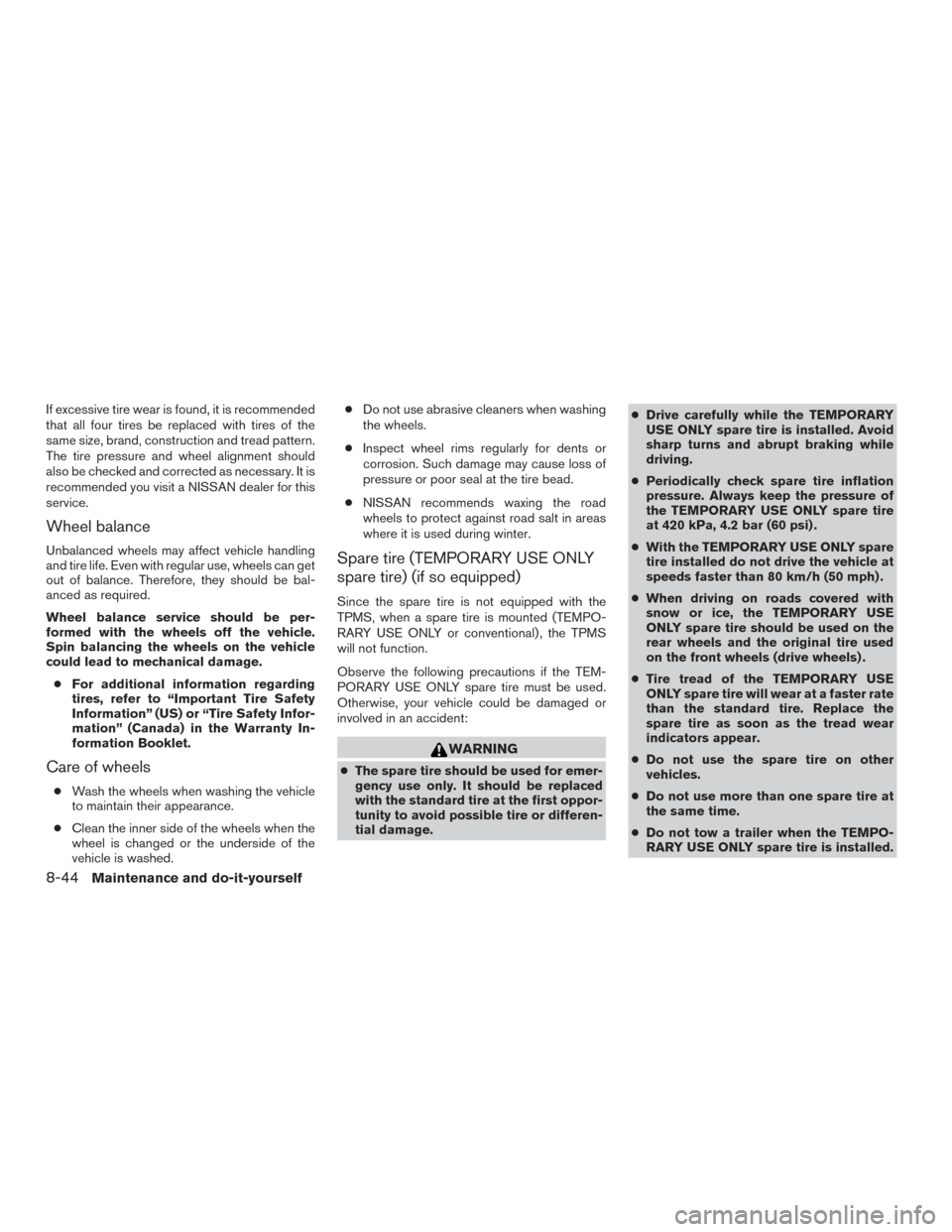
If excessive tire wear is found, it is recommended
that all four tires be replaced with tires of the
same size, brand, construction and tread pattern.
The tire pressure and wheel alignment should
also be checked and corrected as necessary. It is
recommended you visit a NISSAN dealer for this
service.
Wheel balance
Unbalanced wheels may affect vehicle handling
and tire life. Even with regular use, wheels can get
out of balance. Therefore, they should be bal-
anced as required.
Wheel balance service should be per-
formed with the wheels off the vehicle.
Spin balancing the wheels on the vehicle
could lead to mechanical damage.● For additional information regarding
tires, refer to “Important Tire Safety
Information” (US) or “Tire Safety Infor-
mation” (Canada) in the Warranty In-
formation Booklet.
Care of wheels
● Wash the wheels when washing the vehicle
to maintain their appearance.
● Clean the inner side of the wheels when the
wheel is changed or the underside of the
vehicle is washed. ●
Do not use abrasive cleaners when washing
the wheels.
● Inspect wheel rims regularly for dents or
corrosion. Such damage may cause loss of
pressure or poor seal at the tire bead.
● NISSAN recommends waxing the road
wheels to protect against road salt in areas
where it is used during winter.
Spare tire (TEMPORARY USE ONLY
spare tire) (if so equipped)
Since the spare tire is not equipped with the
TPMS, when a spare tire is mounted (TEMPO-
RARY USE ONLY or conventional) , the TPMS
will not function.
Observe the following precautions if the TEM-
PORARY USE ONLY spare tire must be used.
Otherwise, your vehicle could be damaged or
involved in an accident:
WARNING
● The spare tire should be used for emer-
gency use only. It should be replaced
with the standard tire at the first oppor-
tunity to avoid possible tire or differen-
tial damage. ●
Drive carefully while the TEMPORARY
USE ONLY spare tire is installed. Avoid
sharp turns and abrupt braking while
driving.
● Periodically check spare tire inflation
pressure. Always keep the pressure of
the TEMPORARY USE ONLY spare tire
at 420 kPa, 4.2 bar (60 psi) .
● With the TEMPORARY USE ONLY spare
tire installed do not drive the vehicle at
speeds faster than 80 km/h (50 mph) .
● When driving on roads covered with
snow or ice, the TEMPORARY USE
ONLY spare tire should be used on the
rear wheels and the original tire used
on the front wheels (drive wheels) .
● Tire tread of the TEMPORARY USE
ONLY spare tire will wear at a faster rate
than the standard tire. Replace the
spare tire as soon as the tread wear
indicators appear.
● Do not use the spare tire on other
vehicles.
● Do not use more than one spare tire at
the same time.
● Do not tow a trailer when the TEMPO-
RARY USE ONLY spare tire is installed.
8-44Maintenance and do-it-yourself
Page 432 of 478
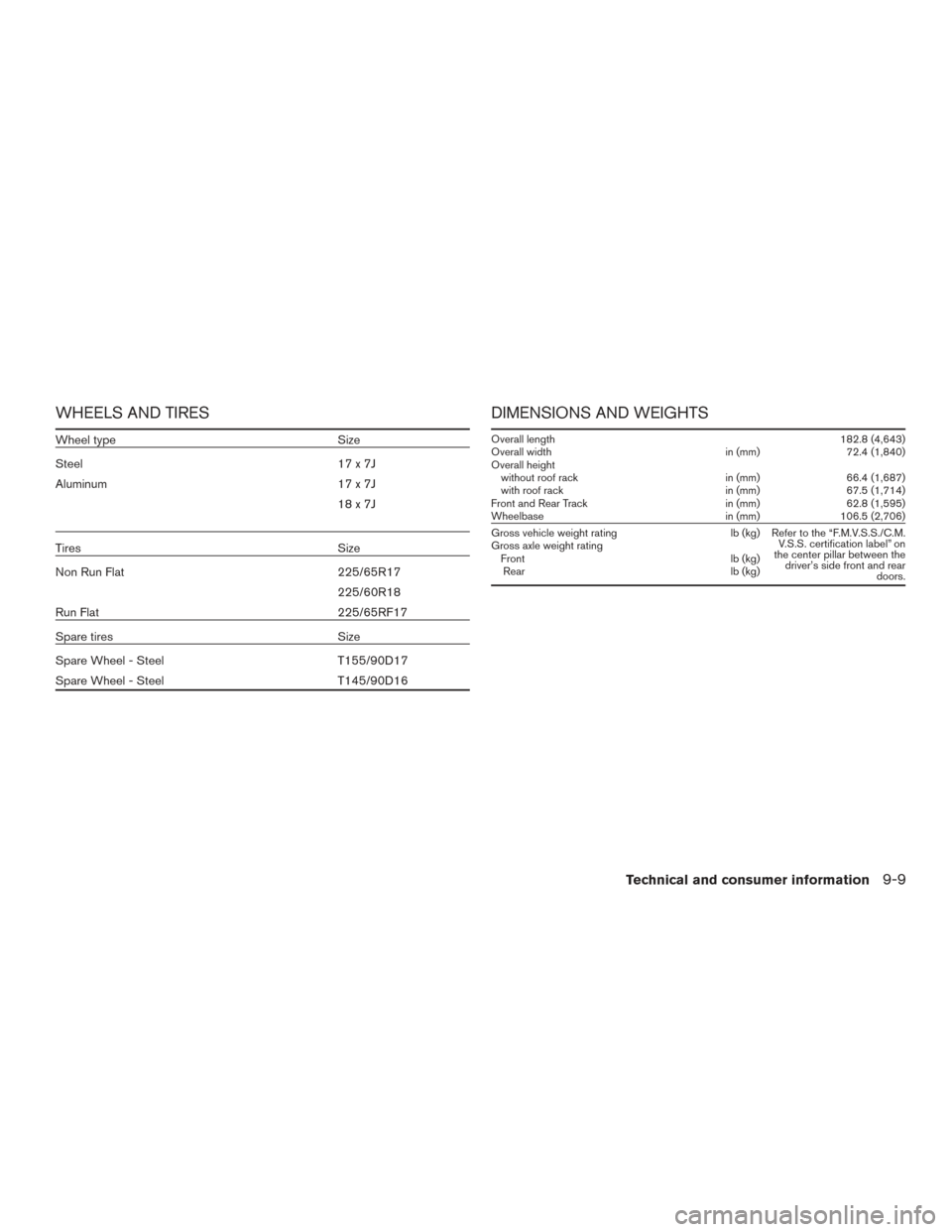
WHEELS AND TIRES
Wheel typeSize
Steel 17 x 7J
Aluminum 17 x 7J
18x7J
Tires Size
Non Run Flat 225/65R17
225/60R18
Run Flat 225/65RF17
Spare tires Size
Spare Wheel - Steel T155/90D17
Spare Wheel - Steel T145/90D16
DIMENSIONS AND WEIGHTS
Overall length 182.8 (4,643)
Overall width in (mm)72.4 (1,840)
Overall height without roof rack in (mm)66.4 (1,687)
with roof rack in (mm)67.5 (1,714)
Front and Rear Track in (mm)62.8 (1,595)
Wheelbase in (mm)106.5 (2,706)
Gross vehicle weight rating lb (kg) Refer to the “F.M.V.S.S./C.M.
V.S.S. certification label” on
the center pillar between the driver’s side front and rear doors.
Gross axle weight rating
Front lb (kg)
Rear lb (kg)
Technical and consumer information9-9
Page 446 of 478
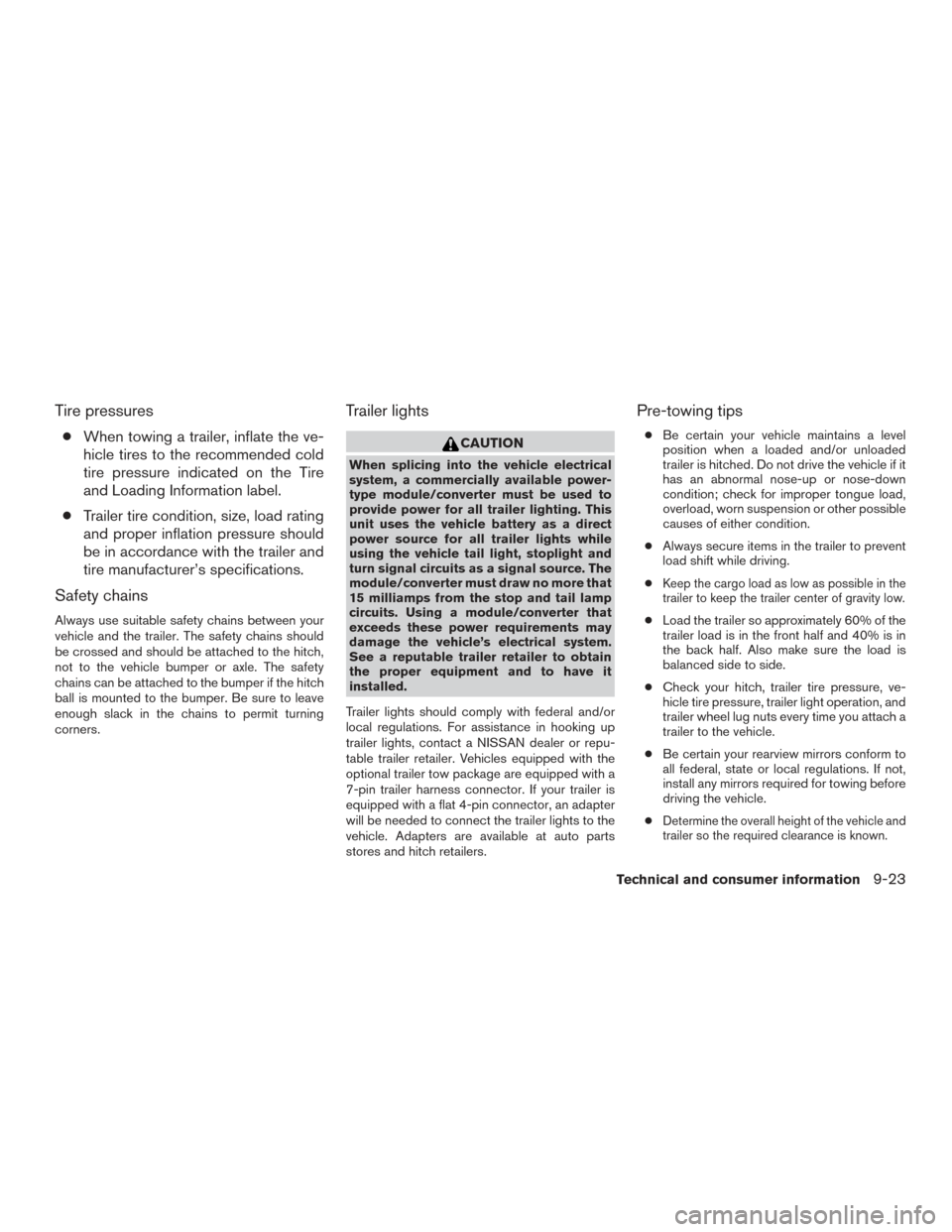
Tire pressures
●When towing a trailer, inflate the ve-
hicle tires to the recommended cold
tire pressure indicated on the Tire
and Loading Information label.
● Trailer tire condition, size, load rating
and proper inflation pressure should
be in accordance with the trailer and
tire manufacturer’s specifications.
Safety chains
Always use suitable safety chains between your
vehicle and the trailer. The safety chains should
be crossed and should be attached to the hitch,
not to the vehicle bumper or axle. The safety
chains can be attached to the bumper if the hitch
ball is mounted to the bumper. Be sure to leave
enough slack in the chains to permit turning
corners.
Trailer lights
CAUTION
When splicing into the vehicle electrical
system, a commercially available power-
type module/converter must be used to
provide power for all trailer lighting. This
unit uses the vehicle battery as a direct
power source for all trailer lights while
using the vehicle tail light, stoplight and
turn signal circuits as a signal source. The
module/converter must draw no more that
15 milliamps from the stop and tail lamp
circuits. Using a module/converter that
exceeds these power requirements may
damage the vehicle’s electrical system.
See a reputable trailer retailer to obtain
the proper equipment and to have it
installed.
Trailer lights should comply with federal and/or
local regulations. For assistance in hooking up
trailer lights, contact a NISSAN dealer or repu-
table trailer retailer. Vehicles equipped with the
optional trailer tow package are equipped with a
7-pin trailer harness connector. If your trailer is
equipped with a flat 4-pin connector, an adapter
will be needed to connect the trailer lights to the
vehicle. Adapters are available at auto parts
stores and hitch retailers.
Pre-towing tips
● Be certain your vehicle maintains a level
position when a loaded and/or unloaded
trailer is hitched. Do not drive the vehicle if it
has an abnormal nose-up or nose-down
condition; check for improper tongue load,
overload, worn suspension or other possible
causes of either condition.
● Always secure items in the trailer to prevent
load shift while driving.
●
Keep the cargo load as low as possible in the
trailer to keep the trailer center of gravity low.
● Load the trailer so approximately 60% of the
trailer load is in the front half and 40% is in
the back half. Also make sure the load is
balanced side to side.
● Check your hitch, trailer tire pressure, ve-
hicle tire pressure, trailer light operation, and
trailer wheel lug nuts every time you attach a
trailer to the vehicle.
● Be certain your rearview mirrors conform to
all federal, state or local regulations. If not,
install any mirrors required for towing before
driving the vehicle.
●
Determine the overall height of the vehicle and
trailer so the required clearance is known.
Technical and consumer information9-23
Page 460 of 478
Tirepressure.................8-32
Tire rotation..................8-41
Types of tires.................8-38
Uniform tire quality grading .........9-26
Wheels and tires ...............8-32
Wheel/tire size .................9-9
Tirepressure...................8-32 Low tire pressure warning light .......2-12
Tire Pressure Monitoring System (TPMS) ....5-3
Top tether strap child restraint .........1-30
Towing Flattowing...............9-25,9-26
Towing load/specification ..........9-20
Towtrucktowing...............6-13
Trailer towing .................9-17
Towing a trailer ..................9-17
Transmission Continuously Variable Transmission (CVT)
fluid......................8-12
Driving with Continuously Variable
Transmission (CVT) .............5-18
Travel (See registering a vehicle in another
country) ......................9-10
Trip odometer ...................2-4
Troubleshooting guide
(NISSAN voice recognition system) .....4-106
Turn signal switch ................2-41
U
Uniform tire quality grading ...........9-26
USB interface ...............4-61,4-63
Audio file operation ..........4-62,4-64 V
Vanity mirror ...................3-33
Vehicle dimensions and weights .........9-9
Vehicle dynamic control (VDC) off switch . . .2-43
Vehicle identification ...............9-10
Vehicle identification number (VIN) .......9-10
Vehicle identification number (VIN)
(Chassis number) ................9-10
Vehicle identification number (VIN) plate ....9-10
Vehicle immobilizer system ....2-33,5-12,5-15
Vehicle Information Display ...........2-19
Vehicle loading information ...........9-13
Vehicle recovery ..............6-15,6-16
Vehicle security system .............2-32
Vehicle security system (NISSAN Vehicle Immobi-
lizer System) , engine start .....2-33,5-12,5-15
Ventilators ....................4-31
Visors.......................3-33
Voice Prompt Interrupt ..........4-82,4-95
Voice recognition system ...........4-102
W
Warning Airbagwarninglight.........1-65,2-15
Anti-lock brake warning light ........2-11
Battery charge warning light ........2-12
Blind Spot Warning (BSW) warning
light ..................2-11,5-24
Brake warning light .............2-11
Hazard warning flasher switch ........6-2
Loose fuel cap warning ........2-30,3-31
Lowfuelwarninglight ........2-14,2-30 Low tire pressure warning light
.......2-12
Low windshield-washer fluid warning
light ..................2-14,2-30
Passenger air bag and status light .....1-56
Seat belt warning light ........1-18,2-15
Supplemental air bag warning light .1-65, 2-15
TPMS ......................2-4
Vehicle security system ...........2-32
Warning/indicator lights and audible
reminders ............2-10,2-11,2-15
Warning labels (for SRS) ..........1-64
W
arning/indicator lights and audible
reminders..............2-10,2-11,2-15 Audiblereminders.......2-10,2-11,2-15
Checkingbulbs ...............2-11
Indicatorlights.........2-10,2-11,2-15
Warning lights .........2-10,2-11,2-15
Warning lights ...........2-10,2-11,2-15
Warning lights, indicator lights and audible
reminders.....................2-10
Washer switch Rear window wiper and washer
switches...................2-35
Weights (See dimensions and weights) .....9-9
Wheels and tires .................8-32
Wheel/tire size ...................9-9
When traveling or registering in another
country ......................9-10
Windows .....................2-57
Locking passengers’ windows .......2-58
Power rear windows .............2-59
Rear power windows ............2-59
Windshield-washerfluid.............8-13
Windshieldwiperblades............8-18
10-7