2016 NISSAN PATHFINDER coolant temperature
[x] Cancel search: coolant temperaturePage 447 of 540
Seat beltsCheck that all parts of the seat belt
system (for example, buckles, anchors, adjusters
and retractors) operate properly and smoothly,
and are installed securely. Check the belt web-
bing for cuts, fraying, wear or damage.
Steering wheel Check for changes in the steer-
ing system, such as excessive freeplay, hard
steering or strange noises.
Warning lights and chimes Make sure all
warning lights and chimes are operating properly.
Windshield wiper and washer* Check that
the wipers and washer operate properly and that
the wipers do not streak.
Windshield defroster Check that the air
comes out of the defroster outlets properly and in
sufficient quantity when operating the heater or
air conditioner.
Under the hood and vehicle
The maintenance items listed here should be
checked periodically (for example, each time you
check the engine oil or refuel) .
Battery* Check the fluid level in each cell. It
should be between the MAX and MIN lines. Ve-
hicles operated in high temperatures or under
severe conditions require frequent checks of the
battery fluid level. NOTE:
Care should be taken to avoid situations
that can lead to potential battery discharge
and potential no-start conditions such as:
1. Installation or extended use of electronic accessories that consume battery power
when the engine is not running (Phone char-
gers, GPS, DVD players, etc.)
2. Vehicle is not driven regularly and/or only driven short distances. In these cases, the
battery may need to be charged to maintain
battery health.
Brake fluid level* Make sure that the brake fluid
level is between the MIN and MAX lines on the
reservoir.
Engine coolant level* Check the coolant level
when the engine is cold.
Engine drive belts* Make sure the drive belts
are not frayed, worn, cracked or oily.
Engine oil level* Check the level after parking
the vehicle on a level surface with the engine off.
Wait more than 10 minutes for the oil to drain
back into the oil pan. Exhaust system
Make sure there are no loose
supports, cracks or holes. If the sound of the
exhaust seems unusual or there is a smell of
exhaust fumes, immediately have the exhaust
system inspected. It is recommended you visit a
NISSAN dealer for this service. For additional
information, refer to “Exhaust gas (carbon mon-
oxide)” in the “Starting and driving” section of this
manual.
Fluid leaks Check under the vehicle for fuel, oil,
water or other fluid leaks after the vehicle has
been parked for a while. Water dripping from the
air conditioner after use is normal. If you should
notice any leaks or if gasoline fumes are evident,
check for the cause and have it corrected imme-
diately.
Power steering fluid level* and lines Check
the level when the fluid is cold, with the engine
off. Check the lines for proper attachment, leaks,
cracks, etc.
Radiator and hoses Check the front of the
radiator and clean off any dirt, insects, leaves,
etc., that may have accumulated. Make sure the
hoses have no cracks, deformation, rot or loose
connections.
8-4Maintenance and do-it-yourself
Page 509 of 540
●Always secure items in the trailer to prevent
load shift while driving.
● Lock the trailer hitch coupler with a pin or
lock to prevent the coupler from inadver-
tently becoming unlatched.
● Avoid abrupt starts, acceleration or stops.
● Avoid sharp turns or lane changes.
● Always drive your vehicle at a moderate
speed.
● When backing up, hold the bottom of the
steering wheel with one hand. Move your
hand in the direction in which you want the
trailer to go. Make small corrections and
back up slowly. If possible, have someone
guide you when you are backing up.
Always block the wheels on both vehicle and
trailer when parking. Parking on a slope is not
recommended; however, if you must do so:
CAUTION
If you move the shift lever to the P (Park)
position before blocking the wheels and
applying the parking brake, transmission
damage could occur. 1. Apply and hold the brake pedal.
2. Have someone place blocks on the downhill
side of the vehicle and trailer wheels.
3. After the wheel blocks are in place, slowly release the brake pedal until the blocks ab-
sorb the vehicle load.
4. Apply the parking brake.
5. Shift the transmission into P (Park) .
6. Turn off the engine.
To drive away: 1. Start the vehicle.
2. Apply and hold the brake pedal.
3. Shift the transmission into gear.
4. Release the parking brake.
5. Drive slowly until the vehicle and trailer are clear from the blocks.
6. Apply and hold the brake pedal.
7. Have someone retrieve and store the blocks. ●
While going downhill, the weight of the
trailer pushing on the tow vehicle may de-
crease overall stability. Therefore, to main-
tain adequate control, reduce your speed
and shift to a lower gear. Avoid long or
repeated use of the brakes when descend-
ing a hill, as this reduces their effectiveness
and could cause overheating. Shifting to a
lower gear instead provides “engine brak-
ing” and reduces the need to brake as fre-
quently.
● If the engine coolant temperature rises to a
high temperature, refer to “If your vehicle
overheats” in the “In case of emergency”
section of this owner’s manual.
● Trailer towing requires more fuel than normal
circumstances.
● Avoid towing a trailer for your vehicle’s first
500 miles (805 km) .
● For the first 500 miles (805 km) that you do
tow, do not drive over 50 mph (80 km/h).
● Have your vehicle serviced more often than
at intervals specified in the recommended
Maintenance Schedule in the “NISSAN Ser-
vice and Maintenance Guide”.
9-26Technical and consumer information
Page 517 of 540
Brightness controlInstrument panel ...............2-39
Bulb check/instrument panel ..........2-10
Bulb replacement ................8-27
C
Capacities and recommended fuel/lubricants . .9-2
Cargoareastoragebin.............2-54
Cargolight....................2-63
Cargo(Seevehicleloadinginformation)....9-13
Car phone or CB radio .............4-121
CD care and cleaning .............4-106
CD changer (See audio system) ........4-74
CD player (See audio system) ......4-81,4-88
Check tire pressure ...............2-29
Child restraints .......1-25,1-26,1-27,1-29
LATCH (Lower Anchors and Tethers for
CHildren) System ..............1-29
Precautions on child
restraints.........1-27,1-34,1-40,1-46
Top tether strap anchor point locations . .1-32
Child restraint with top tether strap .......1-32
Child safety rear door lock ............3-7
Chimes, audible reminders ...........2-17
Cleaningexteriorandinterior........7-2,7-4
Clock set/adjustment ...........4-17,4-73
Clock setting
(models without Navigation System) ....4-4,4-8
C.M.V.S.S. certification label ..........9-11
Cold weather driving ...............5-53
Compact disc (CD) player ........4-81,4-88
Consolebox...................2-51 Continuously Variable Transmission (CVT) . . .5-15
Continuously Variable Transmission (CVT)
fluid......................8-13
Driving with Continuously Variable
Transmission (CVT) .............5-15
Control panel buttons ..............4-10
Brightness/contrast button ......4-9,4-20
Enterbutton...............4-4,4-10
Without navigation system ..........4-4
Controls Audio controls (steering wheel) ......4-107
Heater and air conditioner
controls................4-44,4-50
Coolant Capacities and recommended
fuel/lubricants .................9-2
Changingenginecoolant...........8-9
Checking engine coolant level ........8-9
Engine coolant temperature gauge .....2-5
Corrosion protection ...............7-6
Cruisecontrol ...........5-37,5-37,5-38
Cupholders...................2-52
D
Daytime Running Light System .........2-38
Defroster switch Rear window and outside mirror defroster
switch.....................2-35
Digital Versatile Disc (DVD) player .......4-90
Dimensionsandweights.............9-9
Dimmer switch for instrument panel ......2-39
Display controls
(seecontrolpanelbuttons) ........4-4,4-10
Doors ........................3-5 Drive belt
.....................8-17
Drive positioner, Automatic ...........3-36
Driving Cold weather driving .............5-53
Driving with Continuously Variable
Transmission (CVT) .............5-15
Precautions when starting and driving ....5-2
Driving the vehicle ................5-15
Dual head restraint DVD system .......4-109
Dual power moonroof ..............2-59
E
Economy-fuel..................5-40
Emergency engine shutoff .........5-12,6-2
Emission control information label .......9-11
Emission control system warranty .......9-30
Engine Before starting the engine ..........
5-14
Blockheater.................5-54
Capacities and recommended
fuel/lubricants.................9-2
Changing engine coolant ...........8-9
Changingengineoil.............8-11
Changing engine oil filter ..........8-12
Checking engine coolant level ........8-9
Checking engine oil level ..........8-10
Engine compartment check locations ....8-7
Engine coolant temperature gauge .....2-5
Engine cooling system ............8-8
Engineoil...................8-10
Engine oil and oil filter recommendation . . .9-6
Engine oil viscosity ..............9-7
Engine serial number ............9-11
Engine specifications .............9-8
10-2
Page 518 of 540
Starting the engine.............5-14
Engine coolant temperature gauge .......2-5
Enterbutton.................4-4,4-10
Event Data recorders ..............9-32
Exhaust gas (Carbon monoxide) .........5-2
Explanation of maintenance items ........8-2
Extendedstorageswitch ............2-49
Eyeglass case ..................2-52
F
Flashers (See hazard warning flasher switch) . .6-2
Flat tire .......................6-3
Floor mat positioning aid .............7-5
Fluid Brake fluid ..................8-14
Capacities and recommended
fuel/lubricants .................9-2
Continuously Variable Transmission (CVT)
fluid......................8-13
Engine coolant .................8-8
Engine oil ...................8-10
Power steering fluid .............8-13
Windshield-washerfluid...........8-15
F.M.V.S.S. certification label ...........9-11
Foglightswitch .................2-40
Front air bag system
(See supplemental restraint system) ......1-56
Front power seat adjustment ...........1-5
Frontseats.....................1-2
Fuel Capacities and recommended
fuel/lubricants .................9-2
Fuel economy ................5-40
Fuel-filler door and cap ...........3-29 Fuel gauge
...................2-6
Fuel octane rating ...............9-5
Fuel recommendation .............9-4
Loose fuel cap warning ...........2-30
Fuel Cell Vehicle (FCV) System Tirepressure.................8-29
Fuel-filler door ..................3-28
Fuelgauge.....................2-6
Fuses.......................8-22
Fusiblelinks ...................8-22
G
Garage door opener, HomeLink® Universal
Transceiver .........2-63,2-65,2-66,2-66
Gascap .....................3-29
Gauge Engine coolant temperature gauge .....2-5
Fuel gauge ...................2-6
Odometer ...................2-4
Speedometer .................2-4
Tachometer ..................2-5
Trip odometer .................2-4
General maintenance ...............8-2
Glovebox.....................2-51
Gloveboxlock..................2-51
H
Hands-free phone system,
Bluetooth®...............4- 121, 4-135
Hazard warning flasher switch ..........6-2
Headlight and turn signal switch ........2-36
Headlight control switch ............2-36 Headlights....................8-26
Head restraints
..................1-12
Heated rear seats ................2-41
Heated seats ...............2-40,2-44
Heated steering wheel .............2-44
Heater Heater and air conditioner
controls ................4-44,4-50
Heater operation ...........4-45,4-51
Hill descent control switch ...........2-45
Hill
descent control system ...........5-51
Hill start assist system ..............5-52
HomeLink® Universal
Transceiver .........2-63,2-65,2-66,2-66
Hood.......................3-21
Hook Luggage hook ................2-55
Horn .......................2-40
I
Ignition Switch Push-Button Ignition Switch ........5-10
Imageviewer...................4-20
Immobilizer system ............2-32,5-13
Important vehicle information label .......9-11
In-cabin microfilter ................8-19
Increasing fuel economy .............5-40
Indicator lights and audible reminders
(See warning/indicator lights and audible
reminders).............2-10,2-11,2-15
Inside automatic anti-glare mirror ........3-34
Instrument brightness control ..........2-39
Instrumentpanel...............0-6,2-2
Instrument panel dimmer switch ........2-39
10-3
Page 521 of 540
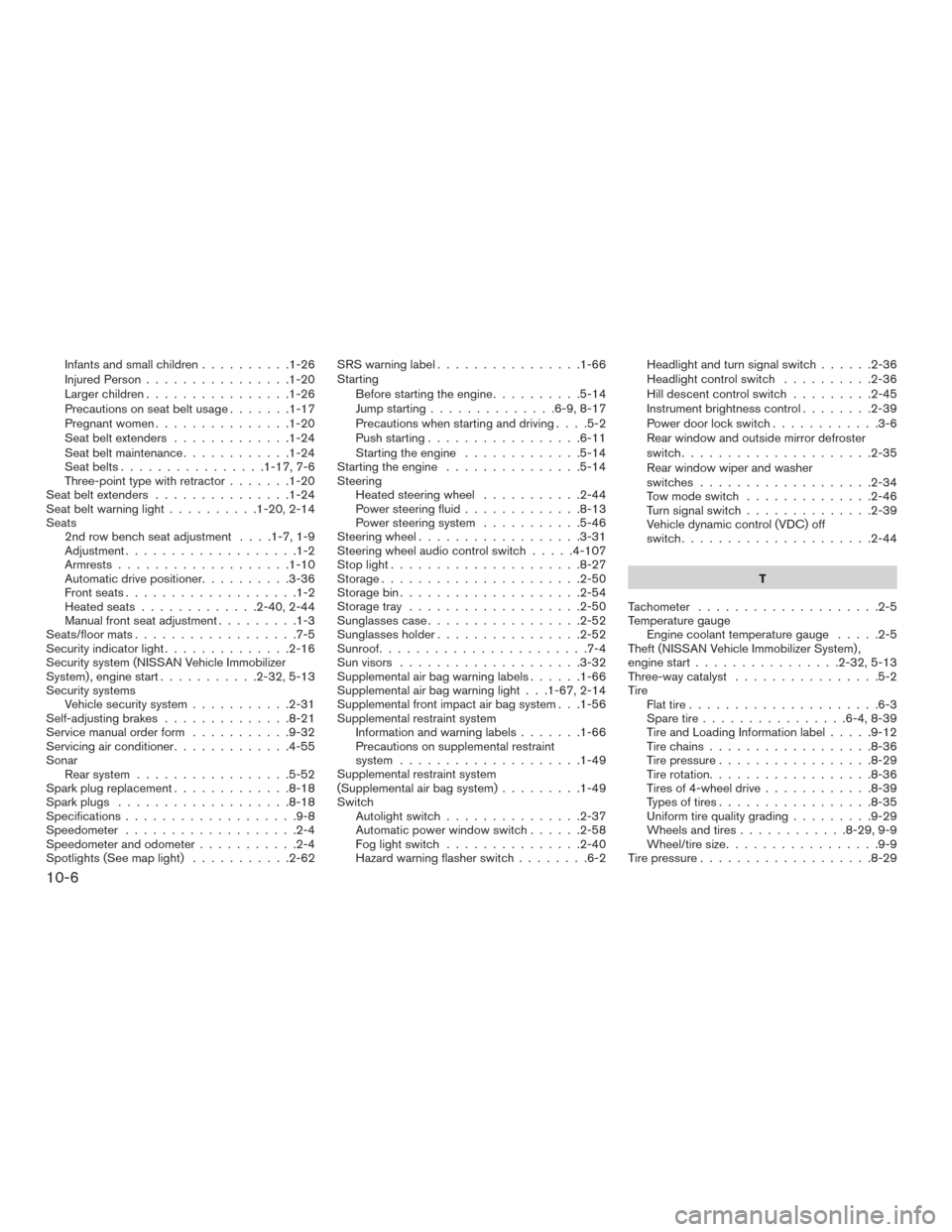
Infantsandsmallchildren..........1-26
Injured Person................1-20
Largerchildren................1-26
Precautionsonseatbeltusage.......1-17
Pregnant women ...............1-20
Seat belt extenders .............1-24
Seat belt maintenance ............1-24
Seat belts ................1-17,7-6
Three-point type with retractor .......1-20
Seat belt extenders ...............1-24
Seatbeltwarninglight..........1-20,2-14
Seats 2nd row bench seat adjustment ....1-7,1-9
Adjustment ...................1-2
Armrests...................1-10
Automatic drive positioner ..........3-36
Frontseats...................1-2
Heatedseats.............2-40,2-44
Manual front seat adjustment .........1-3
Seats/floor mats ..................7-5
Security indicator light ..............2-16
Security system (NISSAN Vehicle Immobilizer
System) , engine start ...........2-32,5-13
Security systems Vehicle security system ...........2-31
Self-adjusting brakes ..............8-21
Service manual order form ...........9-32
Servicing air conditioner .............4-55
Sonar Rear system .................5-52
Spark plug replacement .............8-18
Spark plugs ...................8-18
Specifications ...................9-8
Speedometer ...................2-4
Speedometer and odometer ...........2-4
Spotlights(Seemaplight) ...........2-62 SRSwarninglabel................1-66
Starting
Before starting the engine ..........5-14
Jump starting ..............6-9,8-17
Precautions when starting and driving ....5-2
Push starting .................6-11
Starting the engine .............5-14
Starting the engine ...............5-14
Steering Heated steering wheel ...........2-44
Power steering fluid .............8-13
Power steering system ...........5-46
Steeringwheel..................3-31
Steering wheel audio control switch .....4-107
Stoplight.....................8-27
Storage......................2-50
Storagebin....................2-54
Storage tray ...................2-50
Sunglassescase.................2-52
Sunglassesholder................2-52
Sunroof.......................7-4
Sun visors ....................3-32
Supplemental air bag warning labels ......1-66
Supplemental air bag warning light . . .1-67, 2-14
Supplemental front impact air bag system . . .1-56
Supplemental restraint system Information and warning labels .......1-66
Precautions on supplemental restraint
system ....................1-49
Supplemental restraint system
(Supplemental air bag system) .........1-49
Switch Autolightswitch...............2-37
Automatic power window switch ......2-58
Foglightswitch ...............2-40
Hazard warning flasher switch ........6-2Headlightandturnsignalswitch......2-36
Headlight control switch
..........2-36
Hilldescentcontrolswitch.........2-45
Instrument brightness control ........2-39
Power door lock switch ............3-6
Rear window and outside mirror defroster
switch .....................
2-35
Rear window wiper and washer
switches ...................2-34
Tow mode switch ..............2-46
Turnsignalswitch..............2-39
Vehicle dynamic control (VDC) off
switch .....................2-44
T
Tachometer ....................2-5
Temperature gauge Engine coolant temperature gauge .....2-5
Theft (NISSAN Vehicle Immobilizer System) ,
engine start ................2-32,5-13
Three-way catalyst ................5-2
Tire Flat tire .....................6-3
Spare tire ................6-4,8-39
Tire and Loading Information label .....9-12
Tire chains ..................8-36
Tire pressure .................8-29
Tire rotation..................8-36
Tires of 4-wheel drive ............8-39
Types of tires .................8-35
Uniform tire quality grading .........9-29
Wheels and tires ............8-29,9-9
Wheel/tire size .................9-9
Tirepressure...................8-29
10-6