2016 NISSAN PATHFINDER maintenance
[x] Cancel search: maintenancePage 511 of 540
Tow mode includes the following features:● Grade logic — Adjusts transmission shifts
when pulling a trailer or hauling a load up a
grade.
● Downhill Speed Control (DSC) — automati-
cally downshifts when driving down a grade
with a trailer or heavy load to help control
vehicle speed.
Driving the vehicle in the tow mode with no
trailer/load or light trailer/light load will not cause
any damage. However, fuel economy may be
reduced and the transmission/engine driving
characteristics may feel unusual.
When towing a trailer, final drive gear oil
should be replaced and transmission
oil/fluid should be changed more fre-
quently. For additional information, refer to
the “Maintenance and do-it-yourself” sec-
tion in this manual.
FLAT TOWING FOR 4–WHEEL
DRIVE VEHICLE (if so equipped)
Towing your vehicle with all four wheels on the
ground is sometimes called flat towing. This
method is sometimes used when towing a vehicle
behind a recreational vehicle, such as a motor
home.
CAUTION
● Failure to follow these guidelines can
result in severe transmission damage.
● Never flat tow your 4-wheel drive (4WD)
vehicle.
● DO NOT tow your 4-wheel drive (4WD)
vehicle with any wheels on the ground.
Doing so may cause serious and expen-
sive damage to the powertrain.
● For emergency towing procedures refer
to “Towing recommended by NISSAN”
in the “In case of emergency” section of
this manual.
FLAT TOWING FOR FRONT WHEEL
DRIVE VEHICLE (if so equipped)
Towing your vehicle with all four wheels on the
ground is sometimes called flat towing. This
method is sometimes used when towing a vehicle
behind a recreational vehicle, such as a motor
home.
CAUTION
● Failure to follow these guidelines can
result in severe transmission damage.
● Whenever flat towing your vehicle, al-
ways tow forward, never backward.
● Never tow your front wheel drive vehicle
with the front tires on the ground. Doing
so may cause serious and expensive
damage to the powertrain.
● DO NOT tow your front wheel drive con-
tinuously variable transmission vehicle
with all four wheels on the ground (flat
towing) . Doing so WILL DAMAGE inter-
nal transmission parts due to lack of
transmission lubrication.
● For emergency towing procedures refer
to “Towing recommended by NISSAN”
in the “In case of emergency” section of
this manual.
Continuously Variable Transmission
To tow a vehicle equipped with a continuously
variable transmission, an appropriate vehicle
dolly MUST be placed under the towed vehicle’s
drive wheels. Alwaysfollow the dolly manufac-
turer’s recommendations when using their prod-
uct.
9-28Technical and consumer information
Page 514 of 540
You may contact Transport Canada’s De-
fect Investigations and Recalls Division
toll free at 1-800-333-0510. You may
also report safety defects online at:
https://wwwapps.tc.gc.ca/Saf-Sec-Sur/
7/PCDB-BDPP/fc-cp.aspx?lang=eng
(English speakers) or
https://wwwapps.tc.gc.ca/Saf-Sec-Sur/
7/PCDB-BDPP/fc-cp.aspx?lang=fra
(French speakers)
Additional information concerning motor
vehicle safety may be obtained from
Transport Canada’s Road Safety Informa-
tion Centre at 1-800-333-0371 or online
at www.tc.gc.ca/roadsafety (English
speakers) or
www.tc.gc.ca/securiteroutiere (French
speakers) .
To notify NISSAN of any safety concerns
please contact our Consumer Information
Centre toll free at 1-800-387-0122.WARNING
A vehicle equipped with Four-Wheel Drive
(4WD) should never be tested using a two
wheel dynamometer (such as the dyna-
mometers used by some states for emis-
sions testing) , or similar equipment. Make
sure you inform the test facility personnel
that your vehicle is equipped with 4WD
before it is placed on a dynamometer.
Using the wrong test equipment may re-
sult in transmission damage or unex-
pected vehicle movement which could re-
sult in serious vehicle damage or personal
injury.
Due to legal requirements in some states and
Canadian Provinces, your vehicle may be re-
quired to be in what is called the “ready condi-
tion” for an Inspection/Maintenance (I/M) test of
the emission control system.
The vehicle is set to the “ready condition” when it
is driven through certain driving patterns. Usually,
the ready condition can be obtained by ordinary
usage of the vehicle. If a powertrain system component is repaired or
the battery is disconnected, the vehicle may be
reset to a “not ready” condition. Before taking the
I/M test, check the vehicle’s
inspection/maintenance test readiness condi-
tion. Place the ignition switch in the ON position
without starting the engine. If the Malfunction
Indicator Light (MIL) comes on steady for 20 sec-
onds and then blinks for 10 seconds, the I/M test
condition is “not ready”. If the MIL does not blink
after 20 seconds, the I/M test condition is
“ready”. It is recommended that you visit a
NISSAN dealer to set the “ready condition” or to
prepare the vehicle for testing.
READINESS FOR INSPECTION/
MAINTENANCE (I/M) TEST
Technical and consumer information9-31
Page 518 of 540
Starting the engine.............5-14
Engine coolant temperature gauge .......2-5
Enterbutton.................4-4,4-10
Event Data recorders ..............9-32
Exhaust gas (Carbon monoxide) .........5-2
Explanation of maintenance items ........8-2
Extendedstorageswitch ............2-49
Eyeglass case ..................2-52
F
Flashers (See hazard warning flasher switch) . .6-2
Flat tire .......................6-3
Floor mat positioning aid .............7-5
Fluid Brake fluid ..................8-14
Capacities and recommended
fuel/lubricants .................9-2
Continuously Variable Transmission (CVT)
fluid......................8-13
Engine coolant .................8-8
Engine oil ...................8-10
Power steering fluid .............8-13
Windshield-washerfluid...........8-15
F.M.V.S.S. certification label ...........9-11
Foglightswitch .................2-40
Front air bag system
(See supplemental restraint system) ......1-56
Front power seat adjustment ...........1-5
Frontseats.....................1-2
Fuel Capacities and recommended
fuel/lubricants .................9-2
Fuel economy ................5-40
Fuel-filler door and cap ...........3-29 Fuel gauge
...................2-6
Fuel octane rating ...............9-5
Fuel recommendation .............9-4
Loose fuel cap warning ...........2-30
Fuel Cell Vehicle (FCV) System Tirepressure.................8-29
Fuel-filler door ..................3-28
Fuelgauge.....................2-6
Fuses.......................8-22
Fusiblelinks ...................8-22
G
Garage door opener, HomeLink® Universal
Transceiver .........2-63,2-65,2-66,2-66
Gascap .....................3-29
Gauge Engine coolant temperature gauge .....2-5
Fuel gauge ...................2-6
Odometer ...................2-4
Speedometer .................2-4
Tachometer ..................2-5
Trip odometer .................2-4
General maintenance ...............8-2
Glovebox.....................2-51
Gloveboxlock..................2-51
H
Hands-free phone system,
Bluetooth®...............4- 121, 4-135
Hazard warning flasher switch ..........6-2
Headlight and turn signal switch ........2-36
Headlight control switch ............2-36 Headlights....................8-26
Head restraints
..................1-12
Heated rear seats ................2-41
Heated seats ...............2-40,2-44
Heated steering wheel .............2-44
Heater Heater and air conditioner
controls ................4-44,4-50
Heater operation ...........4-45,4-51
Hill descent control switch ...........2-45
Hill
descent control system ...........5-51
Hill start assist system ..............5-52
HomeLink® Universal
Transceiver .........2-63,2-65,2-66,2-66
Hood.......................3-21
Hook Luggage hook ................2-55
Horn .......................2-40
I
Ignition Switch Push-Button Ignition Switch ........5-10
Imageviewer...................4-20
Immobilizer system ............2-32,5-13
Important vehicle information label .......9-11
In-cabin microfilter ................8-19
Increasing fuel economy .............5-40
Indicator lights and audible reminders
(See warning/indicator lights and audible
reminders).............2-10,2-11,2-15
Inside automatic anti-glare mirror ........3-34
Instrument brightness control ..........2-39
Instrumentpanel...............0-6,2-2
Instrument panel dimmer switch ........2-39
10-3
Page 519 of 540
Intelligent Key systemKey operating range ..............3-9
Key operation ................3-10
Mechanicalkey ................3-3
Remote keyless entry operation.......3-13
Troubleshooting guide ............3-17
Warning signals ...............3-17
Interiorlight....................2-61
iPod®Player ..............4-98,4-100
ISOFIX child restraints .............1-29
J
Jump starting ................6-9,8-17
K
Key.........................3-2
Key fob battery replacement ..........8-24
Keyless entry With Intelligent Key system
(See Intelligent Key system) .........3-13
Keys NISSAN Intelligent Key® ........3-2,3-7
NISSAN Vehicle Immobilizer System keys . .3-4
L
Labels Air conditioner specification label .....9-12
C.M.V.S.S. certification label ........9-11
Emissioncontrolinformationlabel.....9-11
Engine serial number ............9-11 F.M.V.S.S. certification label
.........9-11
Tire and Loading Information label .....9-12
Vehicle identification number (VIN) .....9-10
Vehicle identification number (VIN) plate . .9-10
Warning labels (for SRS) ..........1-66
LATCH (Lower Anchors and Tethers for CHildren)
System ......................1-29
Liftgate ......................3-22
Liftgate release ..................3-27
Light Air bag warning light .........1-67,2-14
Brake light (See stop light) .........8-27
Bulb check/instrument panel ........2-10
Bulbreplacement..............8-27
Charge warning light ............2-11
Exterior and Interior lights ..........8-27
Foglights...................8-26
Foglightswitch ...............2-40
Headlight and turn signal switch ......2-36
Headlight control switch ..........2-36
Headlights..................8-26
Interiorlight..................2-61
Lightbulbs..................8-26
Low tire pressure warning light .......2-12
Low windshield-washer fluid warning
light......................2-29
Passenger air bag and status light .....1-58
Security indicator light ............2-16
Spotlights(Seemaplight) .........2-62
Warning/indicator lights and audible
reminders ............2-10,2-11,2-15
Lights.......................8-26 Maplights ..................2-62
Lock Child safety rear door lock ..........3-7
Gloveboxlock................2-51 Liftgate release
................3-27
Power door locks ...............3-6
Loose fuel cap warning .............2-30
Low fuel warning light ..........2-13,2-29
Low tire pressure warning light .........2-12
Low windshield-washer fluid warning light . . .2-29
Luggage hook ..................2-55
Luggage rack (see roof rack) ..........2-55
Luggage (See vehicle loading information) . .9-13
M
Maintenance General maintenance .............8-2
Insidethevehicle...............8-3
Maintenance precautions ...........8-5
Outside the vehicle ..............8-2
Seat
belt maintenance ............1-24
Under the hood and vehicle .........8-4
Maintenance requirements ............8-2
Malfunction indicator light ............2-15
Manual front seat adjustment ...........1-3
Maplights ....................2-62
Memory Seat ...................3-36
Meters and gauges ................2-3
Instrument brightness control ........2-39
Mirror Automatic anti-glare inside mirror ......3-34
Outside mirrors ...............3-35
Rearview ...................3-33
Vanity mirror .................3-33
Mirrors ......................3-33
Moonroof ......................7-4
10-4
Page 520 of 540
N
NISSAN Intelligent Key® ..........3-2,3-7
NISSAN Vehicle Immobilizer System . .2-32, 5-13
NISSAN voice recognition system ......4-148
O
Octanerating(Seefueloctanerating)......9-5
Odometer .....................2-4
Oil Capacities and recommended
fuel/lubricants .................9-2
Changing engine oil .............8-11
Changing engine oil filter ..........8-12
Checking engine oil level ..........8-10
Engine oil ...................8-10
Engine oil and oil filter recommendation . . .9-6
Engine oil viscosity ..............9-7
Oneshotcall..............4- 125, 4-137
Outside mirrors .................3-35
Overheat Ifyourvehicleoverheats...........6-11
Owner’s manual order form ...........9-32
Owner’s manual/service manual order
information ....................9-32
P
Parking Parking brake operation ...........5-19
Parking/parking on hills ...........5-46
Parking brake ...................5-19 Phone, Bluetooth® hands-free
system
.................4- 121, 4-135
Power Front seat adjustment .............1-5
Power door locks ...............3-6
Power outlet ..............2-47,2-48
Power rear windows .............2-58
Power steering fluid .............8-13
Power steering system ...........5-46
Power windows ...............2-56
Rear power windows ............2-58
Power outlet ................2-47,2-48
Power steering ..................5-46
Power steering fluid ...............8-13
Precautions Maintenance precautions ...........8-5
On-pavement and off-road driving
precautions ..................5-6
Precautions on booster
seats...........1-27,1-34,1-40,1-46
Precautions on child
restraints .........1-27,1-34,1-40,1-46
Precautions on seat belt usage .......1-17
Precautions on supplemental restraint
system ....................1-49
Precautions when starting and driving ....5-2
Push starting ...................6-11
R
Radio Car phone or CB radio ...........4-121
Compact Disc (CD) changer ........4-74
FM-AM radio with compact disc (CD)
changer ....................4-71 FM/AM/SAT radio with CD/DVD player . .4-84
FM/AM/SAT radio with compact disc (CD)
player
.....................4-76
Steering wheel audio control switch . . .4-107
Readiness for inspection maintenance (I/M)
test ........................9-31
Rear power windows ..............2-58
Rear sonar system ................5-52
Rearview mirror .................3-33
RearView
Monitor ................4-22
Rear window and outside mirror defroster
switch.......................2-35
Rear window wiper and washer switches . . .2-34
Recommended Fluids ...............9-2
Recorders EventData..................9-32
Refrigerant recommendation ...........9-7
Registering a vehicle in another country ....9-10
Remote Start ...............3-19,5-15
Reporting safety defects (US only) .......9-30
Roof rack .....................2-55
S
Safety Child safety rear door lock ..........3-7
Child seat belts .....1-27,1-34,1-40,1-46
Reporting safety defects (US only) .....9-30
Seat adjustment Front manual seat adjustment ........1-3
Front power seat adjustment .........1-5
Secondrowbenchseats........1-7,1-9
Seatbackpockets................2-50
Seat belt Child safety ..................1-25
10-5
Page 521 of 540
Infantsandsmallchildren..........1-26
Injured Person................1-20
Largerchildren................1-26
Precautionsonseatbeltusage.......1-17
Pregnant women ...............1-20
Seat belt extenders .............1-24
Seat belt maintenance ............1-24
Seat belts ................1-17,7-6
Three-point type with retractor .......1-20
Seat belt extenders ...............1-24
Seatbeltwarninglight..........1-20,2-14
Seats 2nd row bench seat adjustment ....1-7,1-9
Adjustment ...................1-2
Armrests...................1-10
Automatic drive positioner ..........3-36
Frontseats...................1-2
Heatedseats.............2-40,2-44
Manual front seat adjustment .........1-3
Seats/floor mats ..................7-5
Security indicator light ..............2-16
Security system (NISSAN Vehicle Immobilizer
System) , engine start ...........2-32,5-13
Security systems Vehicle security system ...........2-31
Self-adjusting brakes ..............8-21
Service manual order form ...........9-32
Servicing air conditioner .............4-55
Sonar Rear system .................5-52
Spark plug replacement .............8-18
Spark plugs ...................8-18
Specifications ...................9-8
Speedometer ...................2-4
Speedometer and odometer ...........2-4
Spotlights(Seemaplight) ...........2-62 SRSwarninglabel................1-66
Starting
Before starting the engine ..........5-14
Jump starting ..............6-9,8-17
Precautions when starting and driving ....5-2
Push starting .................6-11
Starting the engine .............5-14
Starting the engine ...............5-14
Steering Heated steering wheel ...........2-44
Power steering fluid .............8-13
Power steering system ...........5-46
Steeringwheel..................3-31
Steering wheel audio control switch .....4-107
Stoplight.....................8-27
Storage......................2-50
Storagebin....................2-54
Storage tray ...................2-50
Sunglassescase.................2-52
Sunglassesholder................2-52
Sunroof.......................7-4
Sun visors ....................3-32
Supplemental air bag warning labels ......1-66
Supplemental air bag warning light . . .1-67, 2-14
Supplemental front impact air bag system . . .1-56
Supplemental restraint system Information and warning labels .......1-66
Precautions on supplemental restraint
system ....................1-49
Supplemental restraint system
(Supplemental air bag system) .........1-49
Switch Autolightswitch...............2-37
Automatic power window switch ......2-58
Foglightswitch ...............2-40
Hazard warning flasher switch ........6-2Headlightandturnsignalswitch......2-36
Headlight control switch
..........2-36
Hilldescentcontrolswitch.........2-45
Instrument brightness control ........2-39
Power door lock switch ............3-6
Rear window and outside mirror defroster
switch .....................
2-35
Rear window wiper and washer
switches ...................2-34
Tow mode switch ..............2-46
Turnsignalswitch..............2-39
Vehicle dynamic control (VDC) off
switch .....................2-44
T
Tachometer ....................2-5
Temperature gauge Engine coolant temperature gauge .....2-5
Theft (NISSAN Vehicle Immobilizer System) ,
engine start ................2-32,5-13
Three-way catalyst ................5-2
Tire Flat tire .....................6-3
Spare tire ................6-4,8-39
Tire and Loading Information label .....9-12
Tire chains ..................8-36
Tire pressure .................8-29
Tire rotation..................8-36
Tires of 4-wheel drive ............8-39
Types of tires .................8-35
Uniform tire quality grading .........9-29
Wheels and tires ............8-29,9-9
Wheel/tire size .................9-9
Tirepressure...................8-29
10-6
Page 524 of 540
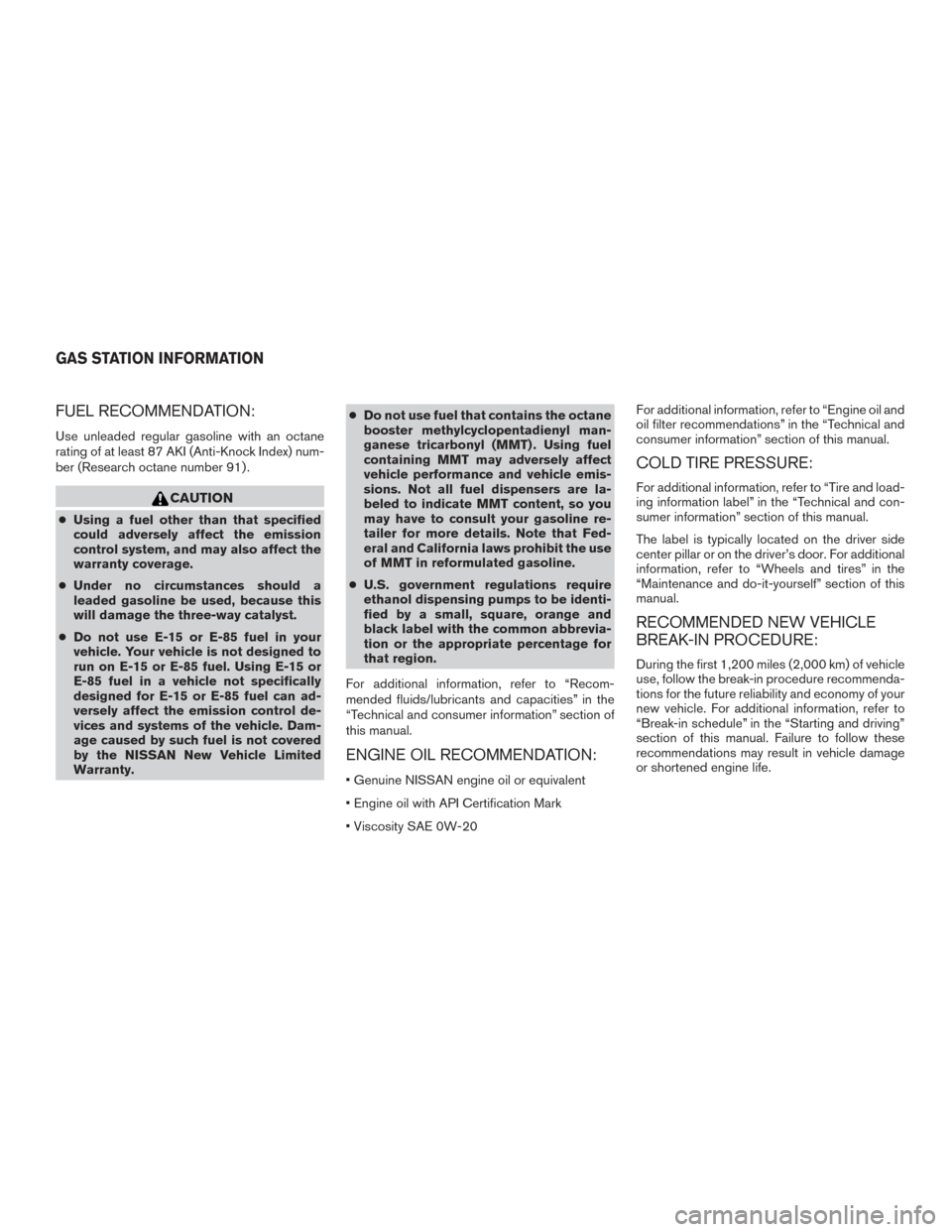
FUEL RECOMMENDATION:
Use unleaded regular gasoline with an octane
rating of at least 87 AKI (Anti-Knock Index) num-
ber (Research octane number 91) .
CAUTION
●Using a fuel other than that specified
could adversely affect the emission
control system, and may also affect the
warranty coverage.
● Under no circumstances should a
leaded gasoline be used, because this
will damage the three-way catalyst.
● Do not use E-15 or E-85 fuel in your
vehicle. Your vehicle is not designed to
run on E-15 or E-85 fuel. Using E-15 or
E-85 fuel in a vehicle not specifically
designed for E-15 or E-85 fuel can ad-
versely affect the emission control de-
vices and systems of the vehicle. Dam-
age caused by such fuel is not covered
by the NISSAN New Vehicle Limited
Warranty. ●
Do not use fuel that contains the octane
booster methylcyclopentadienyl man-
ganese tricarbonyl (MMT) . Using fuel
containing MMT may adversely affect
vehicle performance and vehicle emis-
sions. Not all fuel dispensers are la-
beled to indicate MMT content, so you
may have to consult your gasoline re-
tailer for more details. Note that Fed-
eral and California laws prohibit the use
of MMT in reformulated gasoline.
● U.S. government regulations require
ethanol dispensing pumps to be identi-
fied by a small, square, orange and
black label with the common abbrevia-
tion or the appropriate percentage for
that region.
For additional information, refer to “Recom-
mended fluids/lubricants and capacities” in the
“Technical and consumer information” section of
this manual.
ENGINE OIL RECOMMENDATION:
• Genuine NISSAN engine oil or equivalent
• Engine oil with API Certification Mark
• Viscosity SAE 0W-20 For additional information, refer to “Engine oil and
oil filter recommendations” in the “Technical and
consumer information” section of this manual.
COLD TIRE PRESSURE:
For additional information, refer to “Tire and load-
ing information label” in the “Technical and con-
sumer information” section of this manual.
The label is typically located on the driver side
center pillar or on the driver’s door. For additional
information, refer to “Wheels and tires” in the
“Maintenance and do-it-yourself” section of this
manual.
RECOMMENDED NEW VEHICLE
BREAK-IN PROCEDURE:
During the first 1,200 miles (2,000 km) of vehicle
use, follow the break-in procedure recommenda-
tions for the future reliability and economy of your
new vehicle. For additional information, refer to
“Break-in schedule” in the “Starting and driving”
section of this manual. Failure to follow these
recommendations may result in vehicle damage
or shortened engine life.
GAS STATION INFORMATION