Page 286 of 380
WARNING
Do not push start this vehicle. The 3-way
catalyst may be damaged.
CAUTION
Automatic transmission models cannot be
push-started or tow-started. Attempting
to do so may cause transmission damage.
WARNING
●Do not continue to drive if your vehicle
overheats. Doing so could cause engine
damage or a vehicle fire.
● To avoid the danger of being scalded,
never remove the radiator or coolant
reservoir cap while the engine is still
hot. When the radiator or coolant reser-
voir cap is removed, pressurized hot
water will spurt out, possibly causing
serious injury.
● Do not open the hood if steam is com-
ing out.
● Overheating can result in reduced en-
gine power and vehicle speed. The re-
duced speed may be lower than other
traffic, which could increase the chance
of a collision. Be especially careful
when driving. If the vehicle cannot
maintain a safe driving speed, pull to
the side of the road in a safe area. Allow
the engine to cool and return to normal
operation. If your vehicle is overheating (indicated by an
extremely high temperature gauge reading and
the illumination of the engine oil pressure/engine
coolant temperature high indicator light) , or if you
feel a lack of engine power, detect abnormal
noise, etc., take the following steps.
1. Move the vehicle safely off the road, apply the parking brake and move the shift lever to
P (Park) .
Do not stop the engine.
2. Turn off the air conditioner. Open all the windows, move the heater or air conditioner
temperature control to maximum hot and fan
control to high speed.
3. Get out of the vehicle. Look and listen for steam or coolant escaping from the radiator
before opening the hood. If steam or coolant
is escaping, turn off the engine. Do not open
the hood further until no steam or coolant
can be seen.
4. Open the engine hood.
WARNING
If steam or water is coming from the en-
gine, stand clear to prevent getting
burned.
PUSH STARTING IF YOUR VEHICLE OVERHEATS
In case of emergency6-11
Page 296 of 380
8 Maintenance and do-it-yourself
Maintenance requirements..........................8-2
General maintenance ..............................8-2
Explanation of general maintenance items .........8-2
Maintenance precautions ...........................8-5
Engine compartment check locations ................8-7
Engine cooling system .............................8-9
Checking engine coolant level ..................8-10
Changing engine coolant .......................8-10
Engine oil ........................................ 8-11
Checking engine oil level .......................8-11
Changing engine oil ........................... 8-12
Changing engine oil filter .......................8-14
5-speed automatic transmission fluid (ATF) ..........8-15
Power steering fluid ............................... 8-15
Brake fluid ....................................... 8-16
Windshield-washer fluid ........................... 8-16
Windshield-washer fluid reservoir ...............8-16
Battery .......................................... 8-17
Jump starting ................................. 8-19
Drive belt ........................................ 8-19
Spark plugs ...................................... 8-20
Replacing spark plugs ......................... 8-20Air cleaner
....................................... 8-21
In-cabin microfilter (if so equipped) ..............8-21
Windshield wiper blades .......................... 8-22
Cleaning ..................................... 8-22
Replacing .................................... 8-22
Brakes .......................................... 8-23
Fuses ........................................... 8-24
Engine compartment ........................... 8-25
Passenger compartment .......................8-26
Battery replacement .............................. 8-27
Key fob (if so equipped) ........................ 8-28
Lights ........................................... 8-29
Headlights .................................... 8-29
Fog lights (if so equipped) ......................8-29
Exterior
and interior lights ....................... 8-31
Wheels and tires ................................. 8-33
Tire pressure .................................. 8-33
Tire labeling ................................... 8-36
Types of tires .................................. 8-39
Tire chains .................................... 8-40
Changing wheels and tires .....................8-40
Page 299 of 380
Steering wheelCheck for changes in the steer-
ing system, such as excessive freeplay, hard
steering or strange noises.
Warning lights and chimes Make sure all
warning lights and chimes are operating properly.
Windshield wiper and washer* Check that
the wipers and washer operate properly and that
the wipers do not streak.
Windshield defroster Check that the air
comes out of the defroster outlets properly and in
sufficient quantity when operating the heater or
air conditioner.
Under the hood and vehicle
The maintenance items listed here should be
checked periodically (for example, each time you
check the engine oil or refuel) .
Battery* (for serviceable batteries) Check
the fluid level in each cell. It should be between
the MAX and MIN lines. Vehicles operated in high
temperatures or under severe conditions require
frequent checks of the battery fluid level. NOTE:
Care should be taken to avoid situations
that can lead to potential battery discharge
and potential no-start conditions such as:
1. Installation or extended use of electronic accessories that consume battery power
when the engine is not running (Phone char-
gers, GPS, DVD players, etc.)
2. Vehicle is not driven regularly and/or only driven short distances. In these cases, the
battery may need to be charged to maintain
battery health.
Brake fluid level* Make sure that the brake fluid
level is between the MIN and MAX lines on the
reservoir.
Engine coolant level* Check the coolant level
when the engine is cold.
Engine drive belts* Make sure the drive belts
are not frayed, worn, cracked or oily.
Engine oil level* Check the level after parking
the vehicle on a level surface with the engine off.
Wait more than 10 minutes for the oil to drain
back into the oil pan. Exhaust system
Make sure there are no loose
supports, cracks or holes. If the sound of the
exhaust seems unusual or there is a smell of
exhaust fumes, immediately have the exhaust
system inspected by a NISSAN dealer. For addi-
tional information, refer to the “Exhaust gas (car-
bon monoxide)” in the “Starting and driving” sec-
tion of this manual.
Fluid leaks Check under the vehicle for fuel, oil,
water or other fluid leaks after the vehicle has
been parked for a while. Water dripping from the
air conditioner after use is normal. If you should
notice any leaks or if gasoline fumes are evident,
check for the cause and have it corrected imme-
diately.
Power steering fluid level* and lines Check
the level when the fluid is cold, with the engine
off. Check the lines for proper attachment, leaks,
cracks, etc.
Radiator and hoses Check the front of the
radiator and clean off any dirt, insects, leaves,
etc., that may have accumulated. Make sure the
hoses have no cracks, deformation, rot or loose
connections.
8-4Maintenance and do-it-yourself
Page 301 of 380
CAUTION
●Do not work under the hood while the
engine is hot. Turn the engine off and
wait until it cools down.
● Avoid contact with used engine oil and
coolant. Improperly disposed engine
oil, engine coolant and/or other vehicle
fluids can damage the environment. Al-
ways conform to local regulations for
disposal of vehicle fluid.
● Never leave the engine or the transmis-
sion related component harness con-
nector disconnected while the ignition
switch is in the ON position.
● Never connect or disconnect the battery
or any transistorized component while
the ignition switch is in the ON position.
This “Maintenance and do-it-yourself” section
gives instructions regarding only those items
which are relatively easy for an owner to perform.
A Genuine NISSAN service manual is also avail-
able. For additional information, refer to “Owner’s
Manual/Service Manual order information” in the
“Technical and consumer information” section of
this manual. You should be aware that incomplete or improper
servicing may result in operating difficulties or
excessive emissions, and could affect warranty
coverage.
If in doubt about any servicing,
have it done by a NISSAN dealer.
8-6Maintenance and do-it-yourself
Page 302 of 380
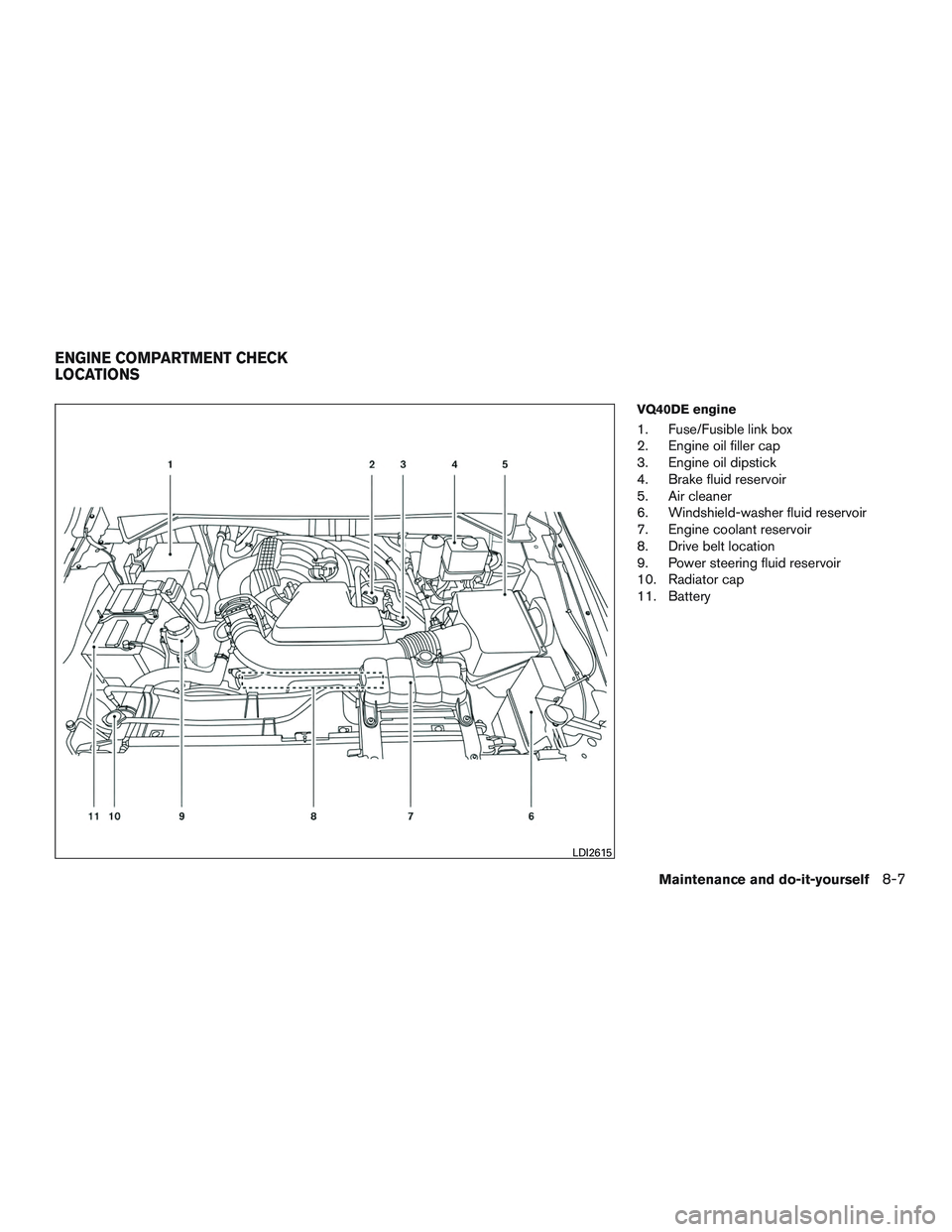
VQ40DE engine
1. Fuse/Fusible link box
2. Engine oil filler cap
3. Engine oil dipstick
4. Brake fluid reservoir
5. Air cleaner
6. Windshield-washer fluid reservoir
7. Engine coolant reservoir
8. Drive belt location
9. Power steering fluid reservoir
10. Radiator cap
11. Battery
LDI2615
ENGINE COMPARTMENT CHECK
LOCATIONS
Maintenance and do-it-yourself8-7
Page 303 of 380
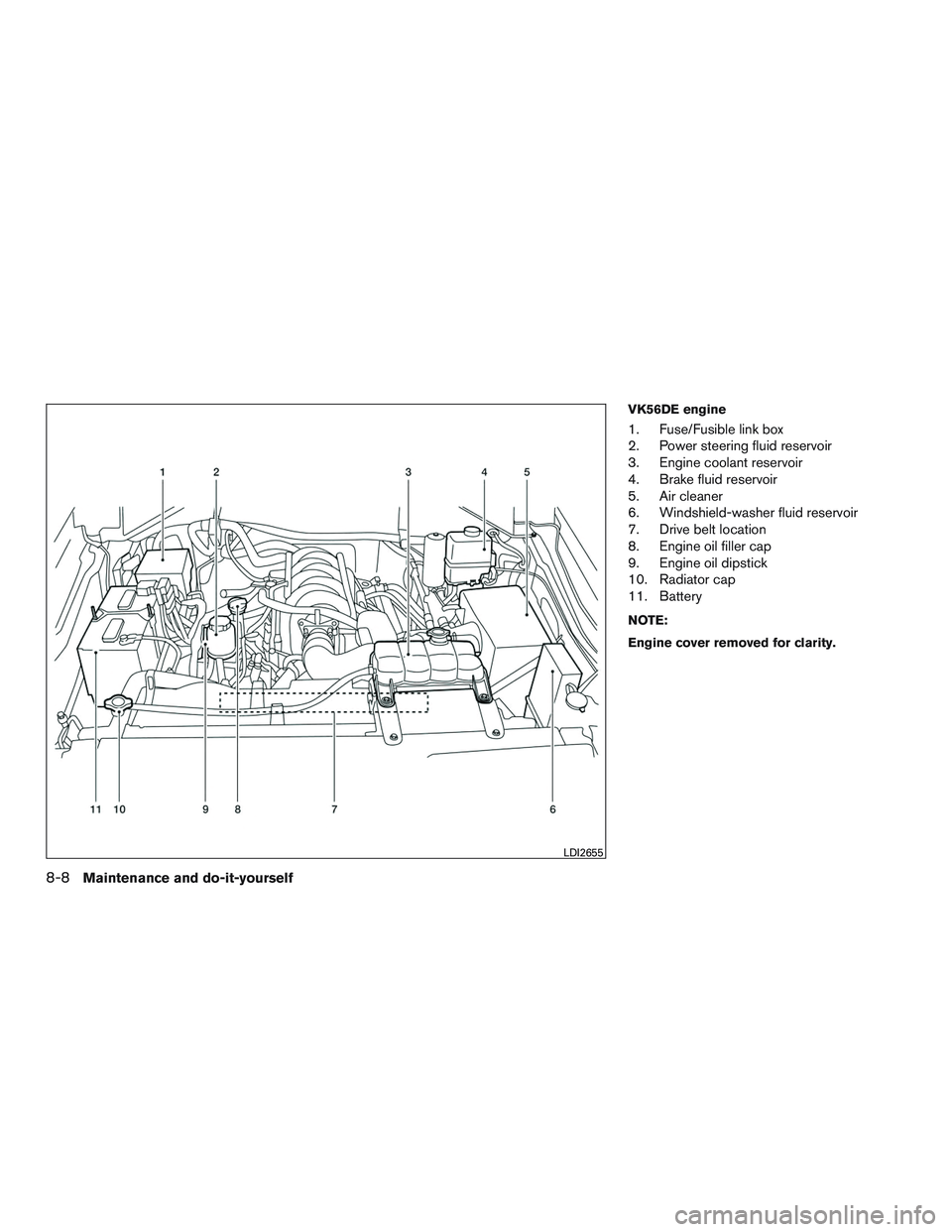
VK56DE engine
1. Fuse/Fusible link box
2. Power steering fluid reservoir
3. Engine coolant reservoir
4. Brake fluid reservoir
5. Air cleaner
6. Windshield-washer fluid reservoir
7. Drive belt location
8. Engine oil filler cap
9. Engine oil dipstick
10. Radiator cap
11. Battery
NOTE:
Engine cover removed for clarity.
LDI2655
8-8Maintenance and do-it-yourself
Page 306 of 380
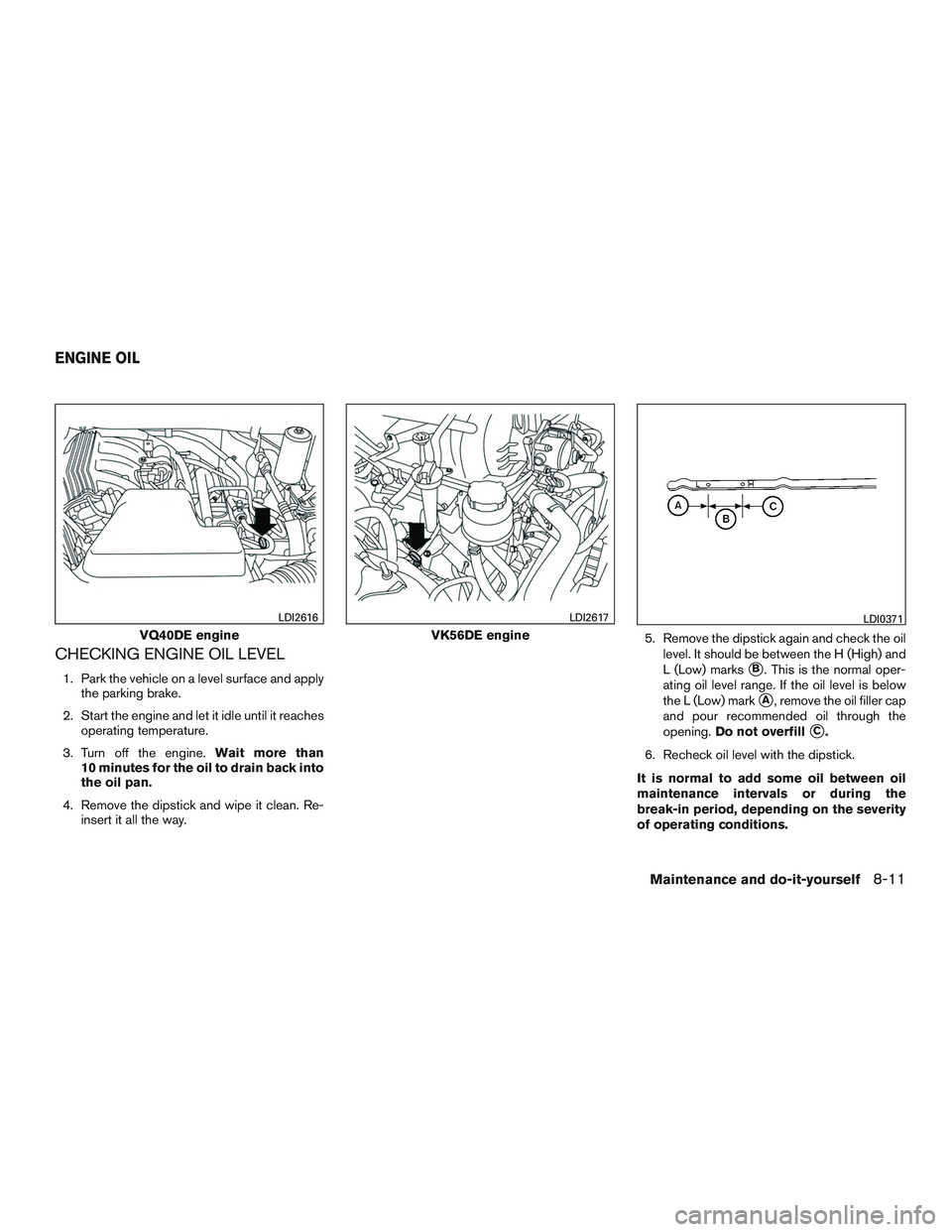
CHECKING ENGINE OIL LEVEL
1. Park the vehicle on a level surface and applythe parking brake.
2. Start the engine and let it idle until it reaches operating temperature.
3. Turn off the engine. Wait more than
10 minutes for the oil to drain back into
the oil pan.
4. Remove the dipstick and wipe it clean. Re- insert it all the way. 5. Remove the dipstick again and check the oil
level. It should be between the H (High) and
L (Low) marks�B. This is the normal oper-
ating oil level range. If the oil level is below
the L (Low) mark
�A, remove the oil filler cap
and pour recommended oil through the
opening. Do not overfill
�C.
6. Recheck oil level with the dipstick.
It is normal to add some oil between oil
maintenance intervals or during the
break-in period, depending on the severity
of operating conditions.
VQ40DE engine
LDI2616
VK56DE engine
LDI2617LDI0371
ENGINE OIL
Maintenance and do-it-yourself8-11
Page 307 of 380
CAUTION
Oil level should be checked regularly. Op-
erating the engine with an insufficient
amount of oil can damage the engine, and
such damage is not covered by warranty.
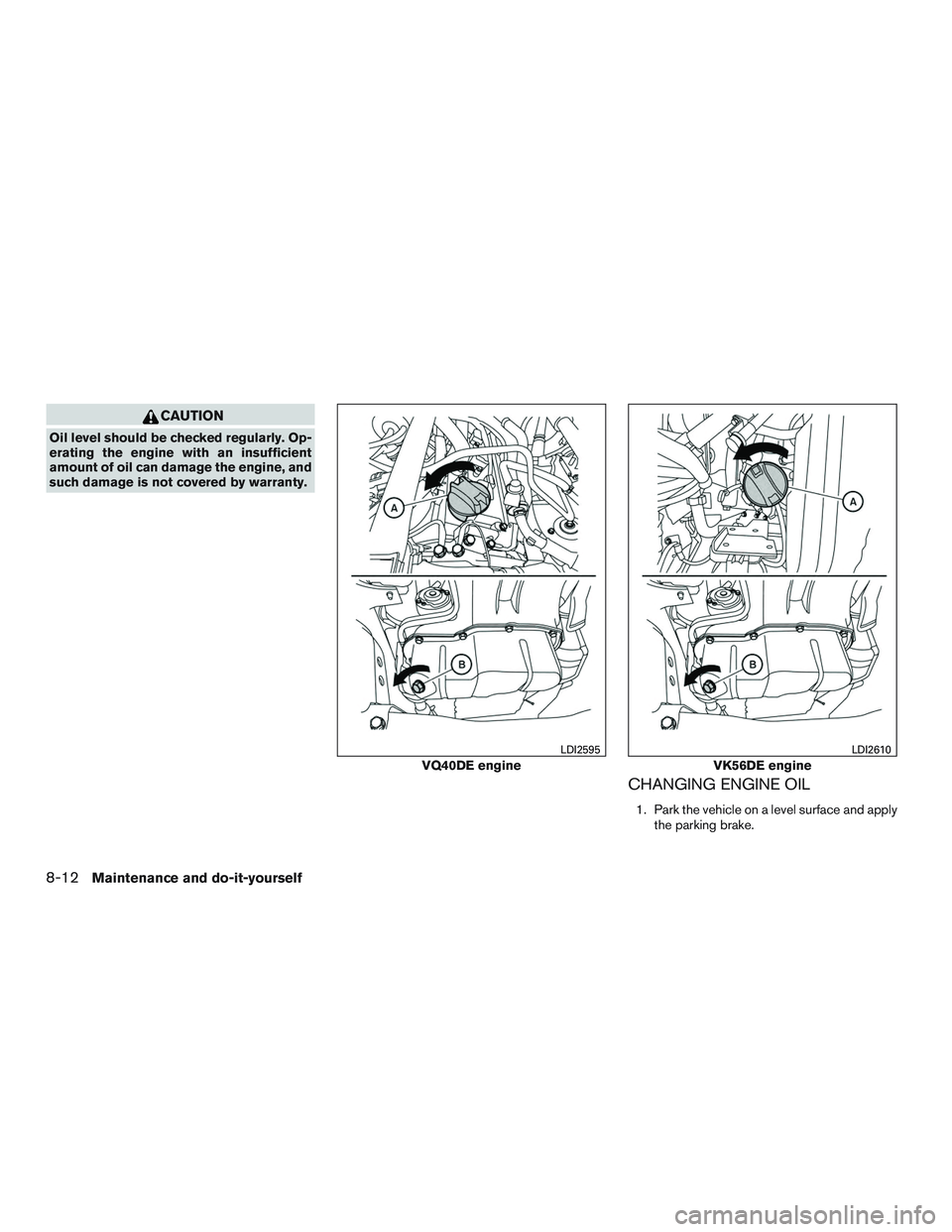
CHANGING ENGINE OIL
1. Park the vehicle on a level surface and applythe parking brake.
VQ40DE engine
LDI2595
VK56DE engine
LDI2610
8-12Maintenance and do-it-yourself