2016 NISSAN MURANO roof
[x] Cancel search: roofPage 257 of 465
WARNING
●Do not leave children or adults who
would normally require the assistance
of others alone in your vehicle. Pets
should also not be left alone. They
could accidentally injure themselves or
others through inadvertent operation of
the vehicle. Also, on hot, sunny days,
temperatures in a closed vehicle could
quickly become high enough to cause
severe or possibly fatal injuries to
people or animals.
●Properly secure all cargo with ropes or
straps to help prevent it from sliding or
shifting. Do not place cargo higher than
the seatbacks. In a sudden stop or col-
lision, unsecured cargo could cause
personal injury.
●Exceeding the roof rack capacity can
change the vehicle’s center of gravity
and adversely affect the handling and
stability of the vehicle resulting in an
accident causing death or serious
injury.
EXHAUST GAS (carbon monoxide)
WARNING
●Do not breathe exhaust gases; they
contain colorless and odorless carbon
monoxide. Carbon monoxide is danger-
ous. It can cause unconsciousness or
death.
●If you suspect that exhaust fumes are
entering the vehicle, drive with all win-
dows fully open, and have the vehicle
inspected immediately.
●Do not run the engine in closed spaces
such as a garage.
●Do not park the vehicle with the engine
running for any extended length of time.
●Keep the liftgate and rear vent windows
closed while driving, otherwise exhaust
gases could be drawn into the passen-
ger compartment. If you must drive with
the liftgate or rear vent windows open,
follow these precautions:
1. Open all the windows.
2. Set the
air recirculation but-
ton to off and the fan control dial to
high to circulate the air.●If electrical wiring or other cable con-
nections must pass to a trailer through
the seal on the liftgate or the body,
follow the manufacturer’s recommen-
dation to prevent carbon monoxide en-
try into the vehicle.
●The exhaust system and body should be
inspected by a qualified mechanic
whenever:
a. The vehicle is raised for service.
b. You suspect that exhaust fumes are
entering into the passenger
compartment.
c. You notice a change in the sound of
the exhaust system.
d. You have had an accident involving
damage to the exhaust system, un-
derbody, or rear of the vehicle.
THREE-WAY CATALYST
The three-way catalyst is an emission control
device installed in the exhaust system. Exhaust
gases in the three-way catalyst are burned at
high temperatures to help reduce pollutants.
PRECAUTIONS WHEN STARTING
AND DRIVING
5-2Starting and driving
Page 264 of 465
DRIVING SAFETY PRECAUTIONS
Your NISSAN is designed for both normal and
off-road use. However, avoid driving in deep wa-
ter or mud as your NISSAN is mainly designed for
leisure use, unlike a conventional off-road ve-
hicle.
Remember that 2-wheel drive models are less
capable than all-wheel drive models for rough
road driving and extrication when stuck in deep
snow or mud, or the like.
Please observe the following precautions:
WARNING
●Spinning the front wheels on slippery
surface may cause the AWD warning
message to display and the AWD sys-
tem to automatically switch from the
AWD to the 2WD mode. This could re-
duce the traction. Be especially careful
when towing a trailer. (AWD models)
●Drive carefully when off the road and
avoid dangerous areas. Every person
who drives or rides in this vehicle
should be seated with their seat belt
fastened. This will keep you and your
passengers in position when driving
over rough terrain.●Do not drive across steep slopes. In-
stead drive either straight up or straight
down the slopes. Off-road vehicles can
tip over sideways much more easily
than they can forward or backward.
●Many hills are too steep for any vehicle.
If you drive up them, you may stall. If
you drive down them, you may not be
able to control your speed. If you drive
across them, you may roll over.
●Do not shift gears while driving on
downhill grades as this could cause
loss of control of the vehicle.
●Stay alert when driving to the top of a
hill. At the top there could be a drop-off
or other hazard that could cause an
accident.
●If your engine stalls or you cannot make
it to the top of a steep hill, never at-
tempt to turn around. Your vehicle could
tip or roll over. Always back straight
down in R (Reverse) gear and apply
brakes to control your speed.
●Heavy braking going down a hill could
cause your brakes to overheat and fade,
resulting in loss of control and an acci-
dent. Apply brakes lightly and use a low
gear to control your speed.●Unsecured cargo can be thrown around
when driving over rough terrain. Prop-
erly secure all cargo so it will not be
thrown forward and cause injury to you
or your passengers.
●Exceeding the roof rack capacity can
raise the center of gravity excessively
and affect the handling and stability of
the vehicle.
●Secure heavy loads in the cargo area as
far forward and as low as possible. Do
not equip the vehicle with tires larger
than specified in this manual. This could
cause your vehicle to roll over.
●Do not grip the inside or spokes of the
steering wheel when driving off-road.
The steering wheel could move sud-
denly and injure your hands. Instead
drive with your fingers and thumbs on
the outside of the rim.
●Before operating the vehicle, ensure
that the driver and all passengers have
their seat belts fastened.
●Always drive with the floor mats in place
as the floor may become hot.
Starting and driving5-9
Page 445 of 465
K
Key.........................3-2
Key fob battery replacement..........8-25
Keyless entry
With Intelligent Key system
(See Intelligent Key system).........3-12
Keys
NISSAN Intelligent Key®........3-2,3-7
NISSAN Vehicle Immobilizer System keys . .3-4
L
Labels
Air conditioner specification label.....9-12
C.M.V.S.S. certification label........9-11
Emissioncontrolinformationlabel.....9-11
Engine serial number............9-11
F.M.V.S.S. certification label.........9-11
Tire and Loading Information label.....9-12
Vehicle identification number (VIN).....9-10
Vehicle identification number (VIN) plate . .9-10
Warning labels (for SRS)..........1-66
LATCH (Lower Anchors and Tethers for CHildren)
System......................1-29
License plate
Installing the license plate..........9-12
Liftgate......................3-22
Liftgaterelease..................3-26
Light
Airbagwarninglight.........1-67,2-13
Brake light (See stop light).........8-29
Bulb check/instrument panel.........2-8
Bulb replacement..............8-29Charge warning light.............2-9
Exterior and Interior lights..........8-29
Foglights...................8-28
Foglightswitch ...............2-36
Headlight and turn signal switch......2-32
Headlight control switch..........2-32
Headlights..................8-27
Interiorlight..................2-54
Lightbulbs..................8-27
Low tire pressure warning light.......2-10
Low windshield-washer fluid warning
light......................2-25
Passenger air bag and status light.....1-57
Personal lights................2-55
Security indicator light............2-14
Spotlights(Seemaplight) .........2-55
Warning/indicator lights and audible
reminders................2-8,2-13
Lights.......................8-27
Maplights ..................2-55
Lock
Child safety rear door lock..........3-7
Door locks...................3-5
Fuel-filler door lock opener lever......3-27
Liftgate release................3-26
Power door locks...............3-6
Loose fuel cap warning.............2-25
Lowfuelwarninglight ..........2-12,2-25
Low tire pressure warning light.........2-10
Low windshield-washer fluid warning light . . .2-25
Luggage hook..................2-48
Luggage rack (see roof rack)..........2-48
Luggage (See vehicle loading information) . .9-13M
Maintenance
General maintenance.............8-2
Insidethevehicle...............8-3
Maintenance precautions...........8-5
Outside the vehicle..............8-2
Seat belt maintenance............1-24
Under the hood and vehicle.........8-4
Maintenance requirements............8-2
Malfunction indicator light............2-13
Manual front seat adjustment...........1-3
Maplights ....................2-55
Mappocket....................2-43
Memory Seat........3-35,3-36,3-37,3-38
Meters and gauges................2-4
Instrument brightness control........2-35
Mirror
Automatic anti-glare inside mirror......3-33
Outside mirrors...............3-34
Rearview...................3-33
Vanity mirror.................3-32
Mirrors......................3-33
Moonroof.....................2-52
Moving Object Detection (MOD)........4-21
N
NISSAN Intelligent Key®..........3-2,3-7
NISSAN Intelligent Key® battery discharge
indicator .....................5-13
NISSAN Vehicle Immobilizer System . .2-28, 5-14
10-4
Page 446 of 465
O
Octanerating(Seefueloctanerating)......9-5
Odometer.....................2-5
Oil
Capacities and recommended
fuel/lubricants.................9-2
Changing engine oil.............8-11
Changing engine oil filter..........8-12
Checking engine oil level..........8-10
Engine oil...................8-10
Engine oil and oil filter recommendation . . .9-6
Engine oil viscosity..............9-7
Oneshotcall...............4-54,4-54
Outside mirrors.................3-34
Overheat
Ifyourvehicleoverheats...........6-11
Owner’s manual order form...........9-30
Owner’s manual/service manual order
information....................9-30
P
Parking
Parking brake operation...........5-21
Parking/parking on hills...........5-82
Personallights..................2-55
Power
Front seat adjustment.............1-4
Power door locks...............3-6
Power outlet.................2-41
Power rear windows.............2-51
Power steering fluid.............8-14
Power steering system...........5-82Power windows...............2-49
Rear power windows............2-51
Power outlet...................2-41
Power steering..................5-82
Power steering fluid...............8-14
Precautions
Maintenance precautions...........8-5
On-pavement and off-road driving
precautions..................5-7
Precautions on booster
seats...........1-27,1-34,1-40,1-44
Precautions on child
restraints.........1-27,1-34,1-40,1-44
Precautions on seat belt usage.......1-14
Precautions on supplemental restraint
system....................1-47
Precautions when starting and
driving...................5-2,5-9
Push starting...................6-11
R
Radio
Car phone or CB radio...........4-51
FM/AM/SAT radio with compact disc (CD)
player.....................4-38
Readiness for inspection maintenance (I/M)
test........................9-29
Rear center seat belt..............1-20
Rear power windows..............2-51
Rearseat......................1-6
Rearview mirror.................3-33
RearView Monitor.................4-2
Rear window and outside mirror defroster
switch.......................2-32Rear window wiper and washer switches . . .2-31
Recommended Fluids...............9-2
Recorders
EventData..................9-30
Refrigerant recommendation...........9-7
Registering a vehicle in another country....9-10
Remote Start...............3-19,5-15
Reporting safety defects (US only).......9-28
Roof rack.....................2-48
S
Safety
Child safety rear door lock..........3-7
Child seat belts.....1-27,1-34,1-40,1-44
Reporting safety defects (US only).....9-28
Seat adjustment
Front manual seat adjustment........1-3
Front power seat adjustment.........1-4
Seatbackpockets................2-43
Seat belt
Child safety..................1-25
Infants and small children..........1-25
Injured Person................1-17
Largerchildren................1-26
Precautions on seat belt usage.......1-14
Pregnant women...............1-17
Rear center seat belt............1-20
Seatbeltextenders .............1-24
Seatbeltmaintenance............1-24
Seatbelts................1-14,7-5
Shoulder belt height adjustment......1-23
Three-point type with retractor.......1-17
Seat belt extenders...............1-24
Seatbeltwarninglight..........1-17,2-12
10-5
Page 447 of 465
Seats
Adjustment...................1-2
Armrests....................1-7
Automatic drive
positioner........3-35,3-36,3-37,3-38
Frontseats...................1-2
Heatedseats.............2-37,2-40
Manual front seat adjustment.........1-3
Rear seat....................1-6
Seats/floor mats..................7-4
Security indicator light..............2-14
Security system (NISSAN Vehicle Immobilizer
System) , engine start...........2-28,5-14
Security systems
Vehicle security system...........2-27
Self-adjusting brakes..............8-22
Service manual order form...........9-30
Servicing air conditioner.............4-29
Shoulder belt height adjustment........1-23
Spark plug replacement.............8-18
Spark plugs...................8-18
Specifications...................9-8
Speedometer...................2-4
Speedometer and odometer...........2-4
Spotlights(Seemaplight) ...........2-55
SRS warning label................1-66
Starting
Before starting the engine..........5-14
Jump starting..............6-9,8-17
Precautions when starting and
driving...................5-2,5-9
Push starting.................6-11
Starting the engine.............5-15
Starting the engine...............5-15
Steering
Heated steering wheel...........2-40Power steering fluid.............8-14
Power steering system...........5-82
Steeringwheel..................3-30
Stoplight.....................8-29
Storage......................2-43
Storage tray...................2-44
Sunglassescase.................2-45
Sunglassesholder................2-45
Sunroof......................2-52
Sunroof(seeMoonroof).............2-52
Sun visors....................3-32
Supplemental air bag warning labels......1-66
Supplemental air bag warning light . . .1-67, 2-13
Supplemental front impact air bag system . . .1-55
Supplemental restraint system
Information and warning labels.......1-66
Precautions on supplemental restraint
system....................1-47
Supplemental restraint system
(Supplemental air bag system).........1-47
Switch
Autolightswitch...............2-33
Automatic power window switch......2-51
Foglightswitch ...............2-36
Hazard warning flasher switch........6-2
Headlight and turn signal switch......2-32
Headlight control switch..........2-32
Instrument brightness control........2-35
Power door lock switch............3-6
Rear window and outside mirror defroster
switch.....................2-32
Rear window wiper and washer
switches...................2-31
Steering wheel switch for audio
control/Bluetooth® Hands-Free Phone
System....................4-48Turnsignalswitch..............2-35
Vehicle dynamic control (VDC) off
switch.....................2-40
T
Tachometer....................2-5
Temperature gauge
Engine coolant temperature gauge.....2-6
Theft (NISSAN Vehicle Immobilizer System) ,
engine start................2-28,5-14
Three-way catalyst
................5-2
Tire
Flat tire.....................6-3
Spare tire................6-5,8-41
Tire and Loading Information label.....9-12
Tire chains..................8-38
Tire pressure.................8-31
Tire rotation..................8-39
Types of tires.................8-37
Uniform tire quality grading.........9-27
Wheels and tires............8-31,9-9
Wheel/tire size.................9-9
Tirepressure...................8-31
Low tire pressure warning light.......2-10
Tire Pressure Monitoring System (TPMS)....5-3
Top tether strap child restraint.........1-31
Towing
Flattowing..................9-26
Towing load/specification..........9-21
Towtrucktowing...............6-12
Trailer towing.................9-17
Towing a trailer..................9-17
10-6
Page 452 of 465
PRECAUTIONS ON SRS
This SRS section contains important information
concerning the following systems:
●Driver and front passenger supplemental
front-impact air bag (NISSAN Advanced Air
Bag System)
●Front seat-mounted side-impact supple-
mental air bag
●Roof-mounted curtain side-impact and roll-
over supplemental air bag
●Seat belt with pretensioner(s) (front seats)
Supplemental front-impact air bag system
The NISSAN Advanced Air Bag System can help
cushion the impact force to the head and chest of
the driver and front passenger in certain frontal
collisions.
Front seat-mounted side-impact supple-
mental air bag system
This system can help cushion the impact force to
the chest area of the driver and front passenger in
certain side-impact collisions. The side air bags
are designed to inflate on the side where the
vehicle is impacted.Roof-mounted curtain side-impact and
rollover supplemental air bag system
This system can help cushion the impact force to
the head of occupants in front and rear outboard
seating positions in certain side-impact colli-
sions. The curtain air bags are designed to inflate
on the side where the vehicle is impacted. In a
rollover, the curtain air bags are designed to
inflate and remain inflated for a short time.
The SRS is designed tosupplementthe crash
protection provided by the driver and front pas-
senger seat belts and isnot a substitutefor
them. Seat belts should always be correctly worn
and the occupant seated a suitable distance
away from the steering wheel, instrument panel
and door finishers. For additional information
about instructions and precautions on seat belt
usage, refer to “Seat belts” in this section.
The supplemental air bags operate only
when the ignition switch is placed in the ON
position.
After placing the ignition switch in the ON
position, the supplemental air bag warning
light illuminates. The supplemental air bag
warning light will turn off after about 7 sec-
onds if the system is operational.
SUPPLEMENTAL RESTRAINT
SYSTEM (SRS)
Page 456 of 465
WARNING
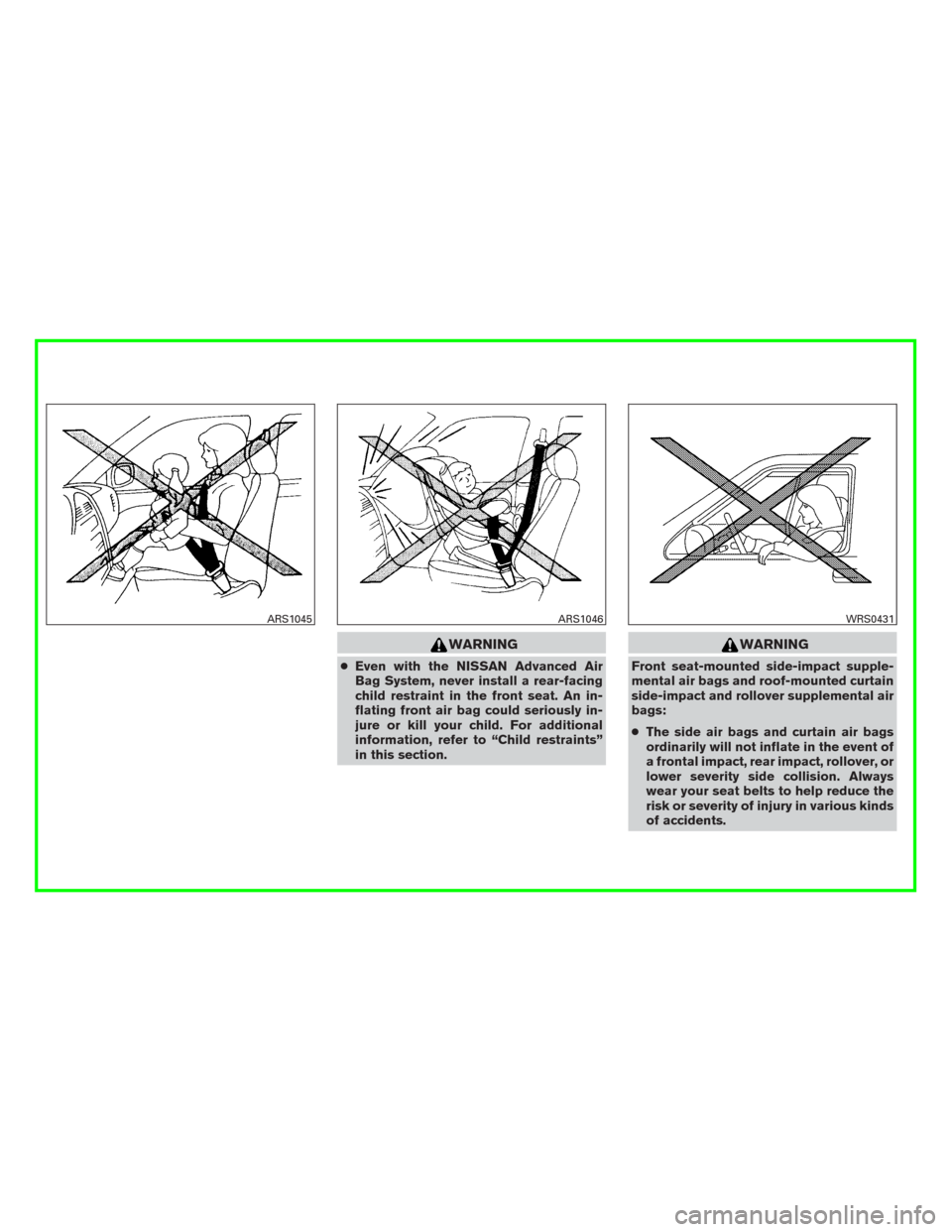
●Even with the NISSAN Advanced Air
Bag System, never install a rear-facing
child restraint in the front seat. An in-
flating front air bag could seriously in-
jure or kill your child. For additional
information, refer to “Child restraints”
in this section.
WARNING
Front seat-mounted side-impact supple-
mental air bags and roof-mounted curtain
side-impact and rollover supplemental air
bags:
●The side air bags and curtain air bags
ordinarily will not inflate in the event of
a frontal impact, rear impact, rollover, or
lower severity side collision. Always
wear your seat belts to help reduce the
risk or severity of injury in various kinds
of accidents.
ARS1045ARS1046WRS0431
Page 457 of 465
WARNING
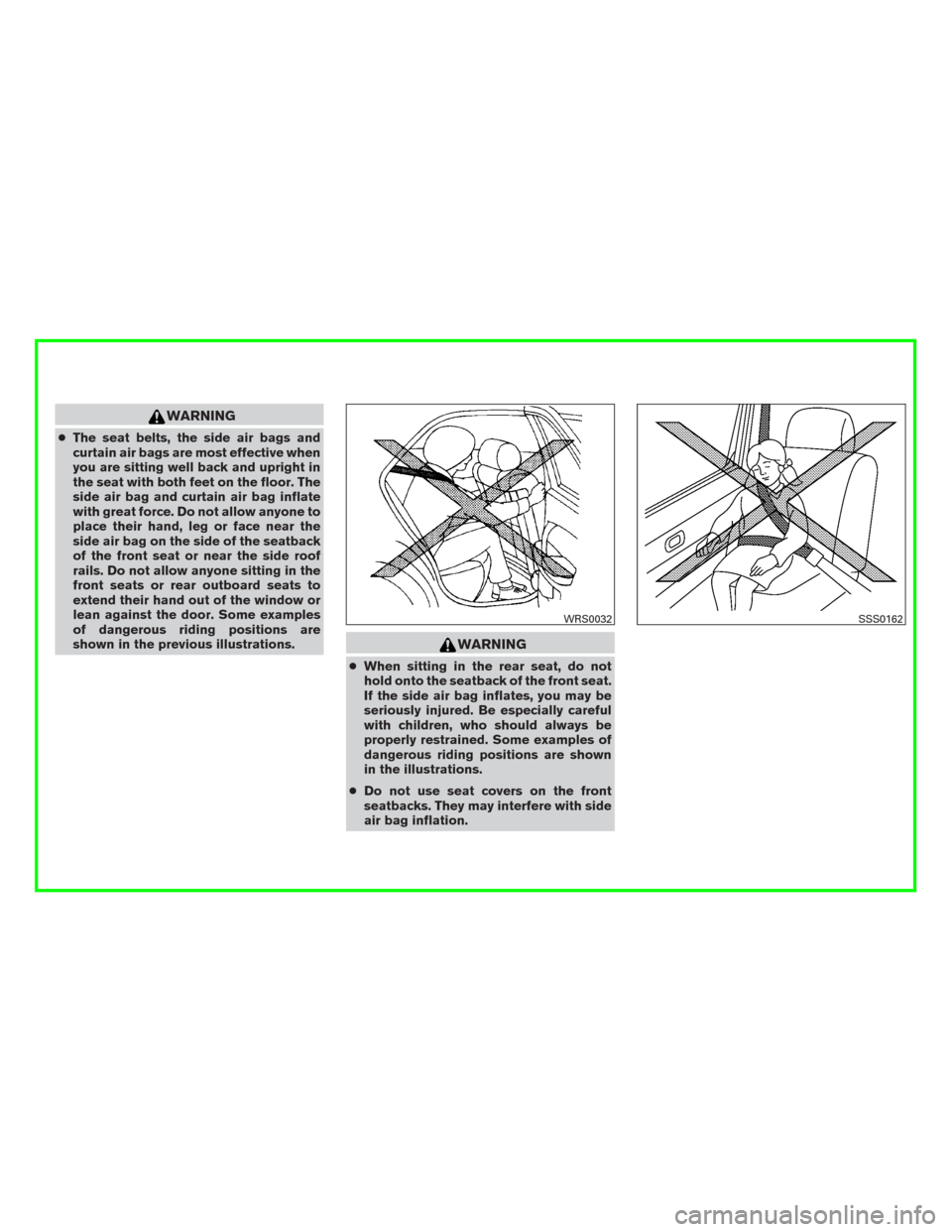
●The seat belts, the side air bags and
curtain air bags are most effective when
you are sitting well back and upright in
the seat with both feet on the floor. The
side air bag and curtain air bag inflate
with great force. Do not allow anyone to
place their hand, leg or face near the
side air bag on the side of the seatback
of the front seat or near the side roof
rails. Do not allow anyone sitting in the
front seats or rear outboard seats to
extend their hand out of the window or
lean against the door. Some examples
of dangerous riding positions are
shown in the previous illustrations.
WARNING
●When sitting in the rear seat, do not
hold onto the seatback of the front seat.
If the side air bag inflates, you may be
seriously injured. Be especially careful
with children, who should always be
properly restrained. Some examples of
dangerous riding positions are shown
in the illustrations.
●Do not use seat covers on the front
seatbacks. They may interfere with side
air bag inflation.
WRS0032SSS0162