Page 21 of 36
High-voltage Battery Electrolyte Solution Characteristics:
• Clear in color
• Sweet odor
• Similar viscosity to water
• Since the high-voltage battery is made up of many small sealed battery modules, electrolyte solution leakage should be minimal.
NOTE:
Other fluids in the vehicle (such as engine oil, washer fluid, brake fluid, coolant, etc.) are
the same as those in a conventional vehicle.
RAG–21
Page 23 of 36
4-1.1 Jump Starting Procedures
NO
TE:
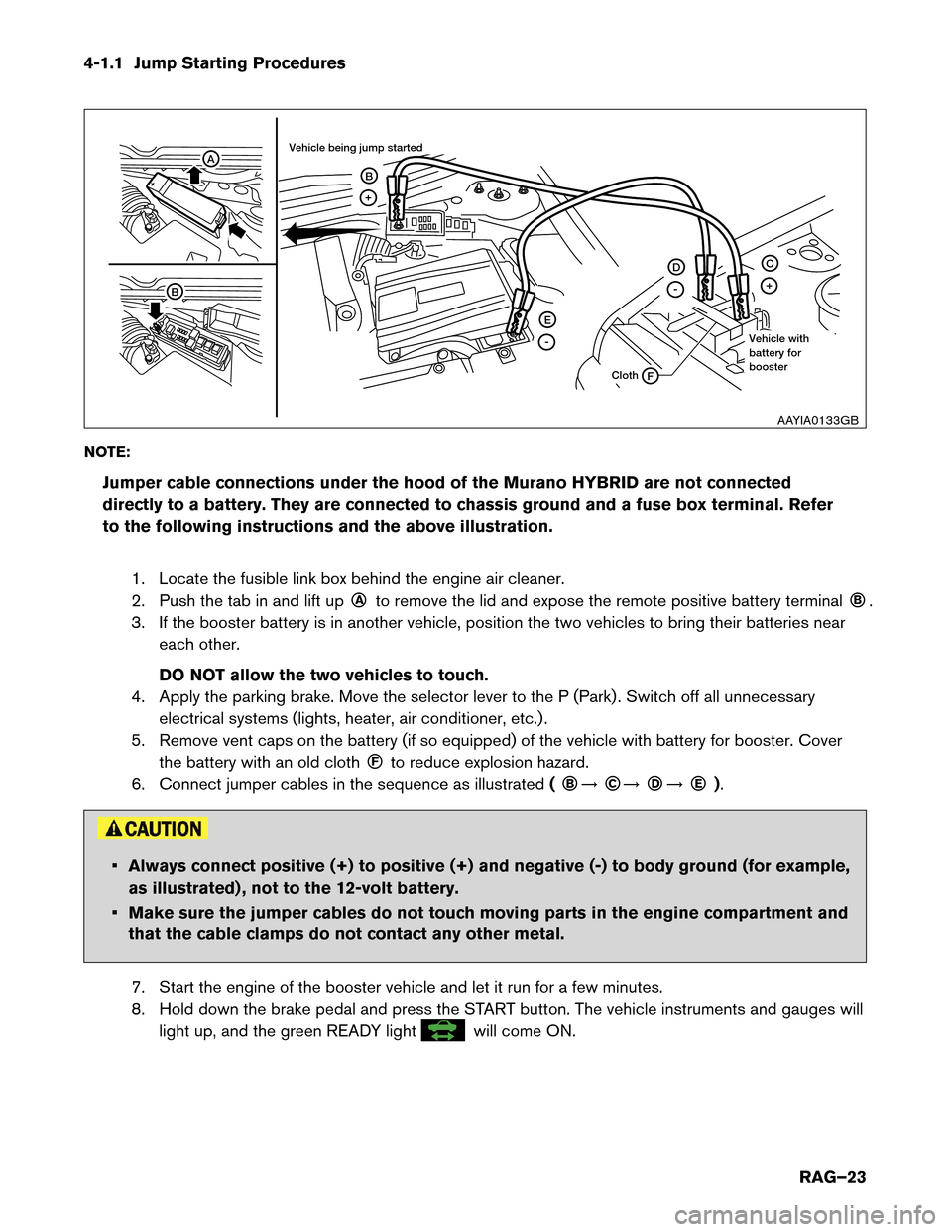
Jumper cable connections under the hood of the Murano HYBRID are not connected
directly to a battery. They are connected to chassis ground and a fuse box terminal. Refer
to the following instructions and the above illustration.
1. Locate the fusible link box behind the engine air cleaner.
2. Push the tab in and lift up ○A
to remove the lid and expose the remote positive battery terminal
○B
.
3. If the booster battery is in another vehicle, position the two vehicles to bring their batteries near each other.
DO NOT allow the two vehicles to touch.
4. Apply the parking brake. Move the selector lever to the P (Park) . Switch off all unnecessary electrical systems (lights, heater, air conditioner, etc.) .
5. Remove vent caps on the battery (if so equipped) of the vehicle with battery for booster. Cover the battery with an old cloth ○F
to reduce explosion hazard.
6. Connect jumper cables in the sequence as illustrated (
○B
○C
○D
○E
). • Always connect positive (+) to positive (+) and negative (-) to body ground (for example,
as
illustrated) , not to the 12-volt battery.
• Make sure the jumper cables do not touch moving parts in the engine compartment and that the cable clamps do not contact any other metal.
7. Start the engine of the booster vehicle and let it run for a few minutes.
8. Hold down the brake pedal and press the START button. The vehicle instruments and gauges will light up, and the green READY light will come ON.A
B
+
E
F
-
D
-
C
+
B
Cloth
Vehicle being jump started
Vehicle with
battery for
boosterAAYIA0133GB
RAG–23
Page 28 of 36
4-4 Jacking Up the Vehicle and Changing a Tire
Always follow these instructions when jacking up the vehicle and changing a tire:
•
Never change a tire when the vehicle is on a slope, ice or slippery areas. Jack must be on
level ground.
• Make sure the parking brake is securely applied and shift selector is in P (Park) position.
• Never get under the vehicle while it is supported only by the jack. If it is necessary to work under the vehicle, support it with safety stands.
• Use the correct jack-up points. Never use any other part of the vehicle for jack support.
• Never jack up the vehicle more than necessary.
• Never use blocks on or under the jack.
• Do not start or run the engine while vehicle is on the jack. It may cause the vehicle to move. This is especially true for vehicles with limited slip differentials.
• Do not allow passengers to stay in the vehicle while it is on the jack.
• Never run the engine with a wheel(s) off the ground. It may cause the vehicle to move.
• Be sure to block the wheel diagonally opposite the wheel being removed as the vehicle may move and result in personal injury.
Failure to follow these instructions can result in serious personal injury or death and/or
vehicle damage.
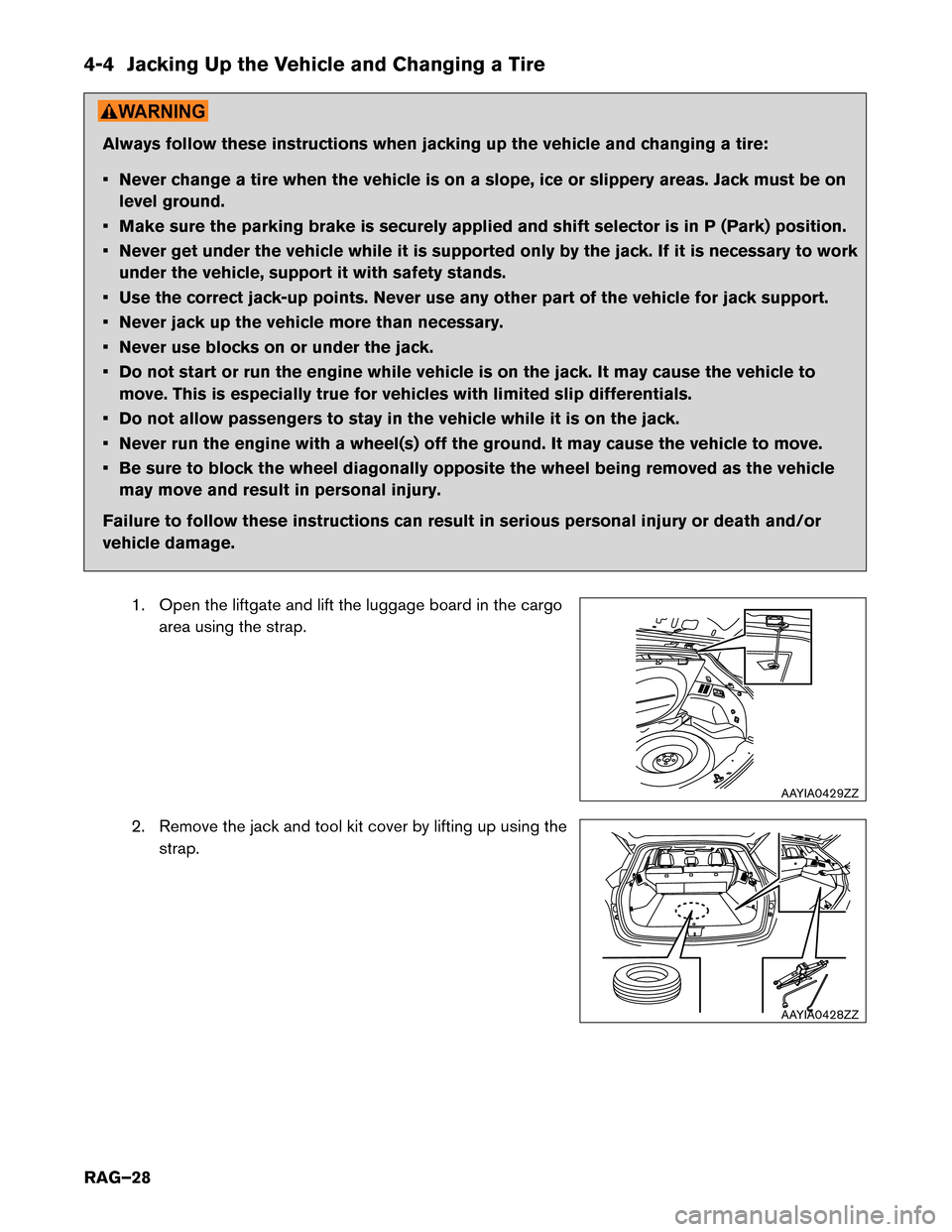
1. Open the liftgate and lift the luggage board in the cargoarea using the strap.
2. Remove the jack and tool kit cover by lifting up using the strap. AAYIA0429ZZ
AAYIA0428ZZ
RAG–28
Page 33 of 36
5-2 Removing The Service Plug
DANGER
• Do not remove the service plug without always wearing appropriate Personal
Protective Equipment (PPE) to help protect the responder from serious injury or death
by electrical shock.
• Immediately cover the service plug socket with insulated tape. The high-voltage
battery
retains high-voltage power even when the service plug is removed. To avoid
electric shock, NEVER touch the terminals inside the socket. To avoid unintended reinstallation and risk of electrical shock and severe personal injury
or
death, the service plug should be securely stored away from the vehicle while the vehicle
is in storage.
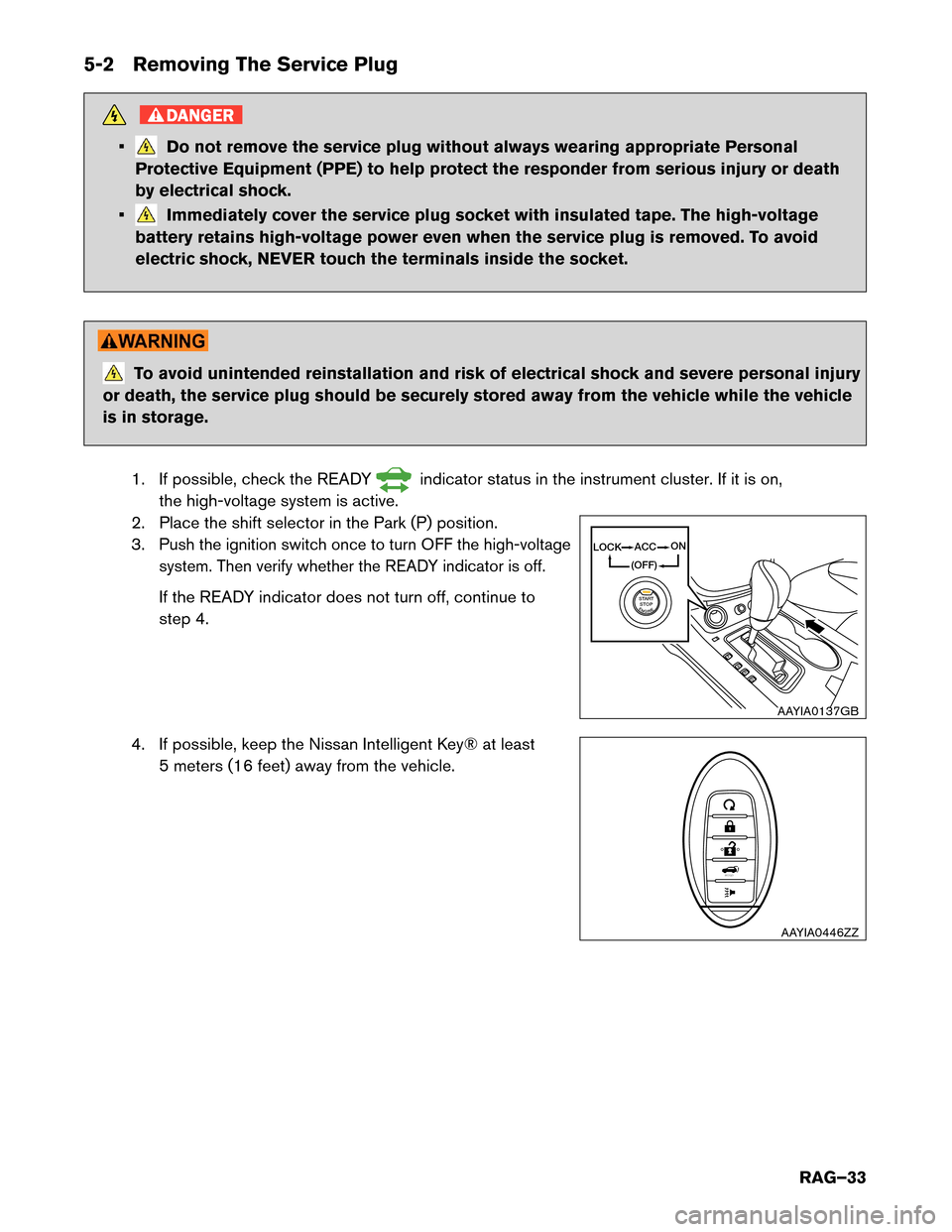
1. If possible, check the READY indicator status in the instrument cluster. If it is on,
the
high-voltage system is active.
2. Place the shift selector in the Park (P) position.
3.
Push the ignition switch once to turn OFF the high-voltage
system. Then verify whether the READY indicator is off.
If the READY indicator does not turn off, continue to
step 4.
4. If possible, keep the Nissan Intelligent Key® at least 5 meters (16 feet) away from the vehicle.
PR N
D ACC
ENGINESTART
STOP LOCK
(OFF)
ON
AAYIA0137GB
HOLD AAYIA0446ZZ
RAG–33