2016 NISSAN MAXIMA steering wheel
[x] Cancel search: steering wheelPage 316 of 401
When driving in areas using road salt or other
corrosive materials, check lubrication frequently.
Lights*Clean the headlights on a regular basis.
Make sure that the headlights, stop lights, tail
lights, turn signal lights, and other lights are all
operating properly and installed securely. Also
check headlight aim.
Road wheel nuts (lug nuts)* When checking
the tires, make sure no wheel nuts are missing,
and check for any loose wheel nuts. Tighten if
necessary.
Tire rotation* Tires should be rotated every
5,000 miles (8,000 km).
Tires* Check the pressure with a gauge often
and always prior to long distance trips. If neces-
sary, adjust the pressure in all tires, including the
spare, to the pressure specified. Check carefully
for damage, cuts or excessive wear.
Tire Pressure Monitoring System (TPMS)
transmitter components Replace the TPMS
transmitter grommet seal, valve core and cap
when the tires are replaced due to wear or age.
Wheel alignment and balance If the vehicle
should pull to either side while driving on a
straight and level road, or if you detect uneven or
abnormal tire wear, there may be a need for wheel alignment. If the steering wheel or seat vibrates at
normal highway speeds, wheel balancing may be
needed.
● For additional information regarding tires,
refer to “Important Tire Safety Information”
(US) or “Tire Safety Information” (Canada) in
the Warranty Information Booklet.
Windshield Clean the windshield on a regular
basis. Check the windshield at least every six
months for cracks or other damage. Have a dam-
aged windshield repaired by a qualified repair
facility.
Windshield wiper blades* Check for cracks or
wear if they do not wipe properly.
Inside the vehicle
The maintenance items listed here should be
checked on a regular basis, such as when per-
forming periodic maintenance, cleaning the ve-
hicle, etc.
Additional information on the following
items with an “*” is found in this section.
Accelerator pedal Check the pedal for smooth
operation and make sure the pedal does not bind
or require uneven effort. Keep the floor mat away
from the pedal.
Brake pedal Check the pedal for smooth opera-
tion. If the brake pedal suddenly goes down fur- ther than normal, the pedal feels spongy or the
vehicle seems to take longer to stop, see a
NISSAN dealer immediately. Keep the floor mat
away from the pedal.
Brakes
Check that the brakes do not pull the
vehicle to one side when applied.
Continuously Variable Transmission (CVT)
P (Park) position mechanism: On a fairly
steep hill check that the vehicle is held securely
with the shift lever in the P (Park) position without
applying any brakes.
Parking brake Check the parking brake opera-
tion regularly. The vehicle should be securely held
on a fairly steep hill with only the parking brake
applied. If the parking brake needs adjustment,
see a NISSAN dealer.
Seats Check seat position controls such as seat
adjusters, seatback recliner, etc., to ensure they
operate smoothly and all latches lock securely in
every position. Check that the head restraints
move up and down smoothly and the lock knobs
(if so equipped) hold securely in all adjustable
positions.
Seat belts Check that all parts of the seat belt
system (for example, buckles, anchors, adjusters
and retractors) operate properly and smoothly,
and are installed securely. Check the belt web-
bing for cuts, fraying, wear or damage.
Maintenance and do-it-yourself8-3
Page 317 of 401
Steering wheelCheck for changes in the steer-
ing system, such as excessive freeplay, hard
steering or strange noises.
Warning lights and chimes Make sure all
warning lights and chimes are operating properly.
Windshield wiper and washer* Check that
the wipers and washer operate properly and that
the wipers do not streak.
Windshield defroster Check that the air
comes out of the defroster outlets properly and in
sufficient quantity when operating the heater or
air conditioner.
Under the hood and vehicle
The maintenance items listed here should be
checked periodically (for example, each time you
check the engine oil or refuel) .
Battery* Check the fluid level in each cell. It
should be between the MAX and MIN lines. Ve-
hicles operated in high temperatures or under
severe conditions require frequent checks of the
battery fluid level. NOTE:
Care should be taken to avoid situations
that can lead to potential battery discharge
and potential no-start conditions such as:
1. Installation or extended use of electronic accessories that consume battery power
when the engine is not running (Phone char-
gers, GPS, DVD players, etc.)
2. Vehicle is not driven regularly and/or only driven short distances. In these cases, the
battery may need to be charged to maintain
battery health.
Brake fluid level* Make sure that the brake fluid
level is between the MIN and MAX lines on the
reservoir.
Engine coolant level* Check the coolant level
when the engine is cold.
Engine drive belts* Make sure the drive belts
are not frayed, worn, cracked or oily.
Engine oil level* Check the level after parking
the vehicle on a level surface with the engine off.
Wait more than 10 minutes for the oil to drain
back into the oil pan.
Exhaust system Make sure there are no loose
supports, cracks or holes. If the sound of the
exhaust seems unusual or there is a smell of
exhaust fumes, immediately have the exhaust system inspected by a NISSAN dealer. For addi-
tional information, refer to “Exhaust gas (carbon
monoxide)” in the “Starting and driving” section of
this manual.
Fluid leaks
Check under the vehicle for fuel, oil,
water or other fluid leaks after the vehicle has
been parked for a while. Water dripping from the
air conditioner after use is normal. If you should
notice any leaks or if gasoline fumes are evident,
check for the cause and have it corrected imme-
diately.
Power steering fluid level* and lines Check
the level when the fluid is cold, with the engine
off. Check the lines for proper attachment, leaks,
cracks, etc.
Radiator and hoses Check the front of the
radiator and clean off any dirt, insects, leaves,
etc., that may have accumulated. Make sure the
hoses have no cracks, deformation, rot or loose
connections.
Underbody The underbody is frequently ex-
posed to corrosive substances such as those
used on icy roads or to control dust. It is very
important to remove these substances from the
underbody, otherwise rust may form on the floor
pan, frame, fuel lines and exhaust system. At the
end of winter, the underbody should be thor-
oughly flushed with plain water, in those areas
where mud and dirt may have accumulated. For
8-4Maintenance and do-it-yourself
Page 380 of 401

Fuel octane rating...............9-6
Fuel recommendation ..........9-2,9-5
Loose fuel cap warning ...........2-24
Fuel Cell Vehicle (FCV) System Tirepressure.................8-31
Fuel-filler door ..................3-23
Fuel gauge .....................2-6
Fuses.......................8-22
Fusible links ...................8-23
G
Garage door opener, HomeLink® Universal
Transceiver .........2-60,2-63,2-63,2-64
Gascap .....................3-23
Gauge Engine coolant temperature gauge .....2-5
Fuel gauge ...................2-6
Odometer ...................2-4
Speedometer .................2-4
Tachometer ..................2-5
Trip odometer .................2-4
General maintenance ...............8-2
Glovebox.....................2-50
Gloveboxlock..................2-50
H
Hazard warning flasher switch ..........6-2
Headlight and turn signal switch ........2-38
Headlightcontrolswitch ............2-38
Headlights....................8-27
Head restraints ..................1-6
Heated seats ...............2-43,2-45 Heated steering wheel
.............2-45
Heater Heater and air conditioner (automatic)
(if so equipped) ...............4-25
Heater and air conditioner controls .....4-26
Heater operation ...............4-27
Heater and air conditioner (automatic) .....4-25
HomeLink® Universal
Transceiver .........2-60,2-63,2-63,2-64
Hood .......................3-20
Horn .......................2-42
I
Ignition Switch Push-Button Ignition Switch ........5-10
Immobilizer system ............2-35,5-13
Important vehicle information label .......9-12
In-cabin microfilter ................8-20
Increasing fuel economy .............5-76
Indicator NISSAN Intelligent Key® battery discharge
indicator ...................5-13
Indicator lights and audible reminders
(See warning/indicator lights and audible
reminders) ..................2-7,2-12
Inside automatic anti-glare mirror ........3-28
Instrument brightness control ..........2-41
Instrument panel ...............0-6,2-2
Instrument panel dimmer switch ........2-41
Intelligent cruise control (ICC) system Brake assist .................5-42
Intelligent Key system Key operating range ..............3-7
Key operation .................3-8 Mechanical key
................3-3
Remote keyless entry operation.......3-11
Troubleshooting guide ............3-16
Warning signals ...............3-16
Interior light ....................2-58
Interior trunk lid release .............3-22
ISOFIX
child restraints .............1-23
J
Jump starting ................6-8,8-17
K
Key.........................3-2
Key fob battery replacement ..........8-25
Keyless entry With Intelligent Key system
(See Intelligent Key system) .........3-11
Keys NISSAN Intelligent Key® ........3-2,3-6
L
Labels Air conditioner specification label .....9-13
C.M.V.S.S. certification label ........9-12
Emission control information label .....9-12
Engine serial number ............9-12
F.M.V.S.S. certification label .........9-12
Tire and Loading Information label .....9-13
Vehicle identification number (VIN) .....9-11
Vehicle identification number (VIN) plate . .9-11
10-3
Page 382 of 401
Parking/parking on hills...........5-77
Parking brake ...................5-21
Personallights..................2-59
Power Power door locks ...............3-5
Power outlet .................2-46
Power rear windows .............2-53
Power steering fluid .............8-14
Power steering system ...........5-78
Rear power windows ............2-53
Power outlet ...................2-46
Power steering ..................5-78
Power steering fluid ...............8-14
Precautions Maintenance precautions ...........8-5
Precautions on booster
seats...........1-21,1-27,1-33,1-37
Precautions on child
restraints .........1-21,1-27,1-33,1-37
Precautionsonseatbeltusage.......1-11
Precautions on supplemental restraint
system ....................1-40
Precautions when starting and driving ....5-4
Push starting ...................6-10
R
Radio Car phone or CB radio ...........4-29
Rainsensor....................2-37
Readiness for inspection maintenance (I/M)
test........................9-21
Rear Cross Traffic Alert (RCTA) ........5-32
Rear power windows ..............2-53
Rearseat......................1-5 Rear sun shade
.................2-57
RearView Monitor .................4-2
Recommended Fluids ...............9-2
Recorders Eventdata..................9-21
Refrigerant recommendation ........9-2,9-8
Registering a vehicle in another country ....9-11
Remote Start ...............3-18,5-15
Reporting safety defects (US only) .......9-20
S
Safety Child safety rear door lock ..........3-6
Child seat belts .....1-21,1-27,1-33,1-37
Reporting safety defects (US only) .....9-20
Seat adjustment Front power seat adjustment .........1-3
Seatback pockets ................2-47
Seat belt Child safety ..................1-18
Infantsandsmallchildren..........1-19
Injured Person ................1-14
Largerchildren................1-19
Precautions on seat belt usage .......1-11
Pregnant women ...............1-14
Seatbeltextenders .............1-17
Seat belt maintenance ............1-18
Seatbelts................1-11,7-7
Shoulder belt height adjustment ......1-17
Three-point type with retractor .......1-14
Seatbeltextenders ...............1-17
Seat belt warning light ..........1-14,2-11
Seats Adjustment...................1-2 Armrests....................1-6
Automatic drive positioner. . .3-30, 3-31, 3-31
Frontseats...................1-2
Heatedseats.............2-43,2-45
Rearseat....................1-5
Seats/floor mats ..................7-6
Security indicator light ..............2-13
Security system (NISSAN Vehicle Immobilizer
System) , engine start ...........2-35,5-13
Security systems Vehicle security system ...........2-34
Self-adjusting brakes ..............
8-22
Service manual order form ...........9-22
Servicing air conditioner .............4-28
Shifting Continuously Variable Transmission
(CVT) .....................5-17
Shoulder belt height adjustment ........1-17
Sparkplugreplacement.............8-19
Sparkplugs ...................8-19
Specifications ...................9-9
Speedometer ...................2-4
Speedometer and odometer ...........2-4
Spotlights (See map light) ...........2-60
SRSwarninglabel................1-57
Stability control .................5-80
Starting Before starting the engine ..........5-14
Jump starting ..............6-8,8-17
Precautions when starting and driving ....5-4
Push starting .................6-10
Starting the engine .............5-14
Starting the engine ...............5-14
Steering Heated steering wheel ...........2-45
Power steering fluid .............8-14
10-5
Page 383 of 401
Power steering system...........5-78
Steering wheel ..................3-25
Stoplight.....................8-28
Storage......................2-47
Storage tray ...................2-50
Sunglassescase.................2-48
Sunglassesholder................2-48
Sunroof......................2-54
Sunroof (see Moonroof) .............2-54
Sun visors ....................3-27
Supplemental air bag warning light . . .1-57, 2-11
Supplemental front impact air bag system . . .1-47
Supplemental restraint system Information and warning labels .......1-57
Precautions on supplemental restraint
system ....................1-40
Supplemental restraint system
(Supplemental air bag system) .........1-40
Switch Autolightswitch...............2-39
Automatic power window switch ......2-53
Foglightswitch ...............2-42
Hazard warning flasher switch ........6-2
Headlight and turn signal switch ......2-38
Headlight control switch ..........2-38
Instrument brightness control ........2-41
Power door lock switch ............3-5
Turnsignalswitch..............2-41
Vehicle dynamic control (VDC) off
switch.....................2-45
T
Tachometer ....................2-5 Temperature gauge
Engine coolant temperature gauge .....2-5
Theft (NISSAN Vehicle Immobilizer System) ,
engine start ................2-35,5-13
Three-way catalyst ................5-4
Tire Flat tire .....................6-3
Spare tire ................6-4,8-41
Tire and Loading Information label .....9-13
Tirechains..................8-38
Tire pressure .................8-31
Tirerotation..................8-38
Types of tires .................8-37
Uniform tire quality grading .........9-18
Wheels and tires ...............8-31
Wheel/tire size ................9-10
Tire pressure ...................8-31
Low tire pressure warning light ........2-9
Tire Pressure Monitoring System (TPMS) ....5-5
Towing Flattowing..................9-18
Towtrucktowing...............6-11
Trailer towing .................9-18
Towingatrailer..................9-18
Transceiver HomeLink® Universal
Transceiver .......2-60,2-63,2-63,2-64
Transmission Continuously Variable Transmission (CVT)
fluid......................8-13
Driving with Continuously Variable
Transmission (CVT) .............5-15
Travel (See registering a vehicle in another
country) ......................9-11
Trip odometer ...................2-4 Trunkaccessthroughtherearseat....1-5,3-22
Trunklidlockopenerlever............3-21
Trunklight ....................2-60
Turn signal switch
................2-41
U
Uniform tire quality grading ...........9-18
V
Vanity mirror ...................3-27
Variable voltage control system .........8-18
Vehicle dimensions and weights ........9-10
Vehicle dynamic control (VDC) off switch . . .2-45
Vehicle dynamic control (VDC) system .....5-80
Vehicle Dynamic Control (VDC) system ....5-80
Vehicle identification ...............9-11
Vehicle identification number (VIN) .......9-11
Vehicle identification number (VIN)
(Chassis number) ................9-11
Vehicle identification number (VIN) plate ....9-11
Vehicle immobilizer system ........
2-35,5-13
Vehicle loading information ...........9-14
Vehicle recovery .................6-13
Vehicle security system .............2-34
Vehicle security system (NISSAN Vehicle
Immobilizer System) , engine start ....2-35,5-13
Vents.......................4-24
Visors.......................3-27
Voice recognition system ............4-30
10-6
Page 388 of 401
PRECAUTIONS ON SRS
This SRS section contains important information
concerning the following systems:
●Driver and front passenger supplemental
front-impact air bag (NISSAN Advanced Air
Bag System)
●Front seat-mounted side-impact supple-
mental air bag
●Roof-mounted curtain side-impact and roll-
over supplemental air bag
●Seat belt with pretensioner(s) (front seats)
Supplemental front-impact air bag system
The NISSAN Advanced Air Bag System can help
cushion the impact force to the head and chest of
the driver and front passenger in certain frontal
collisions.
Front seat-mounted side-impact supple-
mental air bag system
This system can help cushion the impact force to
the chest area of the driver and front passenger in
certain side-impact collisions. The side air bags
are designed to inflate on the side where the
vehicle is impacted.Roof-mounted curtain side-impact and
rollover supplemental air bag system
This system can help cushion the impact force to
the head of occupants in front and rear outboard
seating positions in certain side-impact colli-
sions. The curtain air bags are designed to inflate
on the side where the vehicle is impacted. In a
rollover, the curtain air bags are designed to
inflate and remain inflated for a short time.
The SRS is designed tosupplementthe crash
protection provided by the driver and front pas-
senger seat belts and isnot a substitutefor
them. Seat belts should always be correctly worn
and the occupant seated a suitable distance
away from the steering wheel, instrument panel
and door finishers. For additional information
about instructions and precautions on seat belt
usage, refer to “Seat belts” in this section.
The supplemental air bags operate only
when the ignition switch is placed in the ON
position.
After placing the ignition switch in the ON
position, the supplemental air bag warning
light illuminates. The supplemental air bag
warning light will turn off after about 7 sec-
onds if the system is operational.
SUPPLEMENTAL RESTRAINT
SYSTEM (SRS)
Page 389 of 401
WARNING
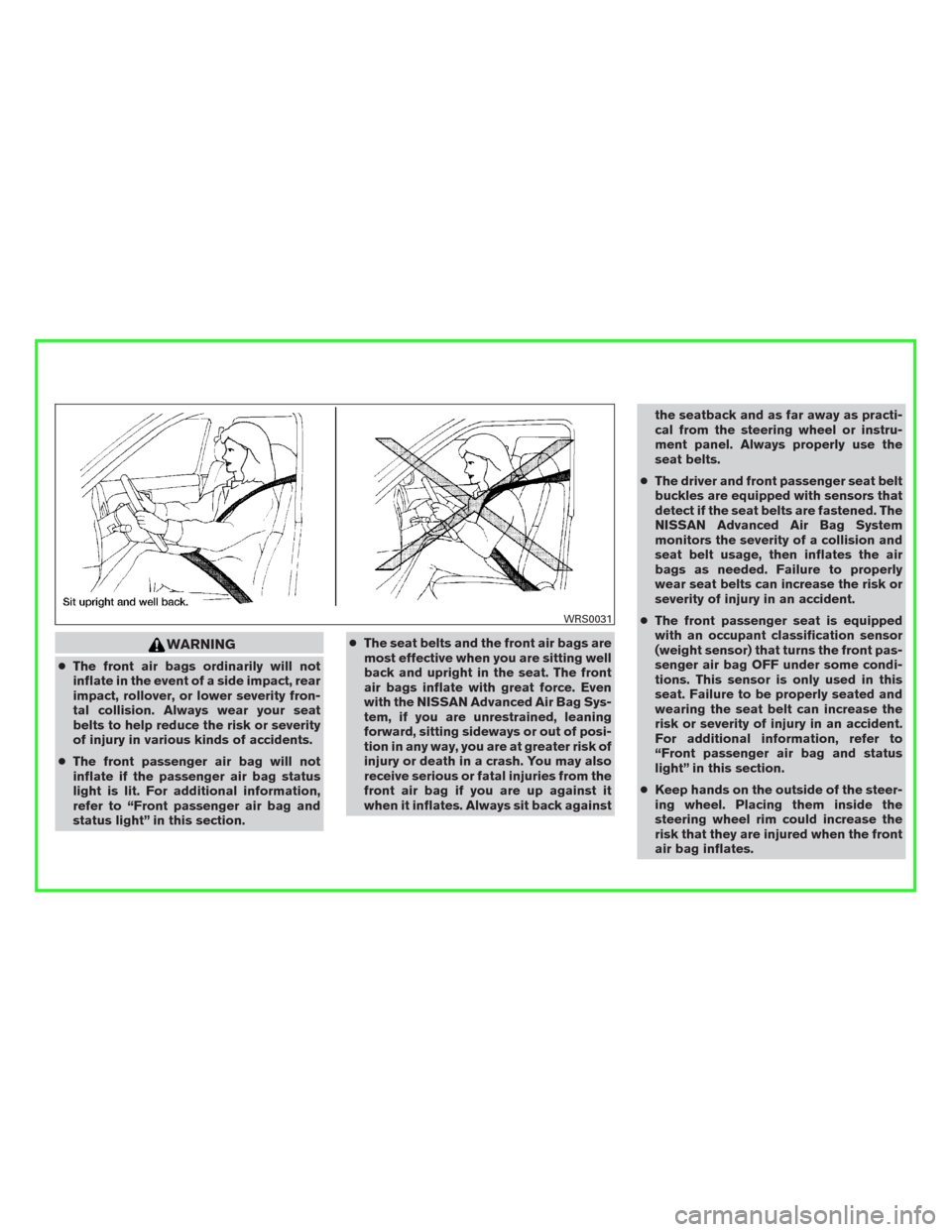
●The front air bags ordinarily will not
inflate in the event of a side impact, rear
impact, rollover, or lower severity fron-
tal collision. Always wear your seat
belts to help reduce the risk or severity
of injury in various kinds of accidents.
●The front passenger air bag will not
inflate if the passenger air bag status
light is lit. For additional information,
refer to “Front passenger air bag and
status light” in this section.●The seat belts and the front air bags are
most effective when you are sitting well
back and upright in the seat. The front
air bags inflate with great force. Even
with the NISSAN Advanced Air Bag Sys-
tem, if you are unrestrained, leaning
forward, sitting sideways or out of posi-
tion in any way, you are at greater risk of
injury or death in a crash. You may also
receive serious or fatal injuries from the
front air bag if you are up against it
when it inflates. Always sit back againstthe seatback and as far away as practi-
cal from the steering wheel or instru-
ment panel. Always properly use the
seat belts.
●The driver and front passenger seat belt
buckles are equipped with sensors that
detect if the seat belts are fastened. The
NISSAN Advanced Air Bag System
monitors the severity of a collision and
seat belt usage, then inflates the air
bags as needed. Failure to properly
wear seat belts can increase the risk or
severity of injury in an accident.
●The front passenger seat is equipped
with an occupant classification sensor
(weight sensor) that turns the front pas-
senger air bag OFF under some condi-
tions. This sensor is only used in this
seat. Failure to be properly seated and
wearing the seat belt can increase the
risk or severity of injury in an accident.
For additional information, refer to
“Front passenger air bag and status
light” in this section.
●Keep hands on the outside of the steer-
ing wheel. Placing them inside the
steering wheel rim could increase the
risk that they are injured when the front
air bag inflates.
WRS0031
Page 395 of 401
The driver supplemental front-impact air bag is
located in the center of the steering wheel. The
front passenger supplemental front-impact air
bag is mounted in the dashboard above the glove
box. The front air bags are designed to inflate in
higher severity frontal collisions, although they
may inflate if the forces in another type of collision
are similar to those of a higher severity frontal
impact. They may not inflate in certain frontal
collisions. Vehicle damage (or lack of it) is not
always an indication of proper front air bag sys-
tem operation.
The NISSAN Advanced Air Bag System monitors
information from the crash zone sensor, the Air
bag Control Unit (ACU) , seat belt buckle sensors
and occupation classification sensor (weight
sensor) . Inflator operation is based on the sever-
ity of a collision and seat belt usage for the driver.
For the front passenger, the occupant classifica-
tion sensor is also monitored. Based on informa-
tion from the sensor, only one front air bag may
inflate in a crash, depending on the crash severity
and whether the front occupants are belted or
unbelted. Additionally, the front passenger air
bag may be automatically turned off under some
conditions, depending on the weight detected on
the front passenger seat and how the seat belt is
used. If the front passenger air bag is OFF, the
front passenger air bag status light will be illumi-
nated. For additional information, refer to “Frontpassenger air bag and status light” in this section.
One front air bag inflating does not indicate im-
proper performance of the system.
If you have any questions about your air bag
system, it is recommended that you visit a
NISSAN dealer to obtain information about the
system. If you are considering modification of
your vehicle due to a disability, you may also
contact NISSAN. Contact information is con-
tained in the front of this Owner’s Manual.
When a front air bag inflates, a fairly loud noise
may be heard, followed by the release of smoke.
This smoke is not harmful and does not indicate a
fire. Care should be taken to not inhale it, as it may
cause irritation and choking. Those with a history
of a breathing condition should get fresh air
promptly.
Front air bags, along with the use of seat belts,
help to cushion the impact force on the face and
chest of the front occupants. They can help save
lives and reduce serious injuries. However, an
inflating front air bag may cause facial abrasions
or other injuries. Front air bags do not provide
restraint to the lower body.
Even with NISSAN Advanced Air Bags, seat
belts should be correctly worn and the driver and
front passenger seated upright as far as practical
away from the steering wheel or instrument
panel. The front air bags inflate quickly in order tohelp protect the front occupants. Because of this,
the force of the front air bag inflating can increase
the risk of injury if the occupant is too close to, or
is against, the front air bag module during infla-
tion.
The front air bags deflate quickly after a collision.
The front air bags operate only when the
ignition switch is in the ON position.
After placing the ignition switch in the ON
position, the supplemental air bag warning
light illuminates. The supplemental air bag
warning light will turn off after about 7 sec-
onds if the system is operational.