Page 161 of 401
●The remote start buttonis not pressed
and held within 5 seconds of pressing the
lock button.
● The brake is pressed.
● The doors are not closed and locked.
● The trunk or back door is open.
● The I–Key Indicator Light
remains
solid in the vehicle information display.
● The alarm sounds due to illegal entry into the
vehicle.
●
Two remote vehicle starts, or a single remote
start with an extension, have already been used.
● The vehicle is not in P (Park) .
● There is a detected registered key already
inside of the vehicle.
● The Remote Start function has been
switched to the OFF position in Vehicle Set-
tings of the vehicle information display. For
additional information, refer to “Vehicle infor-
mation display” in the “Instruments and con-
trols” section of this manual.
The remote engine start may display a warning or
indicator in the vehicle information display. For
additional information, refer to “Vehicle informa-
tion display” in the “Instruments and controls”
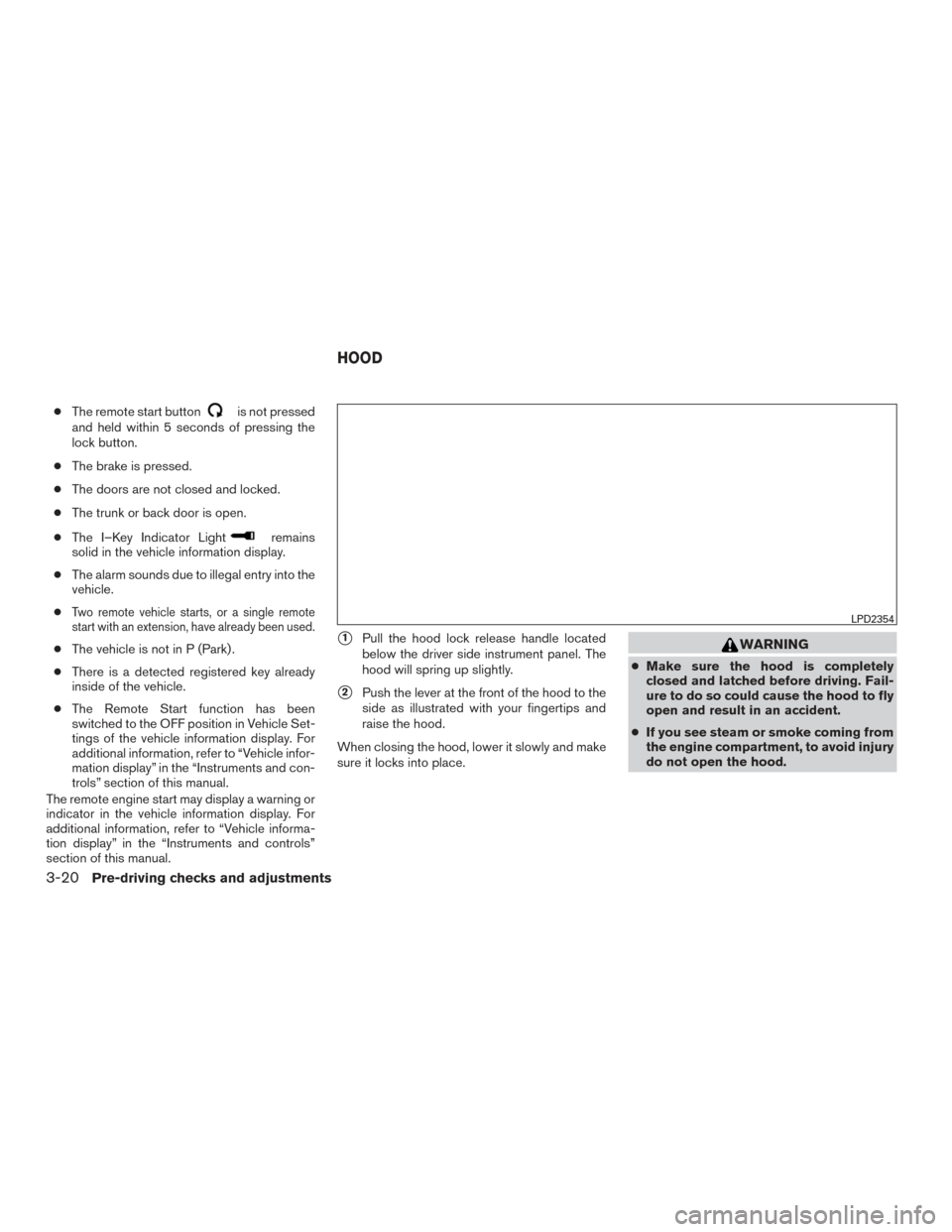
section of this manual.�1Pull the hood lock release handle located
below the driver side instrument panel. The
hood will spring up slightly.
�2Push the lever at the front of the hood to the
side as illustrated with your fingertips and
raise the hood.
When closing the hood, lower it slowly and make
sure it locks into place.
WARNING
● Make sure the hood is completely
closed and latched before driving. Fail-
ure to do so could cause the hood to fly
open and result in an accident.
● If you see steam or smoke coming from
the engine compartment, to avoid injury
do not open the hood.
LPD2354
HOOD
3-20Pre-driving checks and adjustments
Page 162 of 401
WARNING
●Do not drive with the trunk lid open. This
could allow dangerous exhaust gases
to be drawn into the vehicle. For addi-
tional information, refer to “Exhaust
gas (carbon monoxide)” in the “Starting
and driving” section of this manual.
● Closely supervise children when they
are around cars to prevent them from
playing and becoming locked in the
trunk where they could be seriously in-
jured. Keep the car locked, with the rear
seatback and trunk lid securely latched
when not in use, and prevent children’s
access to car keys.
OPENER OPERATION
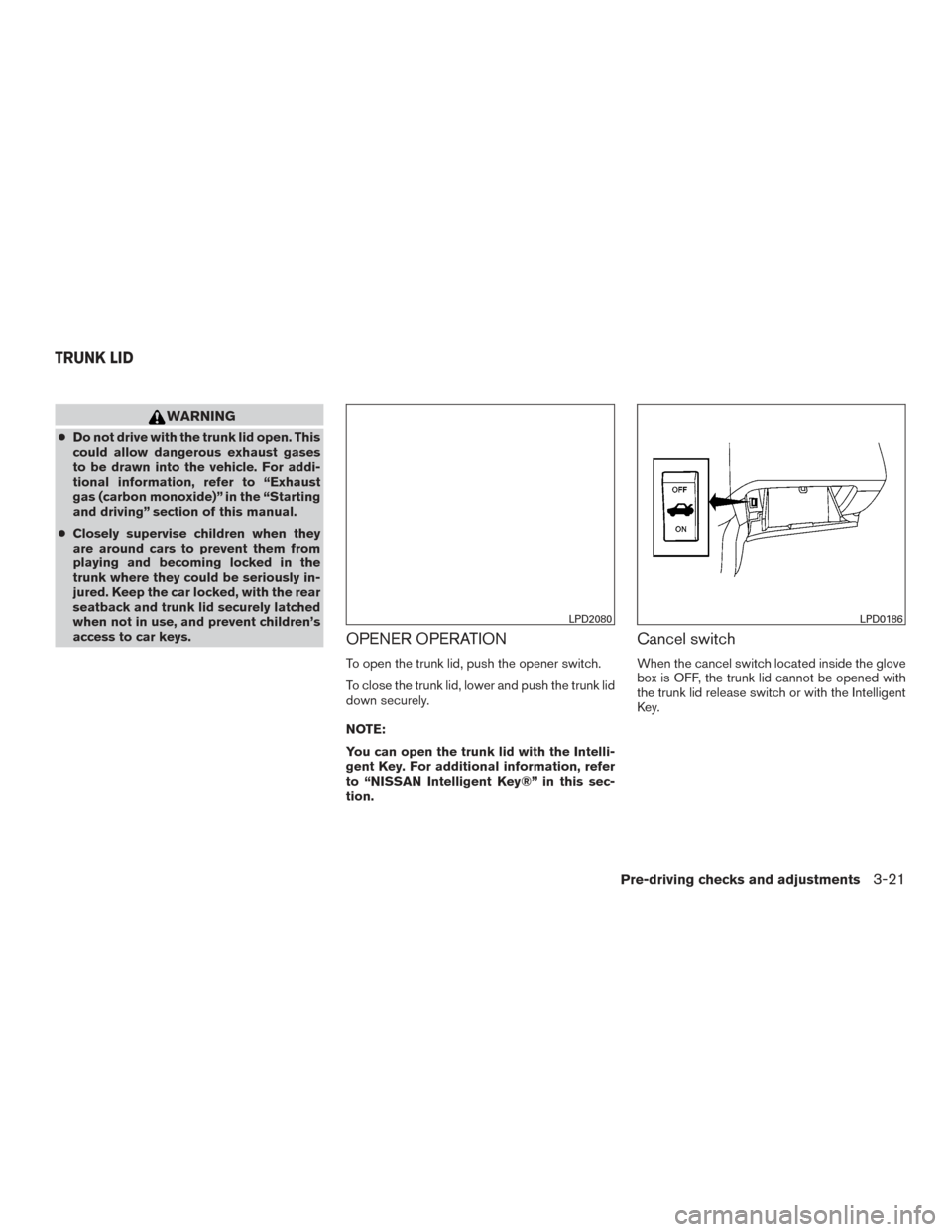
To open the trunk lid, push the opener switch.
To close the trunk lid, lower and push the trunk lid
down securely.
NOTE:
You can open the trunk lid with the Intelli-
gent Key. For additional information, refer
to “NISSAN Intelligent Key®” in this sec-
tion.
Cancel switch
When the cancel switch located inside the glove
box is OFF, the trunk lid cannot be opened with
the trunk lid release switch or with the Intelligent
Key.
LPD2080LPD0186
TRUNK LID
Pre-driving checks and adjustments3-21
Page 163 of 401
INTERIOR TRUNK LID RELEASE
WARNING
Closely supervise children when they are
around cars to prevent them from playing
and becoming locked in the trunk where
they could be seriously injured. Keep the
car locked, with the rear seatback and
trunk lid securely latched when not in use,
and prevent children’s access to car keys.
The interior trunk lid release mechanism provides
a means of escape for children and adults in the
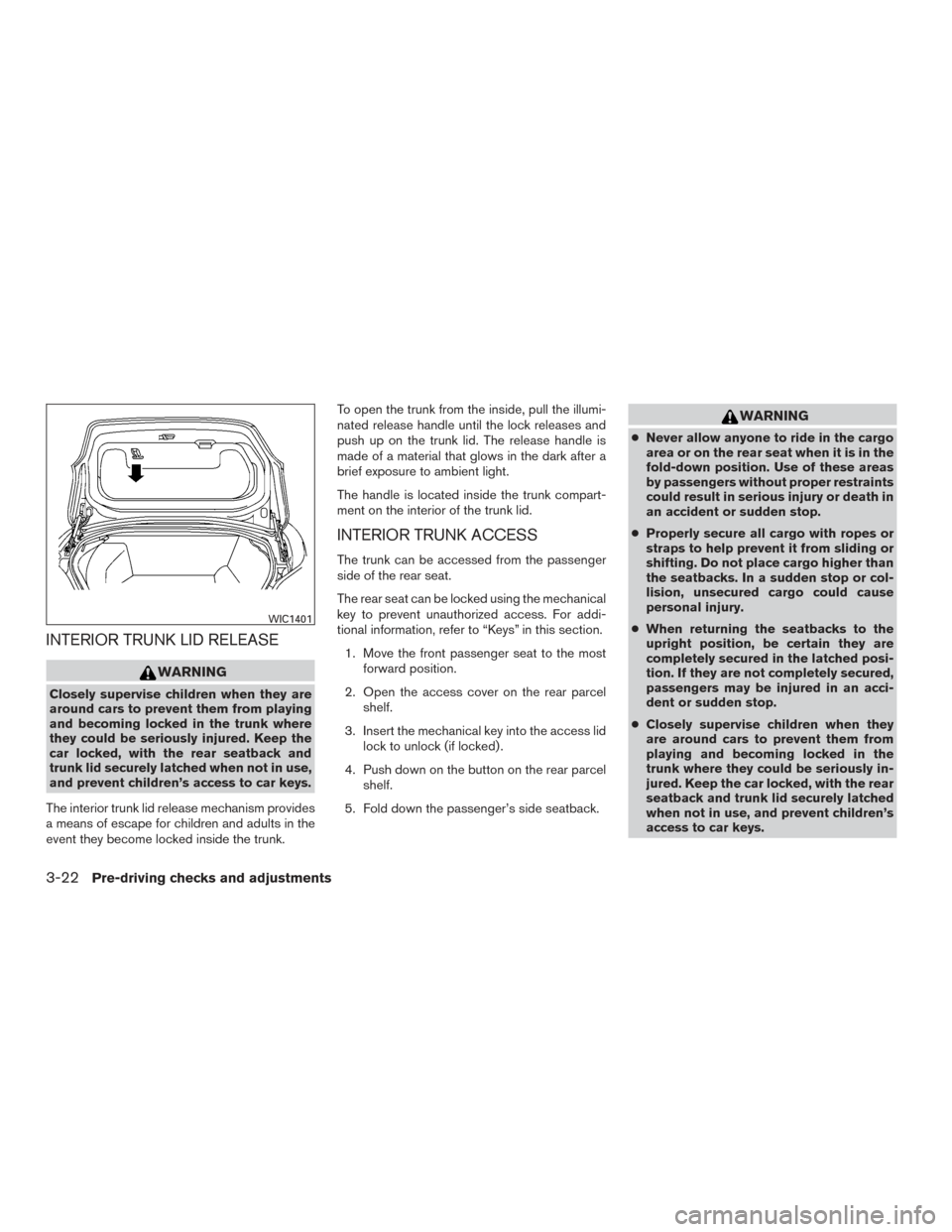
event they become locked inside the trunk. To open the trunk from the inside, pull the illumi-
nated release handle until the lock releases and
push up on the trunk lid. The release handle is
made of a material that glows in the dark after a
brief exposure to ambient light.
The handle is located inside the trunk compart-
ment on the interior of the trunk lid.
INTERIOR TRUNK ACCESS
The trunk can be accessed from the passenger
side of the rear seat.
The rear seat can be locked using the mechanical
key to prevent unauthorized access. For addi-
tional information, refer to “Keys” in this section.
1. Move the front passenger seat to the most forward position.
2. Open the access cover on the rear parcel shelf.
3. Insert the mechanical key into the access lid lock to unlock (if locked) .
4. Push down on the button on the rear parcel shelf.
5. Fold down the passenger’s side seatback.
WARNING
● Never allow anyone to ride in the cargo
area or on the rear seat when it is in the
fold-down position. Use of these areas
by passengers without proper restraints
could result in serious injury or death in
an accident or sudden stop.
● Properly secure all cargo with ropes or
straps to help prevent it from sliding or
shifting. Do not place cargo higher than
the seatbacks. In a sudden stop or col-
lision, unsecured cargo could cause
personal injury.
● When returning the seatbacks to the
upright position, be certain they are
completely secured in the latched posi-
tion. If they are not completely secured,
passengers may be injured in an acci-
dent or sudden stop.
● Closely supervise children when they
are around cars to prevent them from
playing and becoming locked in the
trunk where they could be seriously in-
jured. Keep the car locked, with the rear
seatback and trunk lid securely latched
when not in use, and prevent children’s
access to car keys.
WIC1401
3-22Pre-driving checks and adjustments
Page 380 of 401

Fuel octane rating...............9-6
Fuel recommendation ..........9-2,9-5
Loose fuel cap warning ...........2-24
Fuel Cell Vehicle (FCV) System Tirepressure.................8-31
Fuel-filler door ..................3-23
Fuel gauge .....................2-6
Fuses.......................8-22
Fusible links ...................8-23
G
Garage door opener, HomeLink® Universal
Transceiver .........2-60,2-63,2-63,2-64
Gascap .....................3-23
Gauge Engine coolant temperature gauge .....2-5
Fuel gauge ...................2-6
Odometer ...................2-4
Speedometer .................2-4
Tachometer ..................2-5
Trip odometer .................2-4
General maintenance ...............8-2
Glovebox.....................2-50
Gloveboxlock..................2-50
H
Hazard warning flasher switch ..........6-2
Headlight and turn signal switch ........2-38
Headlightcontrolswitch ............2-38
Headlights....................8-27
Head restraints ..................1-6
Heated seats ...............2-43,2-45 Heated steering wheel
.............2-45
Heater Heater and air conditioner (automatic)
(if so equipped) ...............4-25
Heater and air conditioner controls .....4-26
Heater operation ...............4-27
Heater and air conditioner (automatic) .....4-25
HomeLink® Universal
Transceiver .........2-60,2-63,2-63,2-64
Hood .......................3-20
Horn .......................2-42
I
Ignition Switch Push-Button Ignition Switch ........5-10
Immobilizer system ............2-35,5-13
Important vehicle information label .......9-12
In-cabin microfilter ................8-20
Increasing fuel economy .............5-76
Indicator NISSAN Intelligent Key® battery discharge
indicator ...................5-13
Indicator lights and audible reminders
(See warning/indicator lights and audible
reminders) ..................2-7,2-12
Inside automatic anti-glare mirror ........3-28
Instrument brightness control ..........2-41
Instrument panel ...............0-6,2-2
Instrument panel dimmer switch ........2-41
Intelligent cruise control (ICC) system Brake assist .................5-42
Intelligent Key system Key operating range ..............3-7
Key operation .................3-8 Mechanical key
................3-3
Remote keyless entry operation.......3-11
Troubleshooting guide ............3-16
Warning signals ...............3-16
Interior light ....................2-58
Interior trunk lid release .............3-22
ISOFIX
child restraints .............1-23
J
Jump starting ................6-8,8-17
K
Key.........................3-2
Key fob battery replacement ..........8-25
Keyless entry With Intelligent Key system
(See Intelligent Key system) .........3-11
Keys NISSAN Intelligent Key® ........3-2,3-6
L
Labels Air conditioner specification label .....9-13
C.M.V.S.S. certification label ........9-12
Emission control information label .....9-12
Engine serial number ............9-12
F.M.V.S.S. certification label .........9-12
Tire and Loading Information label .....9-13
Vehicle identification number (VIN) .....9-11
Vehicle identification number (VIN) plate . .9-11
10-3