2016 NISSAN MAXIMA remote control
[x] Cancel search: remote controlPage 200 of 401
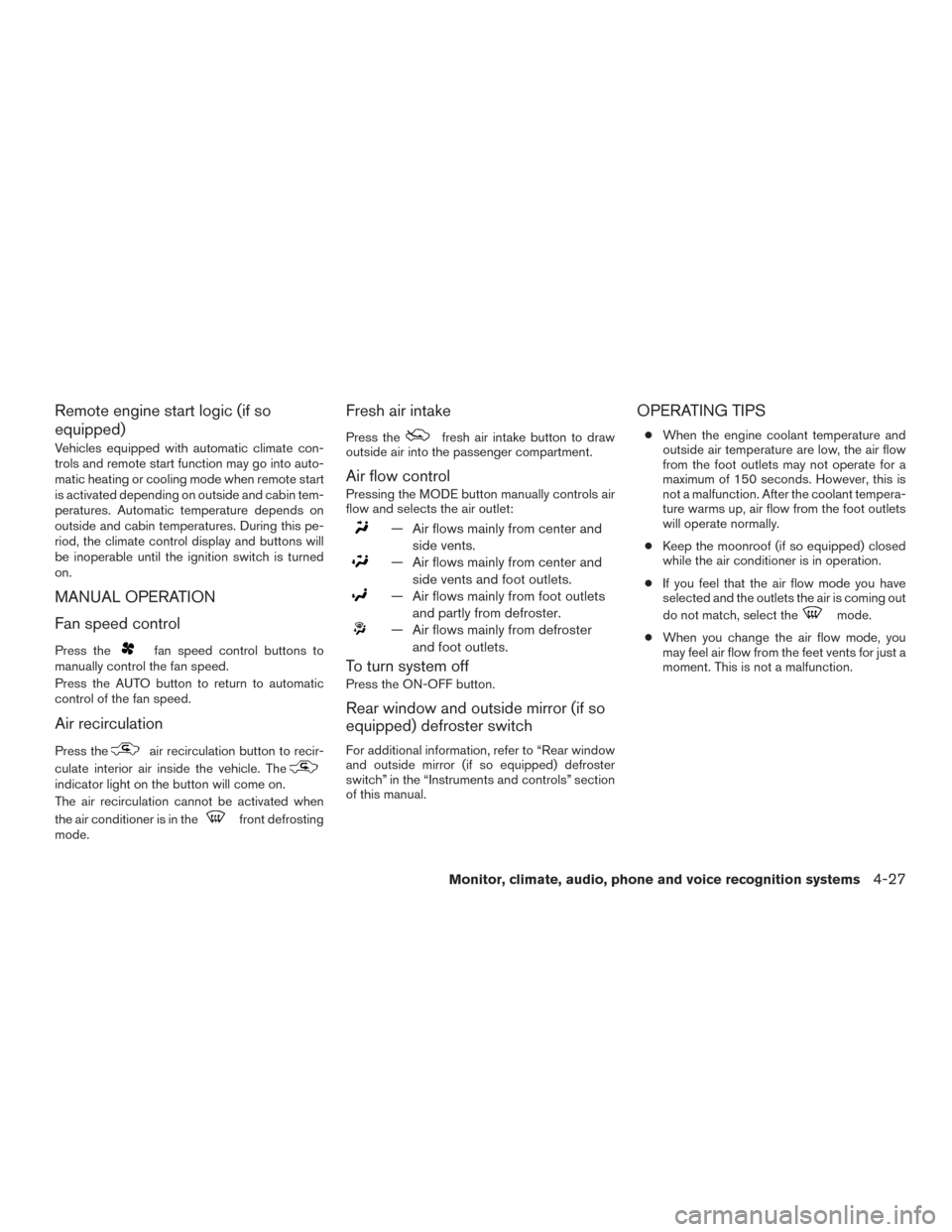
Remote engine start logic (if so
equipped)
Vehicles equipped with automatic climate con-
trols and remote start function may go into auto-
matic heating or cooling mode when remote start
is activated depending on outside and cabin tem-
peratures. Automatic temperature depends on
outside and cabin temperatures. During this pe-
riod, the climate control display and buttons will
be inoperable until the ignition switch is turned
on.
MANUAL OPERATION
Fan speed control
Press thefan speed control buttons to
manually control the fan speed.
Press the AUTO button to return to automatic
control of the fan speed.
Air recirculation
Press theair recirculation button to recir-
culate interior air inside the vehicle. The
indicator light on the button will come on.
The air recirculation cannot be activated when
the air conditioner is in the
front defrosting
mode.
Fresh air intake
Press thefresh air intake button to draw
outside air into the passenger compartment.
Air flow control
Pressing the MODE button manually controls air
flow and selects the air outlet:
— Air flows mainly from center and
side vents.
— Air flows mainly from center andside vents and foot outlets.
— Air flows mainly from foot outletsand partly from defroster.
— Air flows mainly from defrosterand foot outlets.
To turn system off
Press the ON-OFF button.
Rear window and outside mirror (if so
equipped) defroster switch
For additional information, refer to “Rear window
and outside mirror (if so equipped) defroster
switch” in the “Instruments and controls” section
of this manual.
OPERATING TIPS
●When the engine coolant temperature and
outside air temperature are low, the air flow
from the foot outlets may not operate for a
maximum of 150 seconds. However, this is
not a malfunction. After the coolant tempera-
ture warms up, air flow from the foot outlets
will operate normally.
● Keep the moonroof (if so equipped) closed
while the air conditioner is in operation.
● If you feel that the air flow mode you have
selected and the outlets the air is coming out
do not match, select the
mode.
● When you change the air flow mode, you
may feel air flow from the feet vents for just a
moment. This is not a malfunction.
Monitor, climate, audio, phone and voice recognition systems4-27
Page 204 of 401
5 Starting and driving
Precautions when starting and driving................5-4
Exhaust gas (carbon monoxide) ..................5-4
Three-way catalyst ..............................5-4
Tire Pressure Monitoring System (TPMS) ..........5-5
Avoiding collision and rollover . . ..................5-8
Off-road recovery ...............................5-8
Rapid air pressure loss ..........................5-9
Drinking alcohol/drugs and driving ................5-9
Push-Button Ignition Switch .......................5-10
Operating range ............................... 5-11
Push-button ignition switch positions . . . .........5-11
Emergency engine shut off .....................5-12
NISSAN Intelligent Key® battery discharge .......5-13
NISSAN Vehicle Immobilizer System .............5-13
Before starting the engine ......................... 5-14
Starting the engine ............................... 5-14
Remote start .................................. 5-15
Driving the vehicle ................................ 5-15
Continuously Variable Transmission (CVT) ........5-15
Parking brake .................................... 5-21
Drive mode selector .............................. 5-22
Normal mode ................................. 5-22
Sport mode ................................... 5-22Blind Spot Warning (BSW) (if so equipped)
.........5-22
BSW system operation ........................ 5-24
How to enable/disable the BSW system .........5-25
BSW system limitations ........................ 5-26
BSW driving situations ......................... 5-27
System temporarily unavailable ..................5-30
System maintenance ........................... 5-31
Rear Cross Traffic Alert (RCTA) (if so equipped) .....5-32
RCTA system operation ........................ 5-33
How to enable/disable the RCTA system .........5-35
RCTA system limitations ........................ 5-36
System temporarily unavailable ..................5-39
System maintenance ........................... 5-39
Cruise control (if so equipped) . . ...................5-40
Precautions
on cruise control ................... 5-40
Cruise control operations .......................5-41
Intelligent Cruise Control (ICC) (if so equipped) ......5-42
ICC system operation .......................... 5-43
The ICC switch ............................... 5-45
ICC system limitations ......................... 5-50
System temporarily unavailable ..................5-53
System maintenance ........................... 5-55
Forward Emergency Braking (FEB) (if so equipped) . . 5-56
Page 218 of 401
NOTE:
Care should be taken to avoid situations
that can lead to potential battery discharge
and potential no-start conditions such as:1. Installation or extended use of electronic accessories that consume battery power
when the engine is not running (Phone char-
gers, GPS, DVD players, etc.)
2. Vehicle is not driven regularly and/or only driven short distances. In these cases, the
battery may need to be charged to maintain
battery health.
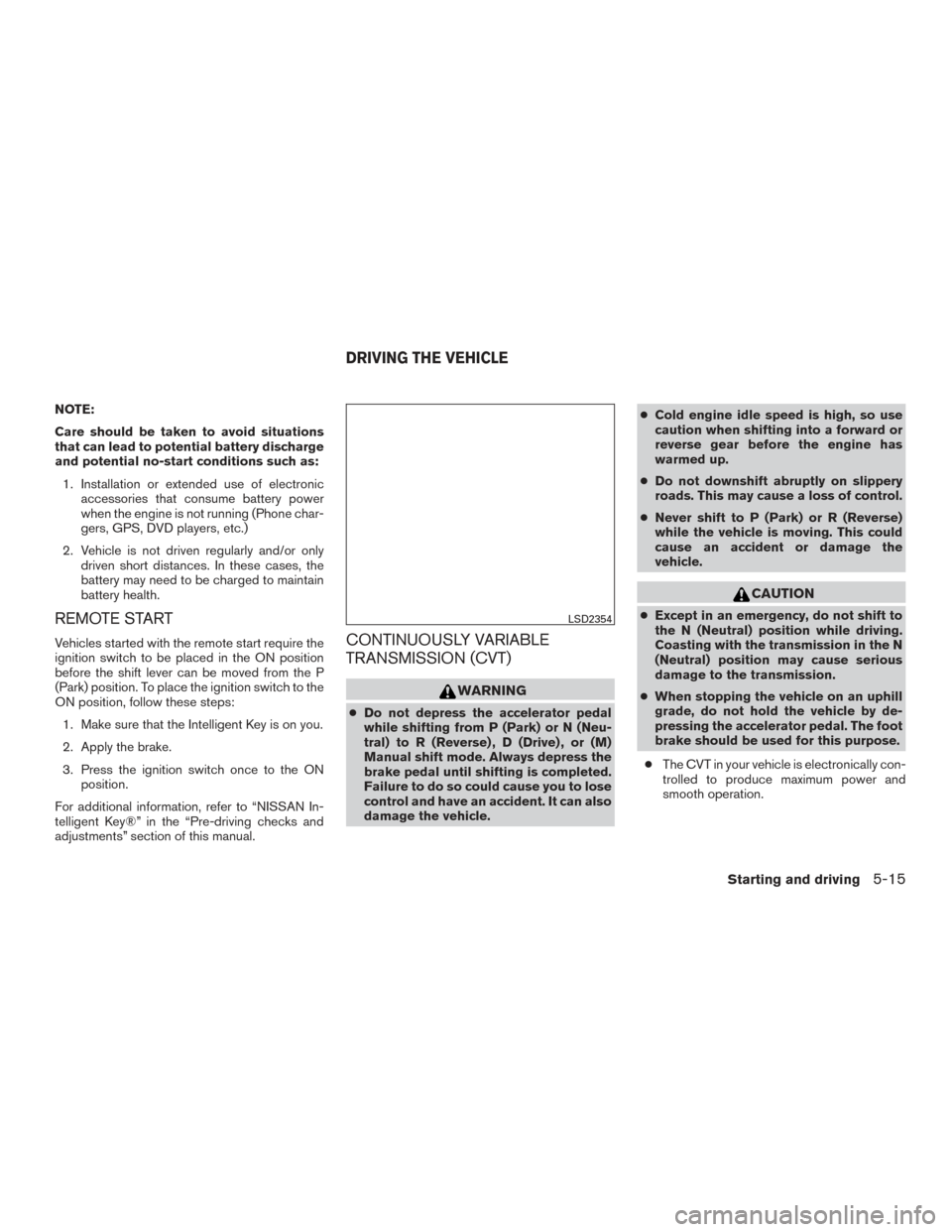
REMOTE START
Vehicles started with the remote start require the
ignition switch to be placed in the ON position
before the shift lever can be moved from the P
(Park) position. To place the ignition switch to the
ON position, follow these steps:
1. Make sure that the Intelligent Key is on you.
2. Apply the brake.
3. Press the ignition switch once to the ON position.
For additional information, refer to “NISSAN In-
telligent Key®” in the “Pre-driving checks and
adjustments” section of this manual.CONTINUOUSLY VARIABLE
TRANSMISSION (CVT)
WARNING
● Do not depress the accelerator pedal
while shifting from P (Park) or N (Neu-
tral) to R (Reverse) , D (Drive) , or (M)
Manual shift mode. Always depress the
brake pedal until shifting is completed.
Failure to do so could cause you to lose
control and have an accident. It can also
damage the vehicle. ●
Cold engine idle speed is high, so use
caution when shifting into a forward or
reverse gear before the engine has
warmed up.
● Do not downshift abruptly on slippery
roads. This may cause a loss of control.
● Never shift to P (Park) or R (Reverse)
while the vehicle is moving. This could
cause an accident or damage the
vehicle.
CAUTION
● Except in an emergency, do not shift to
the N (Neutral) position while driving.
Coasting with the transmission in the N
(Neutral) position may cause serious
damage to the transmission.
● When stopping the vehicle on an uphill
grade, do not hold the vehicle by de-
pressing the accelerator pedal. The foot
brake should be used for this purpose.
● The CVT in your vehicle is electronically con-
trolled to produce maximum power and
smooth operation.LSD2354
DRIVING THE VEHICLE
Starting and driving5-15
Page 380 of 401

Fuel octane rating...............9-6
Fuel recommendation ..........9-2,9-5
Loose fuel cap warning ...........2-24
Fuel Cell Vehicle (FCV) System Tirepressure.................8-31
Fuel-filler door ..................3-23
Fuel gauge .....................2-6
Fuses.......................8-22
Fusible links ...................8-23
G
Garage door opener, HomeLink® Universal
Transceiver .........2-60,2-63,2-63,2-64
Gascap .....................3-23
Gauge Engine coolant temperature gauge .....2-5
Fuel gauge ...................2-6
Odometer ...................2-4
Speedometer .................2-4
Tachometer ..................2-5
Trip odometer .................2-4
General maintenance ...............8-2
Glovebox.....................2-50
Gloveboxlock..................2-50
H
Hazard warning flasher switch ..........6-2
Headlight and turn signal switch ........2-38
Headlightcontrolswitch ............2-38
Headlights....................8-27
Head restraints ..................1-6
Heated seats ...............2-43,2-45 Heated steering wheel
.............2-45
Heater Heater and air conditioner (automatic)
(if so equipped) ...............4-25
Heater and air conditioner controls .....4-26
Heater operation ...............4-27
Heater and air conditioner (automatic) .....4-25
HomeLink® Universal
Transceiver .........2-60,2-63,2-63,2-64
Hood .......................3-20
Horn .......................2-42
I
Ignition Switch Push-Button Ignition Switch ........5-10
Immobilizer system ............2-35,5-13
Important vehicle information label .......9-12
In-cabin microfilter ................8-20
Increasing fuel economy .............5-76
Indicator NISSAN Intelligent Key® battery discharge
indicator ...................5-13
Indicator lights and audible reminders
(See warning/indicator lights and audible
reminders) ..................2-7,2-12
Inside automatic anti-glare mirror ........3-28
Instrument brightness control ..........2-41
Instrument panel ...............0-6,2-2
Instrument panel dimmer switch ........2-41
Intelligent cruise control (ICC) system Brake assist .................5-42
Intelligent Key system Key operating range ..............3-7
Key operation .................3-8 Mechanical key
................3-3
Remote keyless entry operation.......3-11
Troubleshooting guide ............3-16
Warning signals ...............3-16
Interior light ....................2-58
Interior trunk lid release .............3-22
ISOFIX
child restraints .............1-23
J
Jump starting ................6-8,8-17
K
Key.........................3-2
Key fob battery replacement ..........8-25
Keyless entry With Intelligent Key system
(See Intelligent Key system) .........3-11
Keys NISSAN Intelligent Key® ........3-2,3-6
L
Labels Air conditioner specification label .....9-13
C.M.V.S.S. certification label ........9-12
Emission control information label .....9-12
Engine serial number ............9-12
F.M.V.S.S. certification label .........9-12
Tire and Loading Information label .....9-13
Vehicle identification number (VIN) .....9-11
Vehicle identification number (VIN) plate . .9-11
10-3
Page 382 of 401
Parking/parking on hills...........5-77
Parking brake ...................5-21
Personallights..................2-59
Power Power door locks ...............3-5
Power outlet .................2-46
Power rear windows .............2-53
Power steering fluid .............8-14
Power steering system ...........5-78
Rear power windows ............2-53
Power outlet ...................2-46
Power steering ..................5-78
Power steering fluid ...............8-14
Precautions Maintenance precautions ...........8-5
Precautions on booster
seats...........1-21,1-27,1-33,1-37
Precautions on child
restraints .........1-21,1-27,1-33,1-37
Precautionsonseatbeltusage.......1-11
Precautions on supplemental restraint
system ....................1-40
Precautions when starting and driving ....5-4
Push starting ...................6-10
R
Radio Car phone or CB radio ...........4-29
Rainsensor....................2-37
Readiness for inspection maintenance (I/M)
test........................9-21
Rear Cross Traffic Alert (RCTA) ........5-32
Rear power windows ..............2-53
Rearseat......................1-5 Rear sun shade
.................2-57
RearView Monitor .................4-2
Recommended Fluids ...............9-2
Recorders Eventdata..................9-21
Refrigerant recommendation ........9-2,9-8
Registering a vehicle in another country ....9-11
Remote Start ...............3-18,5-15
Reporting safety defects (US only) .......9-20
S
Safety Child safety rear door lock ..........3-6
Child seat belts .....1-21,1-27,1-33,1-37
Reporting safety defects (US only) .....9-20
Seat adjustment Front power seat adjustment .........1-3
Seatback pockets ................2-47
Seat belt Child safety ..................1-18
Infantsandsmallchildren..........1-19
Injured Person ................1-14
Largerchildren................1-19
Precautions on seat belt usage .......1-11
Pregnant women ...............1-14
Seatbeltextenders .............1-17
Seat belt maintenance ............1-18
Seatbelts................1-11,7-7
Shoulder belt height adjustment ......1-17
Three-point type with retractor .......1-14
Seatbeltextenders ...............1-17
Seat belt warning light ..........1-14,2-11
Seats Adjustment...................1-2 Armrests....................1-6
Automatic drive positioner. . .3-30, 3-31, 3-31
Frontseats...................1-2
Heatedseats.............2-43,2-45
Rearseat....................1-5
Seats/floor mats ..................7-6
Security indicator light ..............2-13
Security system (NISSAN Vehicle Immobilizer
System) , engine start ...........2-35,5-13
Security systems Vehicle security system ...........2-34
Self-adjusting brakes ..............
8-22
Service manual order form ...........9-22
Servicing air conditioner .............4-28
Shifting Continuously Variable Transmission
(CVT) .....................5-17
Shoulder belt height adjustment ........1-17
Sparkplugreplacement.............8-19
Sparkplugs ...................8-19
Specifications ...................9-9
Speedometer ...................2-4
Speedometer and odometer ...........2-4
Spotlights (See map light) ...........2-60
SRSwarninglabel................1-57
Stability control .................5-80
Starting Before starting the engine ..........5-14
Jump starting ..............6-8,8-17
Precautions when starting and driving ....5-4
Push starting .................6-10
Starting the engine .............5-14
Starting the engine ...............5-14
Steering Heated steering wheel ...........2-45
Power steering fluid .............8-14
10-5