2016 NISSAN MAXIMA fuel cap
[x] Cancel search: fuel capPage 279 of 401
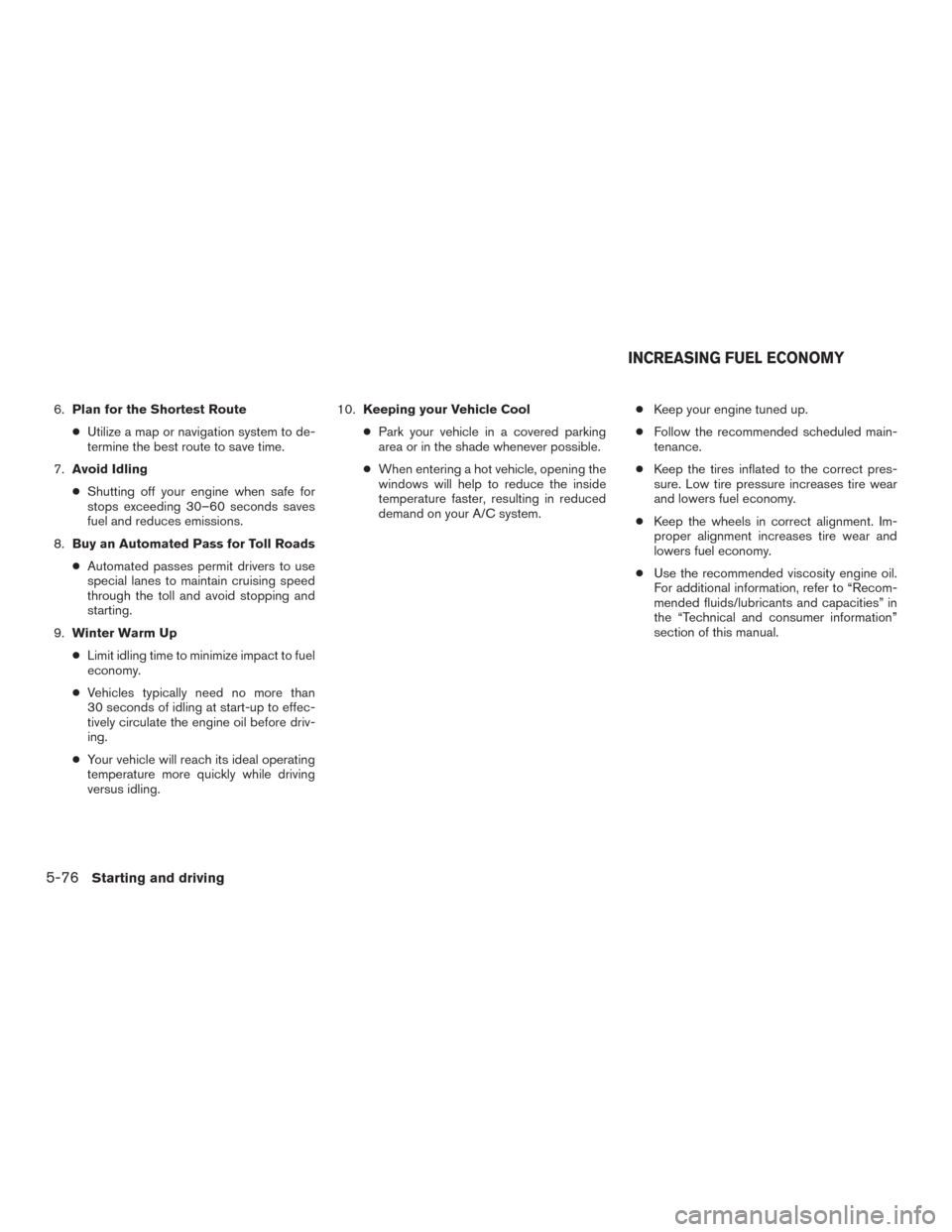
6.Plan for the Shortest Route
● Utilize a map or navigation system to de-
termine the best route to save time.
7. Avoid Idling
● Shutting off your engine when safe for
stops exceeding 30–60 seconds saves
fuel and reduces emissions.
8. Buy an Automated Pass for Toll Roads
● Automated passes permit drivers to use
special lanes to maintain cruising speed
through the toll and avoid stopping and
starting.
9. Winter Warm Up
● Limit idling time to minimize impact to fuel
economy.
● Vehicles typically need no more than
30 seconds of idling at start-up to effec-
tively circulate the engine oil before driv-
ing.
● Your vehicle will reach its ideal operating
temperature more quickly while driving
versus idling. 10.
Keeping your Vehicle Cool
● Park your vehicle in a covered parking
area or in the shade whenever possible.
● When entering a hot vehicle, opening the
windows will help to reduce the inside
temperature faster, resulting in reduced
demand on your A/C system. ●
Keep your engine tuned up.
● Follow the recommended scheduled main-
tenance.
● Keep the tires inflated to the correct pres-
sure. Low tire pressure increases tire wear
and lowers fuel economy.
● Keep the wheels in correct alignment. Im-
proper alignment increases tire wear and
lowers fuel economy.
● Use the recommended viscosity engine oil.
For additional information, refer to “Recom-
mended fluids/lubricants and capacities” in
the “Technical and consumer information”
section of this manual.
INCREASING FUEL ECONOMY
5-76Starting and driving
Page 318 of 401
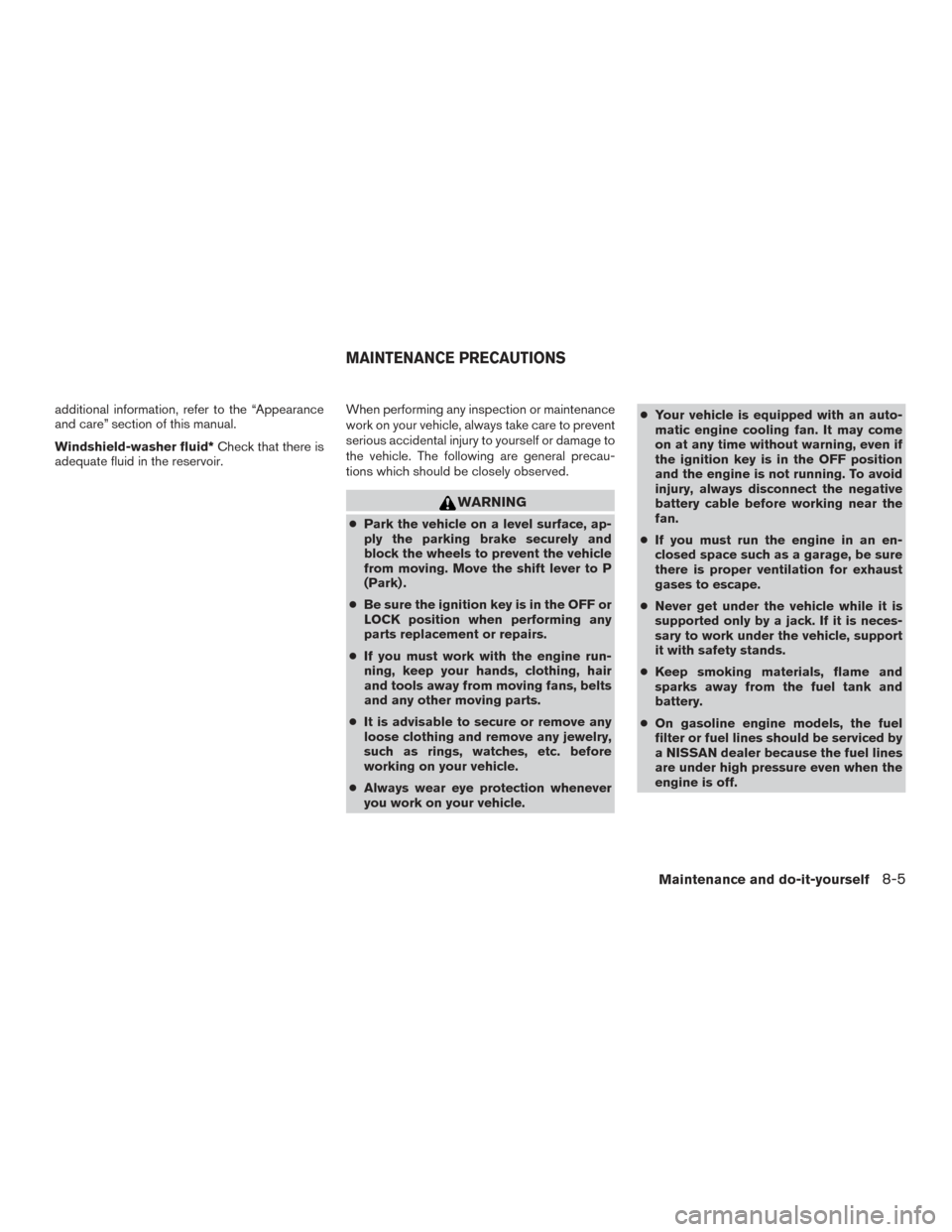
additional information, refer to the “Appearance
and care” section of this manual.
Windshield-washer fluid*Check that there is
adequate fluid in the reservoir. When performing any inspection or maintenance
work on your vehicle, always take care to prevent
serious accidental injury to yourself or damage to
the vehicle. The following are general precau-
tions which should be closely observed.
WARNING
●
Park the vehicle on a level surface, ap-
ply the parking brake securely and
block the wheels to prevent the vehicle
from moving. Move the shift lever to P
(Park) .
● Be sure the ignition key is in the OFF or
LOCK position when performing any
parts replacement or repairs.
● If you must work with the engine run-
ning, keep your hands, clothing, hair
and tools away from moving fans, belts
and any other moving parts.
● It is advisable to secure or remove any
loose clothing and remove any jewelry,
such as rings, watches, etc. before
working on your vehicle.
● Always wear eye protection whenever
you work on your vehicle. ●
Your vehicle is equipped with an auto-
matic engine cooling fan. It may come
on at any time without warning, even if
the ignition key is in the OFF position
and the engine is not running. To avoid
injury, always disconnect the negative
battery cable before working near the
fan.
● If you must run the engine in an en-
closed space such as a garage, be sure
there is proper ventilation for exhaust
gases to escape.
● Never get under the vehicle while it is
supported only by a jack. If it is neces-
sary to work under the vehicle, support
it with safety stands.
● Keep smoking materials, flame and
sparks away from the fuel tank and
battery.
● On gasoline engine models, the fuel
filter or fuel lines should be serviced by
a NISSAN dealer because the fuel lines
are under high pressure even when the
engine is off.
MAINTENANCE PRECAUTIONS
Maintenance and do-it-yourself8-5
Page 356 of 401
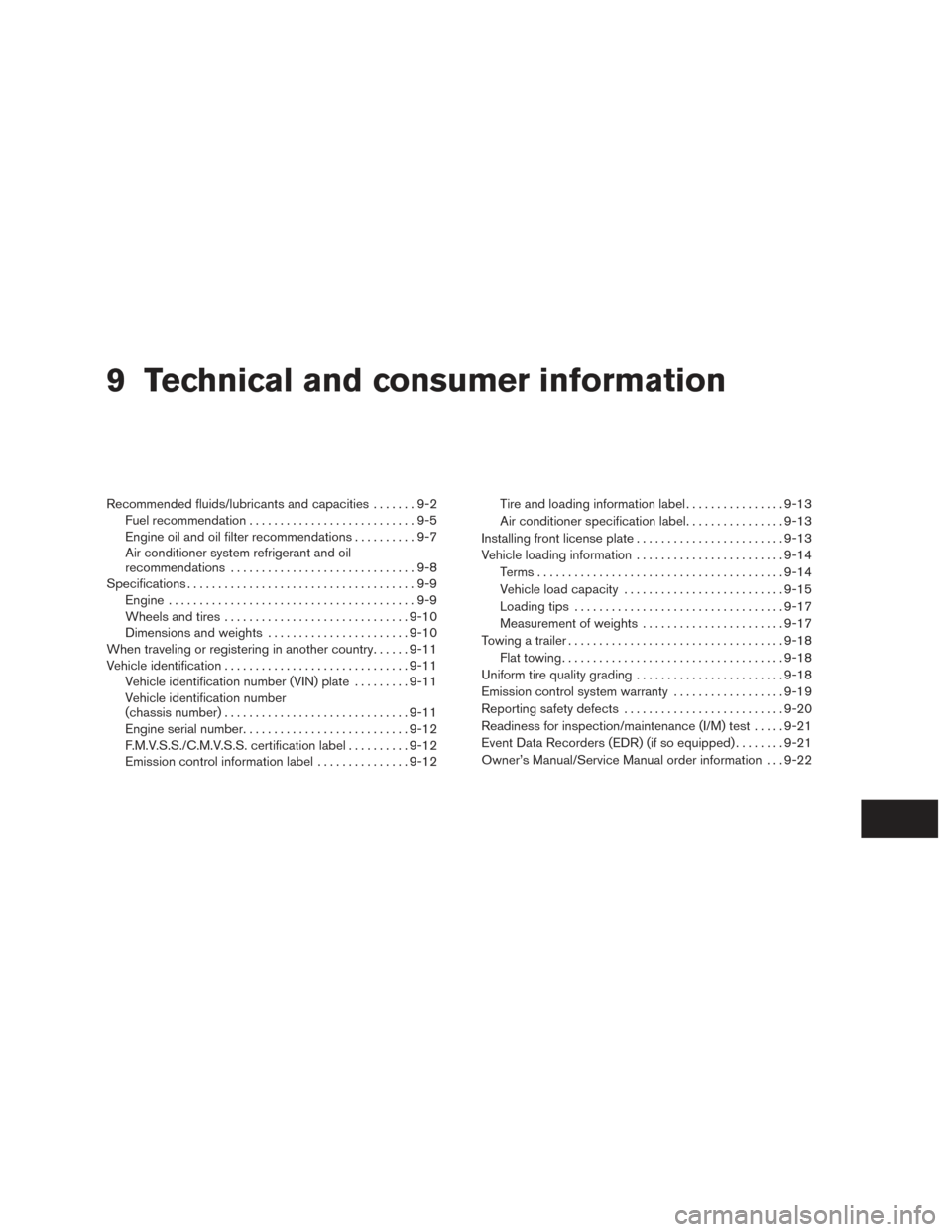
9 Technical and consumer information
Recommended fluids/lubricants and capacities.......9-2
Fuel recommendation ...........................9-5
Engine oil and oil filter recommendations ..........9-7
Air conditioner system refrigerant and oil
recommendations ..............................9-8
Specifications .....................................9-9
Engine ........................................9-9
Wheels and tires .............................. 9-10
Dimensions and weights .......................9-10
When traveling or registering in another country ......9-11
Vehicle identification .............................. 9-11
Vehicle identification number (VIN) plate .........9-11
Vehicle identification number
(chassis number) .............................. 9-11
Engine serial number ........................... 9-12
F.M.V.S.S./C.M.V.S.S. certification label ..........9-12
Emission control information label ...............9-12Tire and loading information label
................9-13
Air conditioner specification label ................9-13
Installing front license plate ........................9-13
Vehicle loading information ........................9-14
Terms ........................................ 9-14
Vehicle load capacity .......................... 9-15
Loading tips .................................. 9-17
Measurement of weights .......................9-17
Towing a trailer ................................... 9-18
Flat towing .................................... 9-18
Uniform tire quality grading ........................9-18
Emission control system warranty ..................9-19
Reporting safety defects .......................... 9-20
Readiness for inspection/maintenance (I/M) test .....9-21
Event Data Recorders (EDR) (if so equipped) ........9-21
Owner’s Manual/Service Manual order information . . . 9-22
Page 357 of 401
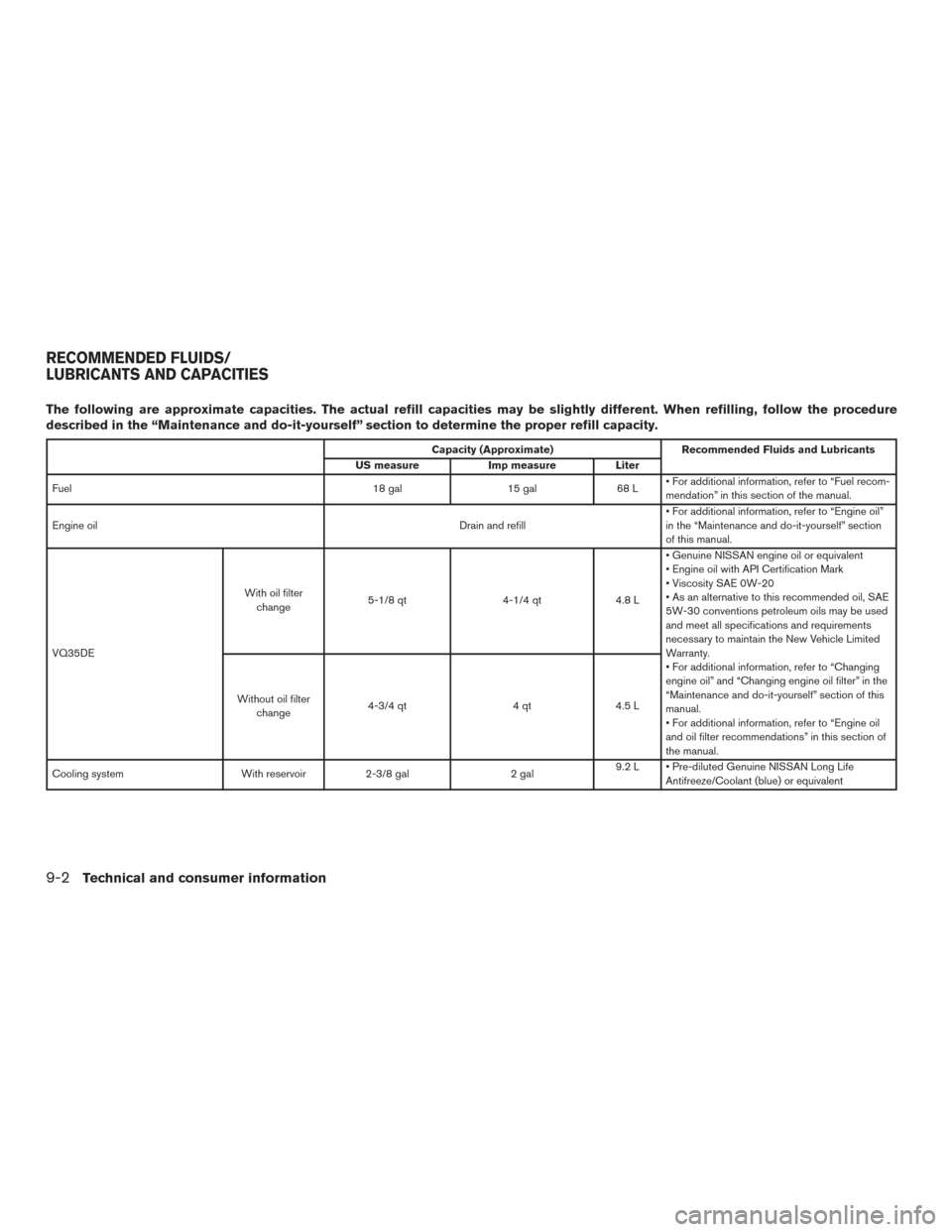
The following are approximate capacities. The actual refill capacities may be slightly different. When refilling, follow the procedure
described in the “Maintenance and do-it-yourself” section to determine the proper refill capacity.
Capacity (Approximate)Recommended Fluids and Lubricants
US measure Imp measureLiter
Fuel 18 gal15 gal68 L• For additional information, refer to “Fuel recom-
mendation” in this section of the manual.
Engine oil Drain and refill• For additional information, refer to “Engine oil”
in the “Maintenance and do-it-yourself” section
of this manual.
VQ35DE With oil filter
change 5-1/8 qt
4-1/4 qt4.8 L• Genuine NISSAN engine oil or equivalent
• Engine oil with API Certification Mark
• Viscosity SAE 0W-20
• As an alternative to this recommended oil, SAE
5W-30 conventions petroleum oils may be used
and meet all specifications and requirements
necessary to maintain the New Vehicle Limited
Warranty.
• For additional information, refer to “Changing
engine oil” and “Changing engine oil filter” in the
“Maintenance and do-it-yourself” section of this
manual.
• For additional information, refer to “Engine oil
and oil filter recommendations” in this section of
the manual.
Without oil filter
change 4-3/4 qt
4 qt4.5 L
Cooling system With reservoir2-3/8 gal 2 gal9.2 L • Pre-diluted Genuine NISSAN Long Life
Antifreeze/Coolant (blue) or equivalent
RECOMMENDED FLUIDS/
LUBRICANTS AND CAPACITIES
9-2Technical and consumer information
Page 362 of 401
ENGINE OIL AND OIL FILTER
RECOMMENDATIONS
Selecting the correct oil
It is essential to choose the correct grade, quality
and viscosity engine oil to ensure satisfactory
engine life and performance. For additional infor-
mation, refer to “Recommended fluids/lubricants
and capacities” in this section. NISSAN recom-
mends the use of an energy conserving oil in
order to improve fuel economy.
Select only engine oils that meet the American
Petroleum Institute (API) certification or Interna-
tional Lubricant Standardization and ApprovalCommittee (ILSAC) certification and SAE vis-
cosity standard. These oils have the API certifica-
tion mark on the front of the container. Oils which
do not have the specified quality label should not
be used as they could cause engine damage.Oil additives
NISSAN does not recommend the use of oil
additives. The use of an oil additive is not neces-
sary when the proper oil type is used and main-
tenance intervals are followed.
Oil which may contain foreign matter or has been
previously used should not be used.
Oil viscosity
The engine oil viscosity or thickness changes
with temperature. Because of this, it is important
to select the engine oil viscosity based on the
temperatures at which the vehicle will be oper-
ated before the next oil change. Choosing an oil
viscosity other than that recommended could
cause serious engine damage.
Selecting the correct oil filter
Your new NISSAN vehicle is equipped with a
high-quality Genuine NISSAN oil filter. When
replacing, use a Genuine NISSAN oil filter or its
equivalent for the reason described in “Change
intervals.”
Change intervals
The oil and oil filter change intervals for your
engine are based on the use of the specified
quality oils and filters. Using engine oil and filters
that are not of the specified quality, or exceeding
recommended oil and filter change intervals
could reduce engine life. Damage to the engine
caused by improper maintenance or use of incor-
rect oil and filter quality and/or viscosity is not
covered by the NISSAN new vehicle limited war-
ranty.
LTI2051
Technical and consumer information9-7
Page 378 of 401
10 Index
A
Air bag (See supplemental restraint
system) .....................1-40
Air bag system Front (See supplemental front impact
air bag system) ...............1-47
Airbagwarninglight...........1-57,2-11
Air bag warning light, supplemental . .1-57, 2-11
AirCleaner ...................8-20
Air cleaner housing filter ............8-20
Air conditioner Air conditioner service ...........4-28
Air conditioner specification label .....9-13
Air conditioner system refrigerant and
oil recommendations ..........9-2,9-8
Air conditioner system refrigerant
recommendations ............9-2,9-8
Heater and air conditioner (automatic)
(if so equipped) ...............4-25
Heater and air conditioner controls ....4-26
Servicing air conditioner ..........4-28
Alarm system
(See vehicle security system) .........2-34
Anchor point locations .............1-25
Antenna .....................4-28
Antifreeze ....................5-86
Anti-lock brake warning light ..........2-7
Anti-lock Braking System (ABS) ........5-79
Armrests .....................1-6
Around View® Monitor .............4-9
Audible reminders ...............2-14 Audio system
..................4-28
Radio ....................4-28
Autolight switch .................2-39
Automatic Automatic drive positioner . .3-30, 3-31, 3-31
Automatic power window switch .....2-53
Automatic anti-glare inside mirror .......3-28
Automatic door locks ..............3-5
Automatic drive positioner ....3-30,3-31,3-31
B
Battery ..................5-86,8-16
Chargewarninglight.............2-8
Battery replacement Keyfob ...................8-25
NISSAN Intelligent Key® ..........8-25
Before starting the engine ...........5-14
Belt (See drive belt) ..............8-18
Blind Spot Warning (BSW) warning
system ......................5-22
Block heater Engine ....................5-87
Bluetooth® Hands-Free Phone System with
NavigationSystem...............4-29
Boosterseats..................1-37
Brake Anti-lock Braking System (ABS) ......5-79
Brake assist (for Intelligent cruise control
system) ...................5-80
Brake fluid ..................8-14
Brake light (See stop light) .........8-28 Brake system
................5-78
Brakewarninglight..............2-8
Brakewearindicators........2-14,8-22
Parking brake operation ..........5-21
Self-adjusting brakes ............8-22
Brake fluid ....................8-14
Brakes ......................8-22
Brake system ..................5-78
Break-inschedule ...............5-75
Brightness control Instrument panel ..............2-41
Bulb check/instrument panel ..........2-7
Bulbreplacement................8-28
C
Capacities and recommended
fuel/lubricants .................. .9-2
Cargo
(See vehicle loading information) . . .9-14
Car phone or CB radio .............4-29
Check tire pressure ...............2-25
Child restraints .......1-18,1-19,1-21,1-23
LATCH (Lower Anchors and Tethers for
CHildren) System ..............1-23
Precautions on child
restraints ........1-21,1-27,1-33,1-37
Top tether strap anchor point locations . .1-25
Child safety rear door lock ............3-6
Chimes, audible reminders ...........2-14
Cleaning exterior and interior .......7-2,7-4
Climate control seat switch ..........2-44
C.M.V.S.S. certification label ..........9-12
Page 379 of 401
Cold weather driving...............5-86
Consolebox...................2-51
Consolelight...................2-59
Continuously Variable Transmission (CVT) . . .5-15 Continuously Variable Transmission (CVT)
fluid ......................8-13
Driving with Continuously Variable
Transmission (CVT) .............5-15
Transmission shift selector lock release . .5-19
Controls Heater and air conditioner controls .....4-26
Coolant Capacities and recommended
fuel/lubricants .................9-2
Changing engine coolant ...........8-9
Checking engine coolant level ........8-9
Engine coolant temperature gauge .....2-5
Corrosionprotection ...............7-7
Cruisecontrol..................5-40
Cupholders...................2-49
D
Daytime Running Light System .........2-40
Defogger Switch .................2-38
Dimensionsandweights ............9-10
Dimmer switch for instrument panel ......2-41
Door locks .....................3-4
Doors ........................3-3
Drive belt .....................8-18
Drive Mode Selector ...............5-22
Drive positioner, Automatic ....3-30,3-31,3-31
Drive Sport Mode Selector ...........5-22
Driving Cold weather driving .............5-86 Driving with Continuously Variable
Transmission (CVT)
.............5-15
Precautions when starting and driving ....5-4
Driving the vehicle ................5-15
E
Economy - fuel ..................5-76
Emergency engine shutoff ............5-12
Emission control information label .......9-12
Emission control system warranty .......9-19
Engine Before starting the engine ..........5-14
Block heater .................5-87
Capacities and recommended
fuel/lubricants .................9-2
Changingenginecoolant...........8-9
Changingengineoil.............8-11
Changing engine oil filter ..........8-12
Checking engine coolant level ........8-9
Checking engine oil level ..........8-10
Engine compartment check locations ....8-7
Engine coolant temperature gauge .....2-5
Engine cooling system ............8-8
Engineoil...................8-10
Engine oil and oil filter
recommendation .............9-2,9-7
Engine oil pressure warning light .......2-8
Engine oil viscosity ..............9-7
Engine serial number ............9-12
Engine specifications .............9-9
Starting the engine .............5-14
Engine coolant temperature gauge .......2-5
Eventdatarecorders ..............9-21
Exhaust gas (Carbon monoxide) .........5-4Explanation of maintenance items
........8-2
Extended storage switch ............2-46
Eyeglass case ..................2-48
F
Flashers (See hazard warning flasher switch) . .6-2
Flat
tire.......................6-3
Floor mat positioning aid .............7-6
Fluid Brake fluid ..................8-14
Capacities and recommended
fuel/lubricants.................9-2
Continuously Variable Transmission (CVT)
fluid......................8-13
Enginecoolant.................8-8
Engineoil...................8-10
Power steering fluid .............8-14
Windshield-washer fluid ...........8-15
F.M.V.S.S. certification label ...........9-12
Foglightswitch .................2-42
Foldingrearseat..................1-5
Forward Emergency Braking (FEB) .......2-9
Front air bag system
(See supplemental restraint system) ......1-47
Front and rear sonar system ..........5-84
Front power seat adjustment ...........1-3
Frontseats.....................1-2
Fuel Capacities and recommended
fuel/lubricants.................9-2
Fuel economy ................5-76
Fuel-filler cap .................3-23
Fuel-filler lid .................3-23
Fuelgauge...................2-6
10-2
Page 380 of 401

Fuel octane rating...............9-6
Fuel recommendation ..........9-2,9-5
Loose fuel cap warning ...........2-24
Fuel Cell Vehicle (FCV) System Tirepressure.................8-31
Fuel-filler door ..................3-23
Fuel gauge .....................2-6
Fuses.......................8-22
Fusible links ...................8-23
G
Garage door opener, HomeLink® Universal
Transceiver .........2-60,2-63,2-63,2-64
Gascap .....................3-23
Gauge Engine coolant temperature gauge .....2-5
Fuel gauge ...................2-6
Odometer ...................2-4
Speedometer .................2-4
Tachometer ..................2-5
Trip odometer .................2-4
General maintenance ...............8-2
Glovebox.....................2-50
Gloveboxlock..................2-50
H
Hazard warning flasher switch ..........6-2
Headlight and turn signal switch ........2-38
Headlightcontrolswitch ............2-38
Headlights....................8-27
Head restraints ..................1-6
Heated seats ...............2-43,2-45 Heated steering wheel
.............2-45
Heater Heater and air conditioner (automatic)
(if so equipped) ...............4-25
Heater and air conditioner controls .....4-26
Heater operation ...............4-27
Heater and air conditioner (automatic) .....4-25
HomeLink® Universal
Transceiver .........2-60,2-63,2-63,2-64
Hood .......................3-20
Horn .......................2-42
I
Ignition Switch Push-Button Ignition Switch ........5-10
Immobilizer system ............2-35,5-13
Important vehicle information label .......9-12
In-cabin microfilter ................8-20
Increasing fuel economy .............5-76
Indicator NISSAN Intelligent Key® battery discharge
indicator ...................5-13
Indicator lights and audible reminders
(See warning/indicator lights and audible
reminders) ..................2-7,2-12
Inside automatic anti-glare mirror ........3-28
Instrument brightness control ..........2-41
Instrument panel ...............0-6,2-2
Instrument panel dimmer switch ........2-41
Intelligent cruise control (ICC) system Brake assist .................5-42
Intelligent Key system Key operating range ..............3-7
Key operation .................3-8 Mechanical key
................3-3
Remote keyless entry operation.......3-11
Troubleshooting guide ............3-16
Warning signals ...............3-16
Interior light ....................2-58
Interior trunk lid release .............3-22
ISOFIX
child restraints .............1-23
J
Jump starting ................6-8,8-17
K
Key.........................3-2
Key fob battery replacement ..........8-25
Keyless entry With Intelligent Key system
(See Intelligent Key system) .........3-11
Keys NISSAN Intelligent Key® ........3-2,3-6
L
Labels Air conditioner specification label .....9-13
C.M.V.S.S. certification label ........9-12
Emission control information label .....9-12
Engine serial number ............9-12
F.M.V.S.S. certification label .........9-12
Tire and Loading Information label .....9-13
Vehicle identification number (VIN) .....9-11
Vehicle identification number (VIN) plate . .9-11
10-3