2016 NISSAN LEAF warning
[x] Cancel search: warningPage 64 of 437
5. Store in its case.
NOTE:
Perform the following procedure to
store the EVSE (Electric Vehicle Supply
Equipment) in the case.a. Wind the charge cable into a size that will allow it to be stored in the case
(approximately 9.8 in (250 mm) in
diameter) .
b. Place the EVSE (Electric Vehicle Sup- ply Equipment) control box into the
back of the case. c. Place the charge cable and charge
connector into the case in front of the
EVSE (Electric Vehicle Supply Equip-
ment) control box.
WARNING
Pass the lower side belt of the EVSE
(Electric Vehicle Supply Equipment) case
securely through the fastener on the bot-
tom of the luggage board. If the case
suddenly becomes loose, it may cause
serious injury or death.
6. After closing the cap on the charge port, close the charge port lid.
NOTE:
To stop charging mid-charge, remove the
charge connector. Charging automatically
stops.
HOW TO QUICK CHARGE (IF SO
EQUIPPED)
Quick charge uses public charging stations (up
to 50 kW of power) to charge the battery in a
short period of time.
WARNING
• Always use a quick charger that is compatible with the LEAF. Using an
incompatible quick charger may cause
a fire or malfunction resulting in seri-
ous personal injury or death.
• Before starting the quick charge, care- fully read the instructions provided on
the quick charger and make sure the
quick charge connector is properly
connected and locked. Failure to con-
nector or operate the quick charger
correctly could cause damage to the
vehicle or the charging equipment.
ChargingCH-15
Page 81 of 437
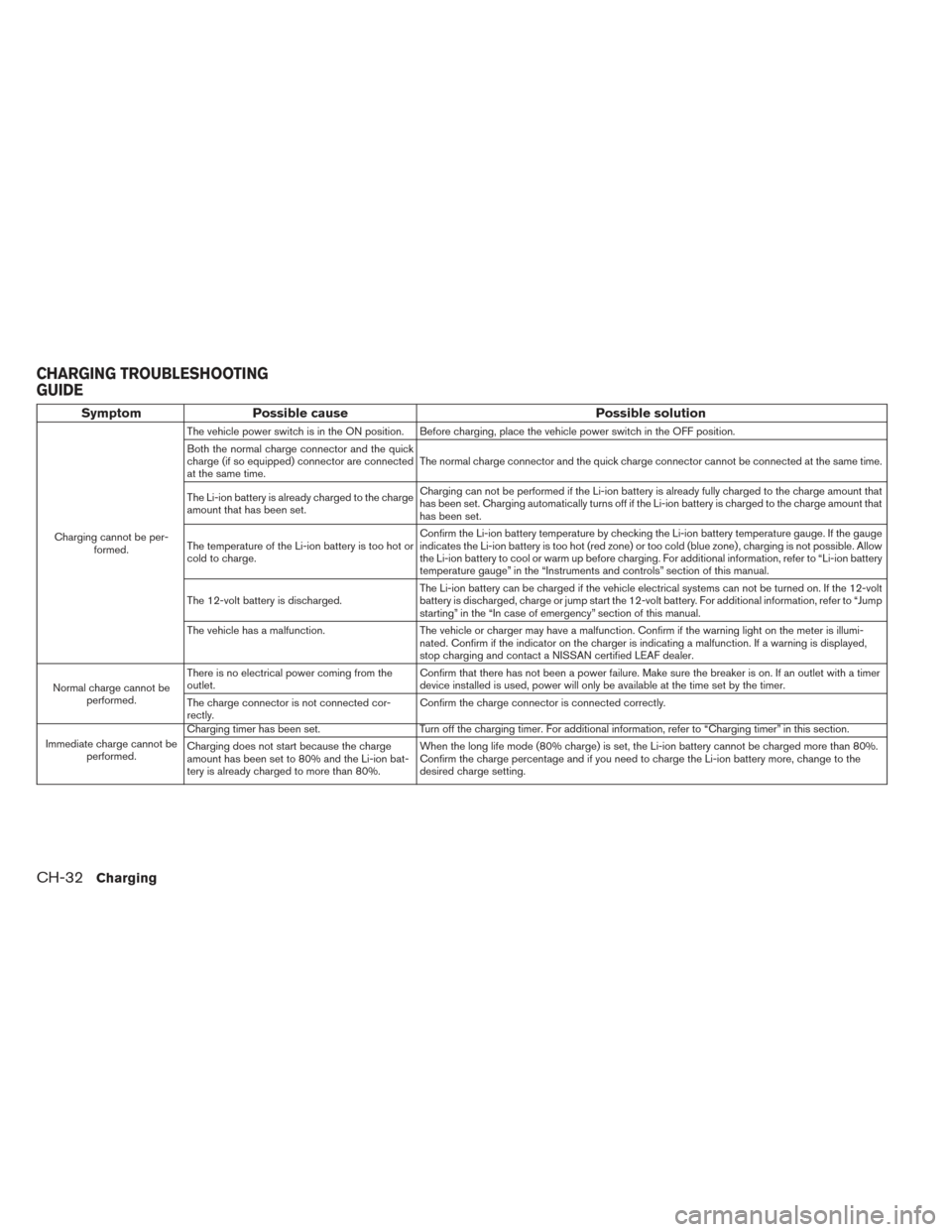
SymptomPossible cause Possible solution
Charging cannot be per-
formed. The vehicle power switch is in the ON position. Before charging, place the vehicle power switch in the OFF position.
Both the normal charge connector and the quick
charge (if so equipped) connector are connected
at the same time.
The normal charge connector and the quick charge connector cannot be connected at the same time.
The Li-ion battery is already charged to the charge
amount that has been set. Charging can not be performed if the Li-ion battery is already fully charged to the charge amount that
has been set. Charging automatically turns off if the Li-ion battery is charged to the charge amount that
has been set.
The temperature of the Li-ion battery is too hot or
cold to charge. Confirm the Li-ion battery temperature by checking the Li-ion battery temperature gauge. If the gauge
indicates the Li-ion battery is too hot (red zone) or too cold (blue zone) , charging is not possible. Allow
the Li-ion battery to cool or warm up before charging. For additional information, refer to “Li-ion battery
temperature gauge” in the “Instruments and controls” section of this manual.
The 12-volt battery is discharged. The Li-ion battery can be charged if the vehicle electrical systems can not be turned on. If the 12-volt
battery is discharged, charge or jump start the 12-volt battery. For additional information, refer to “Jump
starting” in the “In case of emergency” section of this manual.
The vehicle has a malfunction. The vehicle or charger may have a malfunction. Confirm if the warning light on the meter is illumi-
nated. Confirm if the indicator on the charger is indicating a malfunction. If a warning is displayed,
stop charging and contact a NISSAN certified LEAF dealer.
Normal charge cannot be performed. There is no electrical power coming from the
outlet.
Confirm that there has not been a power failure. Make sure the breaker is on. If an outlet with a timer
device installed is used, power will only be available at the time set by the timer.
The charge connector is not connected cor-
rectly. Confirm the charge connector is connected correctly.
Immediate charge cannot be
performed. Charging timer has been set. Turn off the charging timer. For additional information, refer to “Charging timer” in this section.
Charging does not start because the charge
amount has been set to 80% and the Li-ion bat-
tery is already charged to more than 80%.
When the long life mode (80% charge) is set, the Li-ion battery cannot be charged more than 80%.
Confirm the charge percentage and if you need to charge the Li-ion battery more, change to the
desired charge setting.
CHARGING TROUBLESHOOTING
GUIDE
CH-32Charging
Page 84 of 437
1 Safety–Seats, seat belts and
supplemental restraint system
Seats............................. .1-2
Front seats ........................ .1-3
Rear seats ........................ .1-4
Head restraints/headrests ................. .1-5
Adjustable head restraint/headrest components . . .1-6
Non-adjustable head restraint/headrest
components ....................... .1-6
Remove .......................... .1-6
Install ........................... .1-7
Adjust ........................... .1-7
Seat belts .......................... .1-8
Precautions on seat belt usage .............1-8
Seat belt warning light ................ .1-11
Pregnant women ................... .1-11
Injured persons .................... .1-11
Three-point type seat belt with retractor .......1-11
Seat belt extenders .................. .1-15
Seat belt maintenance ................ .1-15
Child safety ......................... .1-16
Infants .......................... .1-17
Small children ..................... .1-17
Larger children ..................... .1-17
Child restraints ....................... .1-18Precautions on child restraints
............1-18
LATCH (Lower Anchors and Tethers for CHildren)
system ......................... .1-20
Rear-facing child restraint installation using latch. .1-23
Rear-facing child restraint installation using
the seat belts ...................... .1-25
Forward-facing child restraint installation using
latch ........................... .1-28
Forward-facing child restraint installation using
the
seat belts ........................ .1-31
Booster seats ..................... .1-35
Supplemental Restraint System (SRS) ..........1-38
Precautions on SRS ................. .1-38
NISSAN Advanced Air Bag System (front seats) . .1-44
Front seat-mounted side-impact supplemental
air bag and roof-mounted curtain side-impact
supplemental air bag systems .............1-51
Seat belt with pretensioner(s) (front seats) .....1-53
Supplemental air bag warning labels .........1-54
Supplemental air bag warning light ..........1-54
Page 85 of 437
WARNING
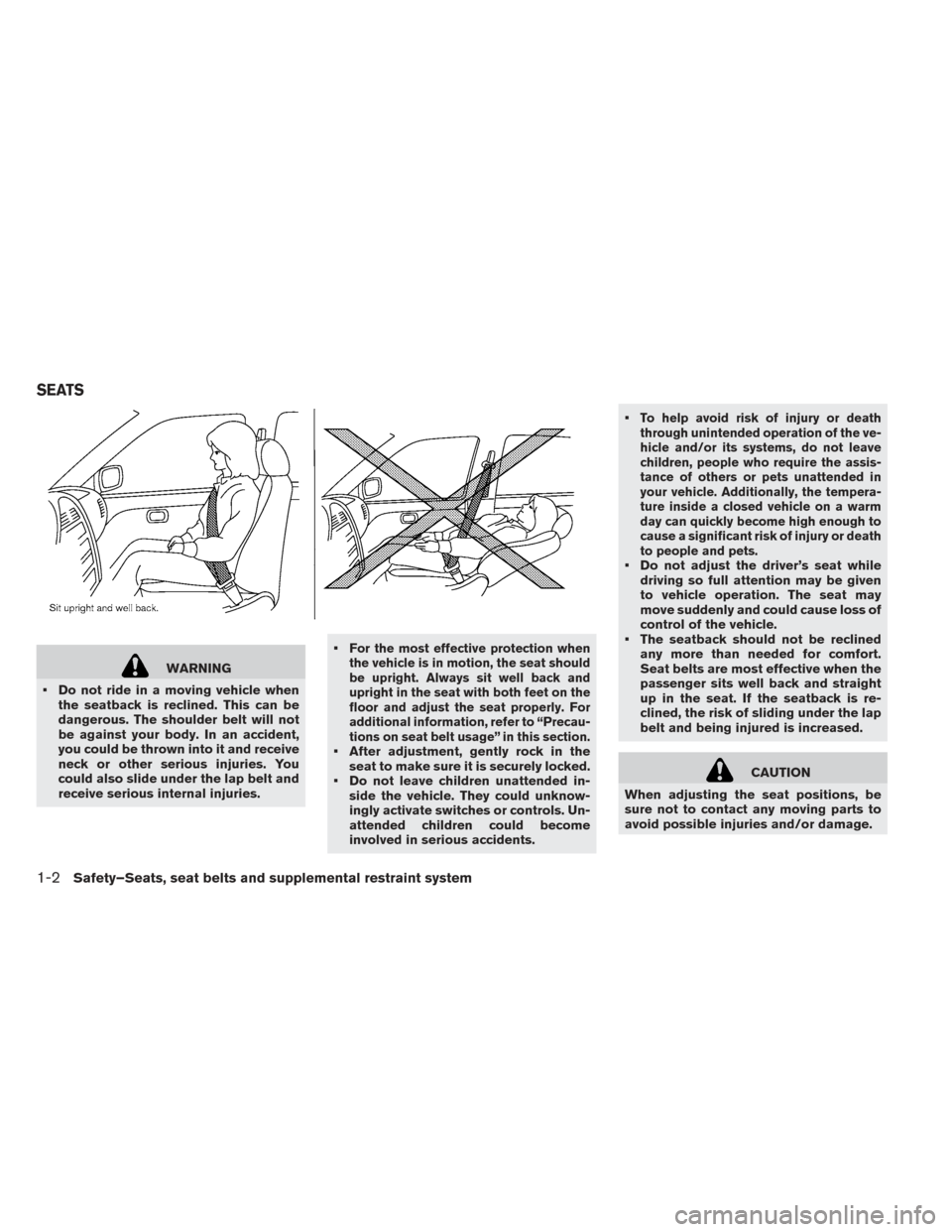
• Do not ride in a moving vehicle when the seatback is reclined. This can be
dangerous. The shoulder belt will not
be against your body. In an accident,
you could be thrown into it and receive
neck or other serious injuries. You
could also slide under the lap belt and
receive serious internal injuries. •
For the most effective protection when
the vehicle is in motion, the seat should
be upright. Always sit well back and
upright in the seat with both feet on the
floor and adjust the seat properly. For
additional information, refer to “Precau-
tions on seat belt usage” in this section.
• After adjustment, gently rock in the
seat to make sure it is securely locked.
• Do not leave children unattended in- side the vehicle. They could unknow-
ingly activate switches or controls. Un-
attended children could become
involved in serious accidents. •
To help avoid risk of injury or death
through unintended operation of the ve-
hicle and/or its systems, do not leave
children, people who require the assis-
tance of others or pets unattended in
your vehicle. Additionally, the tempera-
ture inside a closed vehicle on a warm
day can quickly become high enough to
cause a significant risk of injury or death
to people and pets.
• Do not adjust the driver’s seat while
driving so full attention may be given
to vehicle operation. The seat may
move suddenly and could cause loss of
control of the vehicle.
• The seatback should not be reclined any more than needed for comfort.
Seat belts are most effective when the
passenger sits well back and straight
up in the seat. If the seatback is re-
clined, the risk of sliding under the lap
belt and being injured is increased.
CAUTION
When adjusting the seat positions, be
sure not to contact any moving parts to
avoid possible injuries and/or damage.
SEATS
1-2Safety–Seats, seat belts and supplemental restraint system
Page 87 of 437
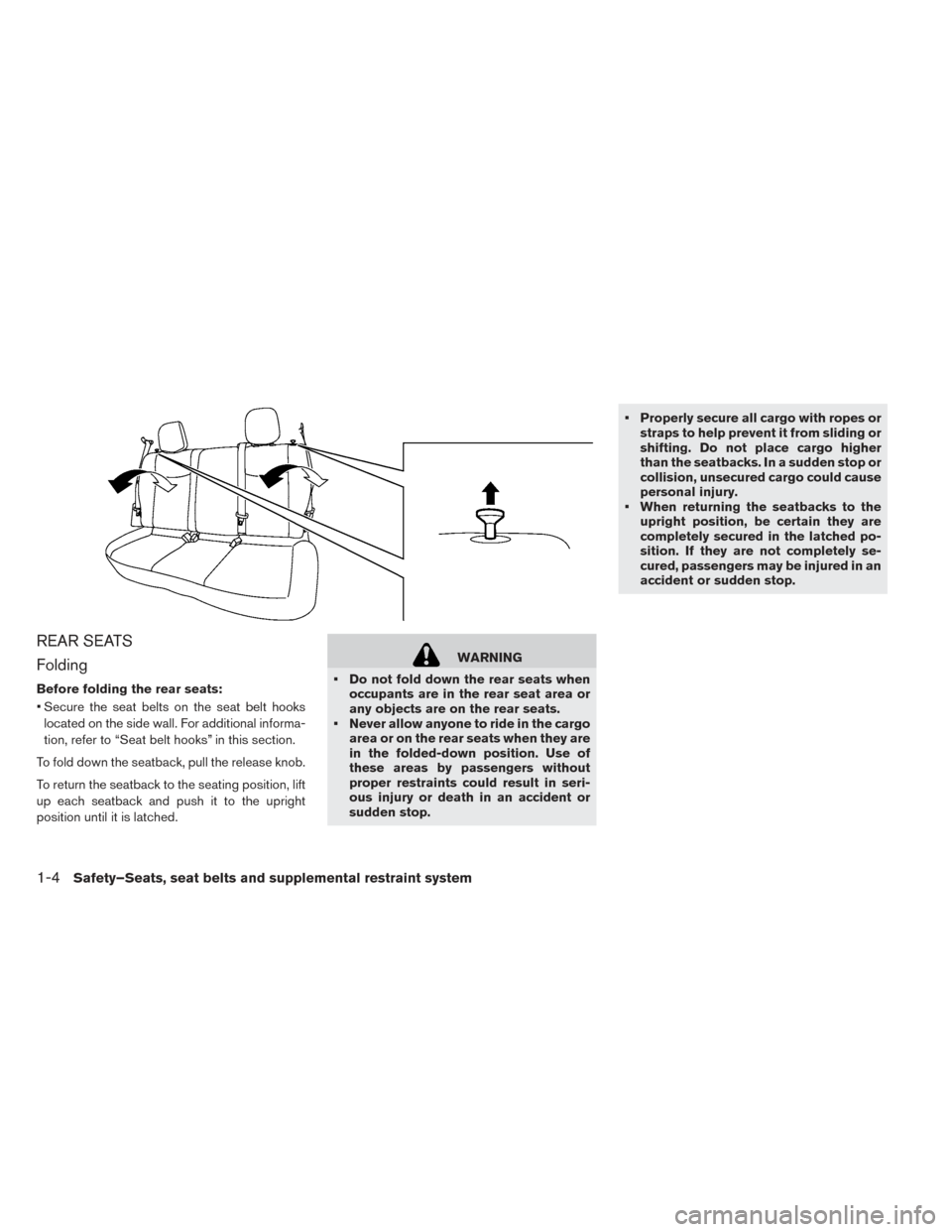
REAR SEATS
Folding
Before folding the rear seats:
• Secure the seat belts on the seat belt hookslocated on the side wall. For additional informa-
tion, refer to “Seat belt hooks” in this section.
To fold down the seatback, pull the release knob.
To return the seatback to the seating position, lift
up each seatback and push it to the upright
position until it is latched.
WARNING
• Do not fold down the rear seats when occupants are in the rear seat area or
any objects are on the rear seats.
• Never allow anyone to ride in the cargo area or on the rear seats when they are
in the folded-down position. Use of
these areas by passengers without
proper restraints could result in seri-
ous injury or death in an accident or
sudden stop. • Properly secure all cargo with ropes or
straps to help prevent it from sliding or
shifting. Do not place cargo higher
than the seatbacks. In a sudden stop or
collision, unsecured cargo could cause
personal injury.
• When returning the seatbacks to the upright position, be certain they are
completely secured in the latched po-
sition. If they are not completely se-
cured, passengers may be injured in an
accident or sudden stop.
1-4Safety–Seats, seat belts and supplemental restraint system
Page 88 of 437
WARNING
Head restraints/headrests supplement
the other vehicle safety systems. They
may provide additional protection
against injury in certain rear end colli-
sions. Adjustable head restraints/
headrests must be adjusted properly, as
specified in this section. Check the ad-
justment after someone else uses the
seat. Do not attach anything to the head
restraint/headrest stalks or remove the
head restraints/headrests. Do not use
the seat if the head restraint/headrest
has been removed. If the head restraint/
headrest was removed, reinstall and
properly adjust the head restraint/
headrest before an occupant uses the
seating position. Failure to follow these
instructions can reduce the effectiveness
of the head restraint/headrest. This may
increase the risk of serious injury or
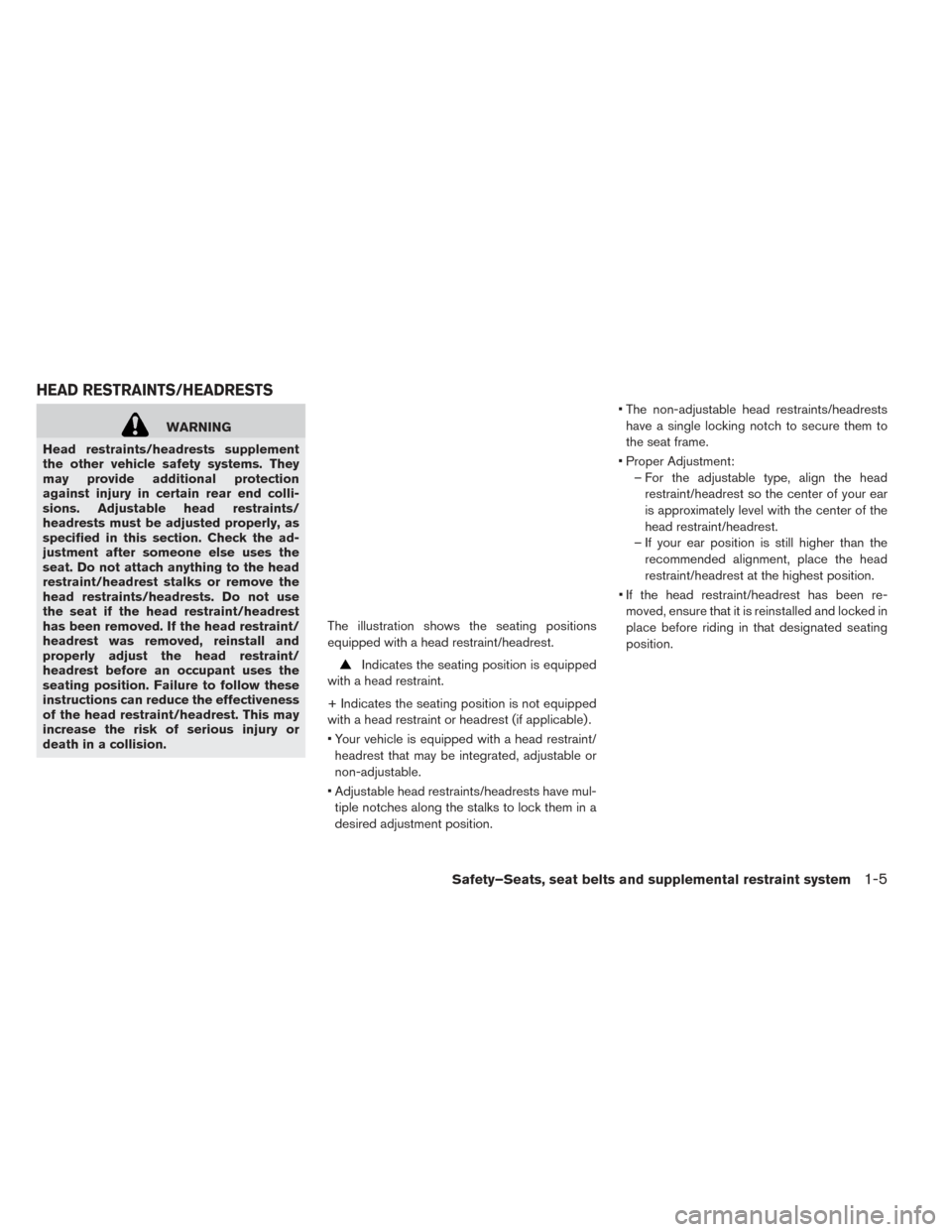
death in a collision. The illustration shows the seating positions
equipped with a head restraint/headrest.
Indicates the seating position is equipped
with a head restraint.
+ Indicates the seating position is not equipped
with a head restraint or headrest (if applicable) .
• Your vehicle is equipped with a head restraint/ headrest that may be integrated, adjustable or
non-adjustable.
• Adjustable head restraints/headrests have mul- tiple notches along the stalks to lock them in a
desired adjustment position. • The non-adjustable head restraints/headrests
have a single locking notch to secure them to
the seat frame.
• Proper Adjustment: – For the adjustable type, align the headrestraint/headrest so the center of your ear
is approximately level with the center of the
head restraint/headrest.
– If your ear position is still higher than the recommended alignment, place the head
restraint/headrest at the highest position.
• If the head restraint/headrest has been re- moved, ensure that it is reinstalled and locked in
place before riding in that designated seating
position.
HEAD RESTRAINTS/HEADRESTS
Safety–Seats, seat belts and supplemental restraint system1-5
Page 93 of 437
WARNING
• Every person who drives or rides in this vehicle should use a seat belt at all
times. Children should be in the rear
seats and in an appropriate restraint.
• The seat belt should be properly ad- justed to a snug fit. Failure to do so
may reduce the effectiveness of the
entire restraint system and increase
the chance or severity of injury in an
accident. Serious injury or death can
occur if the seat belt is not worn prop-
erly.
• Always route the shoulder belt over your shoulder and across your chest.
Never put the belt behind your back,
under your arm or across your neck.
The belt should be away from your face
and neck, but not falling off your
shoulder.
• Position the lap belt as low and snug as possible AROUND THE HIPS, NOT
THE WAIST. A lap belt worn too high
could increase the risk of internal inju-
ries in an accident.
• Be sure the seat belt tongue is se- curely fastened to the proper buckle. • Do not wear the seat belt inside out or
twisted. Doing so may reduce its effec-
tiveness.
• Do not allow more than one person to use the same seat belt.
• Never carry more people in the vehicle than there are seat belts.
• If the seat belt warning light glows continuously while the power switch is
turned ON with all doors closed and all
seat belts fastened, it may indicate a
malfunction in the system. Have the
system checked by a NISSAN certified
LEAF dealer.
• No changes should be made to the seat belt system. For example, do not
modify the seat belt, add material, or
install devices that may change the
seat belt routing or tension. Doing so
may affect the operation of the seat
belt system. Modifying or tampering
with the seat belt system may result in
serious personal injury.
• Once seat belt pretensioner(s) have activated, they cannot be reused and
must be replaced together with the
retractor. See a NISSAN certified LEAF
dealer. • Removal and installation of the pre-
tensioner system components should
be done by a NISSAN certified LEAF
dealer.
• All seat belt assemblies, including re- tractors and attaching hardware,
should be inspected after any collision
by a NISSAN certified LEAF dealer.
NISSAN recommends that all seat belt
assemblies in use during a collision be
replaced unless the collision was mi-
nor and the belts show no damage and
continue to operate properly. Seat belt
assemblies not in use during a colli-
sion should also be inspected and re-
placed if either damage or improper
operation is noted.
• All child restraints and attaching hard- ware should be inspected after any
collision. Always follow the restraint
manufacturer’s inspection instructions
and replacement recommendations.
The child restraints should be replaced
if they are damaged.
1-10Safety–Seats, seat belts and supplemental restraint system
Page 94 of 437
SEAT BELT WARNING LIGHT
Both the driver’s and passenger’s front seats are
equipped with a seat belt warning light. The
warning light, located on the instrument panel,
will show the status of the driver and passenger
seat belt.
NOTE:
The front passenger seat belt warning
light will not light up if the seat is not
occupied.
For additional information, refer to “Warning lights,
indicator lights and audible reminders” in the “In-
struments and controls” section of this manual.
PREGNANT WOMEN
NISSAN recommends that pregnant women use
seat belts. The seat belt should be worn snug,
and always position the lap belt as low as pos-
sible around the hips, not the waist. Place the
shoulder belt over your shoulder and across your
chest. Never put the lap/shoulder belt over your
abdominal area. Contact your doctor for specific
recommendations.
INJURED PERSONS
NISSAN recommends that injured persons use
seat belts, depending on the injury. Check with
your doctor for specific recommendations.
THREE-POINT TYPE SEAT BELT
WITH RETRACTOR
WARNING
• Every person who drives or rides in this vehicle should use a seat belt at all
times. • Do not ride in a moving vehicle when
the seatback is reclined. This can be
dangerous. The shoulder belt will not
be against your body. In an accident,
you could be thrown into it and receive
neck or other serious injuries. You
could also slide under the lap belt and
receive serious internal injuries.
• For the most effective protection when the vehicle is in motion, the seat
should be upright. Always sit well back
and upright in the seat with both feet
on the floor and adjust the seat belt
properly.
• Do not allow children to play with the seat belts. Most seating positions are
equipped with Automatic Locking Re-
tractor (ALR) mode seat belts. If the
seat belt becomes wrapped around a
child’s neck with the ALR mode acti-
vated, the child can be seriously in-
jured or killed if the seat belt retracts
and becomes tight. This can occur
even if the vehicle is parked. Unbuckle
the seat belt to release the child. If the
seat belt cannot be unbuckled or is
already unbuckled, release the child by
cutting the seat belt with a suitable
tool (such as a knife or scissors) to
release the seat belt.
Safety–Seats, seat belts and supplemental restraint system1-11