Page 381 of 437
The TPMS with Easy Fill Tire Alert also
provides visual and audible signals out-
side the vehicle for inflating the tires to the
recommended COLD tire pressure. For
additional information, refer to “TPMS
with Easy Fill Tire Alert” in the “Starting
and driving” section of this manual.
Incorrect tire pressure, including un-
der inflation, may adversely affect
tire life and vehicle handling.
WARNING
•
Improperly inflated tires can fail
suddenly and cause an accident.
•The Gross Vehicle Weight rating
(GVWR) is located on the
F.M.V.S.S./C.M.V.S.S certifica-
tion label. The vehicle weight ca-
pacity is indicated on the Tire
and Loading Information label.
Do not load your vehicle beyond
this capacity. Overloading your
vehicle may result in reduced tire
life, unsafe operating conditions
due to premature tire failure, or
unfavorable handling character-
istics and could also lead to a
serious accident. Loading be-
yond the specified capacity may
also result in failure of other ve-
hicle components.
•Before taking a long trip, or
whenever you heavily load your
vehicle, use a tire pressure
gauge to ensure that the tire
pressures are at the specified
level.
•For additional information re-
garding tires, refer to “Important
Tire Safety Information” (US) or
“Tire Safety Information”
(Canada) in the Warranty Infor-
mation Booklet.
8-28
Maintenance and do-it yourself
Page 384 of 437
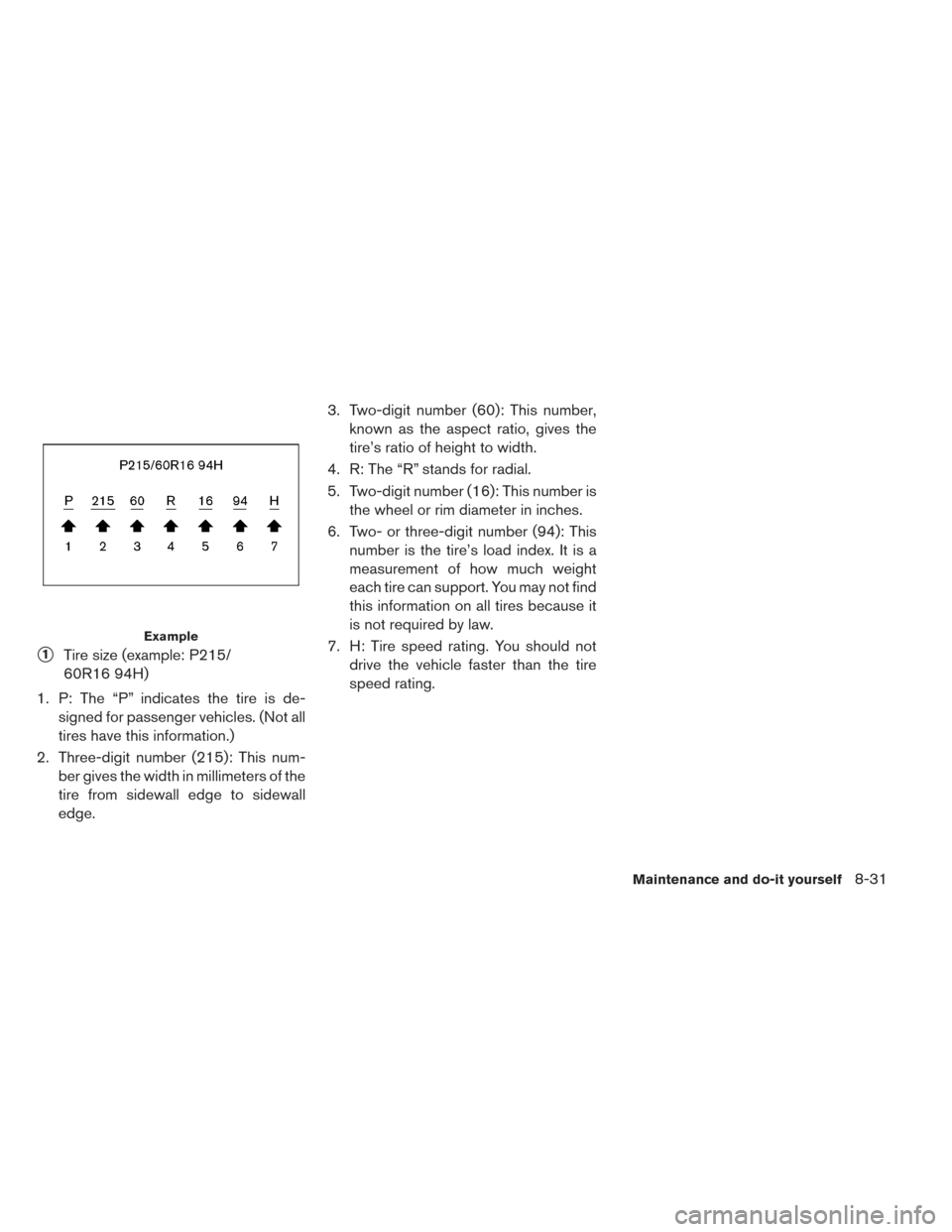
�1Tire size (example: P215/
60R16 94H)
1. P: The “P” indicates the tire is de- signed for passenger vehicles. (Not all
tires have this information.)
2. Three-digit number (215): This num- ber gives the width in millimeters of the
tire from sidewall edge to sidewall
edge. 3. Two-digit number (60): This number,
known as the aspect ratio, gives the
tire’s ratio of height to width.
4. R: The “R” stands for radial.
5. Two-digit number (16): This number is the wheel or rim diameter in inches.
6. Two- or three-digit number (94): This number is the tire’s load index. It is a
measurement of how much weight
each tire can support. You may not find
this information on all tires because it
is not required by law.
7. H: Tire speed rating. You should not drive the vehicle faster than the tire
speed rating.
Example
Maintenance and do-it yourself8-31
Page 392 of 437
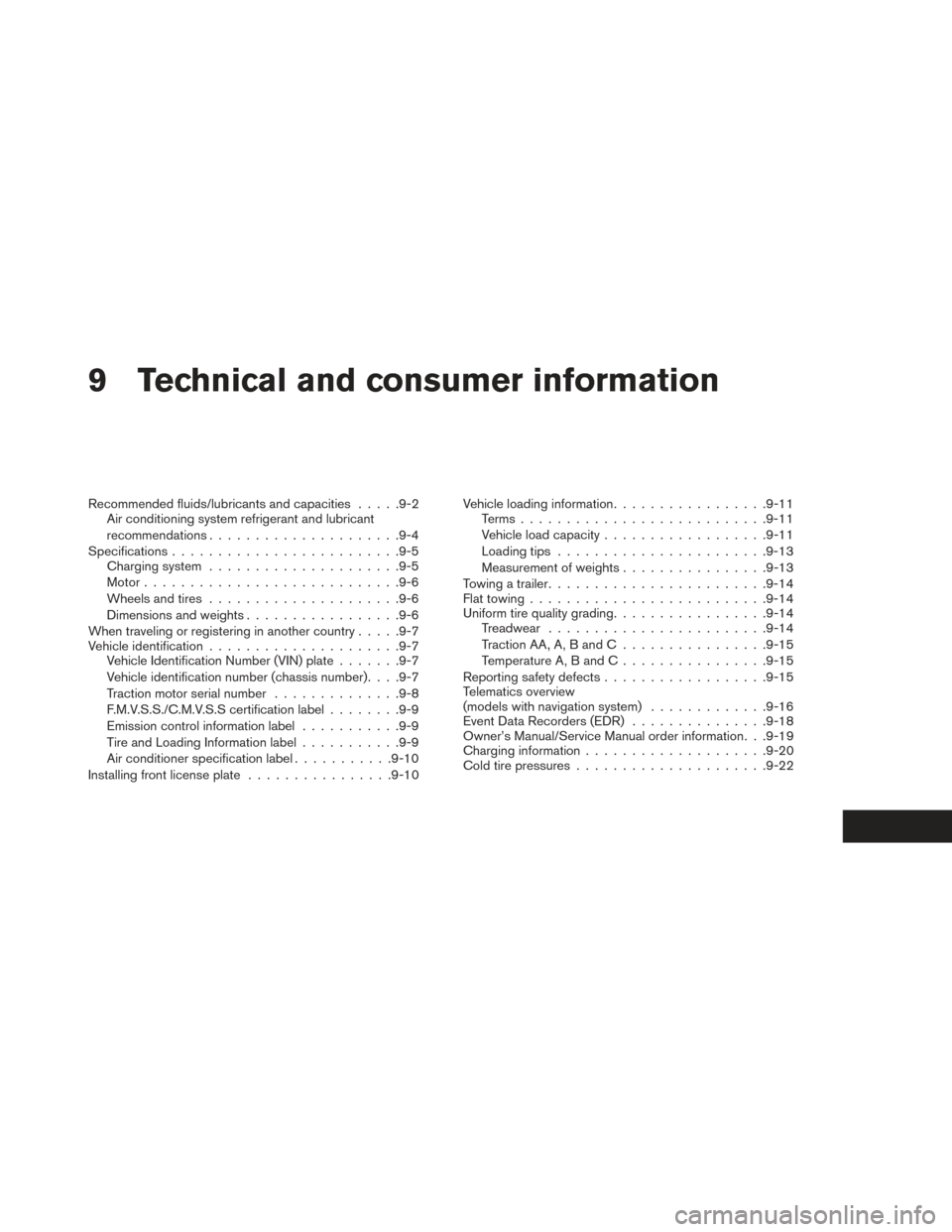
9 Technical and consumer information
Recommended fluids/lubricants and capacities.....9-2
Air conditioning system refrigerant and lubricant
recommendations .................... .9-4
Specifications ........................ .9-5
Charging system .................... .9-5
Motor ........................... .9-6
Wheels and tires .................... .9-6
Dimensions and weights ................ .9-6
When traveling or registering in another country .....9-7
Vehicle identification .................... .9-7
Vehicle Identification Number (VIN) plate .......9-7
Vehicle identification number (chassis number). . . .9-7
Traction motor serial number ..............9-8
F.M.V.S.S./C.M.V.S.S certification label ........9-9
Emission control information label ...........9-9
Tire and Loading Information label ...........9-9
Air conditioner specification label ...........9-10
Installing front license plate ................9-10Vehicle loading information
.................9-11
Terms .......................... .9-11
Vehicle load capacity ................. .9-11
Loading tips ...................... .9-13
Measurement of weights ................9-13
Towing a trailer ....................... .9-14
Flat towing ......................... .9-14
Uniform tire quality grading .................9-14
Treadwear ....................... .9-14
Traction AA, A, B and C ................9-15
Temperature A, B and C ................9-15
Reporting safety defects ................. .9-15
Telematics overview
(models with navigation system) .............9-16
Event Data Recorders (EDR) ...............9-18
Owner’s Manual/Service Manual order information. . .9-19
Charging information ................... .9-20
Cold tire pressures .................... .9-22
Page 397 of 437
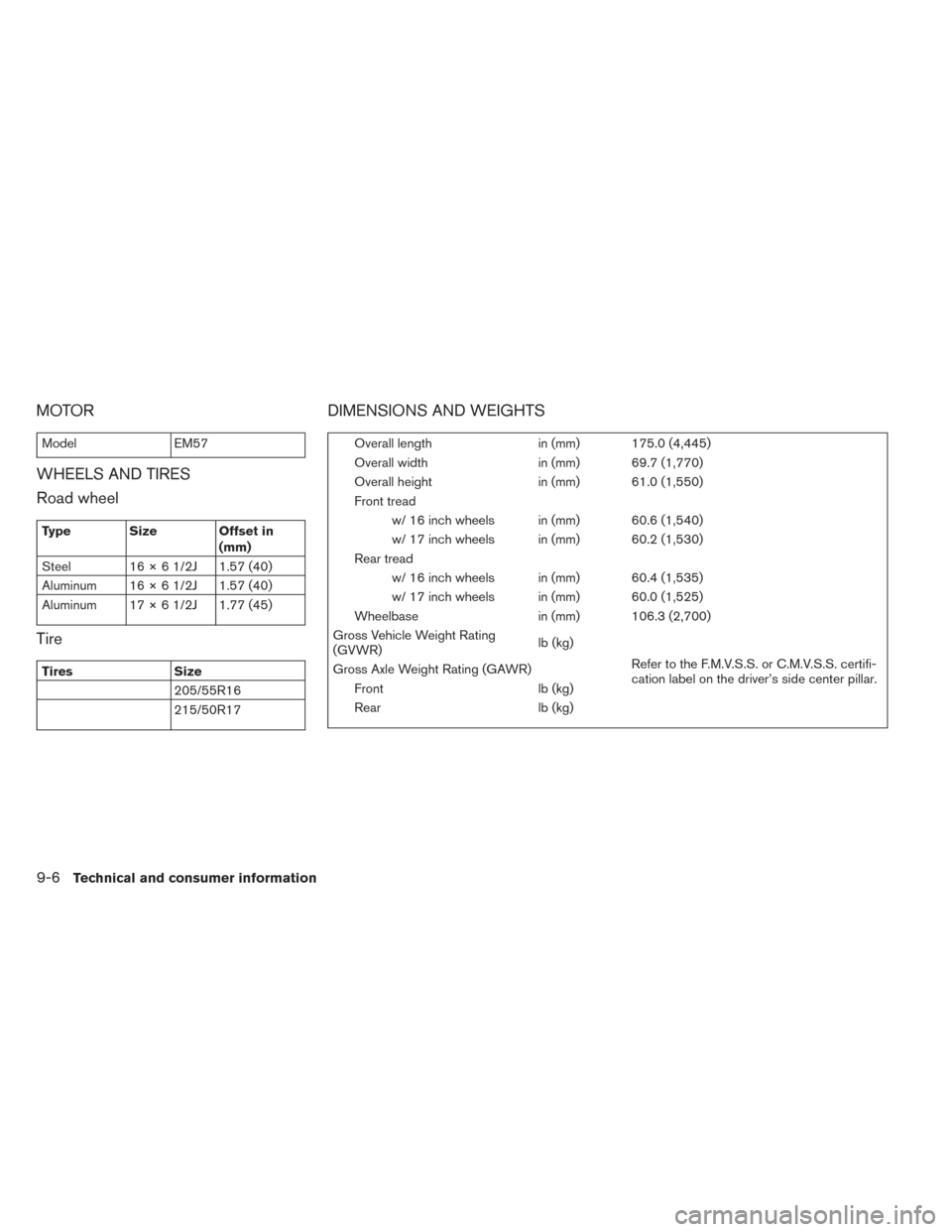
MOTOR
ModelEM57
WHEELS AND TIRES
Road wheel
Type Size Offset in
(mm)
Steel 16 × 6 1/2J 1.57 (40)
Aluminum 16 × 6 1/2J 1.57 (40)
Aluminum 17 × 6 1/2J 1.77 (45)
Tire
Tires Size
205/55R16
215/50R17
DIMENSIONS AND WEIGHTS
Overall length in (mm) 175.0 (4,445)
Overall width in (mm) 69.7 (1,770)
Overall height in (mm) 61.0 (1,550)
Front tread w/ 16 inch wheels in (mm) 60.6 (1,540)
w/ 17 inch wheels in (mm) 60.2 (1,530)
Rear tread w/ 16 inch wheels in (mm) 60.4 (1,535)
w/ 17 inch wheels in (mm) 60.0 (1,525)
Wheelbase in (mm) 106.3 (2,700)
Gross Vehicle Weight Rating
(GVWR) lb (kg)
Refer to the F.M.V.S.S. or C.M.V.S.S. certifi-
cation label on the driver’s side center pillar.
Gross Axle Weight Rating (GAWR)
Front lb (kg)
Rear lb (kg)
9-6Technical and consumer information
Page 400 of 437
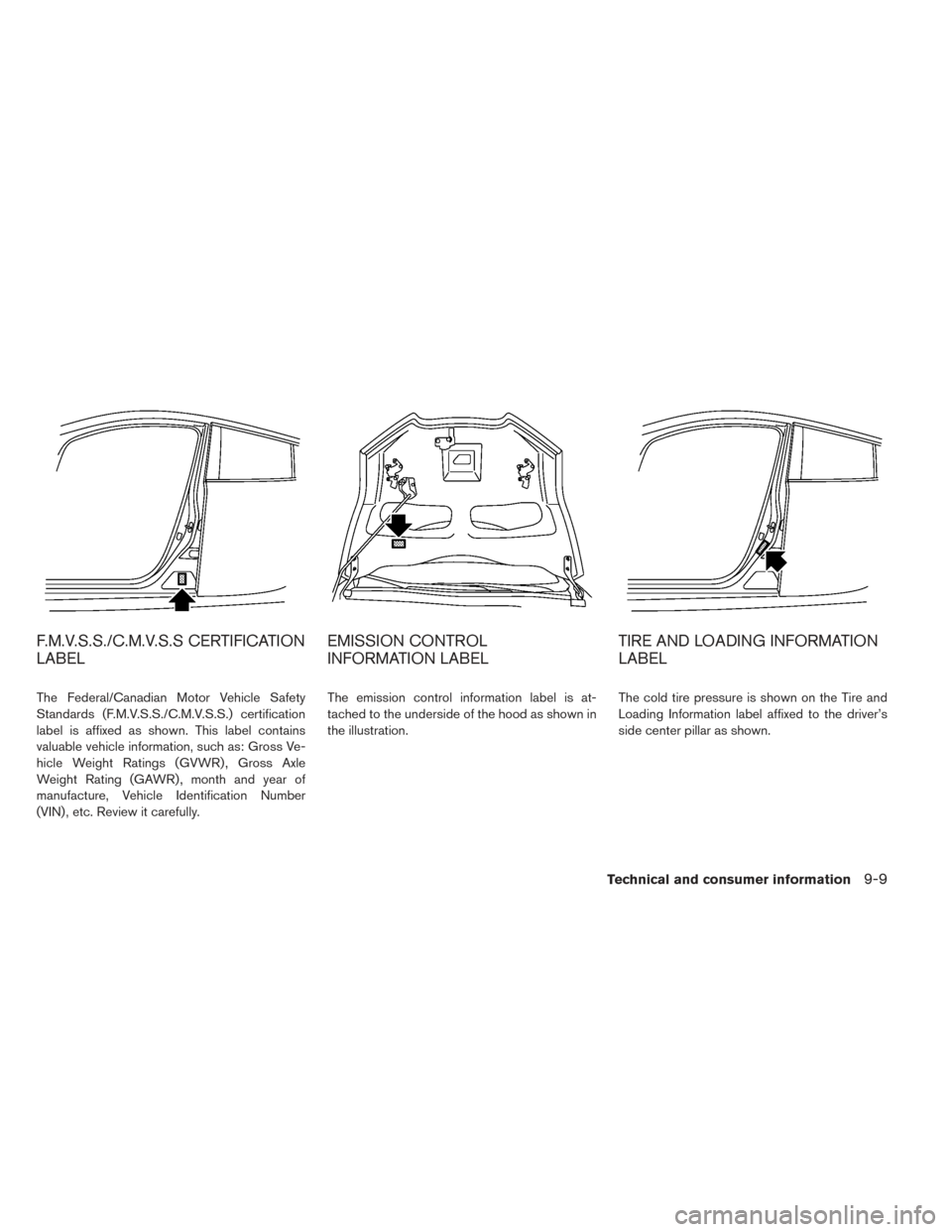
F.M.V.S.S./C.M.V.S.S CERTIFICATION
LABEL
The Federal/Canadian Motor Vehicle Safety
Standards (F.M.V.S.S./C.M.V.S.S.) certification
label is affixed as shown. This label contains
valuable vehicle information, such as: Gross Ve-
hicle Weight Ratings (GVWR) , Gross Axle
Weight Rating (GAWR) , month and year of
manufacture, Vehicle Identification Number
(VIN) , etc. Review it carefully.
EMISSION CONTROL
INFORMATION LABEL
The emission control information label is at-
tached to the underside of the hood as shown in
the illustration.
TIRE AND LOADING INFORMATION
LABEL
The cold tire pressure is shown on the Tire and
Loading Information label affixed to the driver’s
side center pillar as shown.
Technical and consumer information9-9
Page 402 of 437
WARNING
•
It is extremely dangerous to ride
in the cargo area inside the ve-
hicle. In a collision, people riding
in these areas are more likely to
be seriously injured or killed.
•Do not allow people to ride in any
area of your vehicle that is not
equipped with seats and seat belts.
•Be sure everyone in your vehicle
is in a seat and using a seat belt
properly.
TERMS
It is important to familiarize yourself with
the following terms before loading your
vehicle:
• Curb Weight (actual weight of your ve- hicle) - vehicle weight including: stan-
dard and optional equipment, fluids,
emergency tools, and spare tire assem-
bly. This weight does not
include passen-
gers and cargo.
• GVW (Gross Vehicle Weight) - curb weight plus the combined weight of pas-
sengers and cargo.
• GVWR (Gross Vehicle Weight Rating) - maximum total combined weight of the
unloaded vehicle, passengers, luggage,
hitch, trailer tongue load and any other
optional equipment. This information is
located on the F.M.V.S.S./C.M.V.S.S.
label.
• GAWR (Gross Axle Weight Rating) - maximum weight (load) limit specified
for the front or rear axle.
• This information is located on the F.M.V.S.S./
C.M.V.S.S. label.
• GCWR (Gross Combined Weight Rat-ing) - The maximum total weight rating of
the vehicle, passengers, cargo, and
trailer.
• Vehicle Capacity Weight, Load limit, To- tal load capacity - maximum total weight
limit specified of the load (passengers
and cargo) for the vehicle. This is the
maximum combined weight of occu- pants and cargo that can be loaded into
the vehicle. If the vehicle is used to tow a
trailer, the trailer tongue weight must be
included as part of the cargo load. This
information is located on the Tire and
Loading Information label.
• Cargo capacity - permissible weight of cargo, the subtracted weight of occu-
pants from the load limit.
VEHICLE LOAD CAPACITY
Do not exceed the load limit of your ve-
hicle shown as “The combined weight of
occupants and cargo” on the Tire and
Loading Information label. Do not exceed
the number of occupants shown as
“Seating Capacity” on the Tire and Load-
ing Information label.
To get “the combined weight of occu-
pants and cargo”, add the weight of all
occupants, then add the total luggage
weight. Examples are shown in the follow-
ing illustration.
VEHICLE LOADING INFORMATION
Technical and consumer information9-11
Page 403 of 437
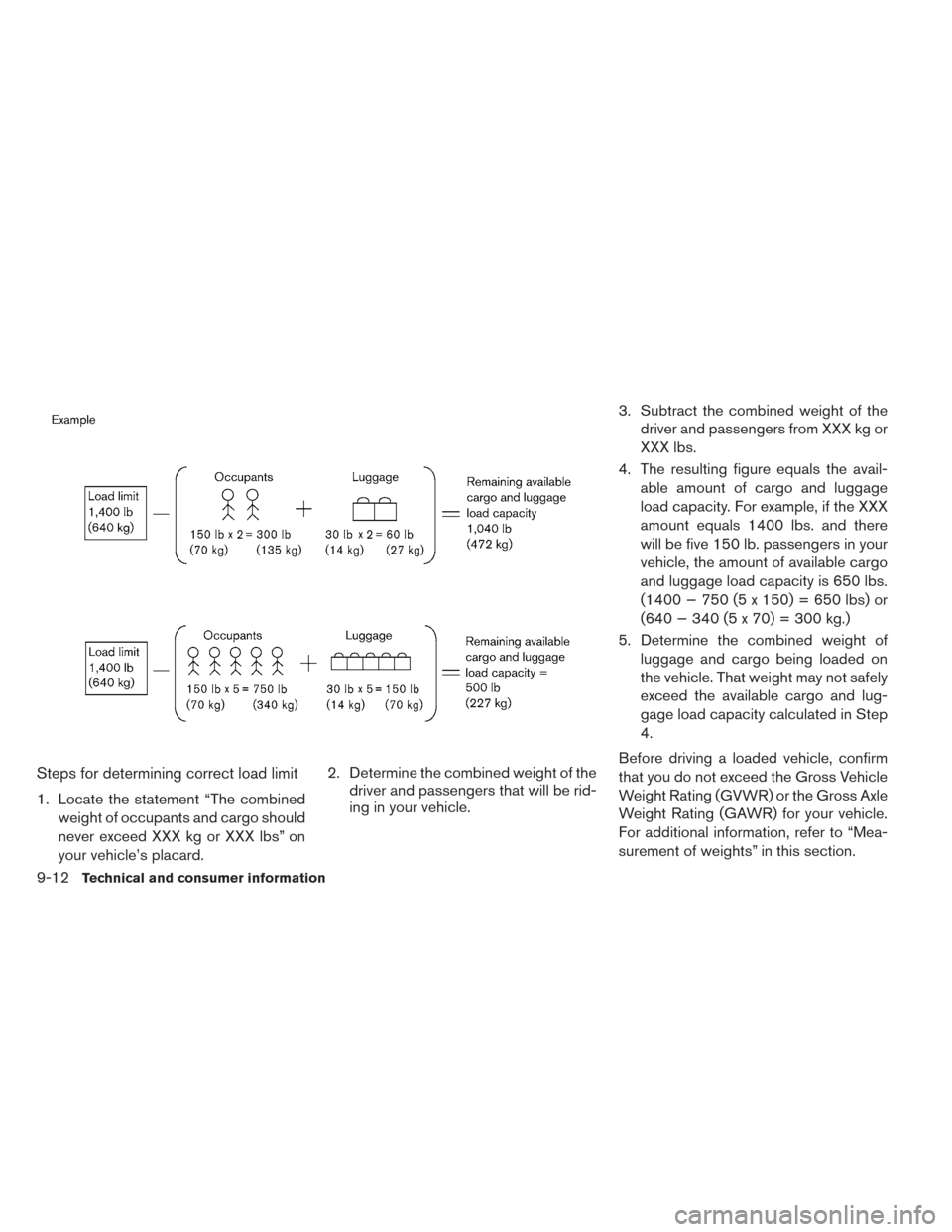
Steps for determining correct load limit
1. Locate the statement “The combinedweight of occupants and cargo should
never exceed XXX kg or XXX lbs” on
your vehicle’s placard. 2. Determine the combined weight of the
driver and passengers that will be rid-
ing in your vehicle. 3. Subtract the combined weight of the
driver and passengers from XXX kg or
XXX lbs.
4. The resulting figure equals the avail- able amount of cargo and luggage
load capacity. For example, if the XXX
amount equals 1400 lbs. and there
will be five 150 lb. passengers in your
vehicle, the amount of available cargo
and luggage load capacity is 650 lbs.
(1400 − 750 (5 x 150) = 650 lbs) or
(640 − 340 (5 x 70) = 300 kg.)
5. Determine the combined weight of luggage and cargo being loaded on
the vehicle. That weight may not safely
exceed the available cargo and lug-
gage load capacity calculated in Step
4.
Before driving a loaded vehicle, confirm
that you do not exceed the Gross Vehicle
Weight Rating (GVWR) or the Gross Axle
Weight Rating (GAWR) for your vehicle.
For additional information, refer to “Mea-
surement of weights” in this section.
9-12Technical and consumer information
Page 404 of 437
Also check tires for proper inflation pres-
sures. For additional information, refer to
the Tire and Loading Information label.
LOADING TIPS
• The GVW must not exceed the GVWRor GAWR as specified on the
F.M.V.S.S./C.M.V.S.S. certification label.
• Do not load the front and rear axle to the GAWR. Doing so will exceed the
GVWR.
WARNING
•
Properly secure all cargo with
ropes or straps to help prevent it
from sliding or shifting. Do not
place cargo higher than the seat-
backs. In a sudden stop or colli-
sion, unsecured cargo could
cause personal injury.
•Do not load your vehicle any
heavier than the GVWR or the
maximum front and rear GAWRs.
If you do, parts of your vehicle
can break, tire damage could oc-
cur, or it can change the way your
vehicle handles. This could result
in loss of control and cause per-
sonal injury.
•Overloading not only can
shorten the life of your vehicle
and the tire, but can cause un-
safe vehicle handling and longer
braking distances. This may
cause a premature tire failure,
which could result in a serious
accident and personal injury.
Failures caused by overloading
are not covered by the vehicle’s
warranty.
MEASUREMENT OF WEIGHTS
Secure loose items to prevent weight
shifts that could affect the balance of your
vehicle. When the vehicle is loaded, drive
to a scale and weigh the front and the rear
wheels separately to determine axle
loads. Individual axle loads should not ex-
ceed either of the Gross Axle Weight
Ratings (GAWR) . The total of the axle
loads should not exceed the Gross Ve-
hicle Weight Rating (GVWR) . These rat-
ings are given on the vehicle certification
label. If weight ratings are exceeded,
move or remove items to bring all weights
below the ratings.
Technical and consumer information9-13