2016 NISSAN LEAF TPMS
[x] Cancel search: TPMSPage 381 of 437
The TPMS with Easy Fill Tire Alert also
provides visual and audible signals out-
side the vehicle for inflating the tires to the
recommended COLD tire pressure. For
additional information, refer to “TPMS
with Easy Fill Tire Alert” in the “Starting
and driving” section of this manual.
Incorrect tire pressure, including un-
der inflation, may adversely affect
tire life and vehicle handling.
WARNING
•
Improperly inflated tires can fail
suddenly and cause an accident.
•The Gross Vehicle Weight rating
(GVWR) is located on the
F.M.V.S.S./C.M.V.S.S certifica-
tion label. The vehicle weight ca-
pacity is indicated on the Tire
and Loading Information label.
Do not load your vehicle beyond
this capacity. Overloading your
vehicle may result in reduced tire
life, unsafe operating conditions
due to premature tire failure, or
unfavorable handling character-
istics and could also lead to a
serious accident. Loading be-
yond the specified capacity may
also result in failure of other ve-
hicle components.
•Before taking a long trip, or
whenever you heavily load your
vehicle, use a tire pressure
gauge to ensure that the tire
pressures are at the specified
level.
•For additional information re-
garding tires, refer to “Important
Tire Safety Information” (US) or
“Tire Safety Information”
(Canada) in the Warranty Infor-
mation Booklet.
8-28
Maintenance and do-it yourself
Page 386 of 437
Other tire-related terminology:
In addition to the many terms that are
defined throughout this section, Intended
Outboard Sidewall is (1) the sidewall that
contains a whitewall, bears white lettering
or bears manufacturer, brand and/or
model name molding that is higher or
deeper than the same molding on the
other sidewall of the tire, or (2) the out-
ward facing sidewall of an asymmetrical
tire that has a particular side that must
always face outward when mounted on a
vehicle.
TYPES OF TIRES
WARNING
• When changing or replacing tires, be sure all four tires are of the same type
(Example: Summer, All Season or
Snow) and construction. A NISSAN
certified LEAF dealer may be able to
help you with information about tire
type, size, speed rating and availabil-
ity. • Replacement tires may have a lower
speed rating than the factory equipped
tires, and may not match the potential
maximum vehicle speed. Never exceed
the maximum speed rating of the tire.
• Replacing tires with those not origi- nally specified by NISSAN could affect
the proper operation of the TPMS.
• For additional information regarding tires, refer to “Important Tire Safety
Information” (US) or “Tire Safety Infor-
mation” (Canada) in the Warranty In-
formation Booklet.
All season tires
NISSAN specifies all season tires on some mod-
els to provide good performance all year, includ-
ing snowy and icy road conditions. All Season
tires are identified by ALL SEASON and/or M&S
(Mud and Snow) on the tire sidewall. Snow tires
have better snow traction than All Season tires
and may be more appropriate in some areas.
Summer tires
NISSAN specifies summer tires on some models
to provide superior performance on dry roads.
Summer tire performance is substantially re-
duced in snow and ice. Summer tires do not have
the tire traction rating M&S on the tire sidewall. If you plan to operate your vehicle in snowy or icy
conditions, NISSAN recommends the use of
SNOW tires or ALL SEASON tires on all four
wheels.
Snow tires
If snow tires are needed, it is necessary to select
tires equivalent in size and load rating to the
original equipment tires. If you do not, it can
adversely affect the safety and handling of your
vehicle.
Generally, snow tires will have lower speed rat-
ings than factory equipped tires and may not
match the potential maximum vehicle speed.
Never exceed the maximum speed rating of the
tire.
If you install snow tires, they must be the same
size, brand, construction and tread pattern on all
four wheels.
For additional traction on icy roads, studded tires
may be used. However, some U.S. states and
Canadian provinces prohibit their use. Check
local, state and provincial laws before installing
studded tires. Skid and traction capabilities of
studded snow tires, on wet or dry surfaces, may
be poorer than that of non-studded snow tires.
Maintenance and do-it yourself8-33
Page 389 of 437
Replacing wheels and tires
When replacing a tire, use the same size, tread
design, speed rating and load carrying capacity as
originally equipped. For additional information, re-
fer to “Specifications” in the “Technical and con-
sumer information” section of this manual for rec-
ommended types and sizes of tires and wheels.
WARNING
• The use of tires other than those rec- ommended or the mixed use of tires of
different brands, construction (bias,
bias-belted or radial) , or tread patterns
can adversely affect the ride, braking,
handling, Vehicle Dynamic Control
(VDC) system, ground clearance, body-
to-tire clearance, tire chain clearance,
speedometer calibration, headlight
aim and bumper height. Some of these
effects may lead to accidents and
could result in serious personal injury.
• If your vehicle was originally equipped with 4 tires that were the same size
and you are only replacing 2 of the 4
tires, install the new tires on the rear
axle. Placing new tires on the front
axle may cause loss of vehicle control
in some driving conditions and cause
an accident and personal injury. • If the wheels are changed for any rea-
son, always replace with wheels which
have the same off-set dimension.
Wheels of a different off-set could
cause premature tire wear, degrade
vehicle handling characteristics, affect
the VDC system and/or interference
with the brake discs. Such interference
can lead to decreased braking effi-
ciency and/or early brake pad/shoe
wear. For additional information on
wheel-off set dimensions, refer to
“Wheels and tires” in the “Technical
and consumer information” section of
this manual.
• When a wheel is replaced, the TPMS will not function and the low tire pres-
sure warning light will flash for ap-
proximately 1 minute. The light will re-
main on after 1 minute. Contact a
NISSAN certified LEAF dealer as soon
as possible for tire replacement
and/or system resetting.
• Replacing tires with those not origi- nally specified by NISSAN could affect
the proper operation of the TPMS.
• The TPMS sensor may be damaged if it is not handled correctly. Be careful
when handling the TPMS sensor. • When replacing the TPMS sensor, the
ID registration may be required. Con-
tact a NISSAN certified LEAF dealer for
ID registration.
• Do not use a valve stem cap that is not specified by NISSAN. The valve stem
cap may become stuck.
• Be sure that the valve stem caps are correctly fitted. Otherwise the valve
may be clogged up with dirt and cause
a malfunction or loss of pressure.
• Do not install a damaged or deformed wheel or tire even if it has been re-
paired. Such wheels or tires could have
structural damage and could fail with-
out warning.
• The use of retread tire is not recom- mended.
• For additional information regarding tires, refer to “Important Tire Safety
Information” (US) or “Tire Safety Infor-
mation” (Canada) in the Warranty In-
formation Booklet.
8-36Maintenance and do-it yourself
Page 417 of 437
Automatic door locks.............3-6
Door locks ...................3-4
Power door lock ................3-4
Rearhatchlock................3-18
Low tire pressure warning light .........2-16
Low tire pressure warning system (Refer to Tire
Pressure Monitoring System (TPMS)) ......5-2
M
Maintenance...................8-12
12-volt battery ................8-12
Generalmaintenance .............8-2
Indicatorsformaintenance..........2-34
Inside vehicle ..................8-3
Maintenance precautions ...........8-5
Maintenance requirements ..........8-2
Outside vehicle .................8-2
Seatbeltmaintenance............1-15
Manual front seat adjustment ...........1-3
Maplights ....................2-58
Mechanical key (Intelligent Key system) .....3-3
Mirror .......................3-23
Inside rearview mirror.............3-23
Outside mirrors ................3-24
Vanity mirror ..................3-22
Motor....................5-11,9-6 Before starting system ............5-11
Motor compartment ................8-7
N
NISSAN Intelligent Key® system ......3-6,5-7
Key operating range of the door lock/unlock
function.....................3-8
Key operation ..................3-9
NISSAN Vehicle Immobilizer System ......2-37
Normalcharge..................CH-9 Home charge ................CH-9
Occasional charge .............CH-9
Publiccharge ................CH-9
O
Odometer .....................2-6
Off-road recovery .................5-6
Oil .........................9-2 Recommended fluids/lubricants and
capacities ....................9-2
Opening rear hatch ...............3-11
Outside air temperature .............2-10
Outside mirrors .................3-24
Owner’s Manual/Service Manual order
information ....................9-19
P
Panic alarm....................3-15
Parking ......................5-15
Parking on hills ................5-18 Parking brake break-in
..............5-21
Power .......................3-4 Power door lock ................3-4
Power steering system ............5-19
Power windows ................2-55
Powereconomy.................5-18
Powermeter....................2-7
Power outlet ...................2-50
Power steering system .............5-19
Powerswitch.................5-7,5-9
Precautions ....................5-20
Brake precautions ..............5-20
Charging ...................CH-2
Child restraints ................1-18
Cruise control .................5-16
High voltage precautions ..........EV-7
Maintenance..................8-5
Road accident precautions .........EV-8
Seatbeltusage ................1-8
Supplemental restraint system ........1-38
When starting and driving ...........5-2
Push starting ...................6-13
Q
Quickcharge .................CH-15
R
Rapid air pressure loss ..............5-6
10-4Index
Page 419 of 437
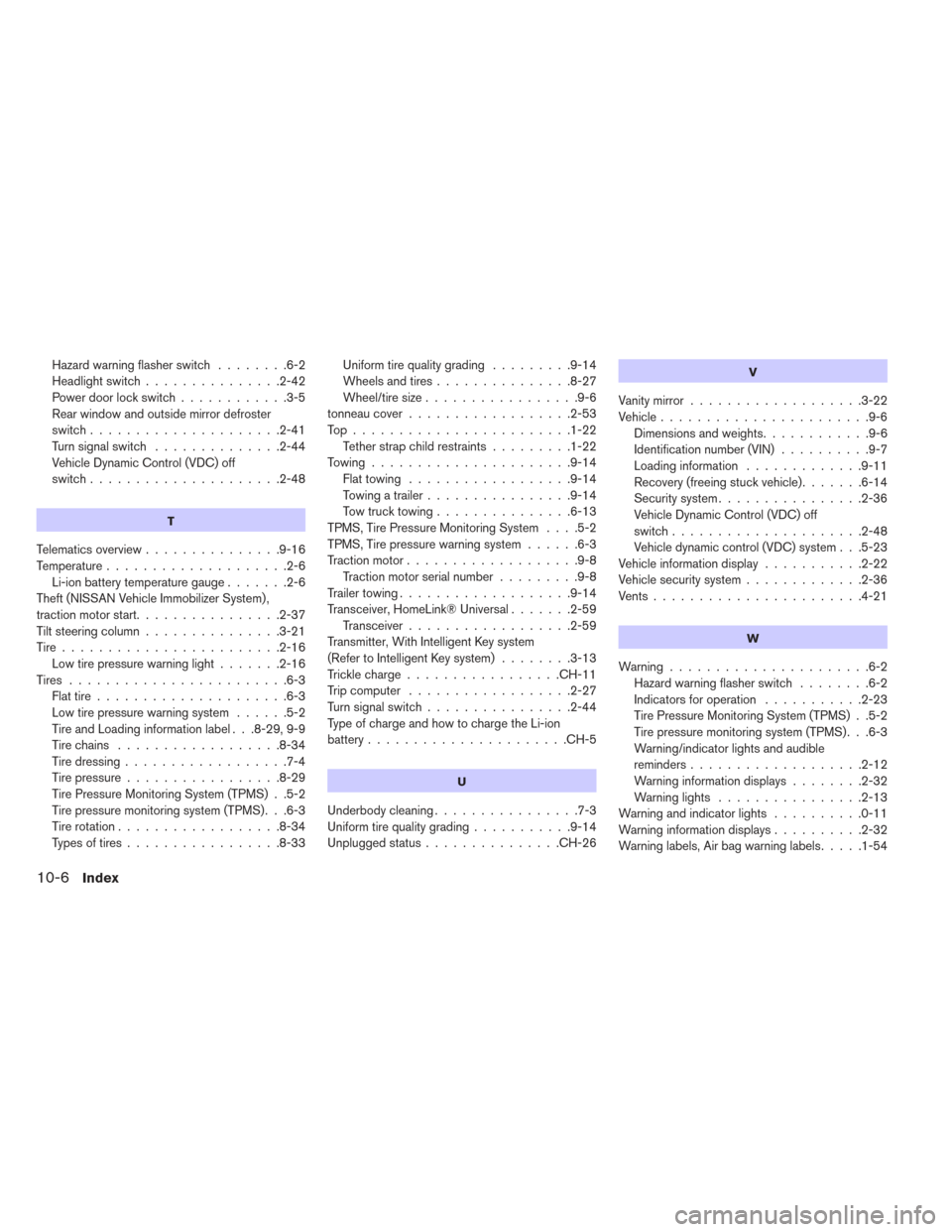
Hazard warning flasher switch........6-2
Headlightswitch...............2-42
Power door lock switch ............3-5
Rear window and outside mirror defroster
switch.....................2-41
Turnsignalswitch ..............2-44
Vehicle Dynamic Control (VDC) off
switch.....................2-48
T
Telematics overview ...............9-16
Temperature ....................2-6
Li-ion battery temperature gauge .......2-6
Theft (NISSAN Vehicle Immobilizer System) ,
traction motor start ................2-37
Tilt steering column ...............3-21
Tire........................2-16 Low tire pressure warning light .......2-16
Tires ........................6-3 Flat tire .....................6-3
Low tire pressure warning system ......5-2
Tire and Loading information label . . .8-29, 9-9
Tire chains ..................8-34
Tire dressing ..................7-4
Tirepressure.................8-29
Tire Pressure Monitoring System (TPMS) . .5-2
Tire pressure monitoring system (TPMS). . .6-3
Tirerotation..................8-34
Types of tires .................8-33 Uniform tire quality grading
.........9-14
Wheels and tires ...............8-27
Wheel/tire size .................9-6
tonneaucover..................2-53
Top........................1-22 Tether strap child restraints .........1-22
Towing......................9-14 Flattowing ..................9-14
Towing a trailer ................9-14
Towtrucktowing...............6-13
TPMS, Tire Pressure Monitoring System ....5-2
TPMS, Tire pressure warning system ......6-3
Tractionmotor...................9-8 Traction motor serial number .........9-8
Trailer towing ...................9-14
Transceiver, HomeLink® Universal .......2-59
Transceiver ..................2-59
Transmitter, With Intelligent Key system
(Refer to Intelligent Key system) ........3-13
Tricklecharge.................CH-11
Trip computer ..................2-27
Turn signal switch ................2-44
Type of charge and how to charge the Li-ion
battery ......................CH-5
U
Underbody cleaning ................7-3
Uniform tire quality grading ...........9-14
Unplugged status ...............CH-26
V
Vanity mirror...................3-22
Vehicle.......................9-6 Dimensionsandweights............9-6
Identification number (VIN) ..........9-7
Loading information .............9-11
Recovery (freeing stuck vehicle) .......6-14
Security system ................2-36
Vehicle Dynamic Control (VDC) off
switch.....................2-48
Vehicle dynamic control (VDC) system . . .5-23
Vehicle information display ...........2-22
Vehicle security system .............2-36
Vents.......................4-21
W
Warning......................6-2 Hazard warning flasher switch ........6-2
Indicators for operation ...........2-23
Tire Pressure Monitoring System (TPMS) . .5-2
Tire pressure monitoring system (TPMS). . .6-3
Warning/indicator lights and audible
reminders...................2-12
Warning information displays ........2-32
Warning lights ................2-13
Warning and indicator lights ..........0-11
Warning information displays ..........2-32
Warning labels, Air bag warning labels .....1-54
10-6Index