Please contact following number if the high voltage battery cannot be discharged.
• Nissan EV Customer Support: 1-877-664-2738 (Hours of operation are Monday - Friday
7am - 7pm, Saturday 8am - 4:30pm Central time zone)
• Nissan Consumer Affairs: 1-800-647-7261 (US) or 1-800-387-0122 (Canada) (Hours of operation are 8am - 5pm (Monday - Friday) Eastern, Central and Pacific time zones)
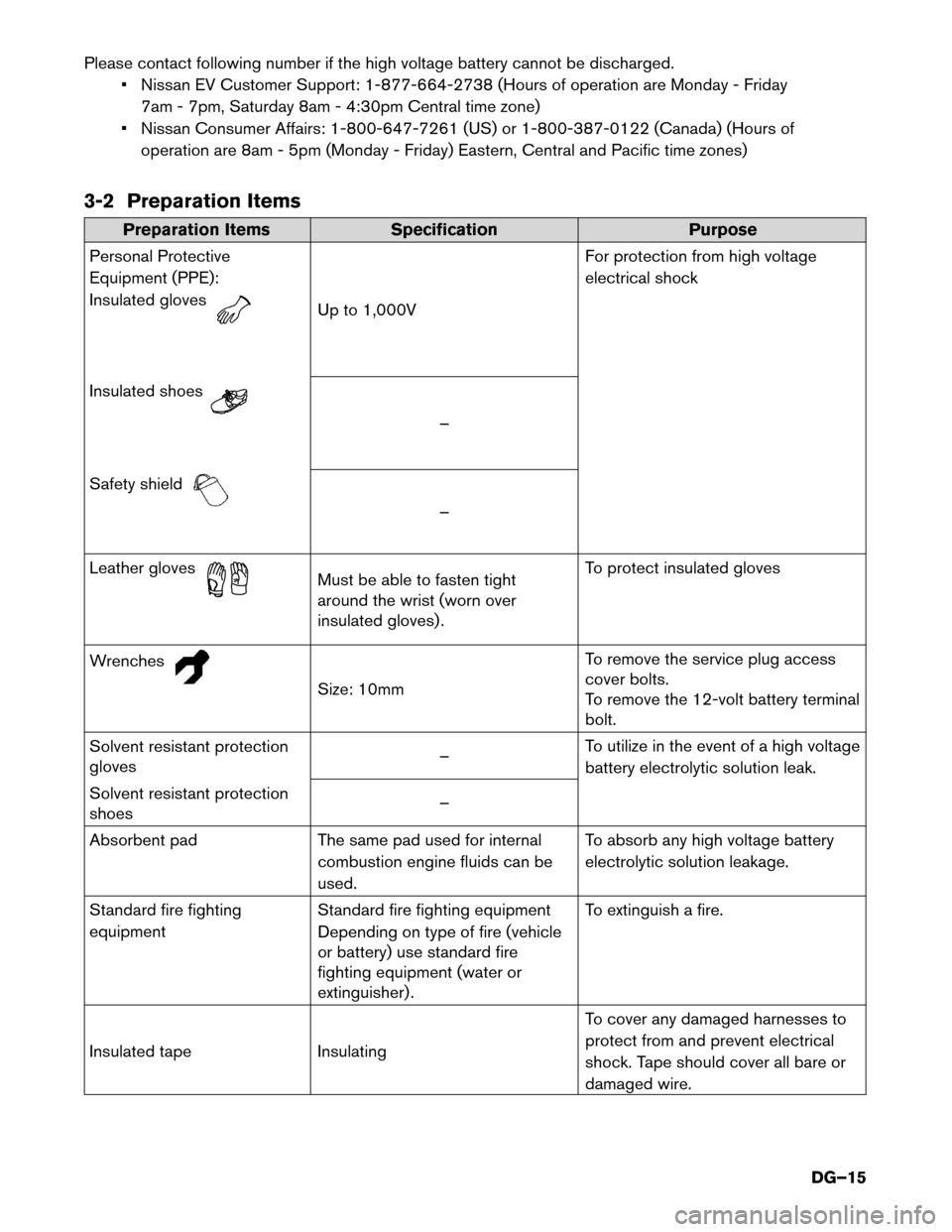
3-2 Preparation Items Preparation Items
Specification Purpose
Personal
Protective
Equipment (PPE):
Insulated gloves Up to 1,000V
For
protection from high voltage
electrical shock
Insulated shoes –
Safety
shield –
Leather
gloves Must be able to fasten tight
around
the wrist (worn over
insulated gloves) . To protect insulated gloves
Wrenches Size: 10mm
T
o remove the service plug access
cover bolts.
To remove the 12-volt battery terminal
bolt.
Solvent resistant protection
gloves –
To utilize in the event of a high voltage
battery electrolytic solution leak.
Solvent resistant protection
shoes –
Absorbent pad The same pad used for internal
combustion engine fluids can be
used. To absorb any high voltage battery
electrolytic solution leakage.
Standard fire fighting
equipment Standard fire fighting equipment
Depending on type of fire (vehicle
or battery) use standard fire
fighting equipment (water or
extinguisher) . To extinguish a fire.
Insulated tape Insulating To cover any damaged harnesses to
protect from and prevent electrical
shock. Tape should cover all bare or
damaged wire.
DG–15
3-3 Personal Protective Equipment (PPE) and Insulated Tools
3-3.1
Personal Protective Equipment (PPE) Protective Wear Control
Perform an inspection of the Personal Protective Equipment (PPE) items before beginning work. Do not use
any damaged PPE items.
3-3.2 Daily Inspection
This inspection is performed before and after use. The worker who will be using the items should perform
the inspection and check for deterioration and damage. • Insulated rubber gloves should be inspected for scratches, holes and tears. (Visual check and airleakage test)
• Insulated safety boots should be inspected for holes, damage, nails, metal pieces, wear or other problems on the soles. (Visual check)
• Insulated rubber sheet should be inspected for tears. (Visual check)
3-3.3 Insulated Tools
When performing work at locations where high voltage is applied (such as terminals) , use insulated tools
meeting 1,000V/300A specifications.
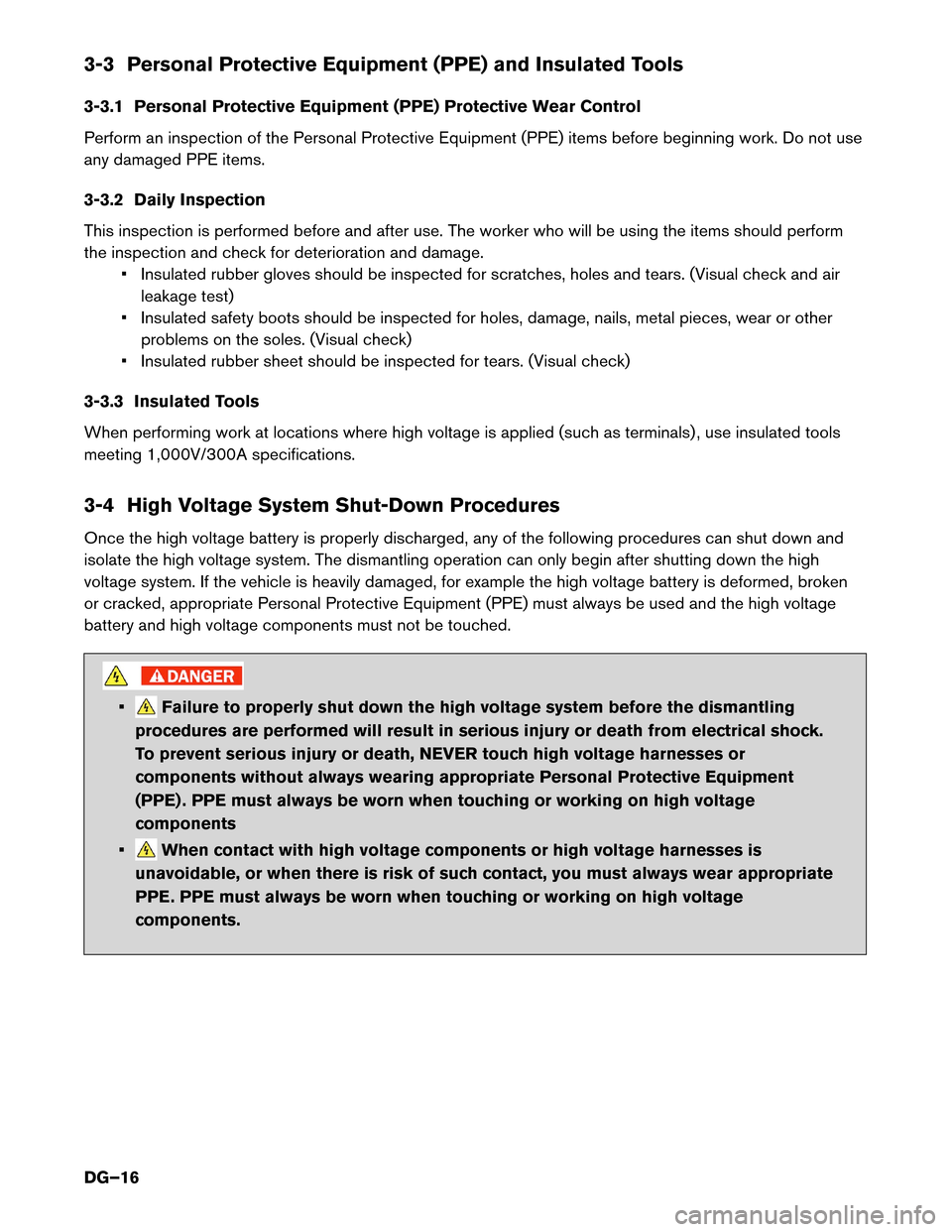
3-4 High Voltage System Shut-Down Procedures
Once the high voltage battery is properly discharged, any of the following procedures can shut down and
isolate the high voltage system. The dismantling operation can only begin after shutting down the high
voltage system. If the vehicle is heavily damaged, for example the high voltage battery is deformed, broken
or cracked, appropriate Personal Protective Equipment (PPE) must always be used and the high voltage
battery and high voltage components must not be touched. • Failure to properly shut down the high voltage system before the dismantling
procedures
are performed will result in serious injury or death from electrical shock.
To prevent serious injury or death, NEVER touch high voltage harnesses or
components without always wearing appropriate Personal Protective Equipment
(PPE) . PPE must always be worn when touching or working on high voltage
components
• When contact with high voltage components or high voltage harnesses is
unavoidable,
or when there is risk of such contact, you must always wear appropriate
PPE. PPE must always be worn when touching or working on high voltage
components.
DG–16