2016 NISSAN LEAF battery
[x] Cancel search: batteryPage 26 of 46
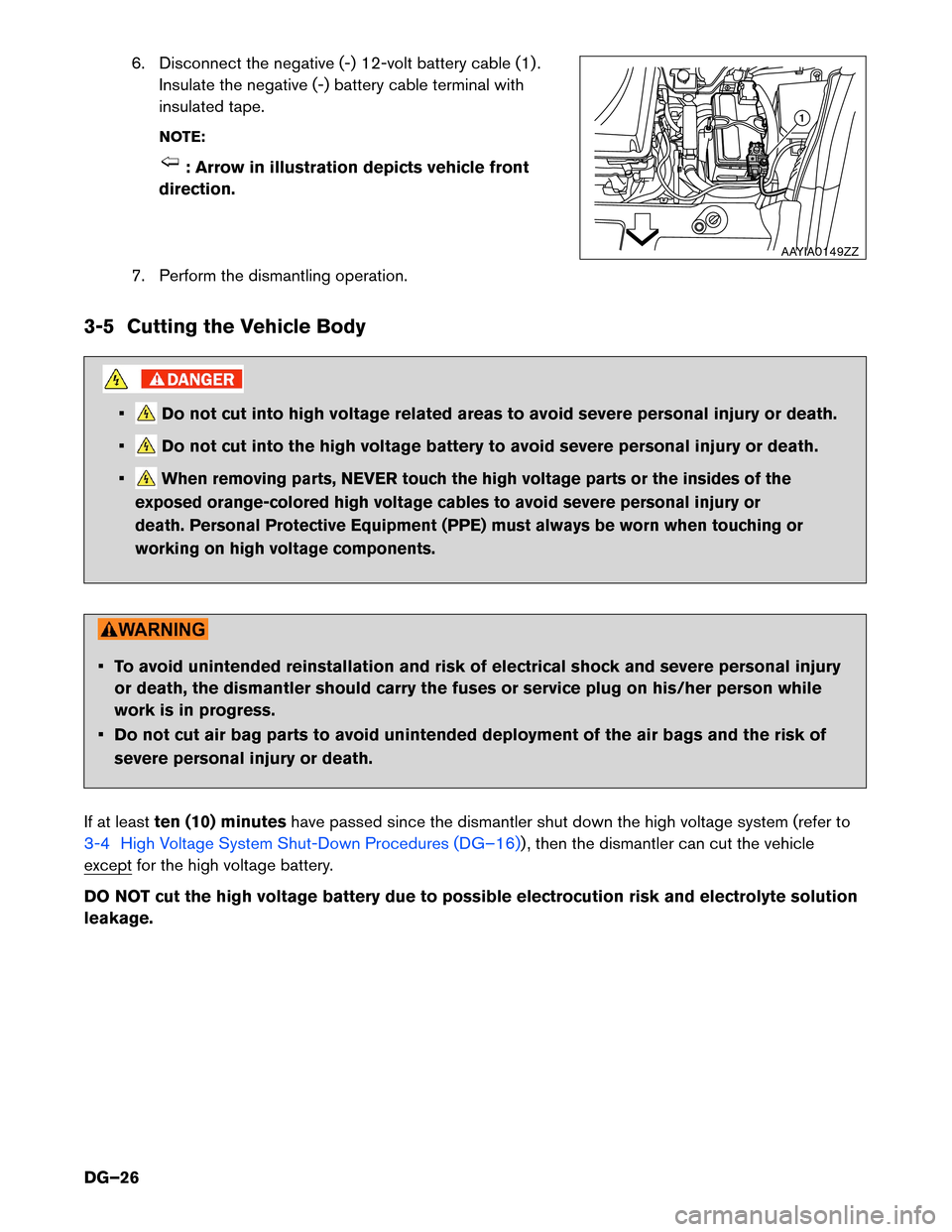
6. Disconnect the negative (-) 12-volt battery cable (1) .
Insulate the negative (-) battery cable terminal with
insulated tape.
NOTE: : Arrow in illustration depicts vehicle front
direction.
7.
Perform the dismantling operation.
3-5 Cutting the Vehicle Body • Do not cut into high voltage related areas to avoid severe personal injury or death.
• Do not cut into the high voltage battery to avoid severe personal injury or death.
•
When removing parts, NEVER touch the high voltage parts or the insides of the
exposed orange-colored high voltage cables to avoid severe personal injury or
death. Personal Protective Equipment (PPE) must always be worn when touching or
working on high voltage components. • To avoid unintended reinstallation and risk of electrical shock and severe personal injury
or
death, the dismantler should carry the fuses or service plug on his/her person while
work is in progress.
• Do not cut air bag parts to avoid unintended deployment of the air bags and the risk of severe personal injury or death.
If at least ten (10) minutes have passed since the dismantler shut down the high voltage system (refer to
3-4 High Voltage System Shut-Down Procedures (DG–16)) , then the dismantler can cut the vehicle
except
for the high voltage battery. DO NOT cut the high voltage battery due to possible electrocution risk and electrolyte solution
leakage. 1
AAYIA0149ZZ
DG–26
Page 27 of 46
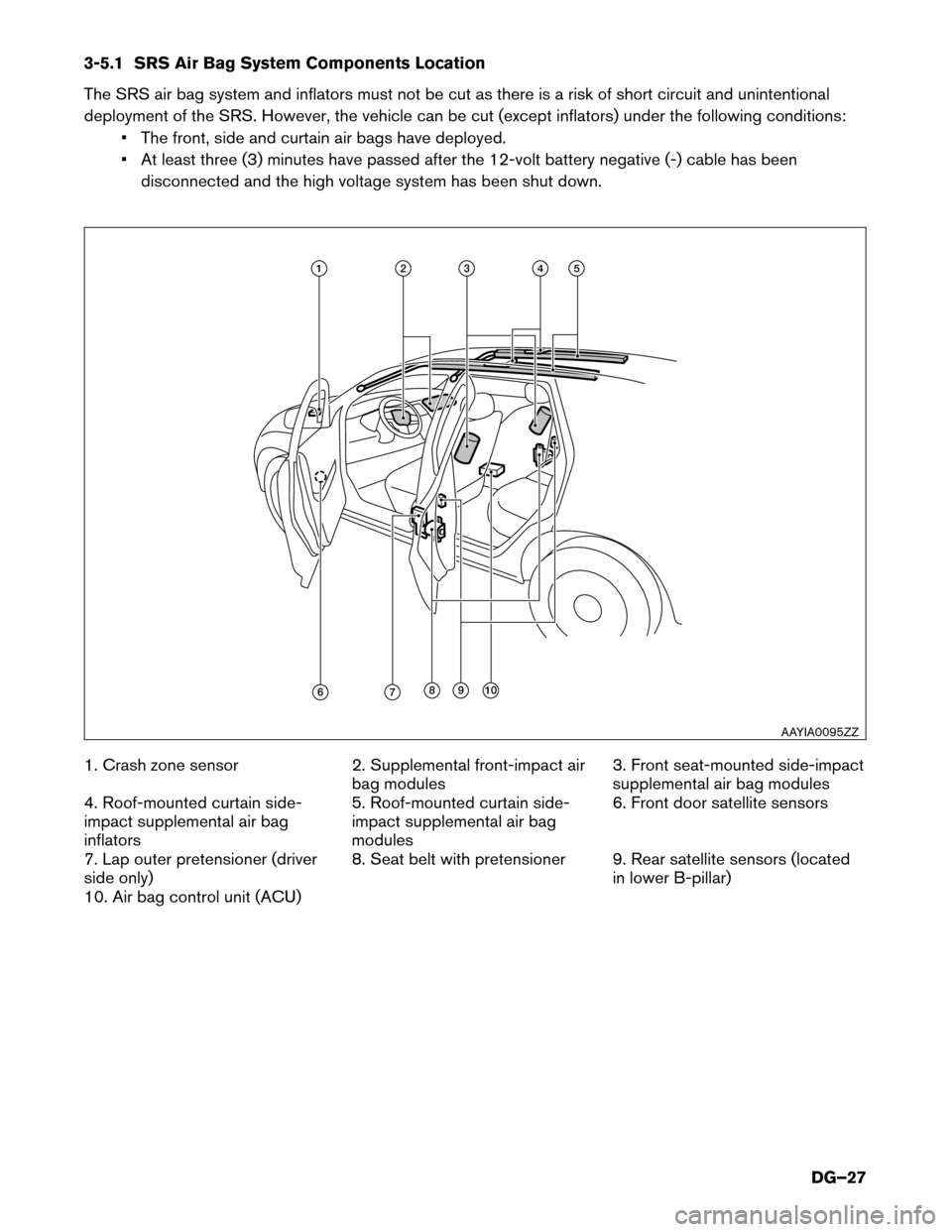
3-5.1 SRS Air Bag System Components Location
The
SRS air bag system and inflators must not be cut as there is a risk of short circuit and unintentional
deployment of the SRS. However, the vehicle can be cut (except inflators) under the following conditions: • The front, side and curtain air bags have deployed.
• At least three (3) minutes have passed after the 12-volt battery negative (-) cable has beendisconnected and the high voltage system has been shut down.
1. Crash zone sensor 2. Supplemental front-impact air
bag modules 3. Front seat-mounted side-impact
supplemental air bag modules
4. Roof-mounted curtain side-
impact supplemental air bag
inflators 5. Roof-mounted curtain side-
impact supplemental air bag
modules6. Front door satellite sensors
7. Lap outer pretensioner (driver
side only) 8. Seat belt with pretensioner 9. Rear satellite sensors (located
in lower B-pillar)
10. Air bag control unit (ACU) 11 2 3 4 5
6 7 8 9 10
AAYIA0095ZZ
DG–27
Page 28 of 46
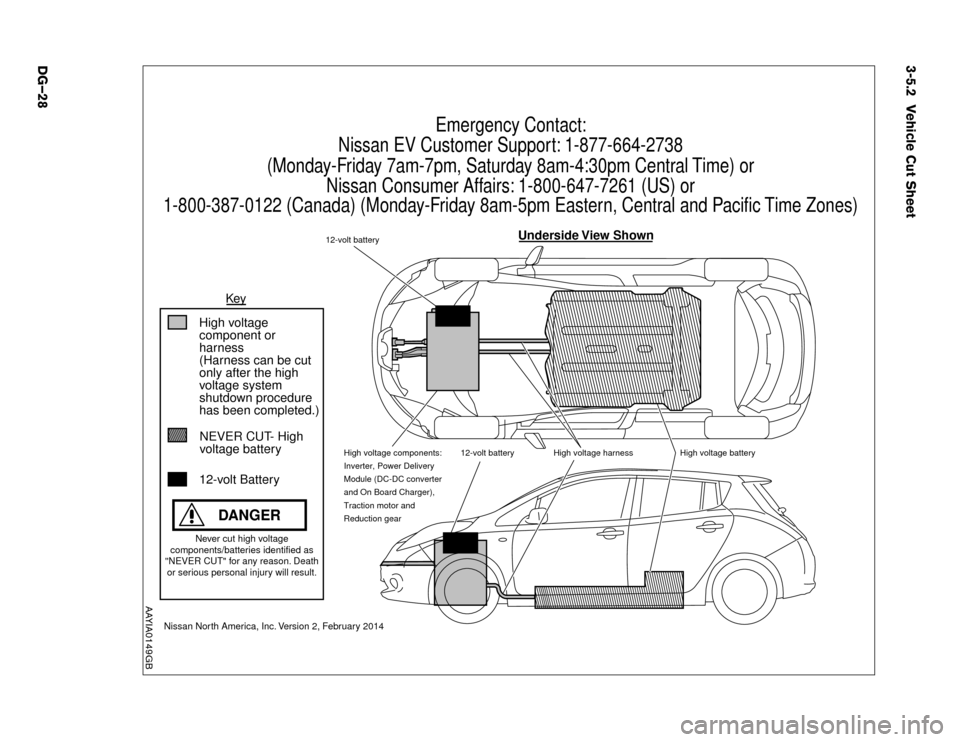
3-5.2 Vehicle Cut Sheet12-volt Battery
Nissan North America, Inc. Version 2, February 2014 DANGER
High voltage battery
High voltage harness
12-volt battery
12-volt battery
1-800-387-0122 (Canada) (Monday-Friday 8am-5pm Eastern, Central and Pacific Time Zones) Nissan Consumer Affairs: 1-800-647-7261 (US) or
(Monday-Friday 7am-7pm, Saturday 8am-4:30pm Central Time) or Nissan EV Customer Support: 1-877-664-2738
Emergency Contact:
NEVER CUT- High
voltage battery
High voltage
component or
harness
(Harness can be cut
only after the high
voltage system
shutdown procedure
has been completed.)
Never cut high voltage
components/batteries identified as
"NEVER CUT" for any reason. Death or serious personal injury will result. High voltage components:
Inverter, Power Delivery
Module (DC-DC converter
and On Board Charger),
Traction motor and
Reduction gear
Key
Under
side View Shown
AAYIA0149GB
DG–28
Page 30 of 46
3-6 High Voltage Battery Damage and Fluid Leaks
The high voltage battery contains electrolyte solution. To avoid exposure to electrolyte
solution
and serious personal injury, always wear appropriate solvent resistant Personal
Protective Equipment (PPE) and read the following precautions:
• Electrolyte solution is a skin irritant.
• Electrolyte solution is an eye irritant – If contact with eyes, rinse with plenty of water and see a doctor immediately.
• If electrolyte leak occurs, wear appropriate solvent resistant PPE and use a dry cloth to clean up the spilled electrolyte. Be sure to adequately ventilate the area.
• Electrolyte solution is highly flammable
• Electrolyte liquid or fumes that have come into contact with water vapors in the air will create an oxidized substance. This substance may irritate skin and eyes. In these
cases, rinse with plenty of water and see a doctor immediately.
• Electrolyte fumes (when inhaled) can cause respiratory irritation and acute intoxication. Move to fresh air and wash mouth with water. See a doctor immediately.
In cases of battery case breach or electrolyte leakage, contact the fire department immediately. If you must
walk away from the vehicle, notify an appropriate responder of the fact that the vehicle is an electric car and
contains a high voltage system and warn all others.
High voltage Battery Electrolyte Solution Characteristics: • Clear in color
• Sweet odor
• Similar viscosity to water
• Since the high voltage battery is made up of many small sealed battery modules, electrolyte solutionleakage should be minimal.
NOTE:
Other fluids in the vehicle are the same as those in a conventional internal combustion
vehicle.
DG–30
Page 31 of 46
4. Jump Starting
T
o start the EV system with a booster battery, the instructions and precautions below must be followed. If done incorrectly, jump starting can lead to a 12-volt battery explosion, resulting in severe
personal
injury or death. It could also damage your vehicle.
Discharged 12-volt battery may cause the following issues: • The instrument cluster cannot be displayed while the power switch is turned ON. The start-upsound is not audible. (The electric car system cannot start.)
• The high voltage battery cannot be charged.
• The vehicle cannot be shifted out of PARK normally. • To avoid electrical shock, the high voltage battery CANNOT be jump started.
•
Explosive hydrogen gas is always present in the vicinity of the 12-volt battery. Keep all
sparks and flames away from the 12-volt battery. Make sure the vent tube is correctly
installed.
• Do not allow battery fluid to come into contact with eyes, skin, clothing or painted surfaces. Battery fluid is a corrosive sulfuric acid solution that can cause severe burns.
If the fluid comes into contact with anything, immediately flush the contacted area
with water.
• The booster battery must be rated at 12 volts. Use of an improperly rated battery can damage the vehicle.
• Whenever working on or near a 12-volt battery, always wear suitable eye protectors (for example, goggles or industrial safety spectacles) and remove rings, metal bands,
or any other jewelry. Do not lean over the 12-volt battery when jump starting.
• Do not attempt to jump start a frozen battery. It could explode and cause serious injury.
• LEAF is equipped with an automatic cooling fan. It could come on at any time. Keep hands and other objects away from it.
• Always follow the jump starting instructions below. Failure to do so could result in damage to the charging system and cause personal injury. • Do not use LEAF to jump start another vehicle.
•
Do not attempt to perform a jump start on the 12-volt battery at the same time that the
high voltage battery is being charged. Doing so may damage the vehicle or charging
equipment and could cause an injury.
DG–31
Page 32 of 46
4-1 Jump Starting Procedures
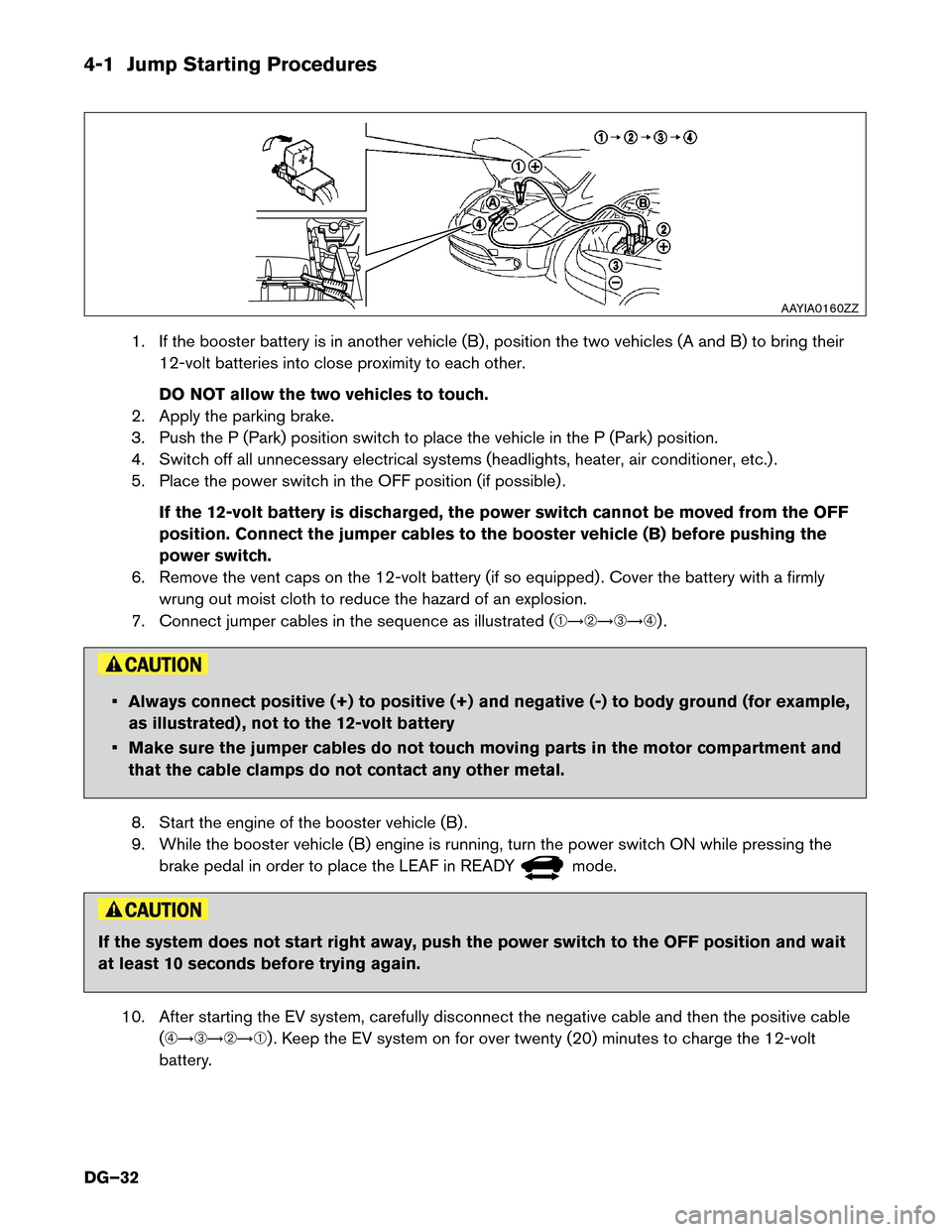
1. If the booster battery is in another vehicle (B) , position the two vehicles (A and B) to bring their
12-volt batteries into close proximity to each other.
DO NOT allow the two vehicles to touch.
2. Apply the parking brake.
3. Push the P (Park) position switch to place the vehicle in the P (Park) position.
4. Switch off all unnecessary electrical systems (headlights, heater, air conditioner, etc.) .
5. Place the power switch in the OFF position (if possible) .
If the 12-volt battery is discharged, the power switch cannot be moved from the OFF
position. Connect the jumper cables to the booster vehicle (B) before pushing the
power switch.
6. Remove the vent caps on the 12-volt battery (if so equipped) . Cover the battery with a firmly wrung out moist cloth to reduce the hazard of an explosion.
7. Connect jumper cables in the sequence as illustrated () . • Always connect positive (+) to positive (+) and negative (-) to body ground (for example,
as
illustrated) , not to the 12-volt battery
• Make sure the jumper cables do not touch moving parts in the motor compartment and that the cable clamps do not contact any other metal.
8. Start the engine of the booster vehicle (B) .
9. While the booster vehicle (B) engine is running, turn the power switch ON while pressing the brake pedal in order to place the LEAF in READY mode.
If the system does not start right away, push the power switch to the OFF position and wait
at
least 10 seconds before trying again.
10. After starting the EV system, carefully disconnect the negative cable and then the positive cable () . Keep the EV system on for over twenty (20) minutes to charge the 12-volt
battery. AAYIA0160ZZ
DG–32
Page 33 of 46
11. Replace the vent caps (if so equipped) . Be sure to properly dispose of the cloth used to cover
the vent holes because it may be contaminated with corrosive acid.
12. If necessary, connect the vehicle to a charging station or EVSE (Electric Vehicle Supply Equipment) to charge the high voltage battery. The vehicle cannot be driven unless the high
voltage battery is charged.
NOTE:
If it is not possible to turn the LEAF system ON by following this procedure, it is
recommended you contact a NISSAN certified LEAF dealer immediately.
4-2 P (Park) Position Release Procedure
If you need to release the vehicle from the P (Park) position, proceed as follows. When power switch is
turned OFF or 12-volt battery is low, LEAF automatically shifts to P position.
NOTE: This procedure requires two (2) people.
1. To start the EV system with a booster battery, refer to 4. Jump Starting (DG–31).
2.
Turn power switch ON by pushing the power switch 2 times without pressing brake pedal.
3. Confirm parking brake is applied.
4. Close all doors and press and hold the brake pedal.
5. Place the selector lever in the N (Neutral) position.
6. Remove the following 2 fuses:
• F/L 40A PBW MTR (under hood fuse and relay box)
• METER 1 10A (in the cabin fuse box)
DG–33
Page 35 of 46
Cabin Fuse Box Location
NO
TE:
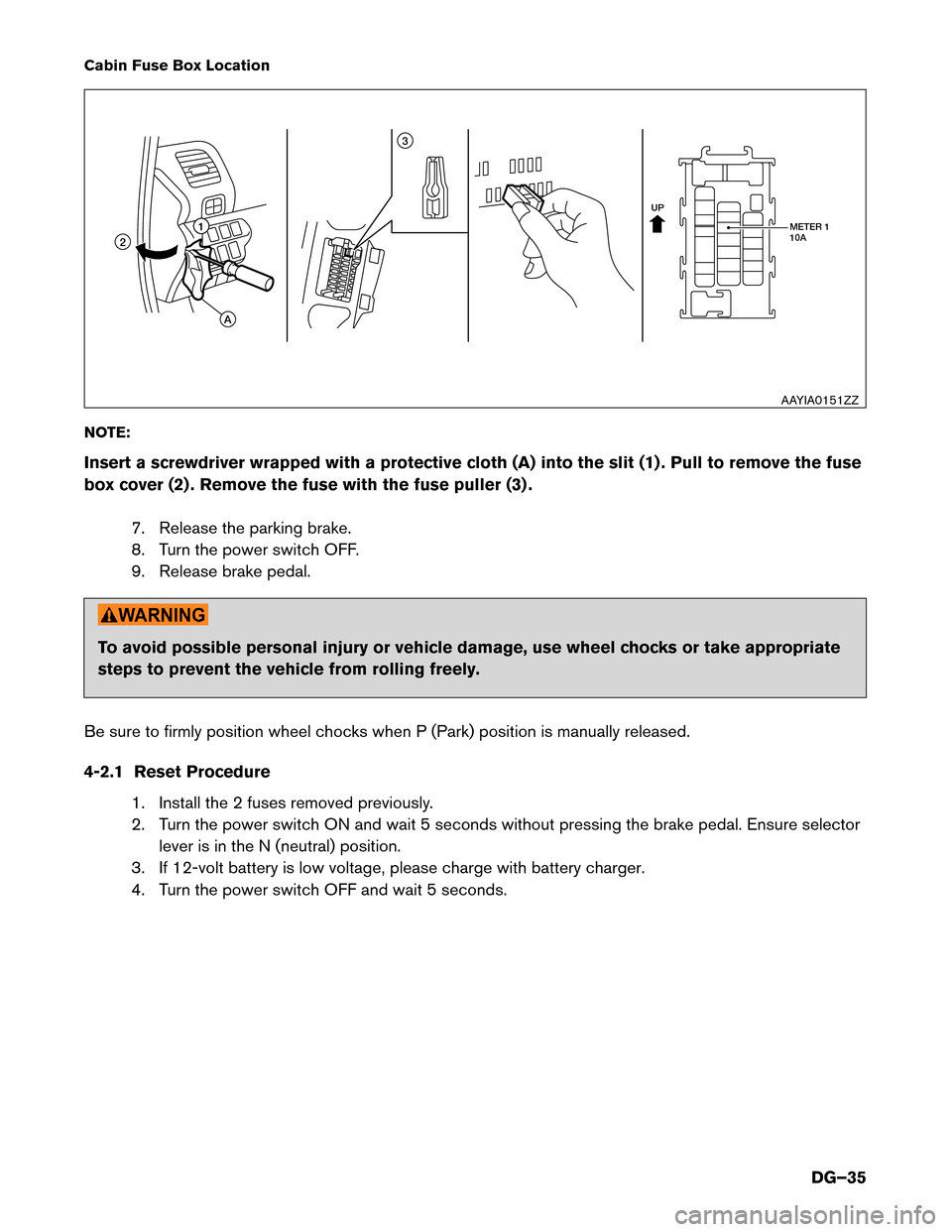
Insert a screwdriver wrapped with a protective cloth (A) into the slit (1) . Pull to remove the fuse
box cover (2) . Remove the fuse with the fuse puller (3) .
7. Release the parking brake.
8. Turn the power switch OFF.
9. Release brake pedal. To avoid possible personal injury or vehicle damage, use wheel chocks or take appropriate
steps
to prevent the vehicle from rolling freely.
Be sure to firmly position wheel chocks when P (Park) position is manually released.
4-2.1 Reset Procedure 1. Install the 2 fuses removed previously.
2. Turn the power switch ON and wait 5 seconds without pressing the brake pedal. Ensure selectorlever is in the N (neutral) position.
3. If 12-volt battery is low voltage, please charge with battery charger.
4. Turn the power switch OFF and wait 5 seconds. UP
METER 1
10A
11 3
2
A
AAYIA0151ZZ
DG–35