2016 NISSAN FRONTIER Fluids
[x] Cancel search: FluidsPage 421 of 469
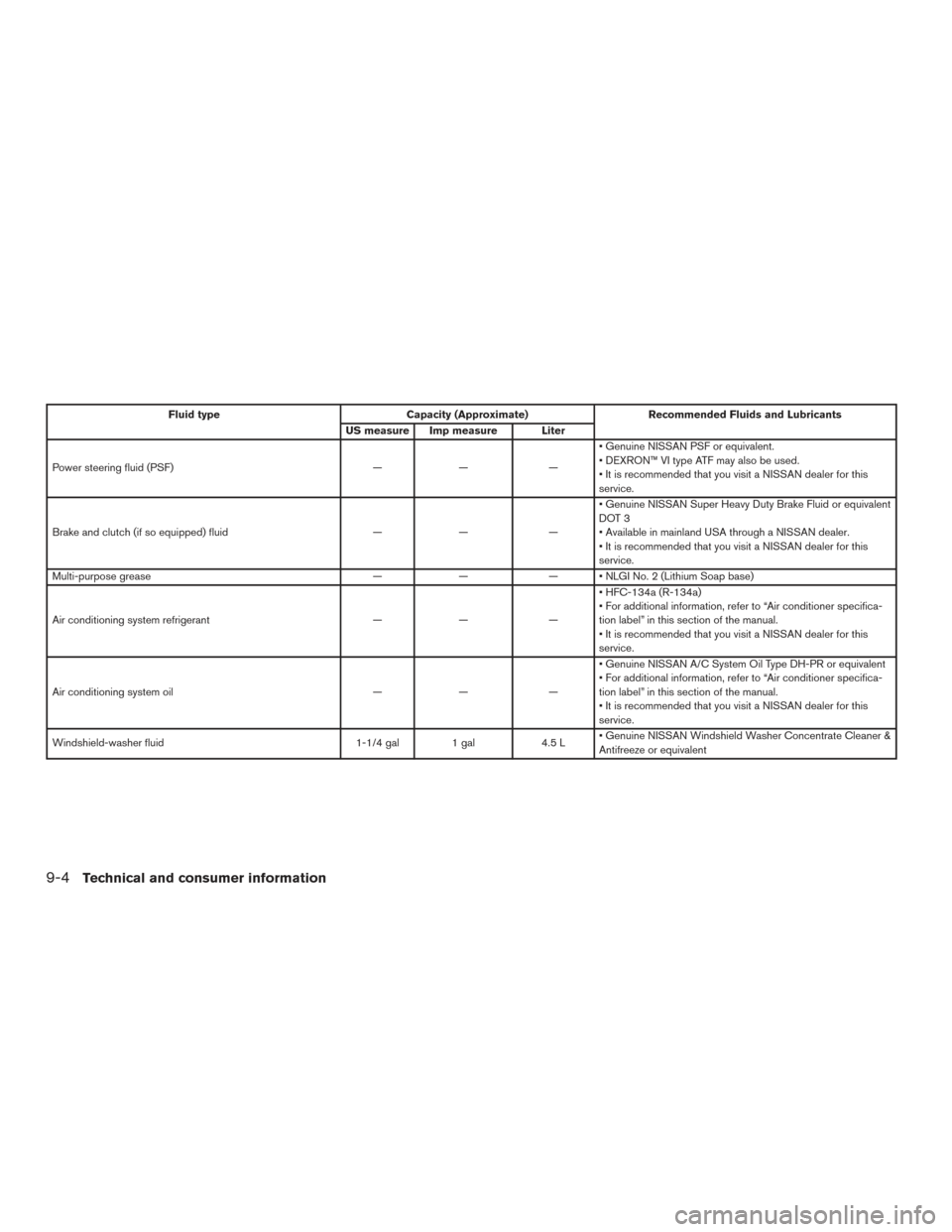
Fluid typeCapacity (Approximate) Recommended Fluids and Lubricants
US measure Imp measure Liter
Power steering fluid (PSF) —— —• Genuine NISSAN PSF or equivalent.
• DEXRON™ VI type ATF may also be used.
• It is recommended that you visit a NISSAN dealer for this
service.
Brake and clutch (if so equipped) fluid —— —• Genuine NISSAN Super Heavy Duty Brake Fluid or equivalent
DOT 3
• Available in mainland USA through a NISSAN dealer.
• It is recommended that you visit a NISSAN dealer for this
service.
Multi-purpose grease —— — • NLGI No. 2 (Lithium Soap base)
Air conditioning system refrigerant —— —• HFC-134a (R-134a)
• For additional information, refer to “Air conditioner specifica-
tion label” in this section of the manual.
• It is recommended that you visit a NISSAN dealer for this
service.
Air conditioning system oil —— —• Genuine NISSAN A/C System Oil Type DH-PR or equivalent
• For additional information, refer to “Air conditioner specifica-
tion label” in this section of the manual.
• It is recommended that you visit a NISSAN dealer for this
service.
Windshield-washer fluid 1-1/4 gal 1 gal4.5 L• Genuine NISSAN Windshield Washer Concentrate Cleaner &
Antifreeze or equivalent
9-4Technical and consumer information
Page 424 of 469
Incorrect ignition timing may result in spark
knock, after-run and/or overheating, which may
cause excessive fuel consumption or engine
damage. If any of the above symptoms are en-
countered, have your vehicle checked. It is rec-
ommended that you visit a NISSAN dealer for
servicing.
However, now and then you may notice
light spark knock for a short time while
accelerating or driving up hills. This is not a
cause for concern, because you get the
greatest fuel benefit when there is light
spark knock for a short time under heavy
engine load.
ENGINE OIL AND OIL FILTER
RECOMMENDATIONS
Selecting the correct oil
It is essential to choose the correct grade, quality
and viscosity engine oil to ensure satisfactory
engine life and performance. For additional infor-
mation, refer to “Recommended fluids/lubricants
and capacities” in this section. NISSAN recom-
mends the use of an energy conserving oil in
order to improve fuel economy.
Select only engine oils that meet the American
Petroleum Institute (API) certification or Interna-
tional Lubricant Standardization and ApprovalCommittee (ILSAC) certification and SAE vis-
cosity standard. These oils have the API certifica-
tion mark on the front of the container. Oils which
do not have the specified quality label should not
be used as they could cause engine damage.Oil additives
NISSAN does not recommend the use of oil
additives. The use of an oil additive is not neces-
sary when the proper oil type is used and main-
tenance intervals are followed.
Oil which may contain foreign matter or has been
previously used should not be used.
LTI2061
Technical and consumer information9-7
Page 464 of 469
O
Octanerating(Seefueloctanerating)......9-6
Odometer .....................2-4
Oil Capacities and recommended
fuel/lubricants .................9-2
Changing engine oil .............8-12
Changing engine oil filter ..........8-13
Checking engine oil level ..........8-11
Engine oil ...................8-11
Engine oil and oil filter recommendation . . .9-7
Engine oil viscosity ..............9-8
Oneshotcall...........4-79,4-93,4-103
Outside mirrors .................3-16
Overdrive switch .................5-17
Overheat Ifyourvehicleoverheats...........6-13
Owner’s manual order form ...........9-41
Owner’s manual/service manual order
information ....................9-41
P
Parking Parking brake operation ...........5-20
Parking/parking on hills ...........5-33
Phone, Bluetooth® hands-free
system ...............4-75,4-90,4-101
Power Front seat adjustment .............1-5
Power door locks ...............3-4
Power outlet .................2-38
Power steering fluid .............8-15 Power steering system
...........5-34
Power windows ...............2-48
Rear power windows ............2-50
Power outlet ...................2-38
Power steering ..................5-34
Power steering fluid ...............8-15
Precautions Maintenance precautions ...........8-5
On-pavement and off-road driving
precautions ..................5-6
Precautions on booster
seats...........1-27,1-39,1-54,1-65
Precautions on child
restraints .........1-27,1-39,1-54,1-65
Precautions on seat belt usage .......1-15
Precautions on supplemental restraint
system ....................1-70
Precautions when starting and driving ....5-2
Programmablefeatures..............4-7
Push starting ...................6-13
R
Radio Car phone or CB radio ...........4-75
FM-AM radio with compact disc (CD)
player .....................4-43
FM/AM/SAT radio with compact disc (CD)
player .................4-47,4-51
Steering wheel audio control switch ....4-69
Readiness for inspection maintenance (I/M)
test........................9-40
Rear power windows ..............2-50
Rearseat......................1-6
Rear sliding window ...............2-51 Rear sonar system
................5-41
Rear sonar system off switch ..........2-38
Rearview mirror .................3-15
RearView Monitor ................4-10
Rear window and outside mirror defroster
switch.......................2-28
Rear window defroster switch .........2-28
Recommended Fluids ...............9-2
Recorders EventData..................9-41
Refrigerant recommendation ...........
9-8
Registering a vehicle in another country ....9-12
Remote keyless entry system ........3-6,3-7
Reporting safety defects (US only) .......9-39
Roof rack .....................2-47
S
Safety Child safety rear door lock ..........3-6
Child seat belts .....1-27,1-39,1-54,1-65
Reporting safety defects (US only) .....9-39
Seat Jumpseat ...................1-7
Seat adjustment Front manual seat adjustment ........1-3
Front power seat adjustment .........1-5
Seatbackpockets................2-45
Seat belt Child safety ..................1-24
Infants and small children ..........1-25
Injured Person ................1-18
Largerchildren................1-25
Precautions on seat belt usage .......1-15
Pregnant women ...............1-18
10-5
Page 468 of 469
FUEL RECOMMENDATION:
Use unleaded regular gasoline with an octane
rating of at least 87 AKI (Anti-Knock Index) num-
ber (Research octane number 91) .
CAUTION
●Using a fuel other than that specified
could adversely affect the emission
control system, and may also affect the
warranty coverage.
● Under no circumstances should a
leaded gasoline be used, because this
will damage the three-way catalyst.
● Do not use E-15 or E-85 fuel in your
vehicle. Your vehicle is not designed to
run on E-15 or E-85 fuel. Using E-15 or
E-85 fuel in a vehicle not specifically
designed for E-15 or E-85 fuel can ad-
versely affect the emission control de-
vices and systems of the vehicle. Dam-
age caused by such fuel is not covered
by the NISSAN New Vehicle Limited
Warranty. ●
Do not use fuel that contains the octane
booster methylcyclopentadienyl man-
ganese tricarbonyl (MMT) . Using fuel
containing MMT may adversely affect
vehicle performance and vehicle emis-
sions. Not all fuel dispensers are la-
beled to indicate MMT content, so you
may have to consult your gasoline re-
tailer for more details. Note that Fed-
eral and California laws prohibit the use
of MMT in reformulated gasoline.
● U.S. government regulations require
ethanol dispensing pumps to be identi-
fied by a small, square, orange and
black label with the common abbrevia-
tion or the appropriate percentage for
that region.
For additional information, refer to “Recom-
mended fluids/lubricants and capacities” in the
“Technical and consumer information” section of
this manual.
ENGINE OIL RECOMMENDATION:
● Genuine NISSAN engine oil or equivalent
● Engine oil with API Certification Mark, Vis-
cosity SAE 5W-30 For additional information, refer to “Engine oil and
oil filter recommendations” in the “Technical and
consumer information” section of this manual.
COLD TIRE PRESSURE:
For additional information, refer to “Tire and load-
ing information label” in the “Technical and con-
sumer information” section of this manual.
The label is typically located on the driver side
center pillar or on the driver’s door. For additional
information, refer to “Wheels and tires” in the
“Maintenance and do-it-yourself” section of this
manual.
RECOMMENDED NEW VEHICLE
BREAK-IN PROCEDURE:
During the first 1,200 miles (2,000 km) of vehicle
use, follow the break-in procedure recommenda-
tions for the future reliability and economy of your
new vehicle. For additional information, refer to
“Break-in schedule” in the “Starting and driving”
section of this manual. Failure to follow these
recommendations may result in vehicle damage
or shortened engine life.
GAS STATION INFORMATION