2016 NISSAN ALTIMA service
[x] Cancel search: servicePage 447 of 491
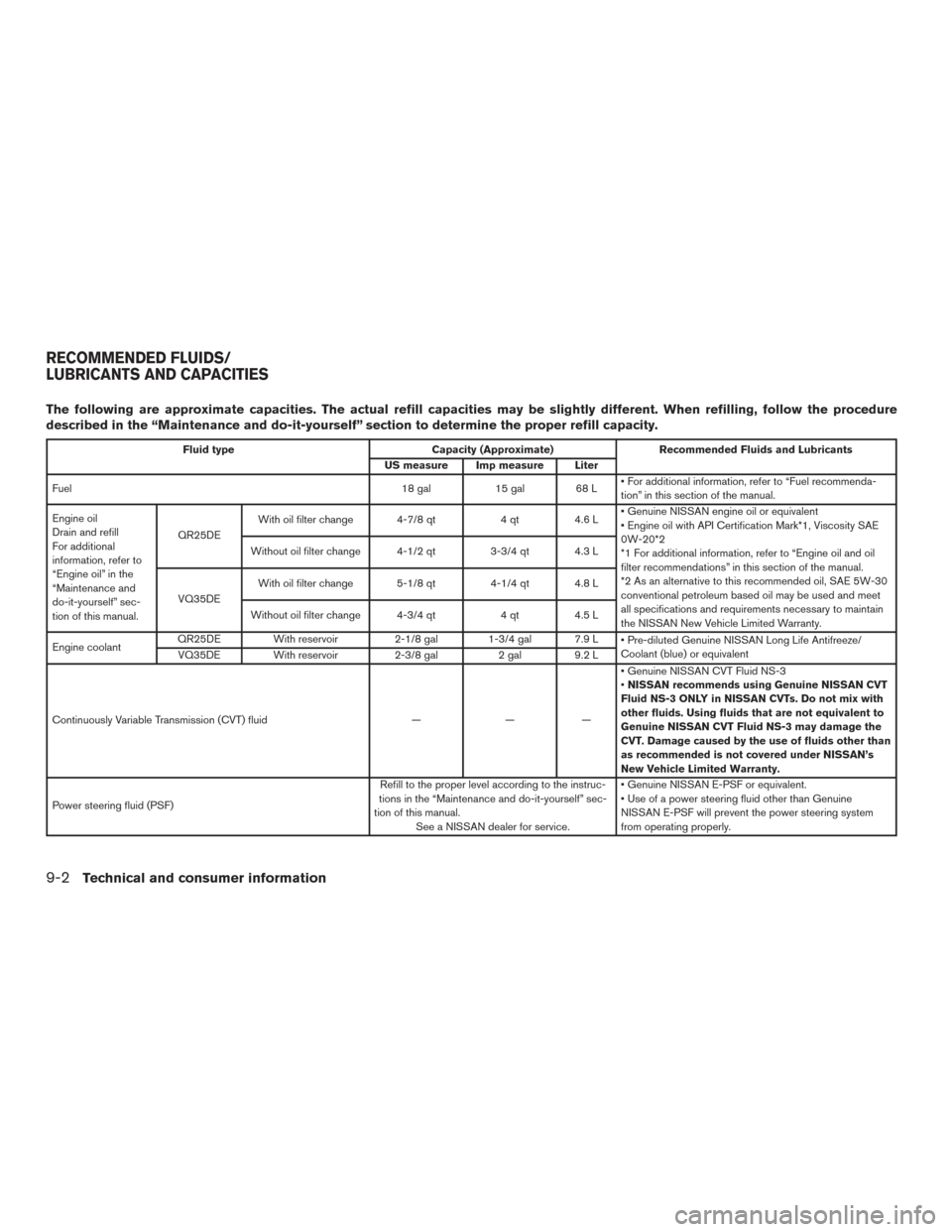
The following are approximate capacities. The actual refill capacities may be slightly different. When refilling, follow the procedure
described in the “Maintenance and do-it-yourself” section to determine the proper refill capacity.
Fluid typeCapacity (Approximate)Recommended Fluids and Lubricants
US measure Imp measure Liter
Fuel 18 gal15 gal 68 L • For additional information, refer to “Fuel recommenda-
tion” in this section of the manual.
Engine oil
Drain and refill
For additional
information, refer to
“Engine oil” in the
“Maintenance and
do-it-yourself” sec-
tion of this manual. QR25DE
With oil filter change 4-7/8 qt
4 qt4.6 L• Genuine NISSAN engine oil or equivalent
• Engine oil with API Certification Mark*1, Viscosity SAE
0W-20*2
*1 For additional information, refer to “Engine oil and oil
filter recommendations” in this section of the manual.
*2 As an alternative to this recommended oil, SAE 5W-30
conventional petroleum based oil may be used and meet
all specifications and requirements necessary to maintain
the NISSAN New Vehicle Limited Warranty.
Without oil filter change 4-1/2 qt
3-3/4 qt 4.3 L
VQ35DE With oil filter change 5-1/8 qt
4-1/4 qt 4.8 L
Without oil filter change 4-3/4 qt 4 qt4.5 L
Engine coolant QR25DE With reservoir
2-1/8 gal 1-3/4 gal 7.9 L
• Pre-diluted Genuine NISSAN Long Life Antifreeze/
Coolant (blue) or equivalent
VQ35DE With reservoir 2-3/8 gal2 gal 9.2 L
Continuously Variable Transmission (CVT) fluid ———• Genuine NISSAN CVT Fluid NS-3
•
NISSAN recommends using Genuine NISSAN CVT
Fluid NS-3 ONLY in NISSAN CVTs. Do not mix with
other fluids. Using fluids that are not equivalent to
Genuine NISSAN CVT Fluid NS-3 may damage the
CVT. Damage caused by the use of fluids other than
as recommended is not covered under NISSAN’s
New Vehicle Limited Warranty.
Power steering fluid (PSF) Refill to the proper level according to the instruc-
tions in the “Maintenance and do-it-yourself” sec-
tion of this manual. See a NISSAN dealer for service. • Genuine NISSAN E-PSF or equivalent.
• Use of a power steering fluid other than Genuine
NISSAN E-PSF will prevent the power steering system
from operating properly.
RECOMMENDED FLUIDS/
LUBRICANTS AND CAPACITIES
9-2Technical and consumer information
Page 448 of 491
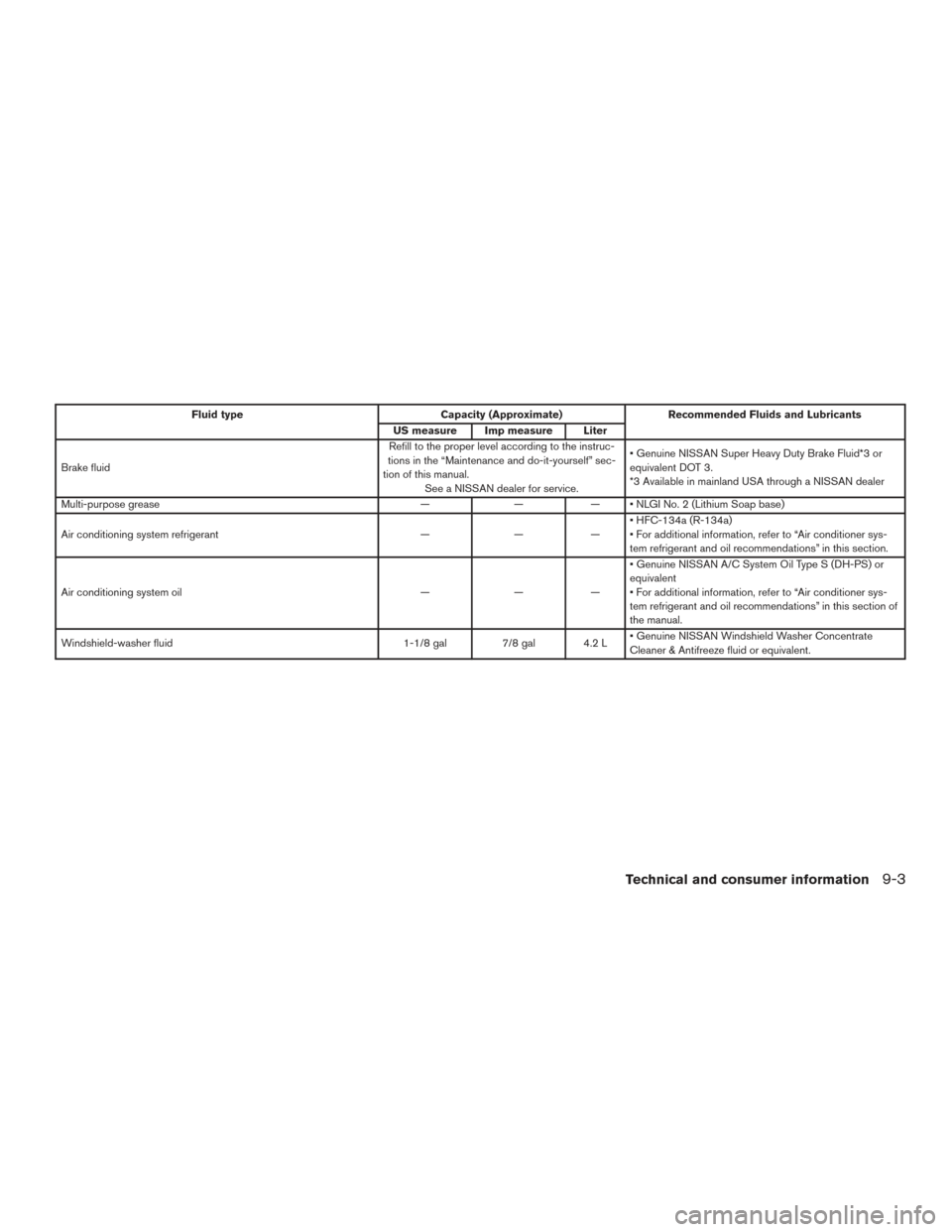
Fluid typeCapacity (Approximate)Recommended Fluids and Lubricants
US measure Imp measure Liter
Brake fluid Refill to the proper level according to the instruc-
tions in the “Maintenance and do-it-yourself” sec-
tion of this manual. See a NISSAN dealer for service. • Genuine NISSAN Super Heavy Duty Brake Fluid*3 or
equivalent DOT 3.
*3 Available in mainland USA through a NISSAN dealer
Multi-purpose grease ——— • NLGI No. 2 (Lithium Soap base)
Air conditioning system refrigerant ———• HFC-134a (R-134a)
• For additional information, refer to “Air conditioner sys-
tem refrigerant and oil recommendations” in this section.
Air conditioning system oil ———• Genuine NISSAN A/C System Oil Type S (DH-PS) or
equivalent
• For additional information, refer to “Air conditioner sys-
tem refrigerant and oil recommendations” in this section of
the manual.
Windshield-washer fluid 1-1/8 gal7/8 gal 4.2 L • Genuine NISSAN Windshield Washer Concentrate
Cleaner & Antifreeze fluid or equivalent.
Technical and consumer information9-3
Page 449 of 491
FUEL RECOMMENDATION
Use unleaded regular gasoline with an octane
rating of at least 87 AKI (Anti-Knock Index) num-
ber (Research octane number 91) .
CAUTION
●Using a fuel other than that specified
could adversely affect the emission
control system, and may also affect the
warranty coverage.
● Under no circumstances should a
leaded gasoline be used, because this
will damage the three-way catalyst.
● Do not use E-15 or E-85 fuel in your
vehicle. Your vehicle is not designed to
run on E-15 or E-85 fuel. Using E-15 or
E-85 fuel in a vehicle not specifically
designed for E-15 or E-85 fuel can ad-
versely affect the emission control de-
vices and systems of the vehicle. Dam-
age caused by such fuel is not covered
by the NISSAN New Vehicle Limited
Warranty. ●
Do not use fuel that contains the octane
booster methylcyclopentadienyl man-
ganese tricarbonyl (MMT) . Using fuel
containing MMT may adversely affect
vehicle performance and vehicle emis-
sions. Not all fuel dispensers are la-
beled to indicate MMT content, so you
may have to consult your gasoline re-
tailer for more details. Note that Fed-
eral and California laws prohibit the use
of MMT in reformulated gasoline.
● U.S. government regulations require
ethanol dispensing pumps to be identi-
fied by a small, square, orange and
black label with the common abbrevia-
tion or the appropriate percentage for
that region.
Gasoline specifications
NISSAN recommends using gasoline that meets
the World-Wide Fuel Charter (WWFC) specifi-
cations where it is available. Many of the automo-
bile manufacturers developed this specification
to improve emission control system and vehicle
performance. Ask your service station manager if
the gasoline meets the WWFC specifications.
Reformulated gasoline
Some fuel suppliers are now producing reformu-
lated gasolines. These gasolines are specially designed to reduce vehicle emissions. NISSAN
supports efforts towards cleaner air and sug-
gests that you use reformulated gasoline when
available.
Gasoline containing oxygenates
Some fuel suppliers sell gasoline containing oxy-
genates such as ethanol, Methyl Tert-butyl Ether
(MTBE) and methanol with or without advertising
their presence. NISSAN does not recommend
the use of fuels of which the oxygenate content
and the fuel compatibility for your NISSAN can-
not be readily determined. If in doubt, ask your
service station manager.
If you use oxygenate-blend gasoline, please take
the following precautions as the usage of such
fuels may cause vehicle performance problems
and/or fuel system damage.
● The fuel should be unleaded and have
an octane rating no lower than that
recommended for unleaded gasoline.
● If an oxygenate-blend other than
methanol blend is used, it should con-
tain no more than 10% oxygenate.
(MTBE may, however, be added up to
15%.)
9-4Technical and consumer information
Page 452 of 491
Oil viscosity
The engine oil viscosity or thickness changes
with temperature. Because of this, it is important
to select the engine oil viscosity based on the
temperatures at which the vehicle will be oper-
ated before the next oil change. Choosing an oil
viscosity other than that recommended could
cause serious engine damage.
Selecting the correct oil filter
Your new NISSAN vehicle is equipped with a
high-quality Genuine NISSAN oil filter. When
replacing, use a Genuine NISSAN oil filter or its
equivalent for the reason described in “Change
intervals.”
Change intervals
The oil and oil filter change intervals for your
engine are based on the use of the specified
quality oils and filters. Using engine oil and filters
that are not of the specified quality, or exceeding
recommended oil and filter change intervals
could reduce engine life. Damage to the engine
caused by improper maintenance or use of incor-
rect oil and filter quality and/or viscosity is not
covered by the NISSAN New Vehicle Limited
Warranty.Your engine was filled with a high-quality engine
oil when it was built. You do not have to change
the oil before the first recommended change
interval. Oil and filter change intervals depend
upon how you use your vehicle.
Operation under the following conditions may
require more frequent oil and filter changes:
● repeated short distance driving at cold out-
side temperatures
● driving in dusty conditions
● extensive idling
● towing a trailer
● stop and go commuting
For additional information, refer to “NISSAN Ser-
vice and Maintenance Guide” for the mainte-
nance schedule.
AIR CONDITIONER SYSTEM
REFRIGERANT AND OIL
RECOMMENDATIONS
The air conditioner system in your NISSAN
vehicle must be charged with the refriger-
ant HFC-134a (R-134a) and NISSAN A/C
system oil Type DH-PS or the exact equiva-
lents.
CAUTION
The use of any other refrigerant or oil will
cause severe damage to the air condition-
ing system and will require the replace-
ment of all air conditioner system
components.
The refrigerant HFC-134a (R-134a) in your
NISSAN vehicle does not harm the earth’s ozone
layer. Although this refrigerant does not affect the
earth’s atmosphere, certain government regula-
tions require the recovery and recycling of any
refrigerant during automotive air conditioner sys-
tem service. A NISSAN dealer has the trained
technicians and equipment needed to recover
and recycle your air conditioner system refriger-
ant.
It is recommended you visit a NISSAN dealer
when servicing your air conditioner system.
Technical and consumer information9-7
Page 462 of 491
Do not tow a trailer with your vehicle.
FLAT TOWING
Towing your vehicle with all four wheels on the
ground is sometimes called flat towing. This
method is sometimes used when towing a vehicle
behind a recreational vehicle, such as a motor
home.
CAUTION
●Failure to follow these guidelines can
result in severe transmission damage.
● Whenever flat towing your vehicle, al-
ways tow forward, never backward.
● Never tow your front wheel drive vehicle
with the front tires on the ground. Doing
so may cause serious and expensive
damage to the powertrain.
● DO NOT tow any continuously variable
transmission vehicle with all four
wheels on the ground (flat towing) . Do-
ing so WILL DAMAGE internal transmis-
sion parts due to lack of transmission
lubrication.
● For emergency towing procedures refer
to “Towing recommended by NISSAN”
in the “In case of emergency” section of
this manual.
Continuously Variable Transmission
To tow a vehicle equipped with a continuously
variable transmission, an appropriate vehicle
dolly MUST be placed under the towed vehicle’s
drive wheels. Alwaysfollow the dolly manufac-
turer’s recommendations when using their prod-
uct. DOT (Department of Transportation) Quality
Grades: All passenger car tires must conform to
federal safety requirements in addition to these
grades.
Quality grades can be found where applicable on
the tire sidewall between tread shoulder and
maximum section width. For example:
Treadwear 200 Traction AA Temperature A
Treadwear
The treadwear grade is a comparative rating
based on the wear rate of the tire when tested
under controlled conditions on a specified gov-
ernment test course. For example, a tire graded
150 would wear one and one-half (1 1/2) times
as well on the government course as a tire graded
100. The relative performance of tires depends
upon the actual conditions of their use, however,
and may depart significantly from the norm due to
variations in driving habits, service practices and
differences in road characteristics and climate.
Traction AA, A, B and C
The traction grades, from highest to lowest, are
AA, A, B, and C. Those grades represent the
tire’s ability to stop on wet pavement as mea-
sured under controlled conditions on specified
government test surfaces of asphalt and con-
crete. A tire marked C may have poor traction
performance.
TOWING A TRAILER
UNIFORM TIRE QUALITY GRADING
Technical and consumer information9-17
Page 466 of 491
Genuine NISSAN Service Manuals for this model
year and prior can be purchased. A Genuine
NISSAN Service Manual is the best source of
service and repair information for your vehicle.
This manual is the same one used by the factory-
trained technicians working at NISSAN dealer-
ships. Genuine NISSAN Owner’s Manuals can
also be purchased.
For USA
For current pricing and availability of Genuine
NISSAN Service Manuals,contact:
www.nissan-techinfo.com
For current pricing and availability of Genuine
NISSAN Owner’s Manuals, contact:
1-800-247-5321
For Canada
To purchase a copy of a Genuine NISSAN Ser-
vice Manual or Owner’s Manual, for this model
year and prior, please contact your nearest
NISSAN dealer. For the phone number and loca-
tion of a NISSAN dealer in your area, call the
NISSAN Information Center at 1-800-387-0122
and a bilingual NISSAN representative will assist
you.
OWNER’S MANUAL/SERVICE
MANUAL ORDER INFORMATION
Technical and consumer information9-21
Page 472 of 491
N
NissanConnect
SM................4-69
NissanConnectSMServices...........4-70
NISSAN Intelligent Key® .........3-2,3-20
NISSAN Vehicle Immobilizer System . .2-30, 5-11
NISSAN voice recognition system ......4-109
O
Octanerating(Seefueloctanerating)......9-5
Odometer .....................2-4
Oil Capacities and recommended
fuel/lubricants .................9-2
Changing engine oil .............8-12
Changing engine oil filter ..........8-14
Checking engine oil level ..........8-11
Engine oil ...................8-11
Engine oil and oil filter recommendation . . .9-6
Engine oil viscosity ..............9-7
One shot call . . .4-78, 4-91, 4-92, 4-102, 4-103
Outside mirrors .................3-38
Overheat Ifyourvehicleoverheats...........6-10
Owner’s manual order form ...........9-21
Owner’s manual/service manual order
information ....................9-21
P
Parking Parking brake operation ...........5-19
Parking/parking on hills ...........5-73 Personallights..................2-52
Phone, Bluetooth® hands-free
system
...............4-74,4-89,4-100
Power Power door locks ...............3-6
Power rear windows .............2-47
Power steering fluid .............8-15
Power steering system ...........5-73
Power windows ...............2-46
Rear power windows ............2-47
Power steering ..................5-73
Power steering fluid ...............8-15
Precautions Maintenance precautions ...........8-5
Precautions on booster
seats...........1-22,1-28,1-34,1-39
Precautions on child
restraints .........1-22,1-28,1-34,1-39
Precautions on seat belt usage .......1-12
Precautions on supplemental restraint
system ....................1-42
Precautions when starting and driving ....5-2
Push starting ...................6-10
R
Radio Car phone or CB radio ...........4-74
FM-AM radio with compact disc (CD)
player .....................4-35
FM/AM/SAT radio with compact disc (CD)
player ..............4-39,4-43,4-49
Readiness for inspection maintenance (I/M)
test........................9-20
Rear power windows ..............2-47 Rearseat......................1-6
Rear sonar system
................5-78
Rearview mirror .................3-36
RearView Monitor ................4-10
Rear window and outside mirror defroster
switch.......................2-32
Recommended Fluids ...............9-2
Recorders EventData..................9-20
Refrigerant recommendation ...........9-7
Registering a vehicle in another country ....9-10
Remote Start ...............3-27,5-13
Reporting safety defects (US only) .......9-19
S
Safety Child
safety rear door lock ..........3-7
Child seat belts .....1-22,1-28,1-34,1-39
Reporting safety defects (US only) .....9-19
Seat adjustment Front manual seat adjustment ........1-3
Front power seat adjustment .........1-4
Rear seat adjustment .............1-6
Seatbackpockets................2-42
Seat belt Child safety ..................1-19
Infants and small children ..........1-20
Injured Person ................1-15
Largerchildren................1-20
Precautions on seat belt usage .......1-12
Pregnant women ...............1-15
Seatbeltextenders .............1-18
Seatbeltmaintenance............1-19
Seatbelts................1-12,7-6
10-5
Page 473 of 491
Shoulder belt height adjustment......1-18
Three-point type with retractor .......1-15
Seat belt extenders ...............1-18
Seatbeltwarninglight..........1-14,2-14
Seats Adjustment ...................1-2
Armrests....................1-7
Frontseats...................1-2
Heatedseats.................2-37
Manual front seat adjustment .........1-3
Rear seat ....................1-6
Seats/floor mats ..................7-5
Security indicator light ..............2-16
Security system (NISSAN Vehicle Immobilizer
System) , engine start ...........2-30,5-11
Security systems Vehicle security system ...........2-29
Self-adjusting brakes ..............8-24
Service manual order form ...........9-21
Servicing air conditioner .............4-27
Shifting Continuously Variable Transmission
(CVT) .....................5-14
Shift lever lock release..............5-17
Shoulder belt height adjustment ........1-18
Smartphone connectivity ............4-69
Sonar Rear system .................5-78
Spark plug replacement .............8-21
Spark plugs ...................8-21
Specifications ...................9-8
Speedometer ...................2-4
Spotlights(Seemaplight) ...........2-51
SRS warning label ................1-59
Stability control .................5-76 Starting
Before starting the engine ..........5-12
Jump starting ..............6-8,8-19
Precautions when starting and driving ....5-2
Push starting .................6-10
Starting the engine .............5-12
Starting the engine ...............5-12
Steering Heated steering wheel ...........2-38
Power steering fluid .............8-15
Power steering system ...........5-73
Steeringwheel..................3-35
Stoplight.....................8-31
Storage......................2-42
Sunglassescase.................2-44
Sunglassesholder................2-44
Sunroof(seeMoonroof).............2-49
Sun visors ....................3-35
Supplemental air bag warning light . . .1-59, 2-14
Supplemental front impact air bag system . . .1-49
Supplemental restraint system Information and warning labels .......1-59
Precautions on supplemental restraint
system ....................1-42
Supplemental restraint system
(Supplemental air bag system) .........1-42
Switch Autolightswitch...............2-34
Automatic power window switch ......2-48
Foglightswitch ...............2-37
Hazard warning flasher switch ........6-2
Headlight and turn signal switch ......2-33
Headlight control switch ..........2-33
Instrument brightness control ........2-36
Power door lock switch ............3-6 Rear window and outside mirror defroster
switch
.....................2-32
Turnsignalswitch..............2-36
Vehicle dynamic control (VDC) off
switch .....................2-39
T
Tachometer ....................2-5
T
emperature gauge Engine coolant temperature gauge .....2-5
Theft (NISSAN Vehicle Immobilizer System) ,
engine start ................2-30,5-11
Three-way catalyst ................5-2
Tilt Telescopic steering .............3-35
Tire Flat tire ..................6-3,6-4
Spare tire ................6-5,8-45
Tire and Loading Information label .....9-12
Tire chains ..................8-42
Tire pressure .................8-34
Tire rotation..................8-43
Types of tires .................8-41
Uniform tire quality grading .........9-17
Wheels and tires ...............8-34
Wheel/tire size .................9-9
Tirepressure...................8-34 Low tire pressure warning light .......2-12
Tire Pressure Monitoring System
(TPMS) ....................5-3,6-3
Towing Flattowing..................9-17
Trailer towing .................9-17
Towing a trailer ..................9-17
10-6