Page 14 of 428
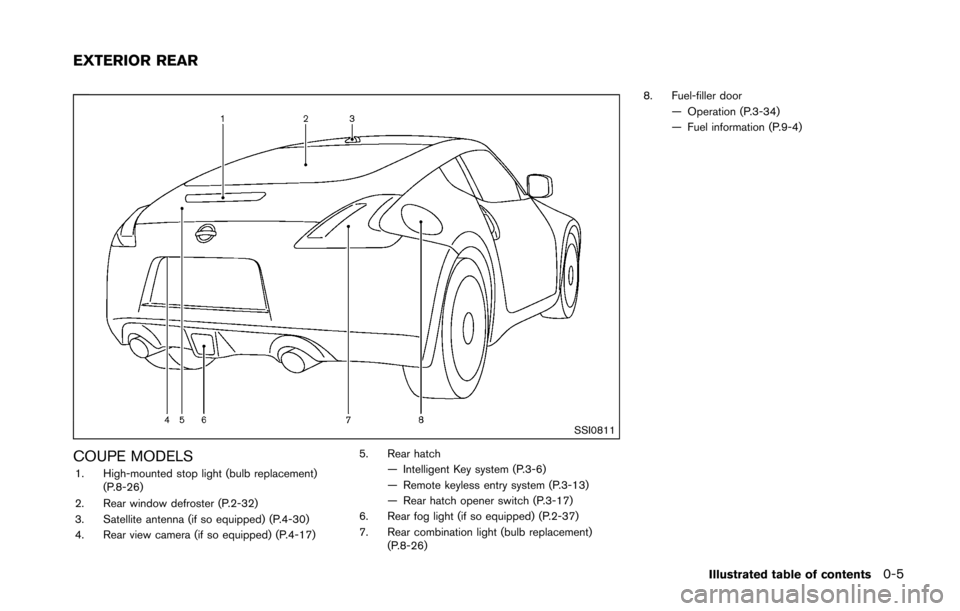
SSI0811
COUPE MODELS1. High-mounted stop light (bulb replacement)(P.8-26)
2. Rear window defroster (P.2-32)
3. Satellite antenna (if so equipped) (P.4-30)
4. Rear view camera (if so equipped) (P.4-17) 5. Rear hatch
— Intelligent Key system (P.3-6)
— Remote keyless entry system (P.3-13)
— Rear hatch opener switch (P.3-17)
6. Rear fog light (if so equipped) (P.2-37)
7. Rear combination light (bulb replacement) (P.8-26) 8. Fuel-filler door
— Operation (P.3-34)
— Fuel information (P.9-4)
Illustrated table of contents0-5
EXTERIOR REAR
Page 15 of 428
0-6Illustrated table of contents
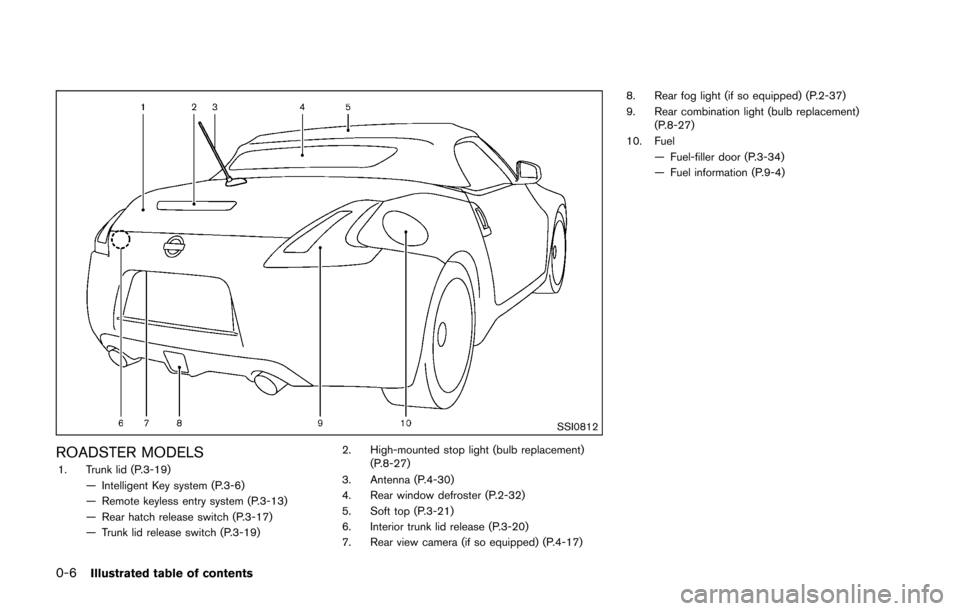
SSI0812
ROADSTER MODELS1. Trunk lid (P.3-19)— Intelligent Key system (P.3-6)
— Remote keyless entry system (P.3-13)
— Rear hatch release switch (P.3-17)
— Trunk lid release switch (P.3-19) 2. High-mounted stop light (bulb replacement)
(P.8-27)
3. Antenna (P.4-30)
4. Rear window defroster (P.2-32)
5. Soft top (P.3-21)
6. Interior trunk lid release (P.3-20)
7. Rear view camera (if so equipped) (P.4-17) 8. Rear fog light (if so equipped) (P.2-37)
9. Rear combination light (bulb replacement)
(P.8-27)
10. Fuel — Fuel-filler door (P.3-34)
— Fuel information (P.9-4)
Page 23 of 428
0-14Illustrated table of contents
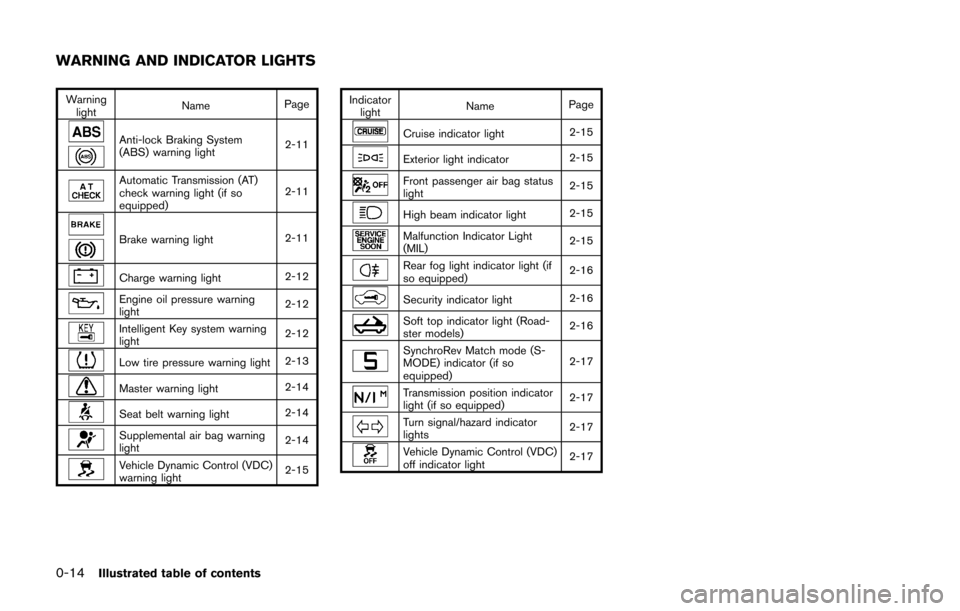
Warninglight Name
Page
Anti-lock Braking System
(ABS) warning light 2-11
Automatic Transmission (AT)
check warning light (if so
equipped)2-11
Brake warning light
2-11
Charge warning light2-12
Engine oil pressure warning
light2-12
Intelligent Key system warning
light
2-12
Low tire pressure warning light
2-13
Master warning light2-14
Seat belt warning light2-14
Supplemental air bag warning
light2-14
Vehicle Dynamic Control (VDC)
warning light2-15Indicator
light Name
Page
Cruise indicator light 2-15
Exterior light indicator
2-15
Front passenger air bag status
light2-15
High beam indicator light
2-15
Malfunction Indicator Light
(MIL)2-15
Rear fog light indicator light (if
so equipped)2-16
Security indicator light
2-16
Soft top indicator light (Road-
ster models)2-16
SynchroRev Match mode (S-
MODE) indicator (if so
equipped)2-17
Transmission position indicator
light (if so equipped)
2-17
Turn signal/hazard indicator
lights
2-17
Vehicle Dynamic Control (VDC)
off indicator light2-17
WARNING AND INDICATOR LIGHTS
Page 29 of 428
1-6Safety — Seats, seat belts and supplemental restraint system
WARNING
Head restraints/headrests supplement
the other vehicle safety systems. They
may provide additional protection
against injury in certain rear end colli-
sions. Adjustable head restraints/head-
rests must be adjusted properly, as
specified in this section. Check the
adjustment after someone else uses
the seat. Do not attach anything to the
head restraint/headrest stalks or re-
move the head restraint/headrest. Do
not use the seat if the head restraint/
headrest has been removed. If the head
restraint/headrest was removed, rein-
stall and properly adjust the head
restraint/headrest before an occupant
uses the seating position. Failure to
follow these instructions can reduce the
effectiveness of the head restraint/
headrest. This may increase the risk of
serious injury or death in a collision.
SSS1007
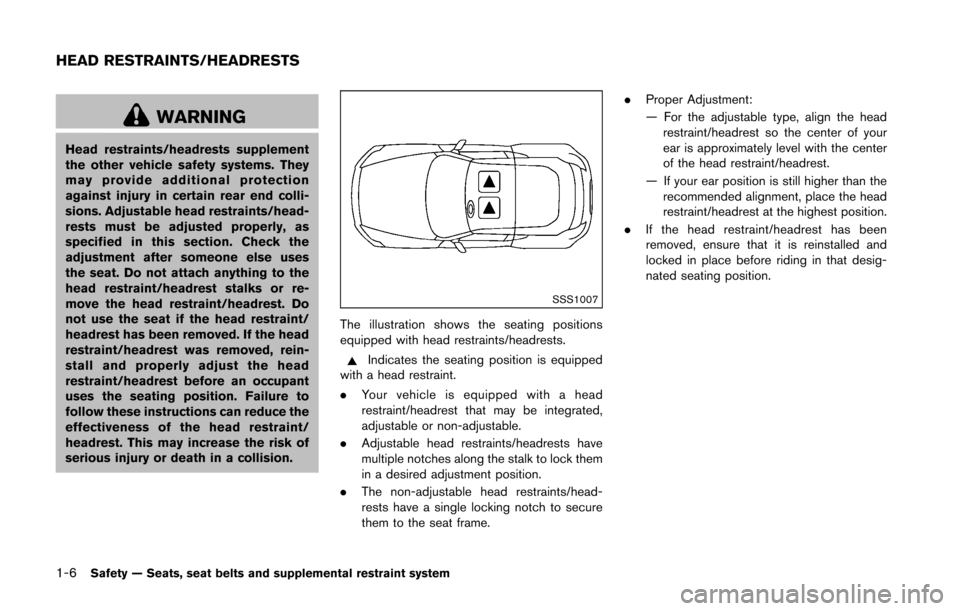
The illustration shows the seating positions
equipped with head restraints/headrests.
Indicates the seating position is equipped
with a head restraint.
. Your vehicle is equipped with a head
restraint/headrest that may be integrated,
adjustable or non-adjustable.
. Adjustable head restraints/headrests have
multiple notches along the stalk to lock them
in a desired adjustment position.
. The non-adjustable head restraints/head-
rests have a single locking notch to secure
them to the seat frame. .
Proper Adjustment:
— For the adjustable type, align the head
restraint/headrest so the center of your
ear is approximately level with the center
of the head restraint/headrest.
— If your ear position is still higher than the recommended alignment, place the head
restraint/headrest at the highest position.
. If the head restraint/headrest has been
removed, ensure that it is reinstalled and
locked in place before riding in that desig-
nated seating position.
HEAD RESTRAINTS/HEADRESTS
Page 30 of 428
SSS0992
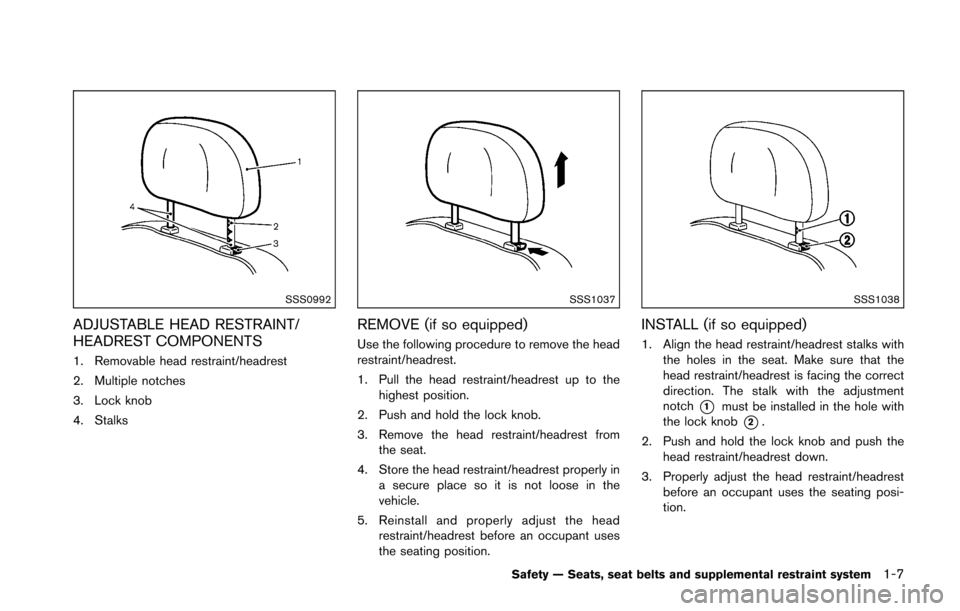
ADJUSTABLE HEAD RESTRAINT/
HEADREST COMPONENTS
1. Removable head restraint/headrest
2. Multiple notches
3. Lock knob
4. Stalks
SSS1037
REMOVE (if so equipped)
Use the following procedure to remove the head
restraint/headrest.
1. Pull the head restraint/headrest up to thehighest position.
2. Push and hold the lock knob.
3. Remove the head restraint/headrest from the seat.
4. Store the head restraint/headrest properly in a secure place so it is not loose in the
vehicle.
5. Reinstall and properly adjust the head restraint/headrest before an occupant uses
the seating position.
SSS1038
INSTALL (if so equipped)
1. Align the head restraint/headrest stalks withthe holes in the seat. Make sure that the
head restraint/headrest is facing the correct
direction. The stalk with the adjustment
notch
*1must be installed in the hole with
the lock knob
*2.
2. Push and hold the lock knob and push the head restraint/headrest down.
3. Properly adjust the head restraint/headrest before an occupant uses the seating posi-
tion.
Safety — Seats, seat belts and supplemental restraint system1-7
Page 31 of 428
1-8Safety — Seats, seat belts and supplemental restraint system
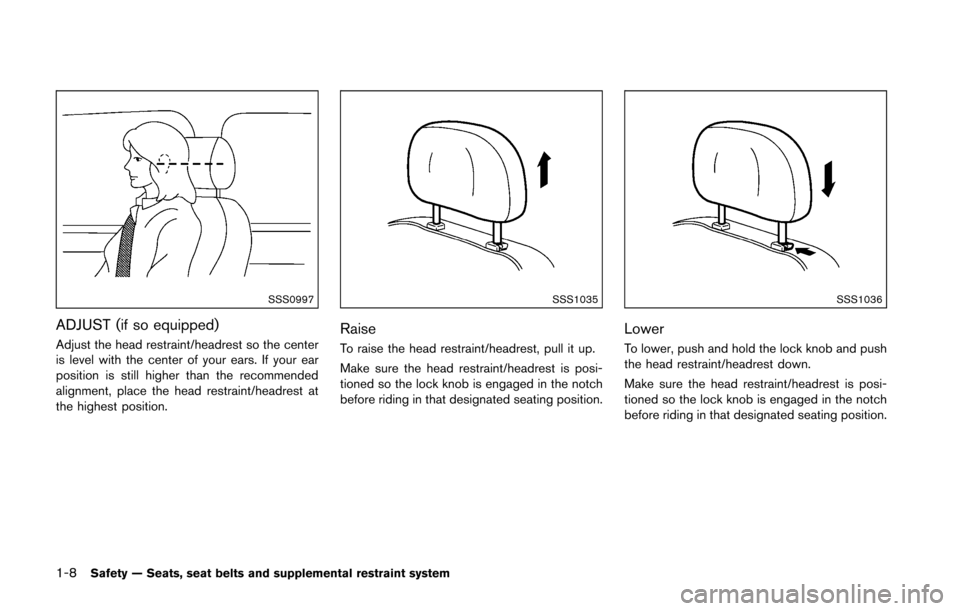
SSS0997
ADJUST (if so equipped)
Adjust the head restraint/headrest so the center
is level with the center of your ears. If your ear
position is still higher than the recommended
alignment, place the head restraint/headrest at
the highest position.
SSS1035
Raise
To raise the head restraint/headrest, pull it up.
Make sure the head restraint/headrest is posi-
tioned so the lock knob is engaged in the notch
before riding in that designated seating position.
SSS1036
Lower
To lower, push and hold the lock knob and push
the head restraint/headrest down.
Make sure the head restraint/headrest is posi-
tioned so the lock knob is engaged in the notch
before riding in that designated seating position.
Page 34 of 428
SSS0016
SSS0014
WARNING
.Every person who drives or rides in
this vehicle should use a seat belt at
all times.
. The seat belt should be properly
adjusted to a snug fit. Failure to do
so may reduce the effectiveness of
the entire restraint system and in-
crease the chance or severity of
injury in an accident. Serious injury
or death can occur if the seat belt is
not worn properly.
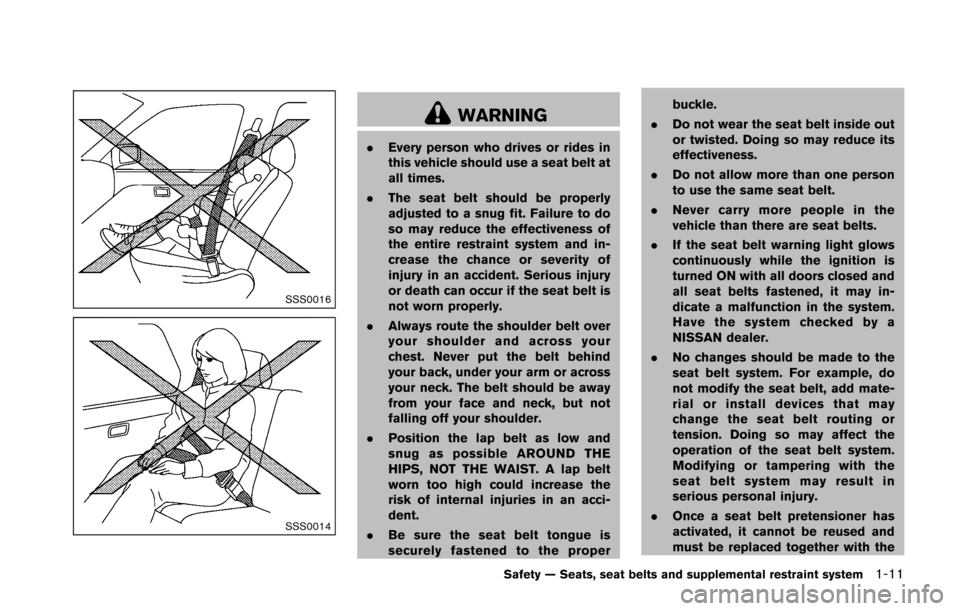
. Always route the shoulder belt over
your shoulder and across your
chest. Never put the belt behind
your back, under your arm or across
your neck. The belt should be away
from your face and neck, but not
falling off your shoulder.
. Position the lap belt as low and
snug as possible AROUND THE
HIPS, NOT THE WAIST. A lap belt
worn too high could increase the
risk of internal injuries in an acci-
dent.
. Be sure the seat belt tongue is
securely fastened to the proper buckle.
. Do not wear the seat belt inside out
or twisted. Doing so may reduce its
effectiveness.
. Do not allow more than one person
to use the same seat belt.
. Never carry more people in the
vehicle than there are seat belts.
. If the seat belt warning light glows
continuously while the ignition is
turned ON with all doors closed and
all seat belts fastened, it may in-
dicate a malfunction in the system.
Have the system checked by a
NISSAN dealer.
. No changes should be made to the
seat belt system. For example, do
not modify the seat belt, add mate-
rial or install devices that may
change the seat belt routing or
tension. Doing so may affect the
operation of the seat belt system.
Modifying or tampering with the
seat belt system may result in
serious personal injury.
. Once a seat belt pretensioner has
activated, it cannot be reused and
must be replaced together with the
Safety — Seats, seat belts and supplemental restraint system1-11
Page 40 of 428
should choose a child restraint that fits your
vehicle and always follow the manufacturer’s
instructions for installation and use.
LARGER CHILDREN
Children should remain in a forward-facing child
restraint with a harness until they reach the
maximum height or weight limit allowed by the
child restraint manufacturer.
Once a child outgrows the height or weight limit
of the harness-equipped forward-facing child
restraint, NISSAN recommends that the child be
placed in a commercially available booster seat
to obtain proper seat belt fit. For a seat belt to fit
properly, the booster seat should raise the child
so that the shoulder belt is properly positioned
across the chest and the top, middle portion of
the shoulder. The shoulder belt should not cross
the neck or face and should not fall off the
shoulder. The lap belt should lie snugly across
the lower hips or upper thighs, not the abdomen.
A booster seat can only be used in seating
positions that have a three-point type seat belt.
The booster seat should fit the vehicle seat and
have a label certifying that it complies with
Federal Motor Vehicle Safety Standards or
Canadian Motor Vehicle Safety Standards.
Once the child has grown so the shoulder belt
is no longer on or near the face and neck, and
the lap belt can be positioned properly acrossthe lower hips or upper thighs, use the seat belt
without the booster seat.WARNING
Never let a child stand or kneel on any
seat and do not allow a child in the
cargo area. The child could be seriously
injured or killed in a sudden stop or
collision.
Safety — Seats, seat belts and supplemental restraint system1-17