2016 NISSAN 370Z ROADSTER driver
[x] Cancel search: driverPage 6 of 428
NISSAN CUSTOMER CARE PROGRAM
NISSAN CARES ...
Both NISSAN and your NISSAN dealer are dedicated to serving all your automotive needs. Your satisfaction with your vehicle and your NISSAN dealer are
our primary concerns. Your NISSAN dealer is always available to assist you with all your automobile sales and service needs.
However, if there is something that your
NISSAN dealer cannot assist you with or you
would like to provide NISSAN directly with
comments or questions, please contact the
NISSAN Consumer Affairs Department using
our toll-free number:For U.S. customers1-800-NISSAN-1
(1-800-647-7261)
For Canadian customers 1-800-387-0122 The Consumer Affairs Department will ask for
the following information:
.
Your name, address, and telephone number
. Vehicle identification number (attached to
the top of the instrument panel on the
driver’s side)
. Date of purchase
. Current odometer reading
. Your NISSAN dealer’s name
. Your comments or questions
OR You can write to NISSAN with the information on
the left at:
For U.S. customersNissan North America, Inc.
Consumer Affairs Department
P.O. Box 685003
Franklin, TN 37068-5003
or via e-mail at:
[email protected]
For Canadian customers Nissan Canada Inc.
5290 Orbitor Drive
Mississauga, Ontario L4W 4Z5
or via e-mail at:
information.centre@nissancanada.
com
If you prefer, visit us at:
www.nissanusa.com(for U.S. customers) or
www.nissan.ca(for Canadian customers)
We appreciate your interest in NISSAN and
thank you for buying a quality NISSAN vehicle.
Page 19 of 428
0-10Illustrated table of contents
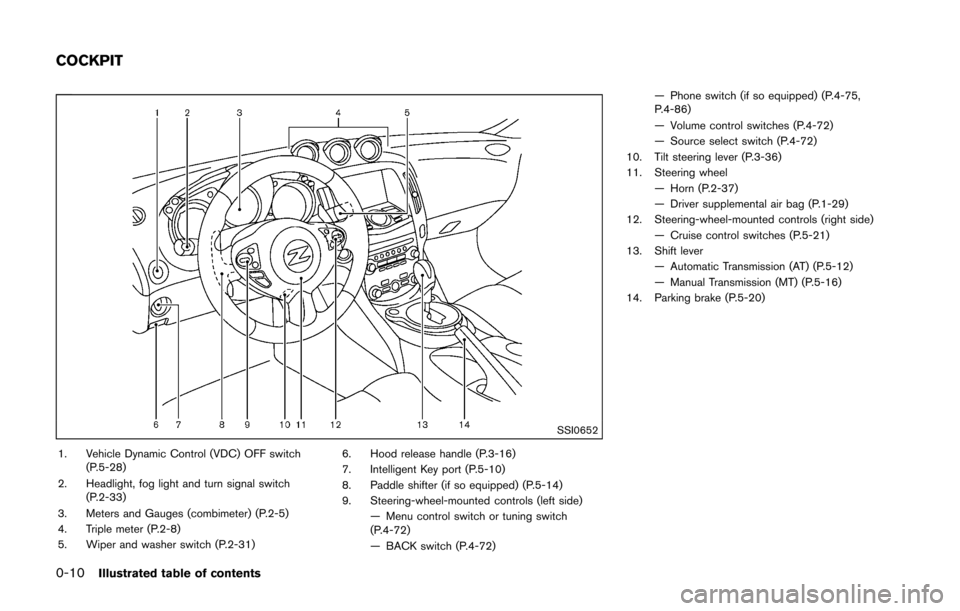
SSI0652
1. Vehicle Dynamic Control (VDC) OFF switch(P.5-28)
2. Headlight, fog light and turn signal switch (P.2-33)
3. Meters and Gauges (combimeter) (P.2-5)
4. Triple meter (P.2-8)
5. Wiper and washer switch (P.2-31) 6. Hood release handle (P.3-16)
7. Intelligent Key port (P.5-10)
8. Paddle shifter (if so equipped) (P.5-14)
9. Steering-wheel-mounted controls (left side)
— Menu control switch or tuning switch
(P.4-72)
— BACK switch (P.4-72) — Phone switch (if so equipped) (P.4-75,
P.4-86)
— Volume control switches (P.4-72)
— Source select switch (P.4-72)
10. Tilt steering lever (P.3-36)
11. Steering wheel — Horn (P.2-37)
— Driver supplemental air bag (P.1-29)
12. Steering-wheel-mounted controls (right side) — Cruise control switches (P.5-21)
13. Shift lever — Automatic Transmission (AT) (P.5-12)
— Manual Transmission (MT) (P.5-16)
14. Parking brake (P.5-20)
COCKPIT
Page 28 of 428
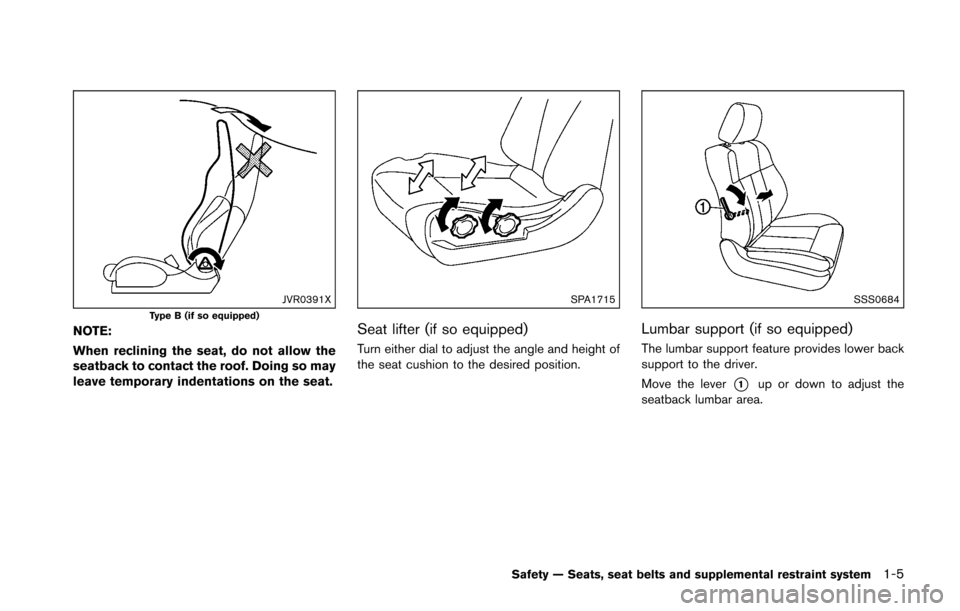
JVR0391XType B (if so equipped)
NOTE:
When reclining the seat, do not allow the
seatback to contact the roof. Doing so may
leave temporary indentations on the seat.
SPA1715
Seat lifter (if so equipped)
Turn either dial to adjust the angle and height of
the seat cushion to the desired position.
SSS0684
Lumbar support (if so equipped)
The lumbar support feature provides lower back
support to the driver.
Move the lever
*1up or down to adjust the
seatback lumbar area.
Safety — Seats, seat belts and supplemental restraint system1-5
Page 36 of 428
SSS0292
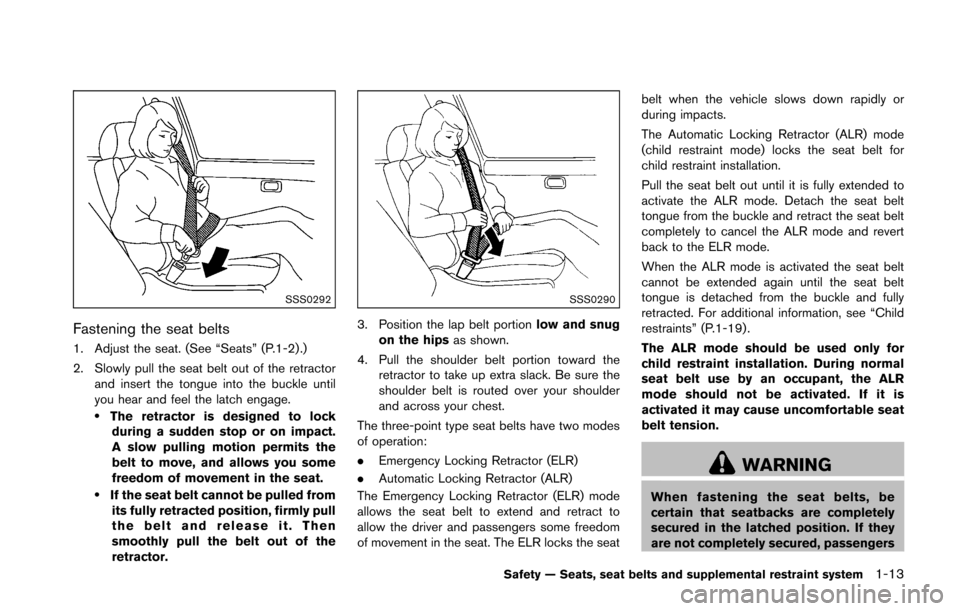
Fastening the seat belts
1. Adjust the seat. (See “Seats” (P.1-2) .)
2. Slowly pull the seat belt out of the retractorand insert the tongue into the buckle until
you hear and feel the latch engage.
.The retractor is designed to lockduring a sudden stop or on impact.
A slow pulling motion permits the
belt to move, and allows you some
freedom of movement in the seat.
.If the seat belt cannot be pulled from
its fully retracted position, firmly pull
the belt and release it. Then
smoothly pull the belt out of the
retractor.
SSS0290
3. Position the lap belt portion low and snug
on the hips as shown.
4. Pull the shoulder belt portion toward the retractor to take up extra slack. Be sure the
shoulder belt is routed over your shoulder
and across your chest.
The three-point type seat belts have two modes
of operation:
. Emergency Locking Retractor (ELR)
. Automatic Locking Retractor (ALR)
The Emergency Locking Retractor (ELR) mode
allows the seat belt to extend and retract to
allow the driver and passengers some freedom
of movement in the seat. The ELR locks the seat belt when the vehicle slows down rapidly or
during impacts.
The Automatic Locking Retractor (ALR) mode
(child restraint mode) locks the seat belt for
child restraint installation.
Pull the seat belt out until it is fully extended to
activate the ALR mode. Detach the seat belt
tongue from the buckle and retract the seat belt
completely to cancel the ALR mode and revert
back to the ELR mode.
When the ALR mode is activated the seat belt
cannot be extended again until the seat belt
tongue is detached from the buckle and fully
retracted. For additional information, see “Child
restraints” (P.1-19) .
The ALR mode should be used only for
child restraint installation. During normal
seat belt use by an occupant, the ALR
mode should not be activated. If it is
activated it may cause uncomfortable seat
belt tension.
WARNING
When fastening the seat belts, be
certain that seatbacks are completely
secured in the latched position. If they
are not completely secured, passengers
Safety — Seats, seat belts and supplemental restraint system1-13
Page 38 of 428
SSS0588
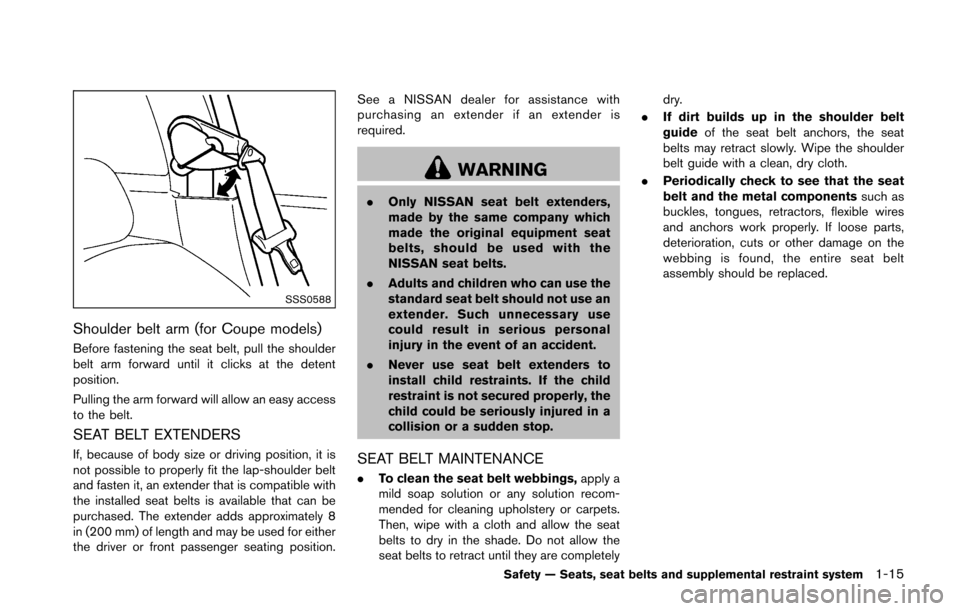
Shoulder belt arm (for Coupe models)
Before fastening the seat belt, pull the shoulder
belt arm forward until it clicks at the detent
position.
Pulling the arm forward will allow an easy access
to the belt.
SEAT BELT EXTENDERS
If, because of body size or driving position, it is
not possible to properly fit the lap-shoulder belt
and fasten it, an extender that is compatible with
the installed seat belts is available that can be
purchased. The extender adds approximately 8
in (200 mm) of length and may be used for either
the driver or front passenger seating position.See a NISSAN dealer for assistance with
purchasing an extender if an extender is
required.
WARNING
.
Only NISSAN seat belt extenders,
made by the same company which
made the original equipment seat
belts, should be used with the
NISSAN seat belts.
. Adults and children who can use the
standard seat belt should not use an
extender. Such unnecessary use
could result in serious personal
injury in the event of an accident.
. Never use seat belt extenders to
install child restraints. If the child
restraint is not secured properly, the
child could be seriously injured in a
collision or a sudden stop.
SEAT BELT MAINTENANCE
.To clean the seat belt webbings, apply a
mild soap solution or any solution recom-
mended for cleaning upholstery or carpets.
Then, wipe with a cloth and allow the seat
belts to dry in the shade. Do not allow the
seat belts to retract until they are completely dry.
. If dirt builds up in the shoulder belt
guide of the seat belt anchors, the seat
belts may retract slowly. Wipe the shoulder
belt guide with a clean, dry cloth.
. Periodically check to see that the seat
belt and the metal components such as
buckles, tongues, retractors, flexible wires
and anchors work properly. If loose parts,
deterioration, cuts or other damage on the
webbing is found, the entire seat belt
assembly should be replaced.
Safety — Seats, seat belts and supplemental restraint system1-15
Page 52 of 428
SSS0988
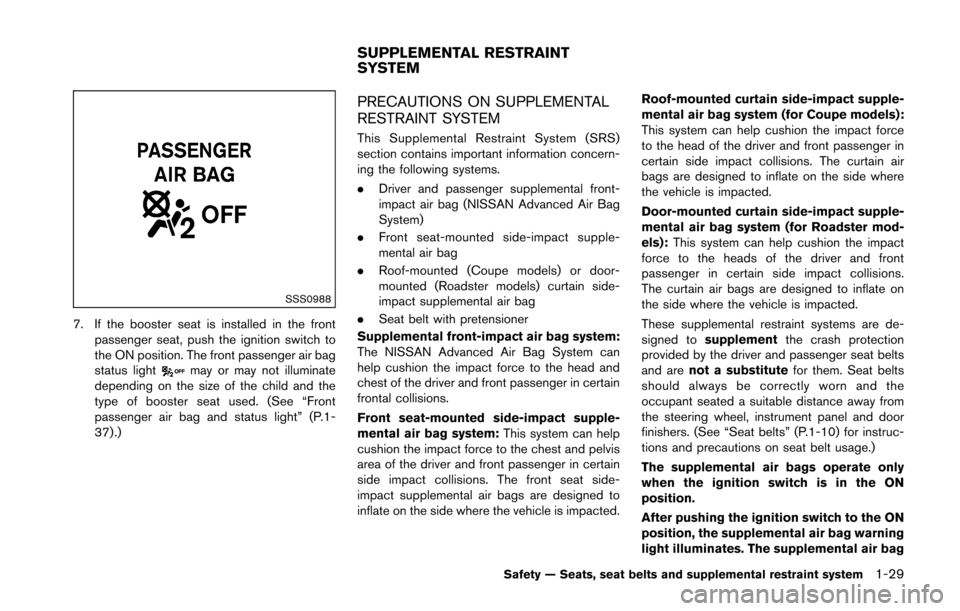
7. If the booster seat is installed in the frontpassenger seat, push the ignition switch to
the ON position. The front passenger air bag
status light
may or may not illuminate
depending on the size of the child and the
type of booster seat used. (See “Front
passenger air bag and status light” (P.1-
37) .)
PRECAUTIONS ON SUPPLEMENTAL
RESTRAINT SYSTEM
This Supplemental Restraint System (SRS)
section contains important information concern-
ing the following systems.
. Driver and passenger supplemental front-
impact air bag (NISSAN Advanced Air Bag
System)
. Front seat-mounted side-impact supple-
mental air bag
. Roof-mounted (Coupe models) or door-
mounted (Roadster models) curtain side-
impact supplemental air bag
. Seat belt with pretensioner
Supplemental front-impact air bag system:
The NISSAN Advanced Air Bag System can
help cushion the impact force to the head and
chest of the driver and front passenger in certain
frontal collisions.
Front seat-mounted side-impact supple-
mental air bag system: This system can help
cushion the impact force to the chest and pelvis
area of the driver and front passenger in certain
side impact collisions. The front seat side-
impact supplemental air bags are designed to
inflate on the side where the vehicle is impacted. Roof-mounted curtain side-impact supple-
mental air bag system (for Coupe models):
This system can help cushion the impact force
to the head of the driver and front passenger in
certain side impact collisions. The curtain air
bags are designed to inflate on the side where
the vehicle is impacted.
Door-mounted curtain side-impact supple-
mental air bag system (for Roadster mod-
els):
This system can help cushion the impact
force to the heads of the driver and front
passenger in certain side impact collisions.
The curtain air bags are designed to inflate on
the side where the vehicle is impacted.
These supplemental restraint systems are de-
signed to supplement the crash protection
provided by the driver and passenger seat belts
and are not a substitute for them. Seat belts
should always be correctly worn and the
occupant seated a suitable distance away from
the steering wheel, instrument panel and door
finishers. (See “Seat belts” (P.1-10) for instruc-
tions and precautions on seat belt usage.)
The supplemental air bags operate only
when the ignition switch is in the ON
position.
After pushing the ignition switch to the ON
position, the supplemental air bag warning
light illuminates. The supplemental air bag
Safety — Seats, seat belts and supplemental restraint system1-29
SUPPLEMENTAL RESTRAINT
SYSTEM
Page 54 of 428
WARNING
.The front air bags ordinarily will not
inflate in the event of a side impact,
rear impact, rollover, or lower se-
verity frontal collision. Always wear
your seat belts to help reduce the
risk or severity of injury in various
kinds of accidents.
. The front passenger air bag will not
inflate if the passenger air bag
status light is lit or if the front
passenger seat is unoccupied. See
“Front passenger air bag and status
light” (P.1-37) .
. The seat belts and the front air bags
are most effective when you are
sitting well back and upright in the
seat with both feet on the floor. The
front air bags inflate with great
force. Even with the NISSAN Ad-
vanced Air Bag System, if you are
unrestrained, leaning forward, sit-
ting sideways or out of position in
any way, you are at greater risk of
injury or death in a crash. You may
also receive serious or fatal injuries
from the supplemental front air bag
if you are up against it when it inflates. Always sit back against
the seatback and as far-away as
practical from the steering wheel or
instrument panel. Always use the
seat belts.
. The driver and front passenger seat
belt buckles are equipped with
sensors that detect if the seat belts
are fastened. The Advanced Air Bag
System monitors the severity of a
collision and seat belt usage then
inflates the air bags. Failure to
properly wear seat belts can in-
crease the risk or severity of injury
in an accident.
. The front passenger seat is
equipped with an occupant classifi-
cation sensor (pattern sensor) that
turns the front passenger air bag
OFF under some conditions. This
sensor is only used in this seat.
Failure to be properly seated and
wearing the seat belt can increase
the risk or severity of injury in an
accident. See “Front passenger air
bag and status light” (P.1-37) .
. Keep hands on the outside of the
steering wheel. Placing them inside
the steering wheel rim could in- crease the risk of injury if the
supplemental front air bag inflates.
Safety — Seats, seat belts and supplemental restraint system1-31
Page 58 of 428
JVR0087X
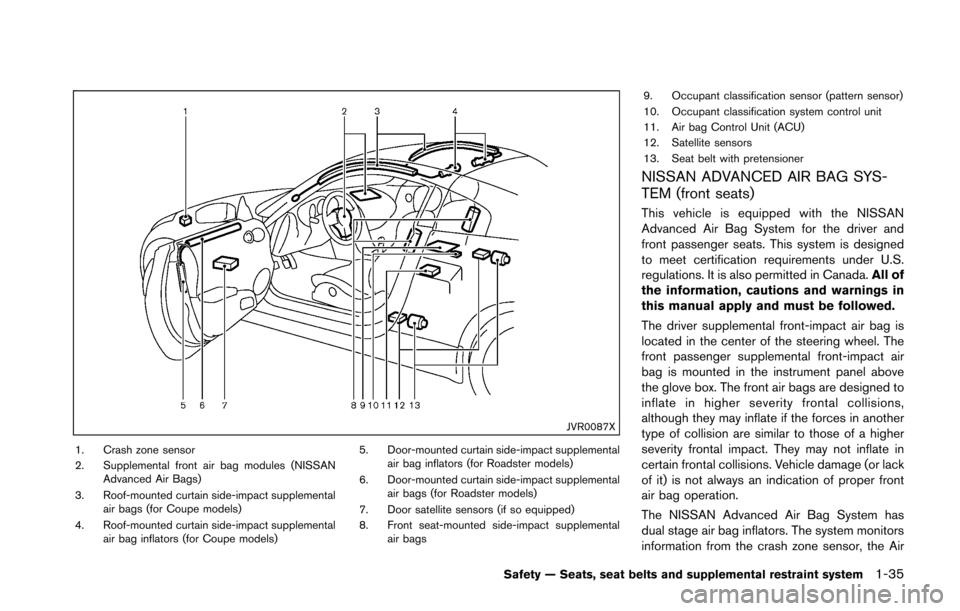
1. Crash zone sensor
2. Supplemental front air bag modules (NISSANAdvanced Air Bags)
3. Roof-mounted curtain side-impact supplemental air bags (for Coupe models)
4. Roof-mounted curtain side-impact supplemental air bag inflators (for Coupe models) 5. Door-mounted curtain side-impact supplemental
air bag inflators (for Roadster models)
6. Door-mounted curtain side-impact supplemental air bags (for Roadster models)
7. Door satellite sensors (if so equipped)
8. Front seat-mounted side-impact supplemental air bags 9. Occupant classification sensor (pattern sensor)
10. Occupant classification system control unit
11. Air bag Control Unit (ACU)
12. Satellite sensors
13. Seat belt with pretensioner
NISSAN ADVANCED AIR BAG SYS-
TEM (front seats)
This vehicle is equipped with the NISSAN
Advanced Air Bag System for the driver and
front passenger seats. This system is designed
to meet certification requirements under U.S.
regulations. It is also permitted in Canada.
All of
the information, cautions and warnings in
this manual apply and must be followed.
The driver supplemental front-impact air bag is
located in the center of the steering wheel. The
front passenger supplemental front-impact air
bag is mounted in the instrument panel above
the glove box. The front air bags are designed to
inflate in higher severity frontal collisions,
although they may inflate if the forces in another
type of collision are similar to those of a higher
severity frontal impact. They may not inflate in
certain frontal collisions. Vehicle damage (or lack
of it) is not always an indication of proper front
air bag operation.
The NISSAN Advanced Air Bag System has
dual stage air bag inflators. The system monitors
information from the crash zone sensor, the Air
Safety — Seats, seat belts and supplemental restraint system1-35