2016 NISSAN 370Z COUPE check engine
[x] Cancel search: check enginePage 358 of 428
JVM0087X
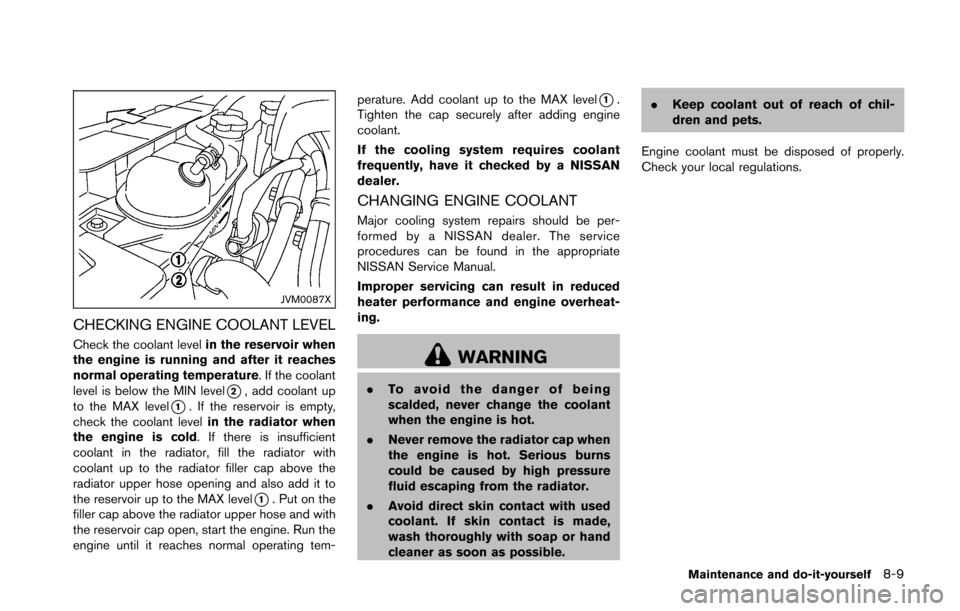
CHECKING ENGINE COOLANT LEVEL
Check the coolant levelin the reservoir when
the engine is running and after it reaches
normal operating temperature. If the coolant
level is below the MIN level
*2, add coolant up
to the MAX level
*1. If the reservoir is empty,
check the coolant level in the radiator when
the engine is cold. If there is insufficient
coolant in the radiator, fill the radiator with
coolant up to the radiator filler cap above the
radiator upper hose opening and also add it to
the reservoir up to the MAX level
*1. Put on the
filler cap above the radiator upper hose and with
the reservoir cap open, start the engine. Run the
engine until it reaches normal operating tem- perature. Add coolant up to the MAX level
*1.
Tighten the cap securely after adding engine
coolant.
If the cooling system requires coolant
frequently, have it checked by a NISSAN
dealer.
CHANGING ENGINE COOLANT
Major cooling system repairs should be per-
formed by a NISSAN dealer. The service
procedures can be found in the appropriate
NISSAN Service Manual.
Improper servicing can result in reduced
heater performance and engine overheat-
ing.
WARNING
. To avoid the danger of being
scalded, never change the coolant
when the engine is hot.
. Never remove the radiator cap when
the engine is hot. Serious burns
could be caused by high pressure
fluid escaping from the radiator.
. Avoid direct skin contact with used
coolant. If skin contact is made,
wash thoroughly with soap or hand
cleaner as soon as possible. .
Keep coolant out of reach of chil-
dren and pets.
Engine coolant must be disposed of properly.
Check your local regulations.
Maintenance and do-it-yourself8-9
Page 359 of 428
8-10Maintenance and do-it-yourself
SDI2348
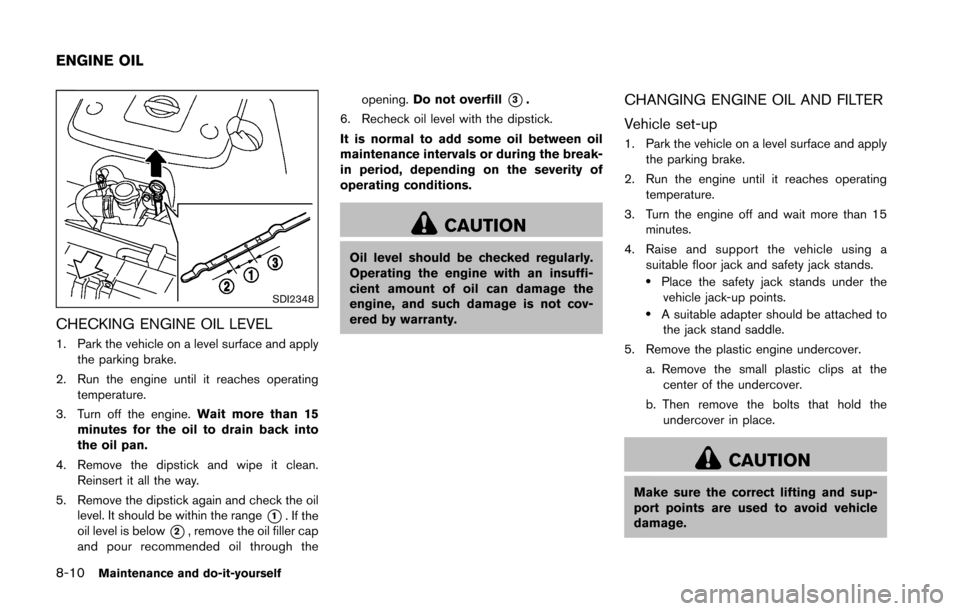
CHECKING ENGINE OIL LEVEL
1. Park the vehicle on a level surface and applythe parking brake.
2. Run the engine until it reaches operating temperature.
3. Turn off the engine. Wait more than 15
minutes for the oil to drain back into
the oil pan.
4. Remove the dipstick and wipe it clean. Reinsert it all the way.
5. Remove the dipstick again and check the oil level. It should be within the range
*1. If the
oil level is below
*2, remove the oil filler cap
and pour recommended oil through the opening.
Do not overfill
*3.
6. Recheck oil level with the dipstick.
It is normal to add some oil between oil
maintenance intervals or during the break-
in period, depending on the severity of
operating conditions.
CAUTION
Oil level should be checked regularly.
Operating the engine with an insuffi-
cient amount of oil can damage the
engine, and such damage is not cov-
ered by warranty.
CHANGING ENGINE OIL AND FILTER
Vehicle set-up
1. Park the vehicle on a level surface and apply the parking brake.
2. Run the engine until it reaches operating temperature.
3. Turn the engine off and wait more than 15 minutes.
4. Raise and support the vehicle using a suitable floor jack and safety jack stands.
.Place the safety jack stands under the
vehicle jack-up points.
.A suitable adapter should be attached tothe jack stand saddle.
5. Remove the plastic engine undercover. a. Remove the small plastic clips at thecenter of the undercover.
b. Then remove the bolts that hold the undercover in place.
CAUTION
Make sure the correct lifting and sup-
port points are used to avoid vehicle
damage.
ENGINE OIL
Page 360 of 428
SDI2335
Engine oil and filter
1. Place a large drain pan under the drain plug.
2. Remove the oil filler cap.
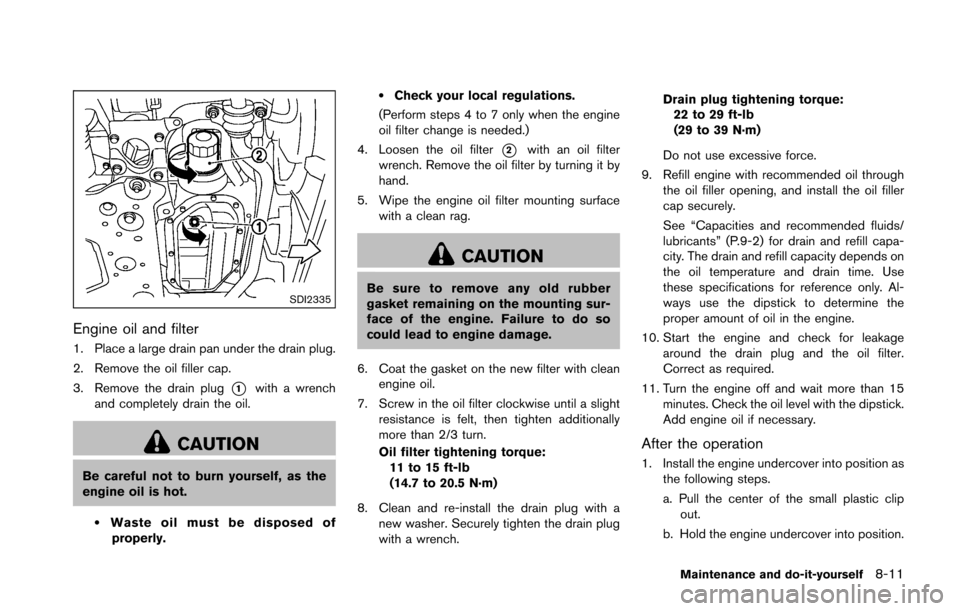
3. Remove the drain plug
*1with a wrench
and completely drain the oil.
CAUTION
Be careful not to burn yourself, as the
engine oil is hot.
.Waste oil must be disposed of properly.
.Check your local regulations.
(Perform steps 4 to 7 only when the engine
oil filter change is needed.)
4. Loosen the oil filter
*2with an oil filter
wrench. Remove the oil filter by turning it by
hand.
5. Wipe the engine oil filter mounting surface with a clean rag.
CAUTION
Be sure to remove any old rubber
gasket remaining on the mounting sur-
face of the engine. Failure to do so
could lead to engine damage.
6. Coat the gasket on the new filter with clean engine oil.
7. Screw in the oil filter clockwise until a slight resistance is felt, then tighten additionally
more than 2/3 turn.
Oil filter tightening torque:11 to 15 ft-lb
(14.7 to 20.5 N·m)
8. Clean and re-install the drain plug with a new washer. Securely tighten the drain plug
with a wrench. Drain plug tightening torque:
22 to 29 ft-lb
(29 to 39 N·m)
Do not use excessive force.
9. Refill engine with recommended oil through the oil filler opening, and install the oil filler
cap securely.
See “Capacities and recommended fluids/
lubricants” (P.9-2) for drain and refill capa-
city. The drain and refill capacity depends on
the oil temperature and drain time. Use
these specifications for reference only. Al-
ways use the dipstick to determine the
proper amount of oil in the engine.
10. Start the engine and check for leakage around the drain plug and the oil filter.
Correct as required.
11. Turn the engine off and wait more than 15 minutes. Check the oil level with the dipstick.
Add engine oil if necessary.
After the operation
1. Install the engine undercover into position asthe following steps.
a. Pull the center of the small plastic clipout.
b. Hold the engine undercover into position.
Maintenance and do-it-yourself8-11
Page 361 of 428
8-12Maintenance and do-it-yourself
c. Insert the clip through the undercoverinto the hole in the frame, then push the
center of the clip in to lock the clip in
place.
d. Install the bolts that hold the undercover in place. Be careful not to strip the bolts
or over-tighten them.
2. Lower the vehicle carefully to the ground.
3. Dispose of waste oil and filter properly.
WARNING
. Prolonged and repeated contact
with used engine oil may cause skin
cancer.
. Try to avoid direct skin contact with
used oil. If skin contact is made,
wash thoroughly with soap or hand
cleaner as soon as possible.
. Keep used engine oil out of reach of
children. When checking or replacement is required, we
recommend a NISSAN dealer for servicing.
CAUTION
.
Use only Genuine NISSAN Matic S
ATF. Do not mix with other fluids.
. Using automatic transmission fluid
other than Genuine NISSAN Matic S
ATF will cause deterioration in dri-
veability and automatic transmis-
sion durability, and may damage
the automatic transmission, which
is not covered by the NISSAN new
vehicle limited warranty.
SDI1765A
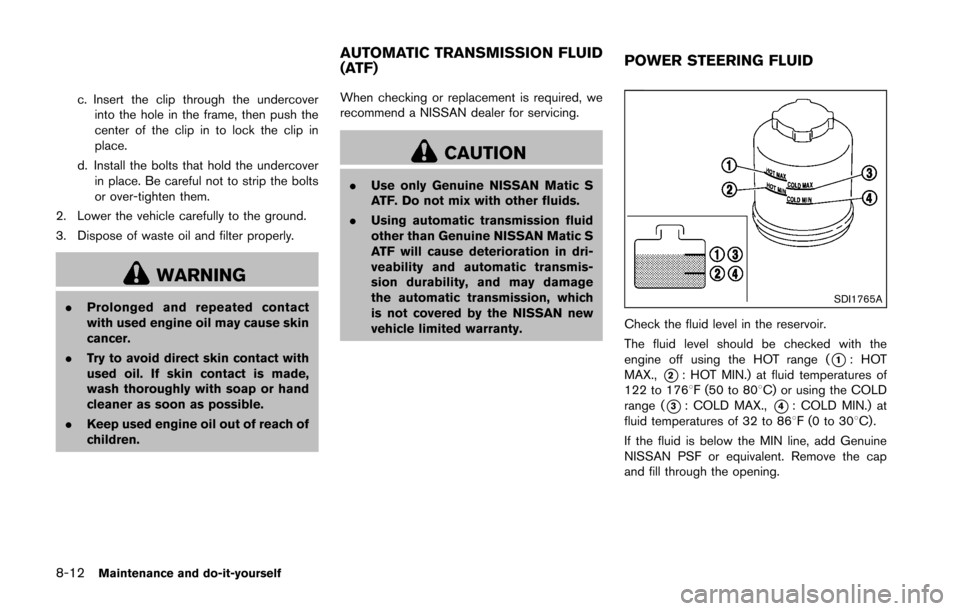
Check the fluid level in the reservoir.
The fluid level should be checked with the
engine off using the HOT range (
*1:HOT
MAX.,
*2: HOT MIN.) at fluid temperatures of
122 to 1768F (50 to 808C) or using the COLD
range (
*3: COLD MAX.,*4: COLD MIN.) at
fluid temperatures of 32 to 868F(0to30 8C) .
If the fluid is below the MIN line, add Genuine
NISSAN PSF or equivalent. Remove the cap
and fill through the opening.
AUTOMATIC TRANSMISSION FLUID
(ATF) POWER STEERING FLUID
Page 366 of 428
SDI1480E
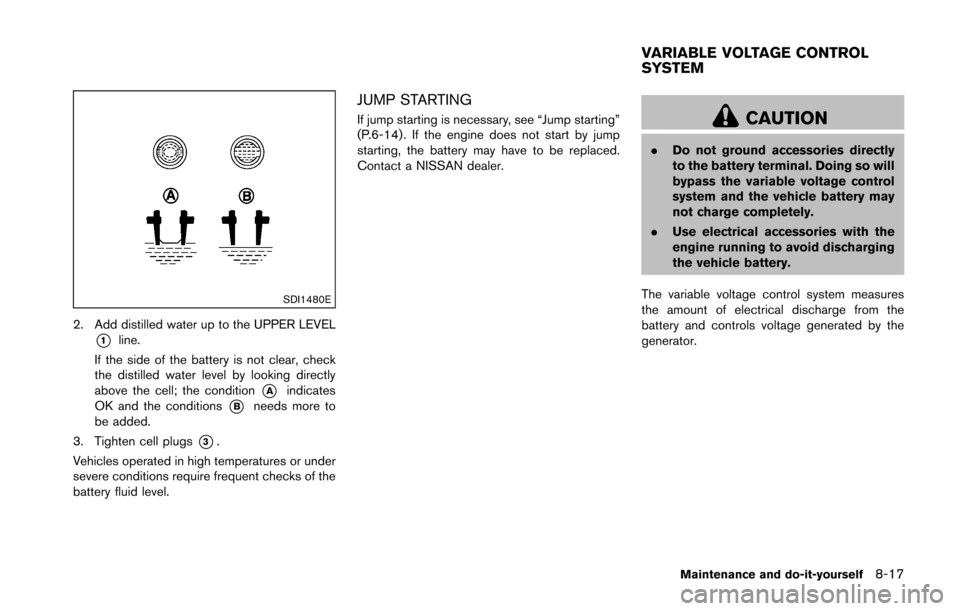
2. Add distilled water up to the UPPER LEVEL
*1line.
If the side of the battery is not clear, check
the distilled water level by looking directly
above the cell; the condition
*Aindicates
OK and the conditions
*Bneeds more to
be added.
3. Tighten cell plugs
*3.
Vehicles operated in high temperatures or under
severe conditions require frequent checks of the
battery fluid level.
JUMP STARTING
If jump starting is necessary, see “Jump starting”
(P.6-14) . If the engine does not start by jump
starting, the battery may have to be replaced.
Contact a NISSAN dealer.CAUTION
. Do not ground accessories directly
to the battery terminal. Doing so will
bypass the variable voltage control
system and the vehicle battery may
not charge completely.
. Use electrical accessories with the
engine running to avoid discharging
the vehicle battery.
The variable voltage control system measures
the amount of electrical discharge from the
battery and controls voltage generated by the
generator.
Maintenance and do-it-yourself8-17
VARIABLE VOLTAGE CONTROL
SYSTEM
Page 367 of 428

8-18Maintenance and do-it-yourself
SDI2119VQ37VHR engine1. Power steering fluid pump
2. Alternator
3. Crankshaft pulley
4. Air conditioner compressor
5. Drive belt auto-tensioner
WARNING
Be sure the ignition switch is in the OFF
or LOCK position before servicing drive
belts. The engine could rotate unex-
pectedly.1. Visually inspect the belt for signs of unusual
wear, cuts, fraying or looseness. If the belt is
in poor condition or loose, have it replaced
or adjusted by a NISSAN dealer.
2. Have the belt condition checked regularly.
WARNING
Be sure the engine and the ignition
switch are off and that the parking
brake is engaged securely.
CAUTION
Be sure to use the correct socket to
remove the spark plugs. An incorrect
socket can damage the spark plugs.
DRIVE BELTS SPARK PLUGS
Page 371 of 428
8-22Maintenance and do-it-yourself
SDI1479A
SDI2566
ENGINE COMPARTMENT
CAUTION
Never use a fuse of a higher or lower
amperage rating than that specified on
the fuse box cover. This could damage
the electrical system or cause a fire.
If any electrical equipment does not operate,
check for an open fuse.
1. Be sure the ignition switch is pushed to the OFF or LOCK position and the headlight
switch is turned to OFF.
2. Open the engine hood.
3. Remove the fuse/fusible link holder cover.
4. Remove the fuse with the fuse puller located in the passenger compartment fuse box.
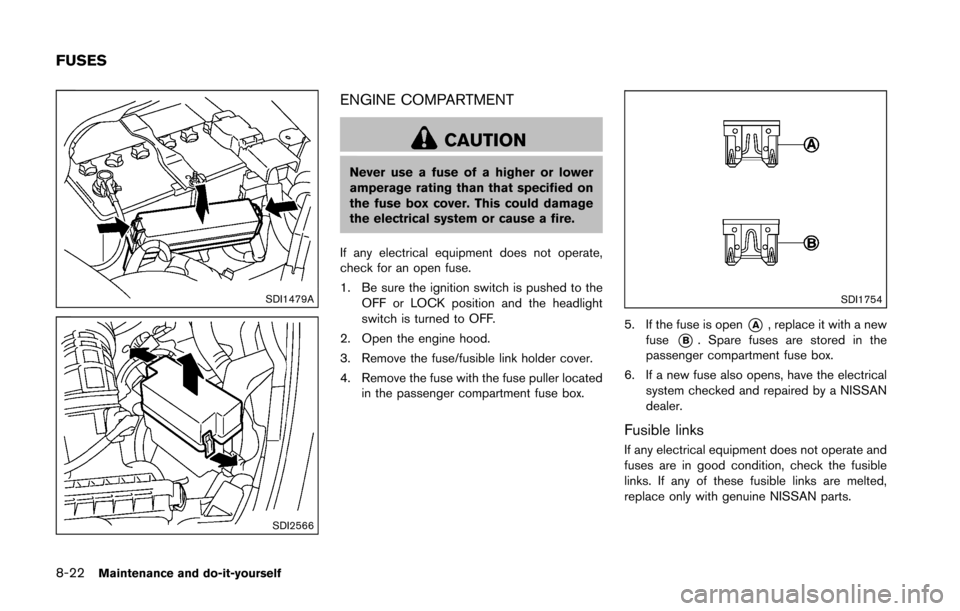
SDI1754
5. If the fuse is open*A, replace it with a new
fuse
*B. Spare fuses are stored in the
passenger compartment fuse box.
6. If a new fuse also opens, have the electrical system checked and repaired by a NISSAN
dealer.
Fusible links
If any electrical equipment does not operate and
fuses are in good condition, check the fusible
links. If any of these fusible links are melted,
replace only with genuine NISSAN parts.
FUSES
Page 396 of 428
.E-15 fuel contains more than 10%
oxygenate. E-15 fuel will adversely
affect the emission control devices
and systems of the vehicle and should
not be used. Damage caused by such
fuel is not covered by the NISSAN New
Vehicle Limited Warranty.
. If a methanol blend is used, it should
contain no more than 5% methanol
(methyl alcohol, wood alcohol) . It
should also contain a suitable amount
of appropriate cosolvents and corro-
sion inhibitors. If not properly formu-
lated with appropriate cosolvents and
corrosion inhibitors, such methanol
blends may cause fuel system damage
and/or vehicle performance problems.
At this time, sufficient data is not
available to ensure that all methanol
blends are suitable for use in NISSAN
vehicles.
If any undesirable driveability problems such as
engine stalling or hard hot starting are experi-
enced after using oxygenate-blend fuels, im-
mediately change to a non-oxygenate fuel or a
fuel with a low blend of MTBE.
Take care not to spill gasoline during
refueling. Gasoline containing oxygenates
can cause paint damage.E-15 fuel
E-15 fuel is a mixture of approximately 15% fuel
ethanol and 85% unleaded gasoline. E-15 can
only be used in vehicles designed to run on E-
15 fuel. Do not use E-15 in your vehicle. U.S.
government regulations require fuel ethanol
dispensing pumps to be identified with small,
square, orange and black label with the common
abbreviation or the appropriate percentage for
that region.
E-85 fuel
E-85 fuel is a mixture of approximately 85% fuel
ethanol and 15% unleaded gasoline. E-85 can
only be used in a Flexible Fuel Vehicle (FFV) . Do
not use E-85 fuel in your vehicle. U.S. govern-
ment regulations require fuel ethanol dispensing
pumps to be identified by a small, square,
orange and black label with the common
abbreviation or the appropriate percentage for
that region.
Aftermarket fuel additives
NISSAN does not recommend the use of any
aftermarket fuel additives (Example: fuel injector
cleaner, octane booster, intake valve deposit
removers, etc.) which are sold commercially.
Many of these additives intended for gum,
varnish or deposit removal may contain active
solvent or similar ingredients that can be harmful to the fuel system and engine.
Octane rating tips
Using unleaded gasoline with an octane
rating lower than recommended above can
cause persistent, heavy spark knock.
(Spark knock is a metallic rapping noise.)
If severe, this can lead to engine damage.
If you detect a persistent heavy spark
knock even when using gasoline of the
stated octane rating, or if you hear steady
spark knock while holding a steady speed
on level roads, have a NISSAN dealer
correct the condition. Failure to correct
the condition is misuse of the vehicle, for
which NISSAN is not responsible.
Incorrect ignition timing will result in knocking,
after-run or overheating. This in turn may cause
excessive fuel consumption or damage to the
engine. If any of the above symptoms are
encountered, have your vehicle checked at a
NISSAN dealer or other competent service
facility.
However, now and then you may notice
light spark knock for a short time while
accelerating or driving up hills. This is no
cause for concern, because you get the
greatest fuel benefit when there is light
spark knock for a short time under heavy
engine load.
Technical and consumer information9-5