2016 NISSAN 370Z COUPE rear
[x] Cancel search: rearPage 27 of 428
1-4Safety — Seats, seat belts and supplemental restraint system
SSS0394Type A (if so equipped)
JVR0389XType B (if so equipped)
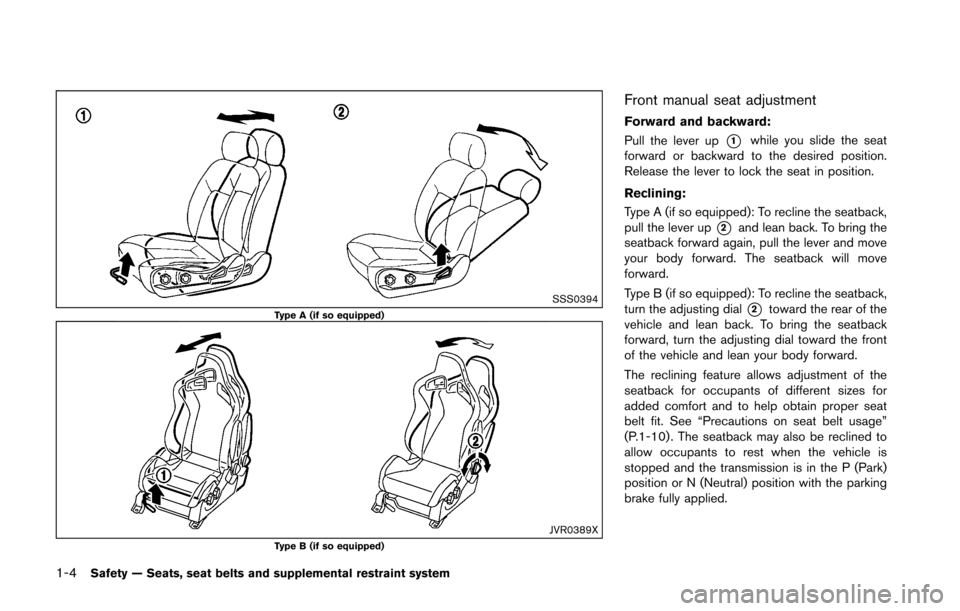
Front manual seat adjustment
Forward and backward:
Pull the lever up
*1while you slide the seat
forward or backward to the desired position.
Release the lever to lock the seat in position.
Reclining:
Type A (if so equipped): To recline the seatback,
pull the lever up
*2and lean back. To bring the
seatback forward again, pull the lever and move
your body forward. The seatback will move
forward.
Type B (if so equipped): To recline the seatback,
turn the adjusting dial
*2toward the rear of the
vehicle and lean back. To bring the seatback
forward, turn the adjusting dial toward the front
of the vehicle and lean your body forward.
The reclining feature allows adjustment of the
seatback for occupants of different sizes for
added comfort and to help obtain proper seat
belt fit. See “Precautions on seat belt usage”
(P.1-10) . The seatback may also be reclined to
allow occupants to rest when the vehicle is
stopped and the transmission is in the P (Park)
position or N (Neutral) position with the parking
brake fully applied.
Page 29 of 428
1-6Safety — Seats, seat belts and supplemental restraint system
WARNING
Head restraints/headrests supplement
the other vehicle safety systems. They
may provide additional protection
against injury in certain rear end colli-
sions. Adjustable head restraints/head-
rests must be adjusted properly, as
specified in this section. Check the
adjustment after someone else uses
the seat. Do not attach anything to the
head restraint/headrest stalks or re-
move the head restraint/headrest. Do
not use the seat if the head restraint/
headrest has been removed. If the head
restraint/headrest was removed, rein-
stall and properly adjust the head
restraint/headrest before an occupant
uses the seating position. Failure to
follow these instructions can reduce the
effectiveness of the head restraint/
headrest. This may increase the risk of
serious injury or death in a collision.
SSS1007
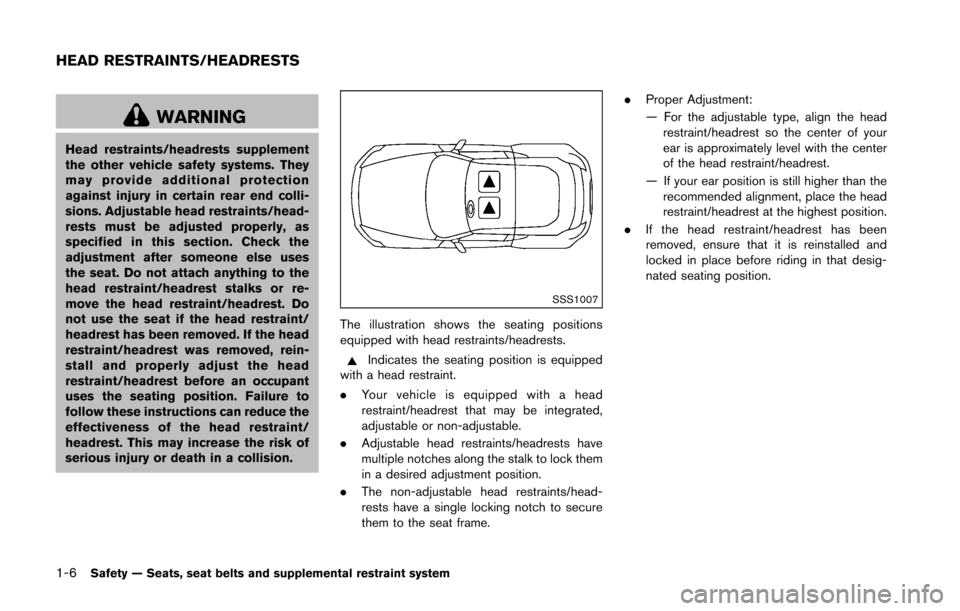
The illustration shows the seating positions
equipped with head restraints/headrests.
Indicates the seating position is equipped
with a head restraint.
. Your vehicle is equipped with a head
restraint/headrest that may be integrated,
adjustable or non-adjustable.
. Adjustable head restraints/headrests have
multiple notches along the stalk to lock them
in a desired adjustment position.
. The non-adjustable head restraints/head-
rests have a single locking notch to secure
them to the seat frame. .
Proper Adjustment:
— For the adjustable type, align the head
restraint/headrest so the center of your
ear is approximately level with the center
of the head restraint/headrest.
— If your ear position is still higher than the recommended alignment, place the head
restraint/headrest at the highest position.
. If the head restraint/headrest has been
removed, ensure that it is reinstalled and
locked in place before riding in that desig-
nated seating position.
HEAD RESTRAINTS/HEADRESTS
Page 32 of 428
SSS0508
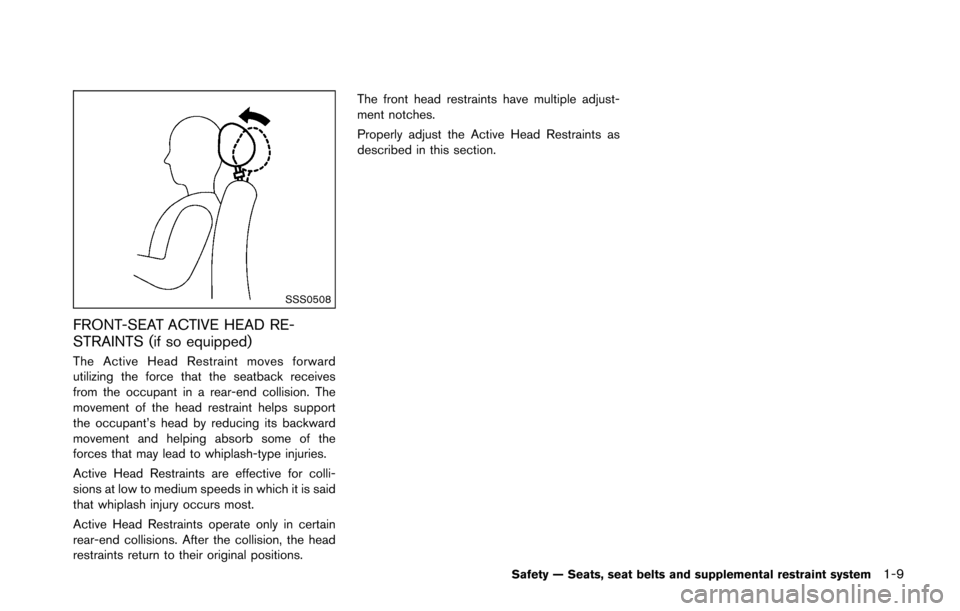
FRONT-SEAT ACTIVE HEAD RE-
STRAINTS (if so equipped)
The Active Head Restraint moves forward
utilizing the force that the seatback receives
from the occupant in a rear-end collision. The
movement of the head restraint helps support
the occupant’s head by reducing its backward
movement and helping absorb some of the
forces that may lead to whiplash-type injuries.
Active Head Restraints are effective for colli-
sions at low to medium speeds in which it is said
that whiplash injury occurs most.
Active Head Restraints operate only in certain
rear-end collisions. After the collision, the head
restraints return to their original positions.The front head restraints have multiple adjust-
ment notches.
Properly adjust the Active Head Restraints as
described in this section.
Safety — Seats, seat belts and supplemental restraint system1-9
Page 39 of 428
1-16Safety — Seats, seat belts and supplemental restraint system
WARNING
Do not allow children to play with the
seat belts. Most seating positions are
equipped with Automatic Locking Re-
tractor (ALR) mode seat belts. If the
seat belt becomes wrapped around a
child’s neck with the ALR mode acti-
vated, the child can be seriously injured
or killed if the seat belt retracts and
becomes tight. This can occur even if
the vehicle is parked. Unbuckle the seat
belt to release the child. If the seat belt
can not be unbuckled or is already
unbuckled, release the child by cutting
the seat belt with a suitable tool (such
as a knife or scissors) to release the
seat belt.
Children need adults to help protect them.
They need to be properly restrained.
In addition to the general information in this
manual, child safety information is available from
many other sources, including doctors, teachers,
government traffic safety offices, and community
organizations. Every child is different, so be sure
to learn the best way to transport your child.
There are three basic types of child restraint systems:
.
Rear-facing child restraint
. Front-facing child restraint
. Booster seat
The proper restraint depends on the child’s size.
Generally, infants (up to about 1 year and less
than 20 lb (9 kg)) should be placed in rear-
facing child restraints. Front-facing child re-
straints are available for children who outgrow
rear-facing child restraints and are at least 1
year old. Booster seats are used to help position
a vehicle lap/shoulder belt on a child who can no
longer use a front-facing child restraint.
WARNING
Infants and children need special pro-
tection. The vehicle’s seat belts may not
fit them properly. The shoulder belt may
come too close to the face or neck. The
lap belt may not fit over their small hip
bones. In an accident, an improperly
fitting seat belt could cause serious or
fatal injury. Always use appropriate
child restraints.
All U.S. states and Canadian provinces or
territories require the use of approved child
restraints for infants and small children. (See “Child restraints” (P.1-19) .)
Also, there are other types of child restraints
available for larger children for additional pro-
tection.
INFANTS
Infants up to at least 1 year old should be placed
in a rear-facing child restraint. NISSAN recom-
mends that infants be placed in child restraints
that comply with Federal Motor Vehicle Safety
Standards or Canadian Motor Vehicle Safety
Standards. You should choose a child restraint
that fits your vehicle and always follow the
manufacturer’s instructions for installation and
use.
SMALL CHILDREN (for Coupe models)
Children that are over 1 year old and weigh at
least 20 lb (9 kg) should remain in a rear-facing
child restraint as long as possible up to the
height or weight limit of the child restraint.
Children who outgrow the height or weight limit
of the rear-facing child restraint and are at least
1 year old should be secured in a forward-facing
child restraint with a harness. Refer to the
manufacturer’s instructions for minimum and
maximum weight and height recommendations.
NISSAN recommends that small children be
placed in child restraints that comply with
Federal Motor Vehicle Safety Standards or
Canadian Motor Vehicle Safety Standards. You
CHILD SAFETY
Page 41 of 428
1-18Safety — Seats, seat belts and supplemental restraint system
SSS0927
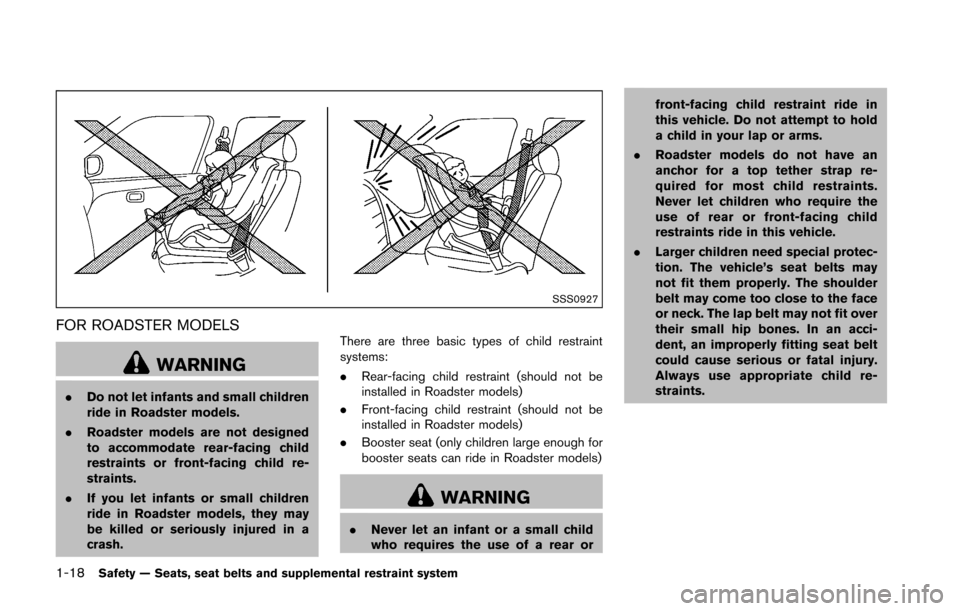
FOR ROADSTER MODELS
WARNING
.Do not let infants and small children
ride in Roadster models.
. Roadster models are not designed
to accommodate rear-facing child
restraints or front-facing child re-
straints.
. If you let infants or small children
ride in Roadster models, they may
be killed or seriously injured in a
crash. There are three basic types of child restraint
systems:
.
Rear-facing child restraint (should not be
installed in Roadster models)
. Front-facing child restraint (should not be
installed in Roadster models)
. Booster seat (only children large enough for
booster seats can ride in Roadster models)
WARNING
.Never let an infant or a small child
who requires the use of a rear or front-facing child restraint ride in
this vehicle. Do not attempt to hold
a child in your lap or arms.
. Roadster models do not have an
anchor for a top tether strap re-
quired for most child restraints.
Never let children who require the
use of rear or front-facing child
restraints ride in this vehicle.
. Larger children need special protec-
tion. The vehicle’s seat belts may
not fit them properly. The shoulder
belt may come too close to the face
or neck. The lap belt may not fit over
their small hip bones. In an acci-
dent, an improperly fitting seat belt
could cause serious or fatal injury.
Always use appropriate child re-
straints.
Page 42 of 428
SSS0099
SSS0100
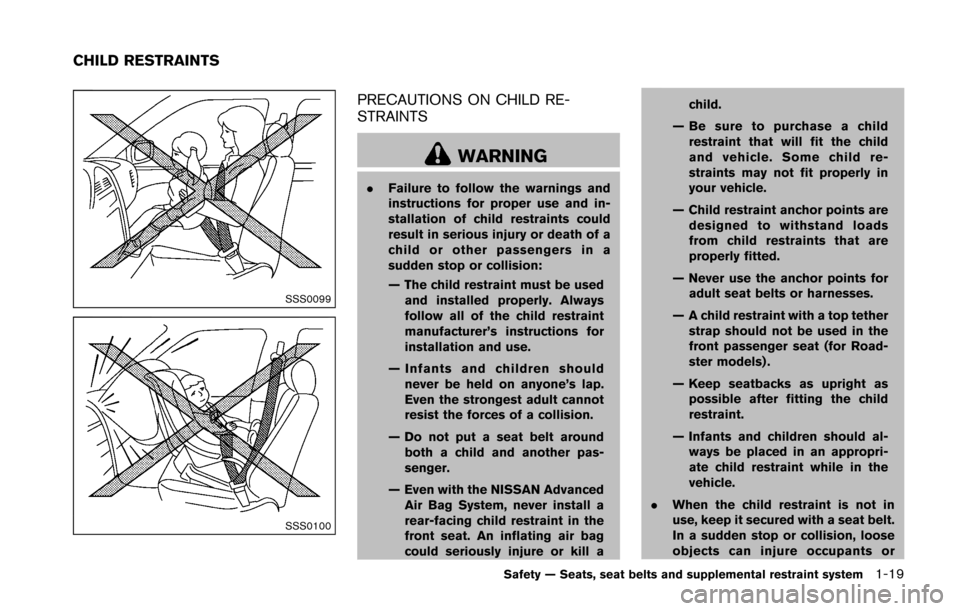
PRECAUTIONS ON CHILD RE-
STRAINTS
WARNING
.Failure to follow the warnings and
instructions for proper use and in-
stallation of child restraints could
result in serious injury or death of a
child or other passengers in a
sudden stop or collision:
— The child restraint must be used
and installed properly. Always
follow all of the child restraint
manufacturer’s instructions for
installation and use.
— Infants and children should never be held on anyone’s lap.
Even the strongest adult cannot
resist the forces of a collision.
— Do not put a seat belt around both a child and another pas-
senger.
— Even with the NISSAN Advanced Air Bag System, never install a
rear-facing child restraint in the
front seat. An inflating air bag
could seriously injure or kill a child.
— Be sure to purchase a child restraint that will fit the child
and vehicle. Some child re-
straints may not fit properly in
your vehicle.
— Child restraint anchor points are designed to withstand loads
from child restraints that are
properly fitted.
— Never use the anchor points for adult seat belts or harnesses.
— A child restraint with a top tether strap should not be used in the
front passenger seat (for Road-
ster models) .
— Keep seatbacks as upright as possible after fitting the child
restraint.
— Infants and children should al- ways be placed in an appropri-
ate child restraint while in the
vehicle.
. When the child restraint is not in
use, keep it secured with a seat belt.
In a sudden stop or collision, loose
objects can injure occupants or
Safety — Seats, seat belts and supplemental restraint system1-19
CHILD RESTRAINTS
Page 43 of 428
1-20Safety — Seats, seat belts and supplemental restraint system
damage the vehicle.
CAUTION
A child restraint in a closed vehicle can
become very hot. Check the seating
surface and buckles before placing a
child in the child restraint.
In general, child restraints are designed to be
installed with the lap portion of a lap/shoulder
seat belt.
Several manufacturers offer child restraints for
children of various sizes. When selecting any
child restraint, keep the following points in mind:
. Choose only a restraint with a label certifying
that it complies with Federal Motor Vehicle
Safety Standard 213 or Canadian Motor
Vehicle Safety Standard 213.
. Check the child restraint in your vehicle to
be sure it is compatible with the vehicle’s
seat and seat belt system.
. If the child restraint is compatible with your
vehicle, place your child in the child restraint
and check the various adjustments to be
sure the child restraint is compatible with
your child. Choose a child restraint that is designed for your child’s height and weight.
Always follow all recommended procedures.
The passenger seat is not suitable for use with a
rear-facing child restraint for infants. Therefore,
infants should not be transported in this vehicle.
All U.S. states and Canadian provinces or
territories require that infants and small
children be restrained in an approved child
restraint at all times while the vehicle is
being operated. Canadian law requires the
top tether strap on front-facing child
restraints to be secured to the designated
anchor point on the vehicle.
TOP TETHER STRAP CHILD RE-
STRAINT (for Coupe models)
If the manufacturer of your child restraint
requires the use of a top tether strap, it must
be secured to an anchor point.
WARNING
. Child restraint anchorages are de-
signed to withstand only those
loads imposed by correctly fitted
child restraints. Under no circum-
stances are they to be used for adult
seat belts, harnesses or for attach-
ing other items or equipment to the vehicle. Doing so could damage the
child restraint anchorages. The child
restraint will not be properly in-
stalled using the damaged ancho-
rage, and a child could be seriously
injured or killed in a collision.
. If the cargo cover (if so equipped)
contacts the top tether strap when it
is attached to the top tether anchor,
remove the cargo cover from the
vehicle or secure it on the cargo
floor below its attachment location.
If the cargo cover is not removed, it
may damage the top tether strap
during a collision. Your child could
be seriously injured or killed in a
collision if the child restraint top
tether strap is damaged.
. Do not allow cargo to contact the
top tether strap when it is attached
to the top tether anchor. Properly
secure the cargo so it does not
contact the top tether strap. Cargo
that is not properly secured or cargo
that contacts the top tether strap
may damage the top tether strap
during a collision. Your child could
be seriously injured or killed in a
collision if the child restraint top
Page 45 of 428
1-22Safety — Seats, seat belts and supplemental restraint system
SSS0100
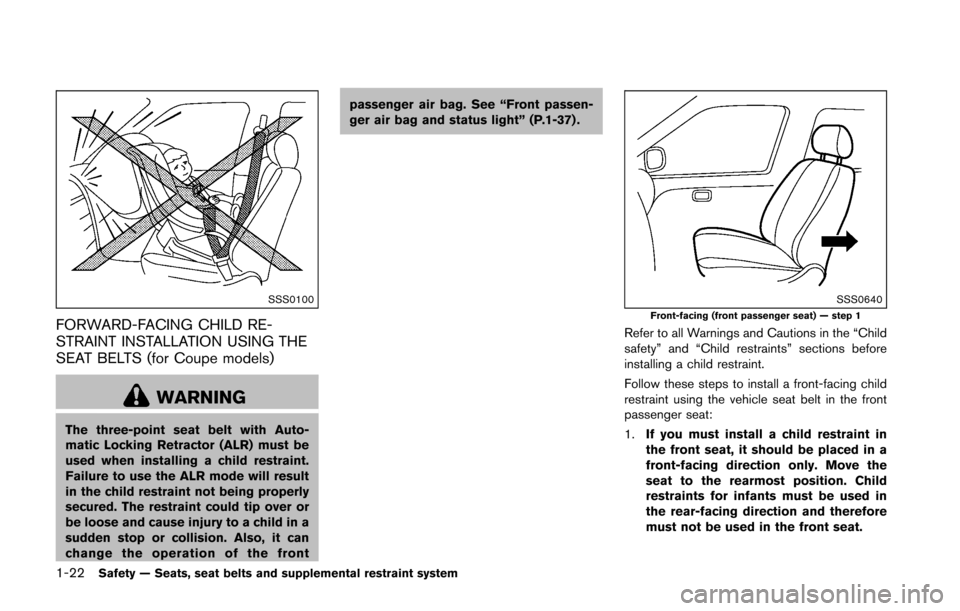
FORWARD-FACING CHILD RE-
STRAINT INSTALLATION USING THE
SEAT BELTS (for Coupe models)
WARNING
The three-point seat belt with Auto-
matic Locking Retractor (ALR) must be
used when installing a child restraint.
Failure to use the ALR mode will result
in the child restraint not being properly
secured. The restraint could tip over or
be loose and cause injury to a child in a
sudden stop or collision. Also, it can
change the operation of the frontpassenger air bag. See “Front passen-
ger air bag and status light” (P.1-37) .
SSS0640Front-facing (front passenger seat) — step 1
Refer to all Warnings and Cautions in the “Child
safety” and “Child restraints” sections before
installing a child restraint.
Follow these steps to install a front-facing child
restraint using the vehicle seat belt in the front
passenger seat:
1. If you must install a child restraint in
the front seat, it should be placed in a
front-facing direction only. Move the
seat to the rearmost position. Child
restraints for infants must be used in
the rear-facing direction and therefore
must not be used in the front seat.