2016 MINI Hardtop 4 Door sunroof
[x] Cancel search: sunroofPage 164 of 246

Saving fuelVehicle features and op‐tions
This chapter describes all standard, country-
specific and optional features offered with the
series. It also describes features that are not necessarily available in your car, e. g., due to
the selected options or country versions. This
also applies to safety-related functions and sys‐
tems. The respectively applicable country provi‐
sions must be observed when using the respec‐
tive features and systems.
General information Your vehicle contains advanced technology for
the reduction of fuel consumption and emis‐
sions.
Fuel consumption depends on a number of dif‐
ferent factors.
The implementation of certain measures, driv‐
ing style and regular maintenance can influ‐
ence fuel consumption and environmental im‐
pact.
Remove unnecessary
cargo
Additional weight increases fuel consumption.
Remove attached parts
following use
Remove roof or rear luggage racks which are
no longer required following use.
Attached parts on the vehicle impair the aero‐
dynamics and increase the fuel consumption.Close the windows and
glass sunroof
Driving with the glass sunroof and windows
open results in increased air resistance and
raises fuel consumption.
Tires
General information Tires can affect fuel consumption in various
ways, e.g., tire size may influence fuel con‐
sumption.
Check the tire inflation pressure
regularly
Check and, if needed, correct the tire inflation
pressure at least twice a month and before
starting on a long trip.
Low tire inflation pressure increases rolling re‐
sistance and thus raises fuel consumption and
tire wear.
Drive away without de‐
lay
Do not wait for the engine to warm-up while
the vehicle remains stationary. Start driving
right away, but at moderate engine speeds.
This is the fastest way for the cold engine to
reach its operating temperature.
Look well ahead when
driving
Avoid unnecessary acceleration and braking.Seite 164DRIVING TIPSSaving fuel164
Online Edition for Part no. 01 40 2 963 334 - VI/15
Page 213 of 246
Starting aid terminals
In the vehicle, only charge the battery via the
starting aid terminals, refer to page 215, in the
engine compartment with the engine off.
Power failure
After a temporary power loss, some equipment
needs to be newly initialized or individual set‐
tings updated, e. g.:▷Time: update.▷Date: update.▷Navigation system: wait for the operability
of the navigation.▷Seat and mirror memory: store the posi‐
tions again.▷Glass sunroof: initialize the system, refer to
page 48.
Disposing of old batteries
Have old batteries disposed of by a
dealer’s service center or another quali‐
fied service center or repair shop or
take them to a collection point.
Maintain the battery in an upright position for
transport and storage. Secure the battery so
that it does not tip over during transport.
Fuses Information WARNING
Incorrect and repaired fuses can overload
electrical lines and components. There is risk of
fire. Never attempt to repair a blown fuse and
do not replace a nonworking fuse with a substi‐
tute of another color or amperage rating. ◀
Replacing fuse
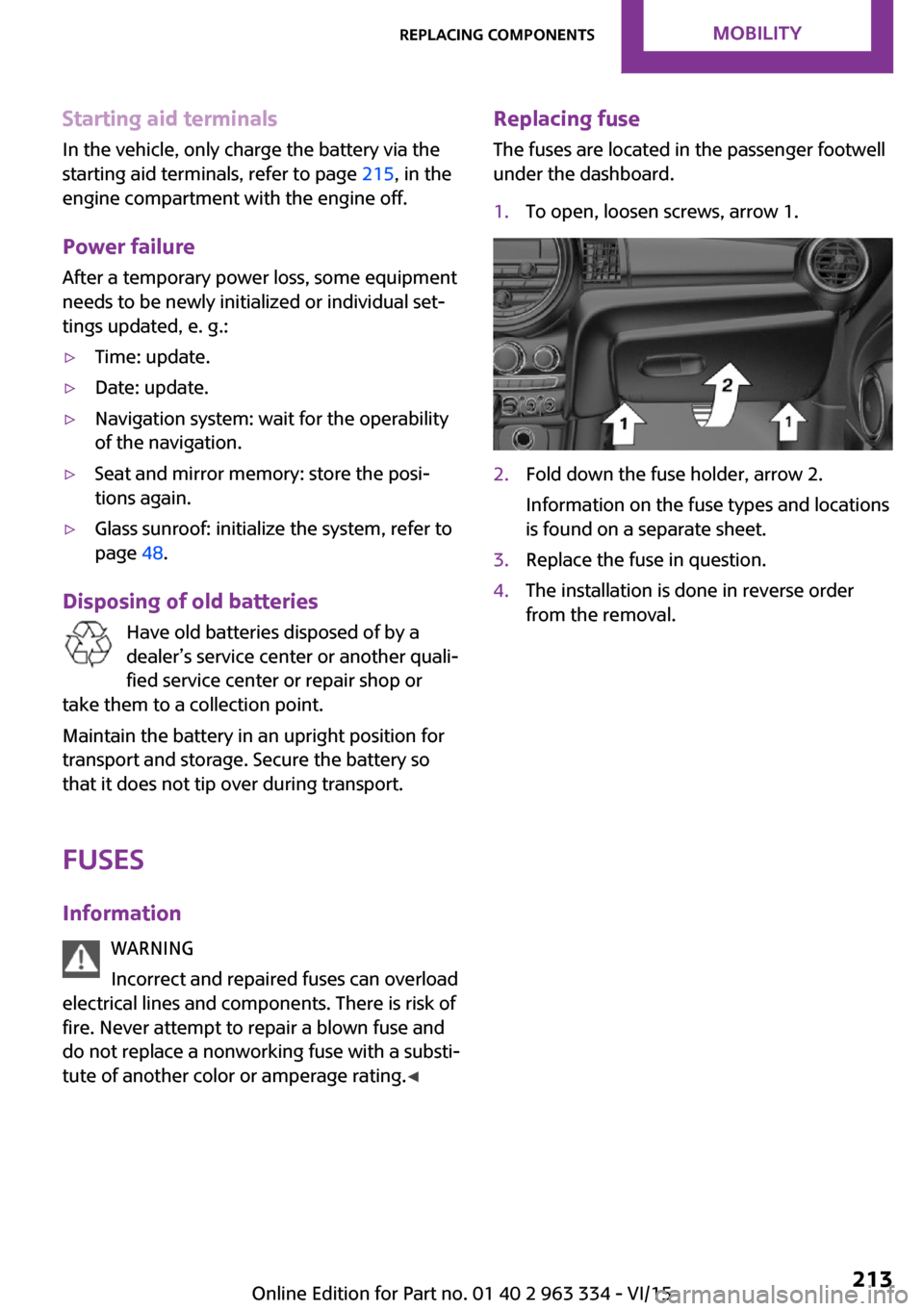
The fuses are located in the passenger footwell
under the dashboard.1.To open, loosen screws, arrow 1.2.Fold down the fuse holder, arrow 2.
Information on the fuse types and locations
is found on a separate sheet.3.Replace the fuse in question.4.The installation is done in reverse order
from the removal.Seite 213Replacing componentsMOBILITY213
Online Edition for Part no. 01 40 2 963 334 - VI/15
Page 220 of 246

CareVehicle features and op‐tions
This chapter describes all standard, country-
specific and optional features offered with the series. It also describes features that are not
necessarily available in your car, e. g., due to
the selected options or country versions. This
also applies to safety-related functions and sys‐
tems. The respectively applicable country provi‐
sions must be observed when using the respec‐
tive features and systems.
Car washes
General information Regularly remove foreign objects such as leaves
in the area below the windshield when the
hood is raised.
Wash your vehicle frequently, particularly in
winter. Intense soiling and road salt can dam‐
age the vehicle.
Steam jets or high-pressure washers
Information CAUTION
When cleaning with high-pressure wash‐
ers, components can be damaged due to the
pressure or temperatures being too high. There
is risk of property damage. Maintain sufficient
distance and do not spray too long continu‐
ously. Follow the user's manual for the high-
pressure washer. ◀
Distances and temperature▷Maximum temperature: 140 ℉/60 ℃.▷Minimum distance from sensors, cameras,
seals: 12 in/30 cm.▷Minimum distance from glass sunroof:
31.5 inches/80 cm.
Automatic car washes
Information
▷Give preference to cloth car washes or
those that use soft brushes in order to
avoid paint damage.▷Make sure that the wheels and tires are not
damaged by the transport mechanisms.▷Fold in the exterior mirrors; otherwise, they
may be damaged, depending on the width
of the vehicle.▷Unscrew the rod antenna.▷Deactivate the rain sensor, refer to
page 69, to avoid unintentional wiper acti‐
vation.▷In some cases, an unintentional alarm can
be triggered by the interior motion sensor
of the alarm system. Follow the instructions
on avoiding an unintentional alarm, refer to
page 44.
CAUTION
Too high guide rails in car washes can
damage body parts. There is risk of property
damage. Avoid car washes with guide rails
higher than 4 in/10 cm. ◀
Before driving into a car wash
In order to ensure that the vehicle can roll in a
car wash, take the following steps:
Manual transmission:
1.Drive into the car wash.2.Shift to neutral.3.Switch the engine off.4.Switch on the ignition.Seite 220MOBILITYCare220
Online Edition for Part no. 01 40 2 963 334 - VI/15
Page 239 of 246

Fold-out position, windshieldwipers 70
Foot brake 159
Front airbags 99
Front-end collision warning with City Braking func‐
tion 109
Front fog lights 97
Front-seat passenger airbags, automatic deactivation 101
Front-seat passenger airbags, indicator lamp 101
FTM Flat Tire Monitor 106
Fuel 176
Fuel consumption, see Aver‐ age fuel consumption 85
Fuel filler flap 174
Fuel gauge 80
Fuel lid 174
Fuel quality 176
Fuel recommendation 176
Fuel, tank capacity 230
Fuse 213
G Garage door opener, see Uni‐ versal Integrated Remote
Control 143
Gasoline 176
Gear change, Steptronic trans‐ mission 71
Gear shift indicator 82
General driving notes 158
Glare shield 147
Glass sunroof, refer to Panor‐ amic glass sunroof 46
Glove compartment 151
GREEN mode 165
GREEN mode, bonus range 167
GREEN mode driving style analysis 169
GREEN mode indicator 165
GREEN - program, driving dy‐ namics 117 GREEN tip 167
Gross vehicle weight, ap‐ proved 227
Ground clearance 160
H
Halogen headlights 204
Handbrake, refer to parking brake 66
Hand-held transmitter, alter‐ nating code 144
Hazard warning flashers 214
Head airbag 99
Headlight control, auto‐ matic 95
Headlight courtesy delay fea‐ ture 95
Headlight flasher 67
Headlight glass 204
Headlights, care 221
Head restraints 49
Head restraints, front 53
Head restraints, rear 54
Head-up Display 89
Head-Up Display, Shift point indicator 91
Head-up Display, sport dis‐ plays 91
Head-up Display, standard view 90
Heavy cargo, stowing 162
High-beam Assistant 96
High beams 67
High beams/low beams, see High-beam Assistant 96
Hills 160
Hill start assistant, see Drive- off assistant 118
Holder for beverages 152
Homepage 6
Hood 194
Horn 14
Hot exhaust system 159
HUD Head-up Display 89
Hydroplaning 159 I
Ice warning, see External tem‐ perature warning 80
Icy roads, see External tem‐ perature warning 80
Identification marks, tires 184
Identification number, see ve‐ hicle identification num‐
ber 10
Ignition key, see Remote con‐ trol 34
Ignition off 62
Ignition on 62
Illuminated ring, central in‐ strument cluster 88
Indication of a flat tire 103 , 106
Indicator lamp, see Check Control 76
Individual air distribu‐ tion 137, 140
Individual settings, see Per‐ sonal Profile 36
Inflation pressure, tires 178
Inflation pressure warning, tires 106
Info display, refer to On-Board computer 84
Information 6
Initialize, Tire Pressure Moni‐ tor TPM 103
Initializing, Flat Tire Monitor FTM 106
Instrument cluster 75
Instrument cluster, electronic displays 76
Instrument lighting 97
Integrated key 34
Integrated Owner's Manual in the vehicle 29
Intelligent Safety 108
Intensity, AUTO program 139
Interior equipment 143
Interior lights 98 Seite 239Everything from A to ZREFERENCE239
Online Edition for Part no. 01 40 2 963 334 - VI/15
Page 241 of 246

MINI maintenance sys‐tem 200
MINIMALISM Analyser 169
MINIMALISM info 168
Minimum tread, tires 185
Mirrors 55
Mobile communication devi‐ ces in the vehicle 159
Mobility System 188
Mode, GREEN Mode 165
Modifications, technical, refer to Own Safety 7
Moisture in headlight 204
Monitor, refer to Control Dis‐ play 18
Mounting of child restraint systems 59
Multifunction steering wheel, buttons 14
Multimedia, refer to Integrated Owner's Manual
N Navigation, refer to Integrated Owner's Manual
Neck restraints, front, see Head restraints 53
Neck restraints, rear, see Head restraints 54
New wheels and tires 186
Nylon rope for tow-starting/ towing 217
O
OBD Onboard Diagnos‐ tics 201
Obstacle marking, rearview camera 131
Octane rating, see Recom‐ mended fuel grade 176
Odometer 80
Office, refer to Integrated Owner's Manual
Oil 195 Oil, adding 196
Oil additives 197
Oil change 197
Oil change interval, service re‐ quirements 81
Oil filler neck 196
Oil types, alternative 197
Oil types, suitable 197
Old batteries, disposal 213
On-board computer 84
On-board computer, refer to On-board computer 84
Onboard Diagnostics OBD 201
Onboard monitor 18
Onboard monitor operating concept 18
Onboard vehicle tool kit 202
Opening/closing via door lock 39
Opening/closing with remote control 37
Operating menus, onboard monitor 18
Optional equipment, standard equipment 6
Outside air, refer to Automatic recirculated-air control 140
Own safety 7
P
Paint, vehicle 221
Panoramic glass sunroof 46
Parallel parking assistant 132
Park Distance Control PDC 126
Parked-car ventilation 141
Parked vehicle, condensa‐ tion 160
Parking aid, see PDC 126
Parking assistant 132
Parking brake 66
Parking lights 94
Passenger side mirror, tilting downward 55 Pathway lines, rearview cam‐
era 130
PDC Park Distance Con‐ trol 126
Pedestrian warning with city braking function 112
Performance Control 116
Personal Profile 36
Phone, refer to Integrated Owner's Manual
Pinch protection system, glass sunroof 47
Pinch protection system, win‐ dows 45
Plastic, care 222
PostCrash 114
Power failure 213
Power windows 44
Prescribed engine oil types 197
Pressure, tire air pressure 178
Pressure warning, tires 106
Profile, see Personal Pro‐ file 36
Protective function, glass sun‐ roof 47
Protective function, win‐ dows 45
Push-and-turn switch, see Controller 19
R Radiator fluid 198
Radio-operated key, see Re‐ mote control 34
Radio ready state 62
Radio, refer to Integrated Owner's Manual
Rain sensor 68
Rear fog lights 97
Rear lights 206
Rear luggage rack 163
Rearview camera 129
Rearview mirror 55 Seite 241Everything from A to ZREFERENCE241
Online Edition for Part no. 01 40 2 963 334 - VI/15