2016 MINI Hardtop 4 Door automatic transmission
[x] Cancel search: automatic transmissionPage 111 of 246
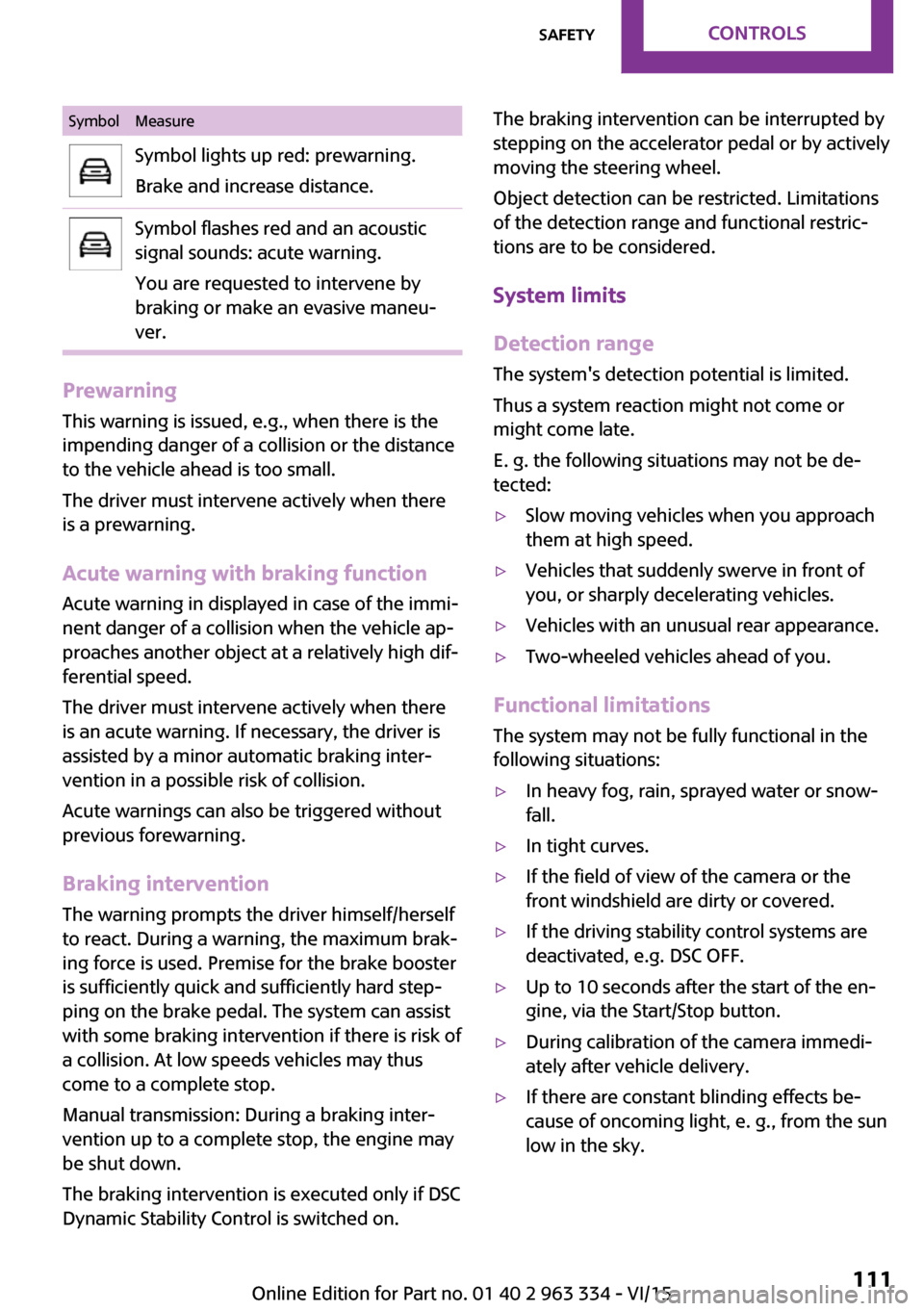
SymbolMeasureSymbol lights up red: prewarning.
Brake and increase distance.Symbol flashes red and an acoustic
signal sounds: acute warning.
You are requested to intervene by
braking or make an evasive maneu‐
ver.
Prewarning
This warning is issued, e.g., when there is the
impending danger of a collision or the distance
to the vehicle ahead is too small.
The driver must intervene actively when there
is a prewarning.
Acute warning with braking function
Acute warning in displayed in case of the immi‐
nent danger of a collision when the vehicle ap‐
proaches another object at a relatively high dif‐
ferential speed.
The driver must intervene actively when there
is an acute warning. If necessary, the driver is
assisted by a minor automatic braking inter‐
vention in a possible risk of collision.
Acute warnings can also be triggered without
previous forewarning.
Braking intervention The warning prompts the driver himself/herself
to react. During a warning, the maximum brak‐
ing force is used. Premise for the brake booster
is sufficiently quick and sufficiently hard step‐
ping on the brake pedal. The system can assist
with some braking intervention if there is risk of
a collision. At low speeds vehicles may thus
come to a complete stop.
Manual transmission: During a braking inter‐
vention up to a complete stop, the engine may
be shut down.
The braking intervention is executed only if DSC
Dynamic Stability Control is switched on.
The braking intervention can be interrupted by
stepping on the accelerator pedal or by actively
moving the steering wheel.
Object detection can be restricted. Limitations
of the detection range and functional restric‐
tions are to be considered.
System limits
Detection range The system's detection potential is limited.
Thus a system reaction might not come or
might come late.
E. g. the following situations may not be de‐
tected:▷Slow moving vehicles when you approach
them at high speed.▷Vehicles that suddenly swerve in front of
you, or sharply decelerating vehicles.▷Vehicles with an unusual rear appearance.▷Two-wheeled vehicles ahead of you.
Functional limitations
The system may not be fully functional in the
following situations:
▷In heavy fog, rain, sprayed water or snow‐
fall.▷In tight curves.▷If the field of view of the camera or the
front windshield are dirty or covered.▷If the driving stability control systems are
deactivated, e.g. DSC OFF.▷Up to 10 seconds after the start of the en‐
gine, via the Start/Stop button.▷During calibration of the camera immedi‐
ately after vehicle delivery.▷If there are constant blinding effects be‐
cause of oncoming light, e. g., from the sun
low in the sky.Seite 111SafetyCONTROLS111
Online Edition for Part no. 01 40 2 963 334 - VI/15
Page 113 of 246

Intelligent Safety button
Camera
The camera is installed near the interior rear‐
view mirror.
Keep the windshield in the area behind the in‐
terior rearview mirror clean and clear.
Switching on/off
Switching on automatically
The system is automatically active after every
driving-off.
Switching on/off manually Press button briefly:
▷The menu for the intelligent safety
system is displayed. The systems
are individually switched off ac‐
cording to their respective settings.▷LED lights up orange or goes out respective
to their individual settings.
Adjust as needed. Individual settings are stored
for the profile currently used.
Press button again:
▷All Intelligent Safety systems are
activated.▷The LED lights up green.
Hold down button:
▷All Intelligent Safety systems are turned off.▷The LED goes out.
Warning with braking function
Display
If a collision with a person detected in this way
is imminent, a warning symbol appears on the
instrument cluster and in the Head-up Display.
The red symbol is displayed and a signal
sounds.
Intervene immediately by braking or
make an evasive maneuver.
Braking intervention
The warning prompts the driver himself/herself
to react. During a warning, the maximum brak‐ ing force is used. Premise for the brake booster
is sufficiently quick and sufficiently hard step‐
ping on the brake pedal. The system can assist
with some braking intervention if there is risk of
a collision. At low speeds vehicles may thus come to a complete stop.
Manual transmission: During a braking inter‐
vention up to a complete stop, the engine may
be shut down.
The braking intervention is executed only if DSC Dynamic Stability Control is switched on.
The braking intervention can be interrupted by
stepping on the accelerator pedal or by actively
moving the steering wheel.
Object detection can be restricted. Limitations
of the detection range and functional restric‐
tions are to be considered.
System limits
Detection range The detection potential of the camera is lim‐
ited.
Thus a warning might not be issued or be is‐
sued late.
Seite 113SafetyCONTROLS113
Online Edition for Part no. 01 40 2 963 334 - VI/15
Page 128 of 246

You may turn off automatic activation:1. "Settings"2."Parking"3.Select setting.
Settings are stored for the profile currently
used.
Automatic deactivation during forward
travel
The system switches off when a certain driving
distance or speed is exceeded.
Switch the system back on if needed.
Switching on/off manually Press button.
▷On: the LED lights up.▷Off: the LED goes out.
The rearview camera image is displayed when
the reverse gear is engaged by pressing the
button.
Display
Signal tones
When approaching an object, an intermittent
sound indicates the position of the object. E. g.
if an object is detected to the left rear of the ve‐
hicle, a signal tone sounds from the left rear
speaker.
The shorter the distance to the object, the
shorter the intervals.
If the distance to a detected object is less than
approx. 10 in/25 cm, a continuous tone is sounded.
If objects are located both in front of and to the
rear of the vehicle, an alternating continuous
signal is sounded.
The signal tone is switched off, when selector
lever position P is engaged on vehicles with Steptronic transmission.
Volume
The ratio of the PDC signal tone volume to the
entertainment volume can be adjusted.1. "Multimedia", "Radio" or
"Settings"2."Tone"3."Volume settings"4."PDC"5.To adjust: turn the controller.6.To store: press the controller.
Settings are stored for the profile currently
used.
Visual warning The approach of the vehicle to an object can be
shown on the Control Display. Objects that are
farther away are already displayed on the Con‐
trol Display before a signal sounds.
A display appears as soon as Park Distance
Control (PDC) is activated.
The range of the sensors is represented in col‐
ors: red, green and yellow.
When the image of the rearview camera is dis‐
played, the switch can be made to PDC:
"Rear view camera"
System limits
Limits of ultrasonic measurement Ultrasonic measuring might not function under
the following circumstances:
▷For small children and animals.▷For persons with certain clothing, e.g.
coats.▷With external interference of the ultra‐
sound, e.g. from passing vehicles or loud
machines.▷When sensors are dirty, iced over, damaged
or out of position.Seite 128CONTROLSDriving comfort128
Online Edition for Part no. 01 40 2 963 334 - VI/15
Page 167 of 246

Display in the instrument cluster
GREEN bonus range An adjusted driving style helps
you extend your driving range.
This may be displayed as the bo‐
nus range in the instrument clus‐
ter.
The bonus range is shown in the range display.
The bonus range is automatically reset every
time the vehicle is refueled.▷Green display: efficient driving style.▷Gray display: adjust driving style, e. g. by
backing off the accelerator pedal.
Driving style
A bar display in the instrument
cluster indicates your current
driving efficiency.
Mark in the left area, arrow 1:
display for energy recovered by
coasting or when braking.
Mark in the right area, arrow 2: display when
accelerating.
Your driving style's efficiency is shown by the
bar's color:
▷Green display: efficient driving style as long
as the mark moves within the green range.▷Gray display: adjust driving style, e. g. by
backing off the accelerator pedal.
The display switches to green as soon as all
conditions for fuel-efficiency-optimized driving
are met.
GREEN tip driving instruction
Instructions tell you to switch to a more fuel-ef‐
ficient driving style when you back off the ac‐
celerator.
Information The driving style display and GREEN mode tips
in the instrument cluster appear when the GREEN mode display is activated.
Activating driving style and GREEN mode tips:
1. "Settings"2."Instrument cluster"3."GREEN Info"
GREEN tip symbols An additional symbol and text instructions aredisplayed.
SymbolMeasureFor efficient driving back off the ac‐
celerator or delay accelerating to al‐
low time to assess road conditions.Reduce speed to the selected GREEN
speed.Steptronic transmission: switch from
M/S to D or avoid manual shift inter‐
ventions.Seite 167Saving fuelDRIVING TIPS167
Online Edition for Part no. 01 40 2 963 334 - VI/15
Page 168 of 246

SymbolMeasureManual transmission: follow shifting
instructions.Manual transmission: engage neutral
for engine stop.
Indications on the Control Display
MINIMALISM
Information on fuel consumption and technol‐
ogy can be displayed while driving.
1. "Vehicle info"2."MINIMALISM"
Displaying MINIMALISM info
The current efficiency can be displayed.
"MINIMALISM info"
The following systems are displayed:
▷Auto Start/Stop function.▷Energy recovery.▷Climate control output.▷Coasting.
Displaying GREEN mode tips
"GREEN tips"
Driving instruction and an additional symbol
are displayed.
Settings are stored for the profile currently
used.
Coasting
The concept The system helps to conserve fuel.
To do this, under certain conditions the engine
is automatically decoupled from the transmis‐ sion when selector lever position D is set. The
vehicle continues traveling with the engine
idling to reduce fuel consumption. Selector
lever position D remains engaged.
This driving condition is referred to as coasting.
As soon as the brake or accelerator pedal is de‐
pressed, the engine is automatically coupled to
the transmission again.
Information
Coasting is a component of the GREEN driving
mode, refer to page 165.
Coasting is automatically activated when
GREEN mode is called via the Driving Dynamics
Control, refer to page 117.
The function is available in a certain speed
range.
A proactively driving style helps the driver to
use the function as often as possible and sup‐
ports the fuel-conserving effect of coasting.
Safety mode
The function is not available under one of the
following conditions.▷DSC OFF or TRACTION activated.▷Driving in the dynamic limit range and on
steep uphill or downhill grades.▷Battery charge status temporarily too low
or vehicle electrical system drawing exces‐
sive current.▷Cruise control activated.
Functional requirements
In GREEN mode, this function is available in a
speed range from approximately 30 mph, ap‐
prox. 50 km/h to 100 mph, approx. 160 km/h,
if the following conditions are met:
▷Accelerator pedal and brake pedal are not
operated.▷The selector lever is in selector lever posi‐
tion D.▷Engine and transmission are at operating
temperature.Seite 168DRIVING TIPSSaving fuel168
Online Edition for Part no. 01 40 2 963 334 - VI/15
Page 220 of 246

CareVehicle features and op‐tions
This chapter describes all standard, country-
specific and optional features offered with the series. It also describes features that are not
necessarily available in your car, e. g., due to
the selected options or country versions. This
also applies to safety-related functions and sys‐
tems. The respectively applicable country provi‐
sions must be observed when using the respec‐
tive features and systems.
Car washes
General information Regularly remove foreign objects such as leaves
in the area below the windshield when the
hood is raised.
Wash your vehicle frequently, particularly in
winter. Intense soiling and road salt can dam‐
age the vehicle.
Steam jets or high-pressure washers
Information CAUTION
When cleaning with high-pressure wash‐
ers, components can be damaged due to the
pressure or temperatures being too high. There
is risk of property damage. Maintain sufficient
distance and do not spray too long continu‐
ously. Follow the user's manual for the high-
pressure washer. ◀
Distances and temperature▷Maximum temperature: 140 ℉/60 ℃.▷Minimum distance from sensors, cameras,
seals: 12 in/30 cm.▷Minimum distance from glass sunroof:
31.5 inches/80 cm.
Automatic car washes
Information
▷Give preference to cloth car washes or
those that use soft brushes in order to
avoid paint damage.▷Make sure that the wheels and tires are not
damaged by the transport mechanisms.▷Fold in the exterior mirrors; otherwise, they
may be damaged, depending on the width
of the vehicle.▷Unscrew the rod antenna.▷Deactivate the rain sensor, refer to
page 69, to avoid unintentional wiper acti‐
vation.▷In some cases, an unintentional alarm can
be triggered by the interior motion sensor
of the alarm system. Follow the instructions
on avoiding an unintentional alarm, refer to
page 44.
CAUTION
Too high guide rails in car washes can
damage body parts. There is risk of property
damage. Avoid car washes with guide rails
higher than 4 in/10 cm. ◀
Before driving into a car wash
In order to ensure that the vehicle can roll in a
car wash, take the following steps:
Manual transmission:
1.Drive into the car wash.2.Shift to neutral.3.Switch the engine off.4.Switch on the ignition.Seite 220MOBILITYCare220
Online Edition for Part no. 01 40 2 963 334 - VI/15
Page 236 of 246

Everything from A to ZIndexA
ABS, Antilock Brake Sys‐ tem 115
Acceleration Assistant, refer to Launch Control 74
ACC, see camera-based cruise control 119
Activated-charcoal filter 141
Active Cruise Control, see camera-based cruise con‐
trol 119
Additives, oil 197
Adjustments, seats/head re‐ straints 49
Adjustments, steering wheel 57
After washing vehicle 221
Airbags 99
Airbags, indicator/warning light 100
Air circulation, refer to Recir‐ culated-air mode 140
Air circulation, see Recircu‐ lated-air mode 137
Air conditioner 136
Air, dehumidifying, see Cool‐ ing function 137, 139
Air distribution, manual 137, 140
Air flow, air conditioner 137
Air flow, automatic climate control 140
Air pressure, tires 178
Air vents, refer to Ventila‐ tion 141
Alarm system 43
Alarm triggering 43
Alarm, unintentional 44
All around the center con‐ sole 16 All around the roofliner 17
All around the steering wheel 14
All-season tires, see Winter tires 187
Alternating-code hand-held transmitter 144
Alternative oil types 197
Antifreeze, washer fluid 70
Antilock Brake System, ABS 115
Anti-slip control, see DSC 115
Approved axle load 227
Arrival time 85
Ash tray 147
Assistance when driving off 118
Assist system, see Intelligent Safety 108
AUTO intensity 139
Automatic car wash 220
Automatic climate con‐ trol 138
Automatic Curb Monitor 55
Automatic deactivation, Front- seat passenger airbags 101
Automatic headlight con‐ trol 95
Automatic locking 43
Automatic recirculated-air control 140
Automatic transmission with Steptronic 71
AUTO program, automatic cli‐ mate control 139
AUTO program, intensity 139
Auto Start/Stop function 64
Average fuel consumption 85
Average speed 85
Axle loads, weights 227 B
Backrest curvature, refer to Lumbar support 50
Band-aids, see First-aid kit 214
Bar for tow-starting/ towing 217
Battery replacement, vehicle battery 212
Battery, vehicle 212
Belts, safety belts 51
Beverage holder, cu‐ pholder 152
Bonus range, GREEN mode 167
Bottle holder, see Cu‐ pholder 152
Brake assistant 115
Brake discs, break-in 158
Brake pads, break-in 158
Braking, hints 159
Breakdown assistance 214
Break-in 158
Brightness of Control Dis‐ play 88
Bug light 204
Bulb replacement 203
Bulb replacement, front 204
Bulb replacement, rear 206
Bulb replacement, side 209
Bulbs and lights 203
Button, Start/Stop 62
Bypassing, see Jump-start‐ ing 214
C
California Proposition 65 Warning 8 Seite 236REFERENCEEverything from A to Z236
Online Edition for Part no. 01 40 2 963 334 - VI/15
Page 240 of 246

Interior lights during unlock‐ing 37
Interior lights with the vehicle locked 38
Interior motion sensor 44
Interior rearview mirror, auto‐ matic dimming feature 56
Interior rearview mirror, com‐ pass 145
Interior rearview mirror, man‐ ually dimmable 56
Internet site 6
Interval display, service re‐ quirements 81
Interval mode 68
J Jacking points for the vehicle jack 210
Joystick, Steptronic transmis‐ sion 71
Jump-starting 214
K
Key/remote control 34
Keyless Go, see Comfort Ac‐ cess 41
Key Memory, see Personal Profile 36
Kickdown, Steptronic trans‐ mission 71
Knee airbag 100
L
Label on recommended tires 186
Lamp replacement 203
Lamp replacement, front 204
Lamp replacement, rear 206
Lamp replacement, side 209
Language on Control Dis‐ play 88 Lashing eyes, securing
cargo 162
LATCH child restraint sys‐ tem 60
Launch Control 74
Leather, care 221
LED bug light 204
LED headlights 204
LED ring, central instrument cluster 88
LEDs, light-emitting di‐ odes 203
Letters and numbers, enter‐ ing 25
Light 94
Light-alloy wheels, care 222
Light-emitting diodes, LEDs 203
Lighter 147
Lighting 94
Lights and bulbs 203
Light switch 94
Load 162
Loading 161
Lock, door 39
Locking/unlocking via door lock 39
Locking/unlocking with re‐ mote control 37
Locking, automatic 43
Locking, settings 42
Lock, power window 46
Locks, doors, and windows 61
Low beams 94
Low beams, automatic, see High-beam Assistant 96
Lower back support, mechani‐ cal 50
Luggage rack, refer to Roof- mounted luggage rack 162
Lumbar support, mechani‐ cal 50
M
Maintenance 200 Maintenance require‐
ments 200
Maintenance, service require‐ ments 81
Maintenance system, MINI 200
Make-up mirror 147
Malfunction displays, see Check Control 76
Manual air distribu‐ tion 137, 140
Manual air flow 137, 140
Manual mode, transmis‐ sion 72
Manual operation, door lock 39
Manual operation, exterior mirrors 55
Manual operation, fuel filler flap 174
Manual operation, Park Dis‐ tance Control PDC 128
Manual operation, rearview camera 130
Manual transmission 71
Manufacturer of the MINI 7
Marking, run-flat tires 187
Master key, see Remote con‐ trol 34
Maximum cooling 139
Maximum speed, display 82
Maximum speed, winter tires 187
Measurement, units of 88
Medical kit 214
Menu in instrument cluster 84
Menus, refer to onboard mon‐ itor operating concept 20
Messages, see Check Con‐ trol 76
Microfilter 138, 141
MID - program, driving dy‐ namics 117
MINI Connected, refer to Integrated Owner's Manual Seite 240REFERENCEEverything from A to Z240
Online Edition for Part no. 01 40 2 963 334 - VI/15