2016 MERCEDES-BENZ SPRINTER trailer
[x] Cancel search: trailerPage 202 of 290

ProblemPossible causes/consequences andMSolutions
?
The red coolant
warning lamp is lit
while the engine
is running.The coolant temperature is too high.
If the vehicle is stopped after being subjected to extreme loads, the
coolant warning lamp may come on when the ignition is switched on
or the engine is restarted. Such loads can be, for example, driving in
mountainous terrain or driving with a trailer.
XRun the engine for approximately 1 minute at idling speed.
XConsult a qualified specialist workshop if the display message con-
tinues to be shown.
7
|The yellow
reserve fuel warn-
ing lamp is on. At
the same time,
0
appears in the
fuel tank content
display while the
engine is running,
although there is
fuel in the fuel
tank.
The fuel filler cap is not closed.
XClose the fuel filler cap.
You will hear a click when the fuel filler cap is closed fully.
XIf the malfunction continues to be displayed, have it rectified imme-
diately at a qualified specialist workshop.
;
The yellow Check
Engine indicator
lamp is lit up or
flashes while the
engine is running.You have used up all fuel in the tank.
The engine is running in emergency mode.
XRefuel at the nearest gas station (Ypage 127).
XBleed the fuel system (Ypage 123).
XStart the engine three to four times in succession after refueling.
Emergency running mode will be canceled. The vehicle does not
need to be checked.
;The yellow Check
Engine indicator
lamp is lit up or
flashes while the
engine is running.The injection control is malfunctioning.
The engine is running in emergency mode.
Engine power output may be reduced.
XHave the vehicle checked at a qualified specialist workshop as soon
as possible.
In some states it is legally prescribed that after the check engine indi- cator lamp lights up you must contact a qualified specialist workshop
immediately. Observe the legal requirements.
200Indicator and warning lamps in the instrument cluster
On-board computer and displays
Page 205 of 290
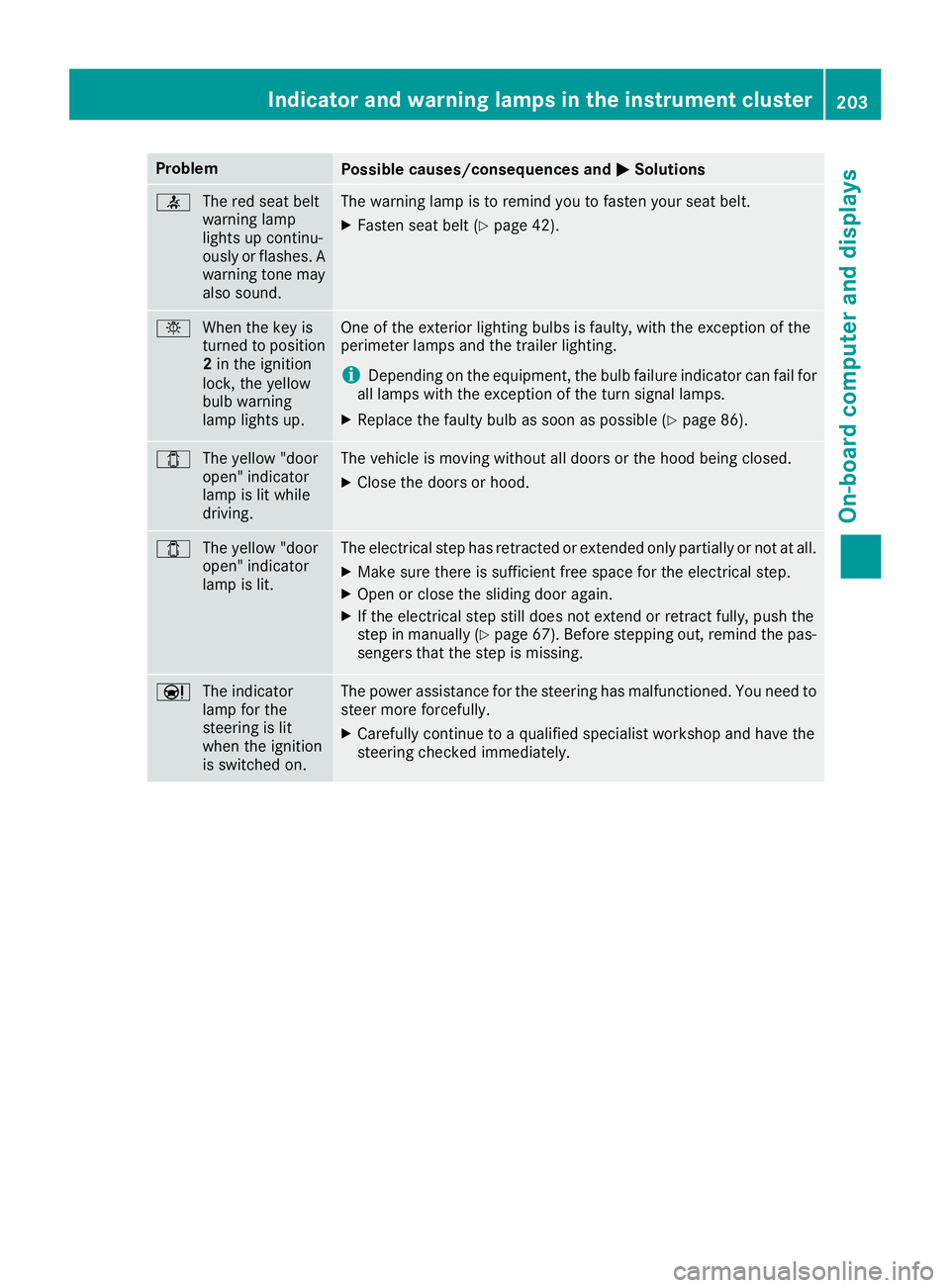
ProblemPossible causes/consequences andMSolutions
7
The red seat belt
warning lamp
lights up continu-
ously or flashes. A
warning tone may
also sound.The warning lamp is to remind you to fasten your seat belt.
XFasten seat belt (Ypage 42).
bWhen the key is
turned to position
2in the ignition
lock, the yellow
bulb warning
lamp lights up.One of the exterior lighting bulbs is faulty, with the exception of the
perimeter lamps and the trailer lighting.
iDepending on the equipment, the bulb failure indicator can fail for
all lamps with the exception of the turn signal lamps.
XReplace the faulty bulb as soon as possible (Ypage 86).
1 The yellow "door
open" indicator
lamp is lit while
driving.The vehicle is moving without all doors or the hood being closed.
XClose the doors or hood.
1The yellow "door
open" indicator
lamp is lit.The electrical step has retracted or extended only partially or not at all.
XMake sure there is sufficient free space for the electrical step.
XOpen or close the sliding door again.
XIf the electrical step still does not extend or retract fully, push the
step in manually (Ypage 67). Before stepping out, remind the pas-
sengers that the step is missing.
Ð The indicator
lamp for the
steering is lit
when the ignition
is switched on.The power assistance for the steering has malfunctioned. You need to
steer more forcefully.
XCarefully continue to a qualified specialist workshop and have the
steering checked immediately.
Indicator and warning lamps in the instrument cluster203
On-board computer and displays
Z
Page 239 of 290

XClean camera lens:with clean water and a
soft cloth.
Make sure that you donot apply any wax to
camera lens :when waxing the veh icle.If nec-
essary, remove the wax using water, shampoo
and a soft cloth.
Cleaning the sliding door
XRemove foreign objects from the vicinity of
the contact surfaces and contact pins of the
slidin g door.
XClean the contact surfaces and contact pins
wit h a mild cleaning agent and a soft cloth.
Do not oil or grease the contact plates and con-
tact pins.
Steps
Cleaning the electrical step
Clean the electrical step at least once a month.
Make sure that no dirtaccumulates inthe hous-
ing or on the step.
XExtend the electrical step (Ypage 66).
XClose the sliding door unt ilthe door lock
engages.
The electrical step remains extended for
cleaning.
XClean the electrical step and the housing with
a power washer.
XAfter cleaning, spray the step guides on each
side wit h silicone spray when the housing and
electrical step are dry.
Do not use oil or grease as a lubricant.
XRetract the electrical step.
Access step in the bumper
Example :access step in th ebumpe r
Pay attention to the important safety notes in
the "Notes on care" (Ypage 233) and "Power
washers" (Ypage 234) sections.
Keep step in the bumper :free from dirt, such
as:
Rmud
Rclay
Rsnow
Rice
XClean access step in the bumper :with a
power washer.
Cleaning the trailer tow hitch
!Do not clean the ball coupling with a power
washer. Do not use solvents.
!Observe the notes on care in the Operator's
Manual for the trailer tow hitch and the ball
coupling manufacturer.
You can also have the maintenance work on the
ball coupling and the trailer tow hitch carried out
by a qualified specialist workshop.
Interior
Cleaning the interior
!When using liquids to clean the vehicle inte-
rior, observe the foll owing points:
RUnder no circumstances use power wash-
ers.
RMake sure that no fluids enter or remain in
gaps and cavities.
REnsure sufficient ventilation when clean-
ing.
RMake sure that the vehicle interior is com-
pletely dry after cleaning.
Cleaning the display
!For cleaning, do not use any of the foll owing:
Ralcohol-based thinner or gasoline
Rabrasive cleaning agents
Rcommercially-availab lehousehold cleaning
agents
These may damage the display surface. Do
not put pressure on the display surface when cleaning. This could lead to irreparable dam-
age to the display.
Care237
Maintenance and care
Z
Page 245 of 290

Before connecting the jumper cables
On vehicles with a battery main switch, check
whether the battery main switch is switched on
(
Ypage 118).
XApply the parking brake.
XMove the selector lever of the automatic
transmission to positionP.
XSwitch off all electrical consumers, e.g. audio
equipment, blower.
XTurn the key to position0in the ignition lock
and remove it (Ypage 119).
XOpen the hood (Ypage 218).
Tow-starting and towing away
Important safety notes
GWARNING
Functions relevant to safety are restricted or
no longer available if:
Rthe engine is not running.
Rthe brake system or the power steering is
malfunctioning.
Rthere is a malfunction in the voltage supply or the vehicle's electrical system.
If your vehicle is being towed, much more
force may be necessary to steer or brake.
There is a risk of an accident.
In such cases, use a tow bar. Before towing,
make sure that the steering moves freely.
GWARNING
You can no longer steer the vehicle if the
steering wheel lock has been engaged. There
is a risk of an accident.
Always switch off the ignition when towing the
vehicle with a tow cable or a tow bar.
GWARNING
When towing or tow-starting another vehicle
and its weight is greater than the permissible
gross weight of your vehicle, the:
Rthe towing eye could detach itself
Rthe vehicle/trailer combination could roll-
over.
There is a risk of an accident.
When towing or tow-starting another vehicle,
its weight should not be greater than the per- missible gross weight of your vehicle.
Information on the gross vehicle weight can be
found on the vehicle identification plate
(
Ypage 276).
!Only secure the tow rope or tow bar at the
towing eyes. Otherwise, the vehicle could be
damaged.
!Observe the following points when towing
with a tow rope:
RSecure the tow rope on the same side on
both vehicles.
REnsure that the tow cable is not longer than
legally permitted. Mark the tow cable in the
middle, e.g. with a white cloth (30 x 30 cm).
This will make other road users aware that
the vehicle is being towed.
ROnly secure the tow cable to the towing
eye.
RObserve the brake lamps of the towing
vehicle while driving. Always maintain a dis-
tance so that the tow rope does not sag.
RDo not use steel cables or chains to tow
your vehicle. You could otherwise damage
the vehicle.
!Do not use the towing eye for recovery, this
could damage the vehicle. If in doubt, recover
the vehicl
e with a crane.
!When towing, pull away slowly and
smoothly. If the tractive power is too high, the
vehicles could be damaged.
When towing away, you must observe the legal
requirements for the country in which you are
currently driving.
It is preferable to have the vehicle transported
on a transporter or trailer instead of towing it.
Tow-starting and towing away243
Roadside Assistance
Z
Page 246 of 290

The automatic transmission selector lever must
be in theNposition when towing the vehicle.
The battery must be connected and charged.
Otherwise, you:
Rcannot turn the key in the ignition lock to
position 2
Rcannot move the selector lever to position N
on vehicles with automatic transmission
Before the vehicle is towed, switch off the auto-
matic locking feature (
Ypage 64). You could
otherwise lock yourself out of the vehicle when
pushing or towing away the vehicle.
Installing/removing the towing eye
The fixture for the front towing eye is located in the
bumper.
Rear towing eye under the bumper, attached to the
chassis
Your vehicle may be equipped with rear towing
eye ;. If you tow or tow-start a vehicle, attach
the towing device to rear towing eye ;.
If your vehicle is equipped with a trailer tow
hitch, attach the towing device to the trailer tow hitch (
Ypage 155). Installing the front towing eye
XTake the towing eye and screwdriver from the
vehicle tool kit (Ypage 240).
XPress cover
:and remove cover :from the
opening.
You will see the fixture for the towing eye.
XScrew in the towing eye clockwise to the stop.
XInsert screwdriver into the towing eye and
tighten it.
Removing the front towing eye
XRemove the screwdriver from the vehicle tool
kit.
XInsert the screwdriver into the towing eye and
turn the screwdriver counter-clockwise.
XUnscrew the towing eye.
XInsert cover :with the lug at the bottom and
press it in at the top until it engages.
XPlace the towing eye and screwdriver back in
the vehicle tool kit.
Towing away in the event of malfunc-
tions
Front or rear axle damage on all-wheel-
drive vehicles
!For vehicles with all-wheel drive, all four
wheels must be raised for towing away. Oth-
erwise, you may damage the transfer case.
If the vehicle can only be raised by the front
axle, you must remove the propeller shaft
between the rear axle and the transfer case.
Always use new bolts when installing the pro-
peller shaft.
If the vehicle has front or rear axle damage, have
it transported on a transporter or trailer.
With transmission damage
!Always use new bolts when installing the
propeller shafts.
iOnly have the propeller shafts fitted or
removed by qualified, skilled personnel.
If the vehicle has transmission damage, have the
propeller shaft removed before towing away.
244Tow-starting and towing away
Roadside Assistance
Page 248 of 290

If the drive wheels get trapped on loose or
muddy ground, recover the vehicle with the
utmost care. This is especially the case if the
vehicle is laden.
Never attempt to recover a vehicle with a trailer
attached.
Pull out the vehicle backwards, if possible, using
the tracks it made when it became stuck.
Transporting the vehicle
!
You may only secure the vehicle by the
wheels, not by parts of the vehicle such as
axle or steering components. Otherwise, the
vehicle could be damaged.
Tow-starting (emergency engine
starting)
Vehicles with automatic transmission
!Vehicles with automatic transmission must
not be tow-started. You could otherwise dam-
age the automatic transmission.
You can find information on jump-starting under
"Jump-starting“ (
Ypage 242).
Electrical fuses
The fuse allocation chart and further information
on the electric fuses and relays can be found in the "Fuse allocation chart" supplement.
246Electrical fuses
Roadside Assistance
Page 261 of 290

Maximum permissible gross vehicle
weight rating
:Maximum number of seats
;Maximum permissible gross vehicle weight
rating
XSpecification for maximum gross vehicle
weight;is listed in the Tire and Loading
Information placard: "The gross weight of
occupants and luggage must not exceed XXX
kilograms or XXX lbs."
The gross weight of all vehicle occupants, cargo,
luggage and trailer load/noseweight (if applica-
ble) must not exceed the specified value.
iThe details on the Tire and Loading Infor-
mation placard illustration are only an exam-
ple. The maximum permissible gross vehicle
weight rating is vehicle-specific and may dif-
fer from that which is illustrated. You can find
the valid maximum permissible gross vehicle
weight rating for your vehicle on the Tire and
Loading Information placard.
Number of seats
:Maximum number of seats
;Maximum permissible gross vehicle weight
rating Maximum number of seats
:determines the
maximum number of occupants allowed to
travel in the vehicle. This information can be
found on the Tire and Loading Information plac-
ard.
iThe details on the Tire and Loading Infor-
mation placard illustration are only an exam-
ple. The number of seats is vehicle-specific
and can differ from the details shown. The
number of seats in your vehicle can be found
on the Tire and Loading Information placard.
Determining the maximum load
Individual steps
The following steps have been developed as
required of all manufacturers under Title 49,
Code of U.S. Federal Regulations, Part 575 in
accordance with the "National Traffic and Motor
Vehicle Safety Act of 1966".
XStep 1: Locate the statement "The combined
weight of occupants and cargo should never
exceed XXX kg or XXX lbs." on your vehicle's
Tire and Loading Information placard.
XStep 2: Determine the combined weight of
the driver and passengers that will be travel-
ing in your vehicle.
XStep 3: Subtract the combined weight of the
driver and passengers from XXX kilograms or
XXX lbs.
XStep 4: The resulting figure equals the avail-
able amount of cargo and luggage load capa- city. For example, if the "XXX" amount equals
1400 lbs and there will be five 150 pound
passengers in your vehicle, the amount of
available cargo and luggage load capacity is
650 lbs (1400 Ò750 (5 x 150) = 650 lbs).
XStep 5: Determine the combined weight of
luggage and cargo being loaded on the vehi-
cle. For reasons of safety, that weight must
not exceed the available cargo and luggage
cargo capacity calculated in step 4.
XStep 6 (if applicable): If you intend to tow a
trailer behind your vehicle, the load on the
trailer is transferred to your vehicle. Please
consult the Tire and Loading Information plac-
ard, to determine how this reduces the avail-
able cargo and luggage load capacity of your
vehicle.
Loading the vehicle259
Wheels and tires
Z
Page 262 of 290

Example: Steps 1 to 3
The following table shows examples of how to calculate total load and cargo capacities with varyingseating configurations and number and size of occupants. The following examples use a maximum
load of 1500 lbs (680 kg). This is for illustration purposes only. Make sure you are using the
actual load limit for your vehicle stated on your vehicle's Tire and Loading Information placard .
Example 1Example 2Example 3
Step 1Combined maximum
weight of occupants
and cargo (data from
the Tire and Loading
Information placard)1500 lbs
(680 kg)1500 lbs
(680 kg)1500 lbs
(680 kg)
Example 1Example 2Example 3
Step 2Number of people in
the vehicle (driver and
occupants)531
Distribution of the
occupantsFront: 2
Rear: 3Front: 1
Rear: 2Front: 1
Weight of the occu-
pantsOccupant 1:
150 lbs (68 kg)
Occupant 2:
180 lbs (82 kg)
Occupant 3:
160 lbs (73 kg)
Occupant 4:
140 lbs (63 kg)
Occupant 5:
120 lbs (54 kg)Occupant 1:
200 lbs (91 kg)
Occupant 2:
190 lbs (86 kg)
Occupant 3:
150 lbs (68 kg)Occupant 1:
150 lbs (68 kg)
Gross weight of all
occupants750 lbs (340 kg)540 lbs (245 kg)150 lbs (68 kg)
Example 1Example 2Example 3
Step 3Permissible cargo and
trailer load/nose-
weight (maximum
gross vehicle weight
rating from the Tire
and Loading Informa-
tion placard minus the
gross weight of all
occupants)1500 lbs
(680 kg) Ò750 lbs
(340 kg) =
750 lbs (340 kg)1500 lbs
(680 kg) Ò540 lbs
(245 kg) =
960 lbs (435 kg)1500 lbs
(680 kg) Ò150 lbs
(68 kg) =
1350 lbs
(612 kg)
The greater the combined weight of the occupants, the lower the maximum luggage load.
Further information can be found under "Towing a trailer" (
Ypage 159).
260Loading the vehicle
Wheels and tires