2016 MERCEDES-BENZ S-Class SEDAN width
[x] Cancel search: widthPage 400 of 438
Example 3
Step 1
RCombined maximum weight of occupants and load (data from the Tire and Loading Information
placard): 1500 lbs (680 kg)
Step 2
RNumber of people in the vehicle (driver and occupants): 2
RDistribution of the occupants:
-Front: 1
RWeight of the occupants
-Occupant 1: 150 lbs (68 kg)
RTotal weight of all occupants: 150 lbs (68 kg)
Step 3
RPermissible load (maximum gross vehicle weight rating from the Tire and Loading Information
placard minus the gross weight of all occupants):
1500 lbs (680 kg) Ò150 lbs (68 kg) = 1350 lbs (612 kg)
Vehicle identification plate
Even if you have calculated the total cargo care-
fully, you should still make sure that the gross
vehicle weight rating and the gross axle weight
rating are not exceeded. Details can be found on
the vehicle identification plate on the B-pillar on
the driver's side of the vehicle (
Ypage 394).
Permissible Gross Vehicle Weight Rating
(GVWR): the gross weight of the vehicle, all pas-
sengers, load and trailer load/noseweight (if
applicable) must not exceed the permissible
gross vehicle weight.
Gross Axle Weight Rating (GAWR): the maxi-
mum permissible weight that can be carried by
one axle (front or rear axle).
To ensure that your vehicle does not exceed the
maximum permissible values (gross vehicle
weight and maximum gross axle weight rating),
have your loaded vehicle (including driver, occu-
pants, cargo, and full trailer load if applicable)
weighed on a suitable vehicle weighbridge.
All about wheels and tires
Uniform Tire Quality Grading Stand-
ards
Overview of Tire Quality Grading Stand-
ards
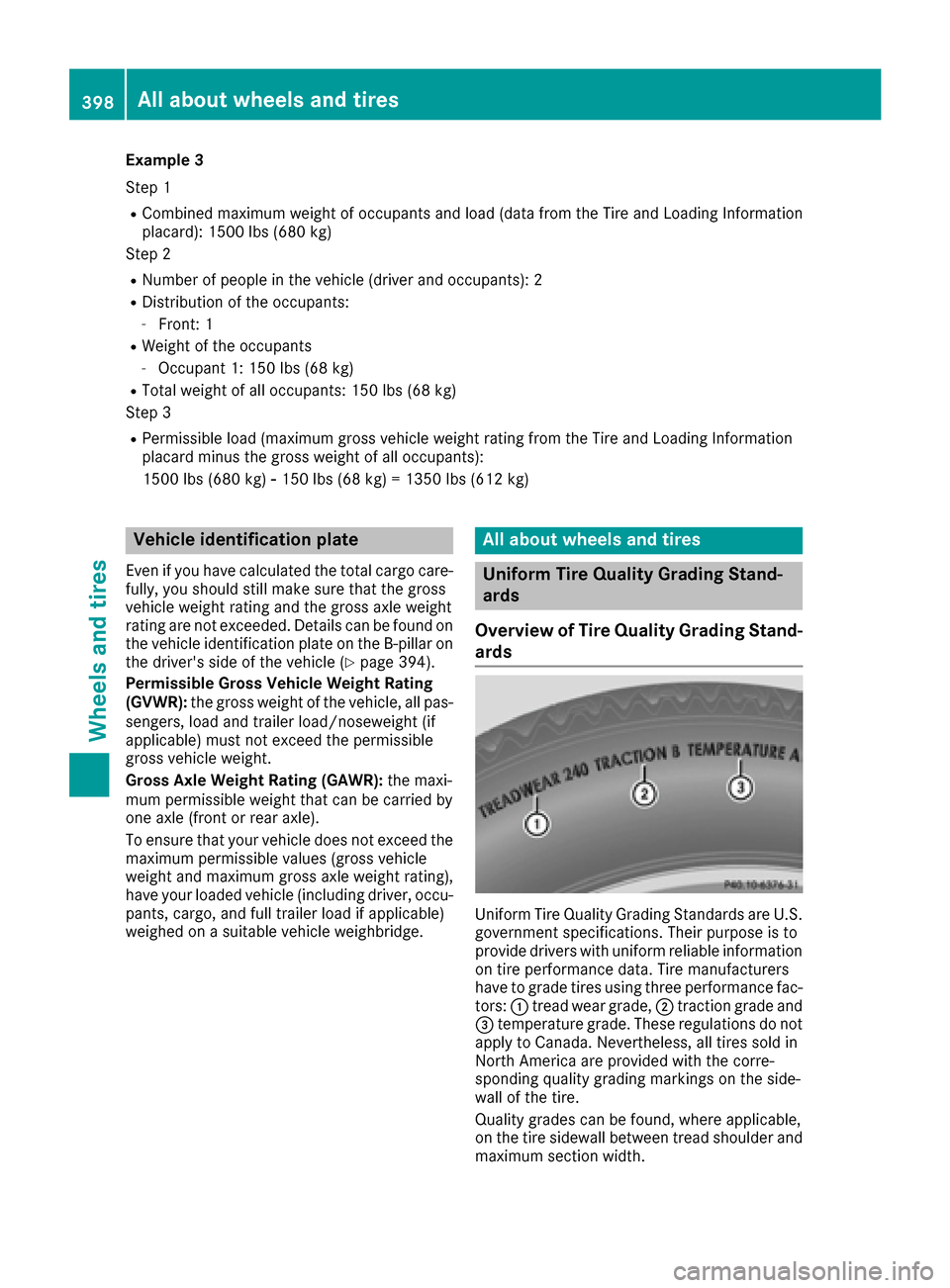
Uniform Tire Quality Grading Standards are U.S.
government specifications. Their purpose is to
provide drivers with uniform reliable information on tire performance data. Tire manufacturers
have to grade tires using three performance fac-
tors: :tread wear grade, ;traction grade and
= temperature grade. These regulations do not
apply to Canada. Nevertheless, all tires sold in
North America are provided with the corre-
sponding quality grading markings on the side-
wall of the tire.
Quality grades can be found, where applicable,
on the tire sidewall between tread shoulder and
maximum section width.
398All about wheels and tires
Wheels and tires
Page 402 of 438

Tire labeling
Overview
:Uniform Tire Quality Grading Standard
(Ypage 403)
;DOT, Tire Identification Number
(Ypage 402)
=Maximum tire load (Ypage 402)
?Maximum tire pressure (Ypage 390)
AManufacturer
BTire material (Ypage 403)
CTire size designation, load-bearing capacity
and speed rating (Ypage 400)
DLoad index (Ypage 402)
ETire name
The markings described above are on the tire in
addition to the tire name (sales designation) and
the manufacturer's name.
iTire data is vehicle-specific and may deviate
from the data in the example.
Tire size designation, load-bearing
capacity and speed rating
GWARNING
Exceeding the stated tire load-bearing capa-
city and the approved maximum speed could
lead to tire damage or the tire bursting. There is a risk of accident.
Therefore, only use tire types and sizes
approved for your vehicle model. Observe the
tire load rating and speed rating required for
your vehicle.
General: depending on the manufacturer's
standards, the size imprinted in the tire wall may
not contain any letters or may contain one letter
that precedes the size description.
If there is no letter preceding the size descrip-
tion (as shown above): these are passenger
vehicle tires according to European manufac-
turing standards.
If "P" precedes the size description: these are
passenger vehicle tires according to U.S. man-
ufacturing standards.
If "LT" precedes the size description: these are
light truck tires according to U.S. manufacturing
standards.
If "T" precedes the size description: compact
emergency wheels with high tire pressure that
are only designed for temporary use in an emer- gency.
Tire width: tire width:shows the nominal tire
width in millimeters.
Height-width ratio: aspect ratio;is the size
ratio between the tire height and tire width and
is shown in percent. The aspect ratio is calcula-
ted by dividing the tire width by the tire height.
Tire code: tire code=specifies the tire type.
"R" represents radial tires; "D" represents diag-
onal tires; "B" represents diagonal radial tires.
Optionally, tires with a maximum speed of over
149 mph (240 km/h) ma y h
ave "ZR" in the size
description, depending on the manufacturer
(e.g. 245/40 ZR 18).
Rim diameter: rim diameter?is the diameter
of the bead seat, not the diameter of the rim
flange. The rim diameter is specified in
inches (in).
400All about wheels an d tires
Wheels and tires
Page 406 of 438

GVWR (Gross Vehicle Weight Rating)
The GVWR is the maximum permissible gross
weight of a fully loaded vehicle (the weight of thevehicle including all accessories, occupants,
fuel, luggage and the drawbar noseweight, if
applicable). The gross vehicle weight rating is
specified on the vehicle identification plate on
the B-pillar on the driver's side.
Maximum loaded vehicle weight
The maximum weight is the sum of:
Rthe curb weight of the vehicle
Rthe weight of the accessories
Rthe load limit
Rthe weight of the factory installed optional
equipment
Kilopascal (kPa)
Metric unit for tire pressure. 6.9 kPa corre-
sponds to 1 psi. Another unit for tire pressure is
bar. 100 kilopascals (kPa) are the equivalent of
1 bar.
Load index
In addition to the load-bearing index, the load
index may also be imprinted on the sidewall of
the tire. This specifies the load-bearing capacity
more precisely.
Curb weight
The weight of a vehicle with standard equipment
including the maximum capacity of fuel, oil and
coolant. It also includes the air-conditioning sys-
tem and optional equipment if these are instal-
led in the vehicle, but does not include passen-
gers or luggage.
Maximum load rating
The maximum tire load is the maximum permis-
sible weight in kilograms or lbs for which a tire is
approved.
Maximum permissible tire pressure
Maximum permissible tire pressure for one tire.
Maximum load on one tire
Maximum load on one tire. This is calculated bydividing the maximum axle load of one axle by
two.
PSI (pounds per square inch)
A standard unit of measure for tire pressure.
Aspect ratio
Relationship between tire height and tire width
in percent.
Tire pressure
This is pressure inside the tire applying an out-
ward force to each square inch of the tire's sur-
face. The tire pressure is specified in pou
nds per
square inch (psi), in kilopascal (kPa) or in bar.
The tire pressure should only be corrected when
the tires are cold.
Cold tire pressure
The tires are cold:
Rif the vehicle has been parked with the tires
out of direct sunlight for at least three hours
and
Rif the vehicle has not been driven further than
1 mile (1.6 km)
Tread
The part of the tire that comes into contact with
the road.
Bead
The tire bead ensures that the tire sits securely
on the wheel. There are several steel wires in the
bead to prevent the tire from coming loose from
the wheel rim.
Sidewall
The part of the tire between the tread and the
bead.
Weight of optional extras
The combined weight of those optional extras
that weigh more than the replaced standard
parts and more than 5 lbs (2.3 kg). These
optional extras, such as high-performance
brakes, level control, a roof rack or a high-per-
formance battery, are not included in the curb
weight and the weight of the accessories.
TIN (Tire Identification Number)
This is a unique identifier which can be used by
a tire manufacturer to identify tires, for example
for a product recall, and thus identify the pur-
chasers. The TIN is made up of the manufactur- er's identity code, tire size, tire type code and
the manufacturing date.
404All about wheels and tires
Wheels and tires
Page 435 of 438
Vehicles with rear-com-
partment air-conditioning
systemCapacity
Refrigerant27.1 ± 0.4 oz(770 ± 10 g)
PAG oil4.2 oz
(120 g)
Vehicle data
General notes
Please note that for the specified vehicle data:
Rthe heights specified may vary as a result of:
-tires
-load
-condition of the suspension
-optional equipment
Roptional equipment reduces the maximum
payload.
Dimensions and weights
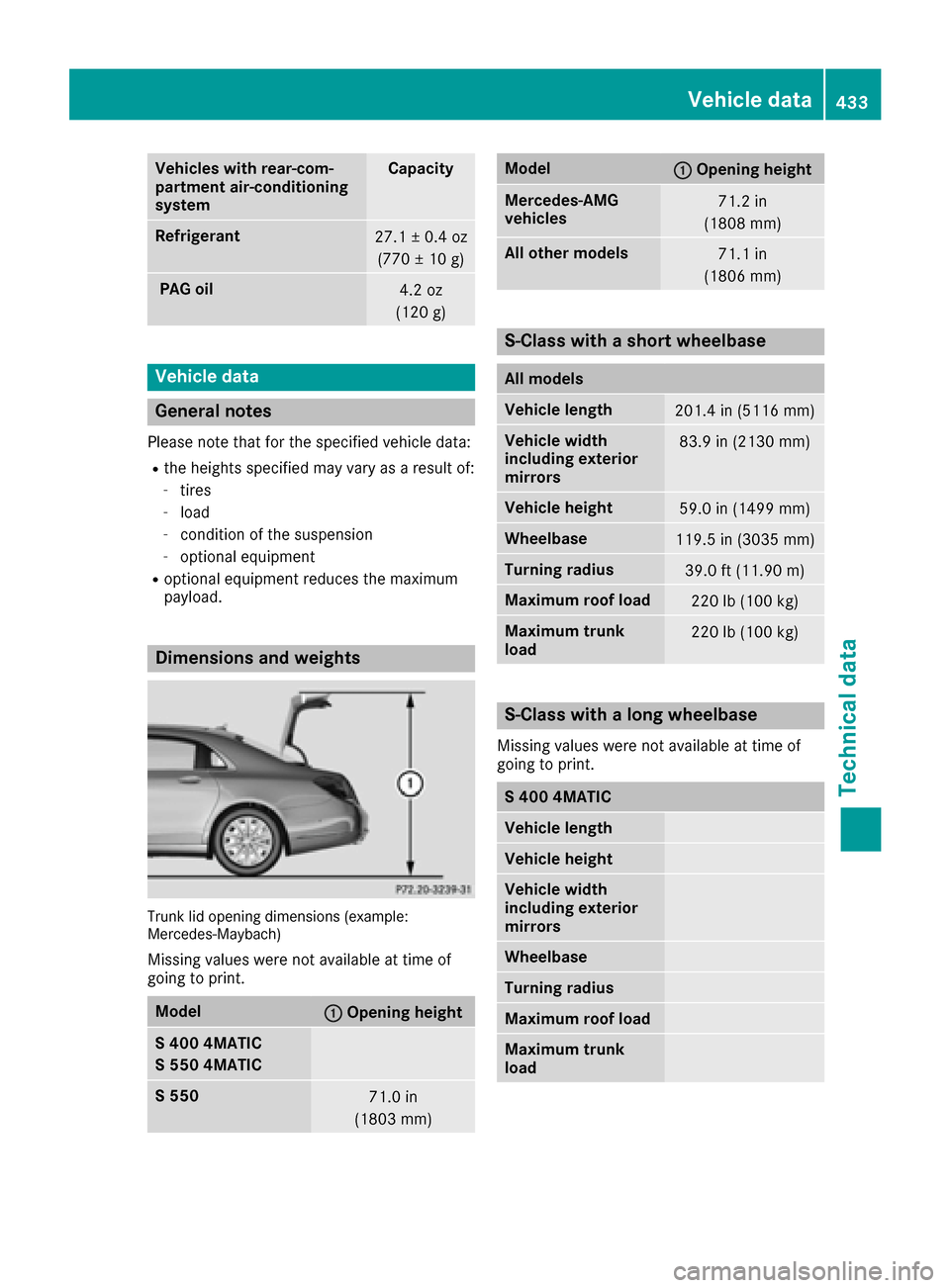
Trunk lid opening dimensions (example:
Mercedes‑Maybach)
Missing values were not available at time of
going to print.
Model:Opening height
S 400 4MATIC
S 550 4MATIC
S 55071.0 in
(1803 mm)
Model:Opening height
Mercedes ‑AMG
vehicles71.2 in
(1808 mm)
All other models71.1 in
(1806 mm)
S-Class with a short wheelbase
All models
Vehicle length201.4 in (5116 mm)
Vehicle width
including exterior
mirrors83.9 in (2130 mm)
Vehicle height59.0 in (1499 mm)
Wheelbase119.5 in (3035 mm)
Turning radius39.0 ft (11.90 m)
Maximum roof load220 lb (100 kg)
Maximum trunk
load220 lb (100 kg)
S-Class with a long wheelbase
Missing values were not available at time of
going to print.
S 400 4MATIC
Vehicle length
Vehicle height
Vehicle width
including exterior
mirrors
Wheelbase
Turning radius
Maximum roof load
Maximum trunk
load
Vehicle data433
Technical data
Z
Page 436 of 438
Mercedes‑AMG
vehicles
Vehicle length208.1 in (5287 mm)
Vehicle height59.0 in (1499 mm)
Vehicle width
including exterior
mirrors83.9 in (2130 mm)
Wheelbase124.6 in (3165 mm)
Turning circle,
Mercedes-AMG S 63
4MATIC41.0 ft (12.50m)
Turning circle,
Mercedes‑AMG S 6540.4 ft (12.30 m)
Maximum roof load220 lb (100 kg)
Maximum trunk
load220 lb (100 kg)
All other models
Vehicle length206.5 in (5246 mm)
Vehicle width
including exterior
mirrors83.9 in (2130 mm)
Wheelbase124.6 in (3165 mm)
Turning radius40.4 ft (12.30m)
Maximum roof load220 lb (100 kg)
Maximum trunk
load220 lb (100 kg)
ModelVehicle height
S 55058.8 in (1494 mm)
S 550 4MATIC
S 550 e
S 60058.9 in (1497 mm)
High-voltage battery
(S 550 e)
ModelLithium-ion
Energy content
High-voltage battery
(S 550 e)
Nominal capacity
Range in electric-only
mode (according to NEDC)
Charging time at 16 A
(using a charging station
or wallbox)
Charging time at 8 A(using
a mains socket)
Mercedes‑Maybach
All models
Vehicle length214.7 in (5453 mm)
Vehicle height59.0 in (1498 mm)
Vehicle width
including exterior
mirrors83.9 in (2130 mm)
Wheelbase132.5 in (3365 mm)
Turning radius42.3 ft (12.90 m)
Maximum trunk
load220 lb (100 kg)
434Vehicle data
Technical data