2016 MERCEDES-BENZ S CLASS ECO mode
[x] Cancel search: ECO modePage 248 of 438

Engine running while vehicle is stationary
The combustion engine is running while the
vehicle is stationary. The high-voltage battery is
not being charged.
The arrows for the energy flow are not shown.
The combustion engine is highlighted.
Charging while vehicle is stationary
The engine powers the electric motor. The elec-
tric motor operates as a generator. The high-
voltage battery is being charged.
The arrow representing energy flow is shown in
white.
Driving using the engine
The engine powers the vehicle. The arrows for the energy flow are shown in
white.
Driving using the engine plus boost mode
If you rapidly depress the accelerator, the elec-
tric motor supports the internal combustion
engine by providing additional torque.
The arrows for the energy flow are shown in red.
Driving using the engine plus energy
recovery
The engine powers the vehicle. The electric
motor is operating as a generator, e.g. in over-
run mode and when braking ( Y
page 253). The
kinetic energy of the vehicle is converted into
electrical energy. The high-voltage battery is
being charged.
The arrows for the energy flow are shown in
green.246
PLUG ‑ IN HYBRID operation
Driving and parking
Page 252 of 438
Pulling away X
Depress the brake pedal and keep it
depressed. X
Shift the transmission to position D or R .X
If the Apply Brake to Shift from 'P'
display message appears in the multifunction
display, depress the brake pedal more firmly
and select the desired transmission position. X
Release the brake pedal. X
Carefully depress the accelerator pedal.
For further information on pulling away
( Y
page 165).
Driving
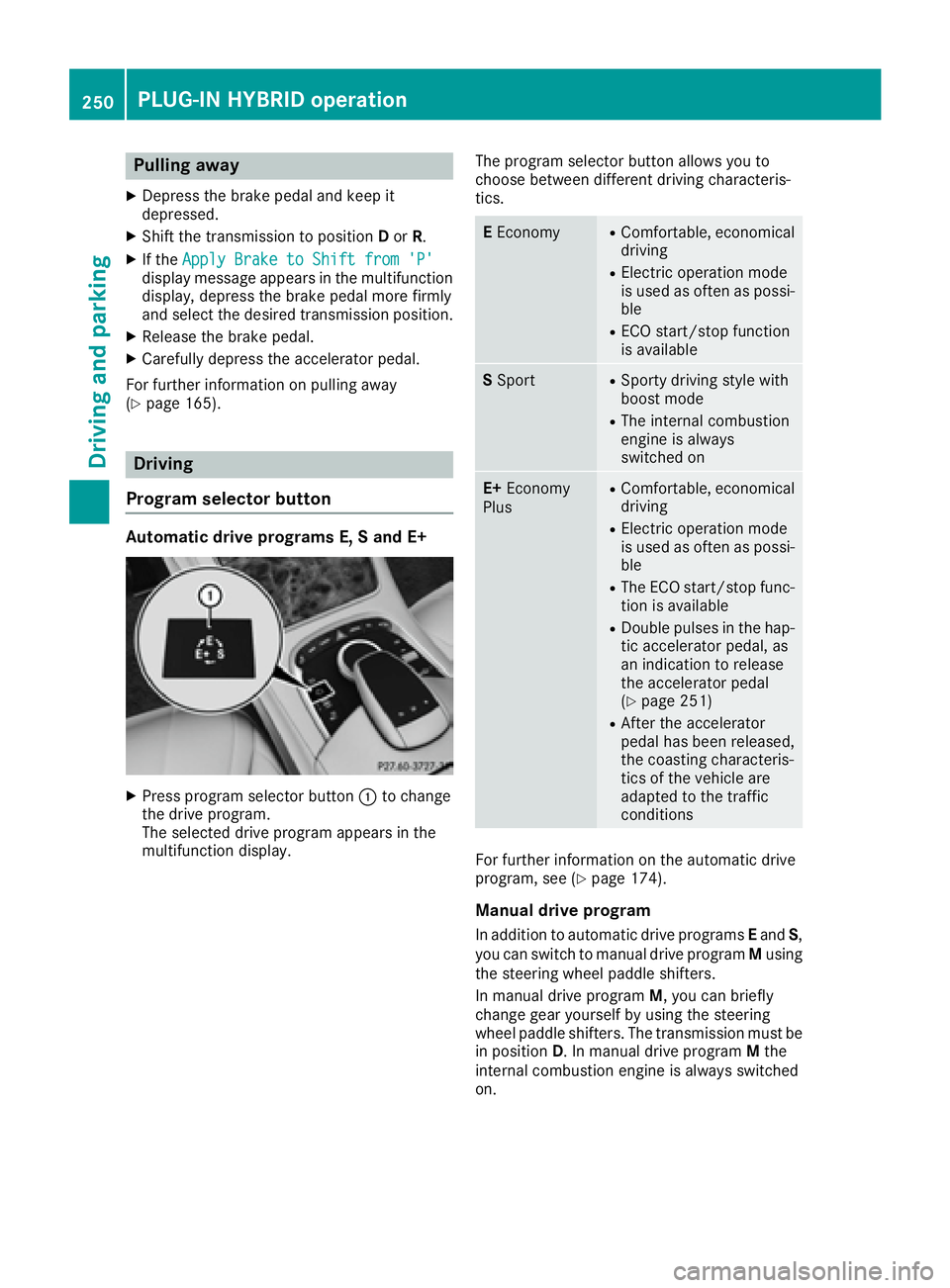
Program selector button Automatic drive programs E, S and E+
X
Press program selector button C to change
the drive program.
The selected drive program appears in the
multifunction display. The program selector button allows you to
choose between different driving characteris-
tics.
E Economy R
Comfortable, economical
driving R
Electric operation mode
is used as often as possi-
ble R
ECO start/stop function
is available
S Sport R
Sporty driving style with
boost mode R
The internal combustion
engine is always
switched on
E+ Economy
Plus R
Comfortable, economical
driving R
Electric operation mode
is used as often as possi-
ble R
The ECO start/stop func-
tion is available R
Double pulses in the hap-
tic accelerator pedal, as
an indication to release
the accelerator pedal
( Y
page 251) R
After the accelerator
pedal has been released,
the coasting characteris-
tics of the vehicle are
adapted to the traffic
conditions
For further information on the automatic drive
program, see ( Y
page 174).
Manual drive program
In addition to automatic drive programs E and S ,
you can switch to manual drive program M using
the steering wheel paddle shifters.
In manual drive program M , you can briefly
change gear yourself by using the steering
wheel paddle shifters. The transmission must be
in position D . In manual drive program M the
internal combustion engine is always switched
on.250
PLUG ‑ IN HYBRID operation
Driving and parking
Page 253 of 438
Activating when driving with the electric motor: X
Pull the left or right steering wheel paddle
shifter ( Y
page 174).
The combustion engine is switched on. Man-
ual drive program M is temporarily activated.
The selected gear and M appear in the multi-
function display.
Activating when driving with the combustion
engine: X
Pull the left or right steering wheel paddle
shifter ( Y
page 174).
Manual drive program M is temporarily acti-
vated. The selected gear and M appear in the
multifunction display.
The ECO start/stop function is not available in
manual drive program M .
Haptic accelerator pedal General notes The haptic accelerator pedal helps you to
reduce the fuel consumption and emissions of
your vehicle.
There are two different functions available for
this purpose: R
an additional point of resistance in E-MODE
operating mode ( Y
page 243)R
a double impulse in E+ operating mode
( Y
page 250)
Additional point of resistance in the hap-
tic accelerator pedal The maximum available electric performance is
indicated by a tangible point of resistance in the
haptic accelerator pedal.
The additional point of resistance is available in
E-MODE operating mode ( Y
page 243).
If you depress the haptic accelerator pedal
beyond the pressure point, the combustion
engine is switched on.
Double pulses in the haptic accelerator
pedal
A tangible double pulse in the haptic accelerator
pedal gives you a recommendation to release
the accelerator pedal. The combustion engine
can switch off and be disconnected from the
drive train (overrun mode).
The double pulse is available in drive program E+
( Y
page 250). After the accelerator pedal has been released,
the coasting characteristics of the vehicle are
adapted to the traffic conditions.
To avo id getting too close to the vehicle in front,
y
ou must apply the brakes manually when nec-
essary.
Driving tips General driving tips Drive carefully and maintain a safe distance
from the vehicle in front. Avoid frequent and
sudden acceleration as well as abrupt braking.
During partial electric driving, pulling away and
acceleration, the electric motor supports the
internal combustion engine.
During overrun in transmission position D and
braking, the electric motor will operate as a gen-
erator.
Further information on the ECO start/stop func-
tion ( Y
page 252).
Additional driving tips ( Y
page 192).
Stationary vehicle If the vehicle is stopped, the combustion engine
is, for the most part, switched off. Automatic
climate control continues to function. The elec-
tromechanically assisted steering gear allows
you to use the power steering without reduced
comfort.
Acceleration Depending on the operating mode, pulling away
and driving under low load conditions are per-
formed: R
entirely by electric propulsion R
in combination with the internal combustion
engine
When accelerating at an increased or full load,
boost mode is utilized. The electric motor sup-
ports the internal combustion engine by provid-
ing additional torque when the accelerator is
depressed rapidly.
Overrun mode or braking
There are three possible operating modes when
the hybrid vehicle is decelerating: R
energy recovery takes place even when the
vehicle is decelerating purely in overrun mode
( Y
page 240). The electric motor operates asPLUG ‑ IN HYBRID operation 251
Driving an d parking Z
Page 254 of 438

a generator and stores the recovered energy
in the high-voltage battery R
when the brakes are applied lightly, the vehi-
cle is slowed down further by the electric
motor. This increases the energy recovery
taking place ( Y
page 240). The electric motor
operates as a generator and stores the recov-
ered energy in the high-voltage battery R
when the brakes are applied with greater
force, the service brakes are also used to slow
the vehicle down. The two systems work
together
Urban driving Energy is recuperated during frequent deceler-
ation and stopping in city traffic.
The vehicle can be driven by the electric motor
alone up to a speed of approximately 81 mph
(130 km/h).
The vehicle is driven by the electric motor alone
only when all conditions for the automatic
engine switch-off are fulfilled.
Further information on the automatic engine
switch-off ( Y
page 252).
Driving on inter-urban roads The following phases are possible when driving
on inter-urban roads: R
rapid acceleration (boost mode) R
constant energy consumption R
energy recuperation R
electric operation mode
A great deal of recovered energy may be avail-
able, depending on the route profile. This
reduces consumption and emissions.
Highway driving
During highway driving, fuel consumption and
emissions are favorably influenced in partic ular
by reduced power losses.
The internal combustion engine will be switched
off automatically, if: R
the driver removes his or her foot from the
accelerator pedal in drive program E and a
speed of 81 mph (130 km/h) is not exceeded R
the driver removes his or her foot from the
accelerator pedal in drive program E+ and a
speed of 112 mph (180 km/h) is not excee-
ded
Further information on the automatic engine
switch-off ( Y
page 252). ECO start/stop function General notes The ECO start/stop function switches the inter-
nal combustion engine off automatically when
the vehicle stops moving and at high speeds
( Y
page 253).
All vehicle systems remain active, e.g. the auto-
matic climate control.
The ECO start/stop function is only available in
drive programs E and E+ . Electric-only operation
is only possible in drive programs E and E+ .
Additional information for drive programs E and
E+ ( Y
page 250).
Automatic engine switch-off The engine is switched off automatically, includ-
ing when: R
the driver removes his or her foot from the
accelerator pedal in drive program E and a
speed of 81 mph (13 0 km/ h) is not exceeded
( Y
page 253) R
the driver removes his or her foot from the
accelerator pedal in drive program E+ and a
speed of 112 mph (180 km/h) is not excee-
ded ( Y
page 253) R
the engine has reached its operating temper-
ature R
the driver’s seat belt is fastened and the
driver’s door is closed R
the driver only slightly depresses the accel-
erator pedal in order to, for example, maintain
the current speed for a limited distance R
the hood is closed and engaged properly R
the high-voltage battery is charged suffi-
ciently R
no malfunctions are present in the hybrid
drive system
The internal combustion engine will not be
switched off automatically, if: R
the self-diagnosis function of the engine con-
trol unit is still active R
there is a malfunction in the hybrid drive sys-
t em R
the climate control of the vehicle requires it R
the high-voltage battery is being charged
( Y
page 246) R
automatic emissions tests are running252
PLUG ‑ IN HYBRID operation
Driving and parking
Page 258 of 438

Useful information
i This Operator's Manual describes all models
and all standard and optional equipment of
your vehicle available at the time of publica-
tion of the Operator's Manual. Country-spe-
cific differences are possible. Please note
that your vehicle may not be equipped with all
features described. This also applies to
safety-related systems and functions.
i Read the information on qualified specialist
workshops ( Y
page 28).
Important safety notes
G WARNING
If you operate information systems and com-
munication equipment integrated in the vehi-
cle while driving, you will be distracted from
traffic conditions. You could also lose control
of the vehicle. There is a risk of an accident.
Only operate the equipment when the traffic
situation permits. If you are not sure that this
is possible, park the vehicle paying attention
to traffic conditions and operate the equip-
ment when the vehicle is stationary.
You must observe the legal requirements for the
country in which you are currently driving when
operating the on-board computer.
PLUG-IN HYBRID vehicles only:
G WARNING
If the instrument cluster has failed or mal-
functioned, you may not recognize function
restrictions in systems relevant to safety. The
operating safety of your vehicle may be
impaired. There is a risk of an accident.
Pull over as soon as it is safe to do so and
consult a qualified specialist workshop.
All vehicles, except PLUG-IN HYBRID vehi-
cles:
G WARNING
If the instrument cluster has failed or mal-
functioned, you may not recognize function
restrictions in systems relevant to safety. The operating safety of your vehicle may be
impaired. There is a risk of an accident.
Drive on carefully. Have the vehicle checked
at a qualified specialist workshop immedi-
ately.
If the operating safety of your vehicle is
impaired, pull over as soon as it is safe to do so.
Contact a qualified specialist workshop.
The on-board computer only shows messages or
warnings from certain systems in the multifunc-
tion display. You should therefore make sure
your vehicle is operating safely at all times.
For an overview, see the instrument panel illus-
tration ( Y
page 33).
Displays and operation
Instrument cluster lighting The light sensor in the instrument cluster auto-
matically controls the brightness of the multi-
function display. In daylight, the displays in the
instrument cluster are illuminated. A dimming
function is not possible in daylight.
The lighting in the instrument cluster, in the dis-
plays and the controls in the vehicle interior can
be adjusted using the brightness control knob.
The brightness control is located between the
instrument cluster and the multimedia system
display ( Y
page 35). X
Turn the brightness control knob clockwise or
counter-clockwise.
If you turn the light switch ( Y
page 130) to the
` , X or X position, the brightness
will depend upon the brightness of the ambi-
ent light.
Tachometer
! Do not drive in the overrevving range, as this
could damage the engine.
The red band in the tachometer indicates the
engine's overrevving range.
The fuel supply is interrupted to protect the
engine when the red band is reached.
PLUG-IN HYBRID vehicles: if you select the oper-
ating mode E-MODE , the display in the instru-
ment cluster changes from tachometer to power
meter ( Y
page 242).256
Displays and operation
On-board computer and displays
Page 299 of 438

Hybrid drive system Display messages
Possible causes/consequences and P Solutions
r Vehicle Operational
Switch the Ignition
Off Before Exiting PLUG-IN HYBRID vehicles:
You are leaving the vehicle when it is in a ready-to-drive state. The
READY indicator in the multifunction display is on. A warning tone also
sounds.
If you leave the vehicle: X
Secure the vehicle against rolling away ( Y
page 189).X
Switch off the ignition and remove the SmartKey.
If you do not leave the vehicle: X
Switch off the electrical consumers, e.g. automatic climate control,
seat heating.
Please note the following: the electrical consumers are supplied by the
12 V battery. If the vehicle is left in a ready-to-drive state for an exten-
ded period, it will switch off once the 12 V battery is almost empty. It
will then only be possible to start the vehicle using a second battery
(jump-starting).
Change the current
drive program
before changing the
operating mode. or
Exit manual drive
program M before
changing the operat‐
ing mode. PLUG-IN HYBRID vehicles:
You have attempted to change the operating mode when in automatic
drive program S (Sport) or manual drive program M .X
Activate the drive program E (Economy) or E+ (Economy Plus)
( Y
page 250). X
Select the preferred operating mode HYBRID , E-MODE , E-SAVE or
CHARGE ( Y
page 243).
E-MODE Currently
Unavailable PLUG-IN HYBRID vehicles:
The condition of charge of the high-voltage battery has dropped to the
lower limit and the E-MODE operating mode has been switched off.
Driving with the internal combustion engine is activated and the oper-
ating mode switches to the basic HYBRID setting.X
Continue driving using the internal combustion engine.
You can switch to the E-SAVE or CHARGE operating mode as
required ( Y
page 243).
If you select CHARGE , the high-voltage battery is charged.
Once the charge level display for the high-voltage battery has
increased slightly, you can switch to the E-MODE operating mode
again. Display messages 297
On-board computer and displays Z
Page 327 of 438

Useful information
i This Operator's Manual describes all models
and all standard and optional equipment of
your vehicle available at the time of publica-
tion of the Operator's Manual. Country-spe-
cific differences are possible. Please note
that your vehicle may not be equipped with all
features described. This also applies to
safety-related systems and functions.
i Read the information on qualified specialist
workshops ( Y
page 28).
Stowage areas
Loading guidelines
G WARNING
Combustion engines emit poisonous exhaust
gases such as carbon monoxide. Exhaust
gases can enter the vehicle interior if the
trunk lid is open when the engine is running,
especially if the vehicle is in motion. There is a
risk of poisoning.
Always switch off the engine before opening
the trunk lid. Never drive with the trunk lid
open.
G WARNING
If objects, luggage or loads are not secured or
not secured sufficiently, they could slip, tip
over or be flung around and thereby hit vehicle
occupants. There is a risk of injury, particu-
larly in the event of sudden braking or a sud-
den change in direction.
Always store objects so that they cannot be
flung around. Secure objects, luggage or
loads against slipping or tipping before the
journey.
G WARNING
The exhaust tail pipe and tail pipe trim can
become very hot. If you come into contact
with these parts of the vehicle, you could burn
yourself. There is a risk of injury.
Always be particularly careful around the
exhaust tail pipe and the tail pipe trim. Allow these components to cool down before touch-
ing them.
The handling characteristics of a laden vehicle
are dependent on the distribution of the load
within the vehicle. For this reason, you should
observe the following notes when transporting a
load: R
Never exceed the maximum permissible
gross vehicle weight or the gross axle weight
rating of the vehicle (including occupants).
The values are specified on the vehicle iden-
tification plate on the B-pillar of the driver's
door. R
The trunk is the preferred place to carry
objects. R
Position heavy loads as far forwards as pos-
sible and as low down in the trunk as possible. R
The load must not protrude above the upper
edge of the seat backrests. R
Always place the load behind unoccupied
seats if possible. R
Secure the load with sufficiently strong and
wear-resistant tie-downs. Pad sharp edges for
protection.
Stowage spaces
Important safety notes
G WARNING
If objects in the passenger compartment are
stowed incorrectly, they can slide or be
thrown around and hit vehicle occupants. In
addition, cupholders, open stowage spaces
and mobile phone brackets cannot always
retain all objects they contain. There is a risk
of injury, particularly in the event of sudden
braking or a sudden change in direction. R
Always stow objects so that they cannot be
thrown around in such situations. R
Always make sure that objects do not pro-
trude from stowage spaces, parcel nets or
stowage nets.Stowage areas 325
Stowage and features Z
Page 354 of 438

Useful information
i This Operator's Manual describes all models
and all standard and optional equipment of
your vehicle available at the time of publica-
tion of the Operator's Manual. Country-spe-
cific differences are possible. Please note
that your vehicle may not be equipped with all
features described. This also applies to
safety-related systems and functions.
i Read the information on qualified specialist
workshops ( Y
page 28).
Engine compartment
Hood
Important safety notes
G WARNING
If the hood is unlatched, it may open up when
the vehicle is in motion and block your view.
There is a risk of an accident.
Never unlatch the hood while driving. Before
every trip, ensure that the hood is locked.
G WARNING
When opening and closing the hood, it may
suddenly fall into the closed position. There is
a risk of injury to persons within range of
movement of the hood.
Open and close the hood only when no one is
within its range of movement.
G WARNING
Opening the hood when the engine is over-
heated or when there is a fire in the engine
compartment could expose you to hot gases
or other service products. There is a risk of
injury.
Let an overheated engine cool down before
opening the hood. If there is a fire in the
engine compartment, keep the hood closed
and contact the fire department. G WARNING
The engine compartment contains moving
components. Certain components, such as
the radiator fan, may continue to run or start
again suddenly when the ignition is off. There
is a risk of injury.
If you need to do any work inside the engine
compartment: R
switch off the ignition R
never reach into the area where there is a
risk of danger from moving components,
such as the fan rotation area R
remove jewelry and watches R
keep items of clothing and hair, for exam-
ple, away from moving parts
G WARNING
The ignition system and the fuel injection sys-
tem work under high voltage. If you touch
components which are under voltage, you
could get an electric shock. There is a risk of
injury.
Never touch components of the ignition sys-
tem or fuel injection system when the ignition
is switched on.
Opening the hood
G WARNING
Certain components in the engine compart-
ment, such as the engine, radiator and parts
of the exhaust system, can become very hot.
Working in the engine compartment poses a
risk of injury.
Where possible, let the engine cool down and
touch only the components described in the
following.
G WARNING
When the hood is open and the windshield
wipers are set in motion, you can be injured by
the wiper linkage. There is a risk of injury.
Always switch off the windshield wipers and
the ignition before opening the hood.352
Engine compartment
Maintenance and care