2016 MERCEDES-BENZ S CLASS warning
[x] Cancel search: warningPage 386 of 438

Useful information
i This Operator's Manual describes all models
and all standard and optional equipment of
your vehicle available at the time of publica-
tion of the Operator's Manual. Country-spe-
cific differences are possible. Please note
that your vehicle may not be equipped with all
features described. This also applies to
safety-related systems and functions.
i Read the information on qualified specialist
workshops ( Y
page 28).
Important safety notes
G WARNING
If wheels and tires of the wrong size are used,
the wheel brakes or suspension components
may be damaged. There is a risk of an acci-
dent.
Always replace wheels and tires with those
that fulfill the specifications of the original
part.
When replacing wheels, make sure to use the
correct: R
designation R
model
When replacing tires, make sure to use the
correct: R
designation R
manufacturer R
model
G WARNING
A flat tire severely impairs the driving, steer-
ing and braking characteristics of the vehicle.
There is a risk of accident.
Tires without run-flat characteristics: R
do not drive with a flat tire. R
immediately replace the flat tire with your
emergency spare wheel or spare wheel, or
consult a qualified specialist workshop. Tires with run-flat characteristics: R
pay attention to the information and warn-
ing notices on MOExtended tires (tires with
run-flat characteristics).
Accessories that are not approved for your vehi-
cle by Mercedes-Benz or are not being used cor-
rectly can impair the operating safety.
Before purchasing and using non-approved
accessories, visit a qualified specialist work-
shop and inquire about: R
suitability R
legal stipulations R
factory recommendations
Information on the sizes and types of wheels and
tires for your vehicle can be found under
"Wheel/tire combinations" ( Y
page 410).
Information on tire pressure can be found: R
on the vehicle's Tire and Loading Information
placard on the B-pillar ( Y
page 394)R
in the tire pressure table in the fuel filler flap
( Y
page 189) R
under "Tire pressure" ( Y
page 387)
Operation
Information on driving Check the tire pressure when the vehicle is
heavily laden and adjust prior to a trip.
While driving, pay attention to vibrations, noises
and unusual handling characteristics, e.g. pull-
ing to one side. This may indicate that the
wheels or tires are damaged. If you suspect that
a tire is defective, reduce your speed immedi-
ately. Stop the vehicle as soon as possible to
check the wheels and tires for damage. Hidden
tire damage could also be causing the unusual
handling characteristics. If you find no signs of
damage, have the tires and wheels checked at a
qualified specialist workshop.
When parking your vehicle, make sure that the
tires do not get deformed by the curb or other
obstacles. If they cannot be avoided, drive over
obstacles such as curbs slowly and at an obtuse
angle. Otherwise, you may damage the wheels
or tires.384
Operation
Wheels and tires
Page 387 of 438

Regular checking of wheels and tires
G WARNING
Damaged tires can cause tire inflation pres-
sure loss. As a result, you could lose control of
your vehicle. There is a risk of accident.
Check the tires regularly for signs of damage
and replace any damaged tires immediately.
Check wheels and tires for damage at least once
a month. Check wheels and tires after driving
off-road or on rough roads. Damaged wheels
can cause a loss of tire pressure. Pay particular
attention to damage such as: R
cuts in the tires R
punctures R
tears in the tires R
bulges on tires R
deformation or severe corrosion on wheels
Regularly check the tire tread depth and the
condition of the tread across the whole width of
the tire ( Y
page 385). If necessary, turn the
front wheels to full lock in order to inspect the
inner side of the tire surface.
All wheels must have a valve cap to protect the
valve against dirt and moisture. Do not mount
anything onto the valve other than the standard
valve cap or other valve caps approved by
Mercedes-Benz for your vehicle. Do not use any
other valve caps or systems, e.g. tire pressure
monitoring systems.
Regularly check the pressure of all the tires par-
ticularly prior to long trips. Adjust the tire pres-
sure as necessary ( Y
page 387).
The service life of tires depe nds, among other
thi ngs, on the following factors: R
driving style R
tire pressure R
distance covered
Notes on tire tread
G WARNING
Insufficient tire tread will reduce tire traction.
The tire is no longer able to dissipate water.
This means that on wet road surfaces, the risk
of hydroplaning increases, in particular where speed is not adapted to suit the driving con-
ditions. There is a risk of accident.
If the tire pressure is too high or too low, tires
may exhibit different levels of wear at differ-
ent locations on the tire tread. Thus, you
should regularly check the tread depth and
the condition of the tread across the entire
width of all tires.
Minimum tire tread depth for: R
Summer tires:
Page 388 of 438

R
Break in new tires at moderate speeds for the
first 60 miles (100 km). They only reach their
full performance after this distance. R
Do not drive with tires which have too little
tread depth, as this significantly reduces the
traction on wet roads (hydroplaning). R
Replace the tires after six years at the latest,
regardless of wear.
MOExtended tires (tires with run-flat
properties) With MOExtended tires (tires with run flat char-
acteristics), you can continue to drive your vehi-
cle even if there is a total loss of pressure in one
or more tires.
MOExtended tires may only be used in conjunc-
tion with an active tire pressure loss warning
system or with an active tire pressure monitor
and on wheels specifically tested by Mercedes-
Benz.
Notes on driving with MOExtended tires with a
flat tire ( Y
page 368).
Vehicles equipped with MOExtended tires are
not equipped with a TIREFIT kit at the factory. It
is therefore recommended that you additionally
equip your vehicle with a TIREFIT kit if you mount
tires that do not feature run-flat properties, e.g.
winter tires. A TIREFIT kit can be obtained from
a qualified specialist workshop.
Winter operation
General notes Have your vehicle winterproofed at a qualified
specialist workshop at the onset of winter.
Observe the notes in the "Changing a wheel"
section ( Y
page 405).
Driving with summer tires At temperatures below 45 ‡ (+7 †), summer
tires lose elasticity and therefore traction and
braking power. Change the tires on your vehicle
to M+S tires. Using summer tires at very cold
temperatures could cause cracks to form,
thereby damaging the tires permanently.
Mercedes-Benz cannot accept responsibility for
this type of damage. G WARNING
Damaged tires can cause tire inflation pres-
sure loss. As a result, you could lose control of
your vehicle. There is a risk of accident.
Check the tires regularly for signs of damage
and replace any damaged tires immediately.
M+S tires
G WARNING
M+S tires with a tire tread depth of less than
Page 389 of 438

To avoid hazardous situations: R
never install snow chains to the front
wheels R
always install snow chains in pairs to the
rear wheels.
For safety reasons, Mercedes-Benz recom-
mends that you only use snow chains that have
been specially approved for your vehicle by
Mercedes-Benz, or are of a corresponding
standard of quality.
If you intend to mount snow chains, please bear
the following points in mind: R
Snow chains may not be mounted on all
wheel/tire combinations. Permissible wheel-
tire combinations ( Y
page 410).R
Only use snow chains when driving on roads
completely covered by snow. Remove the
snow chains as soon as possible when you
come to a road that is not snow-covered. R
Local regulations may restrict the use of snow
chains. Observe the appropriate regulations if
you wish to mount snow chains. R
Do not exceed the maximum permissible
speed of 31 mph (50 km/h). R
On vehicles with AIRMATIC ( Y
page 212) or
Magic Body Control (MBC) ( Y
page 210), you
must drive at raised vehicle level if snow
chains have been mounted. R
When snow chains are installed, never use
Active Parking Assist ( Y
page 216).
You may wish to deactivate ESP ®
when pulling
away with snow chains installed ( Y
page 74).
You can thereby allow the wheels to spin in a
controlled manner, achieving an increased driv-
ing force (cutting action). Tire pressure
Tire pressure specifications
Important safety notes
G WARNING
Underinflated or overinflated tires pose the
following risks: R
the tires may burst, especially as the load
and vehicle speed increase. R
the tires may wear excessively and/or
unevenly, which may greatly impair tire
traction. R
the driving characteristics, as well as steer-
ing and braking, may be greatly impaired.
There is a risk of an accident.
Follow recommended tire inflation pressures
and check the pressure of all the tires includ-
ing the spare wheel: R
monthly, at least R
if the load changes R
before beginning a long journey R
under different operating conditions, e.g.
off-road driving
If necessary, correct the tire pressure.
The data on the Tire and Loading Information
placard and tire pressure table shown here are
examples. Tire pressure specifications are vehi-
cle-specific and may deviate from the data
shown here. The tire pressure specifications
that are valid for your vehicle can be found on
the Tire and Loading Information placard and
tire pressure table on the vehicle.
General notes The recommended tire pressures for the tires
mounted at the factory can be found on the
labels described here.
Further information on tire pressures can be
obtained at a qualified specialist workshop. Tire pressure 387
Wheels and tires Z
Page 393 of 438

Important safety notes
G WARNIN G
Eac h tire, includin g th e spar e (if provided),
should be checke d at least once every two
week s when cold and inflated to th e pressur e
recommended by th e vehicl e manufacturer
on th e Tir e and Loading Information placard
on th e driver' s door B-pillar or th e tire pres-
sur e label on th e inside of th e fuel filler flap . If
your vehicl e has tires of a differen t siz e than
th e siz e indicated on th e Tir e and Loading
Information placard or, if available, th e tire
pressur e label, you should determine th e
proper tire pressur e for those tires .
As an added safet y feature, your vehicl e has
been equipped wit h a tire pressur e monitoring
system (TPMS) that illuminate s a low tire pres-
sur e telltale when on e or mor e of your tires
are significantly underinflated. Accordingly,
when th e low tire pressur e telltale lights up,
you should stop and chec k your tires as soo n
as possible , and inflat e them to th e proper
pressure. Drivin g on a significantly underin-
flated tire causes th e tire to overheat and can
lead to tire failure.
Underinflation also reduce s fuel efficiency
and tire tread life , and may affec t th e vehicle's
handlin g and stopping ability. Pleas e note that
th e TPM S is no t a substitut e for proper tire
mainte
nance , a nd it is th e d river' s responsi-
bilit y to maintai n correc t tire pressure, eve n if
underinflation has no t reached th e level to
trigge r illumination of th e TPM S low tire pres-
sur e telltale.
Your vehicl e has also been equipped wit h a
TPM S malfunction indicator to indicat e when
th e system is no t operating properly. The
TPM S malfunction indicator is combined wit h
th e low tire pressur e telltale. When th e sys-
te m detects a malfunction , th e warning lamp
will flas h for approximately a minute and then
remain continuously illuminated. This
sequenc e will be repeated every time th e vehi-
cle is started as lon g as th e malfunction
exists. When th e malfunction indicator is illu- minated, th e system may no t be able to detec t
or signal low tire pressur e as intended.
TPM S malfunction s may occur for a variet y of
reasons, includin g th e installation of incom-
patible replacemen t or alternate tires or
wheels on th e vehicl e that preven t th e TPM S
from functioning properly. Always chec k th e
TPM S malfunction telltale after replacing on e
or mor e tires or wheels on your vehicl e to
ensur e that th e replacemen t or alternate Tires
and wheels allow th e TPM S to continue to
function properly.
It is th e driver' s responsibilit y to set th e tire
pressur e to that recommended for cold tires
whic h is suitable for th e operating situation
( Y
page 387). Not e that th e correc t tire pressur e
for th e curren t operating situation must first be
taught-in to th e tire pressur e monitor. If there is
a substantial loss of pressure, th e warning
threshold for th e warning message is aligned to
th e referenc e value s taught-in . Restart th e tire
pressur e monitor after adjusting th e pressur e of
th e cold tires ( Y
page 392). The curren t pres-
sures are saved as ne w referenc e values. As a
result , a warning message will appear if th e tire
pressur e drops significantly.
The tire pressur e mon ito r does no t w
arn you of
an incorrectl y set tire pressure. Observ e th e
note s on th e recommended tire pressur e
( Y
page 387).
The tire pressur e monitor is no t able to warn you
of a sudde n loss of pressure, e.g. if th e tire is
penetrated by a foreign object. In th e event of a
sudde n loss of pressure, brin g th e vehicl e to a
halt by braking carefully. Avoid abrup t steering
movements.
The tire pressur e monitor has a yellow warning
lamp in th e instrumen t cluste r for indicating
pressur e loss or a malfunction . Whether th e
warning lamp flashes or lights up indicates
whether a tire pressur e is to o low or th e tire
pressur e monitor is malfunctioning :R
if th e warning lamp is lit continuously, th e tire
pressur e on on e or mor e tires is significantly
to o low. The tire pressur e monitor is no t mal-
functioning . R
if th e warning lamp flashes for aroun d a
minute and then remain s lit constantly, th e
tire pressur e monitor is malfunctioning .
In addition to th e warning lamp , a message
appear s in th e multifunction display. Observ eTire pressure 391
Wheels and tires Z
Page 394 of 438
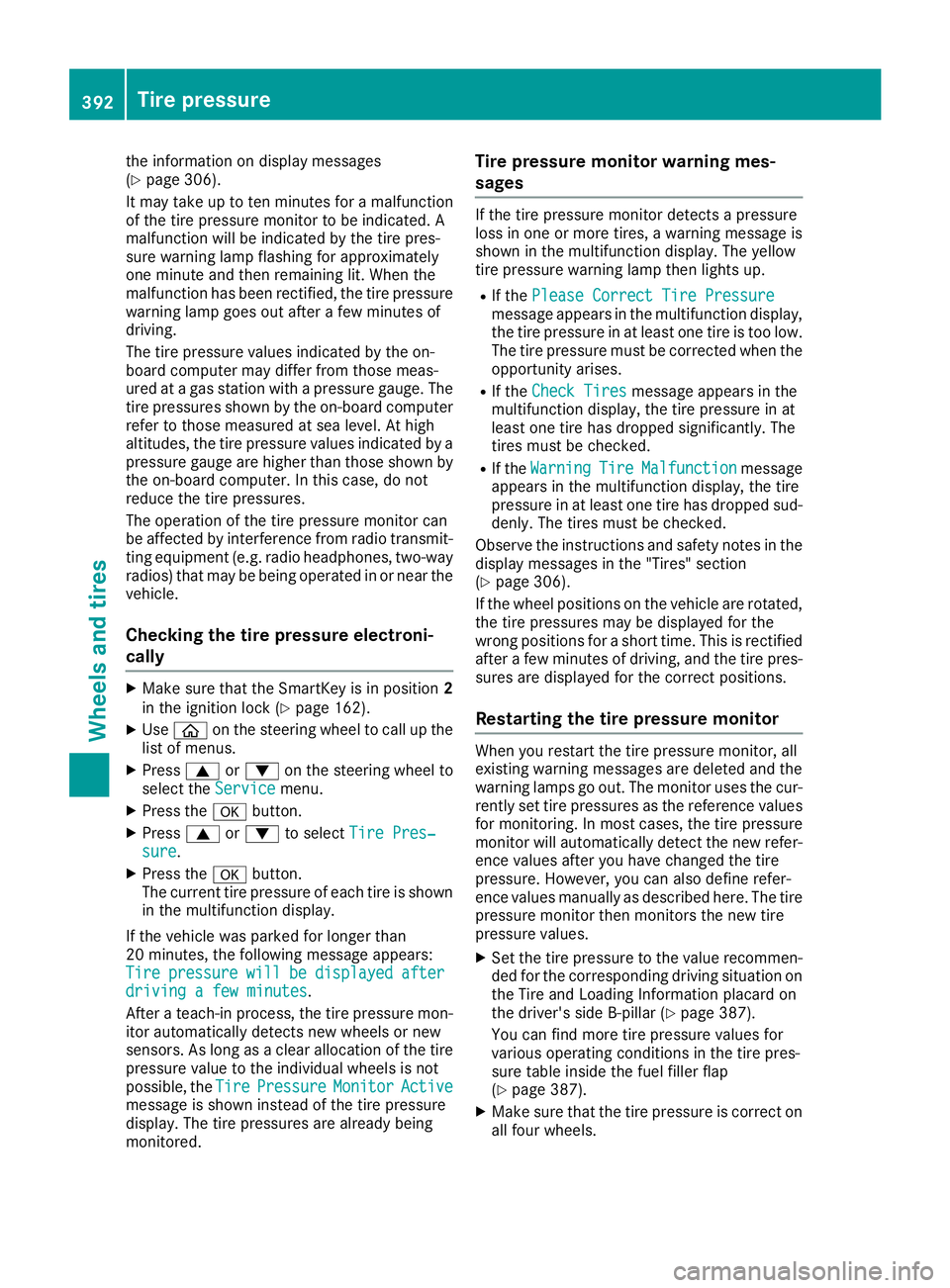
the information on display messages
( Y
page 306).
It may take up to ten minutes for a malfunction
of the tire pressure monitor to be indicated. A
malfunction will be indicated by the tire pres-
sure warning lamp flashing for approximately
one minute and then remaining lit. When the
malfunction has been rectified, the tire pressure
warning lamp goes out after a few minutes of
driving.
The tire pressure values indicated by the on-
board computer may differ from those meas-
ured at a gas station with a pressure gauge. The
tire pressures shown by the on-board computer
refer to those measured at sea level. At high
altitudes, the tire pressure values indicated by a
pressure gauge are higher than those shown by
the on-board computer. In this case, do not
reduce the tire pressures.
The operation of the tire pressure monitor can
be affected by interference from radio transmit-
ting equipment (e.g. radio headphones, two-way
radios) that may be being operated in or near the
vehicle.
Checking the tire pressure electroni-
cally X
Make sure that the SmartKey is in position 2
in the ignition lock ( Y
page 162).X
Use
Page 396 of 438
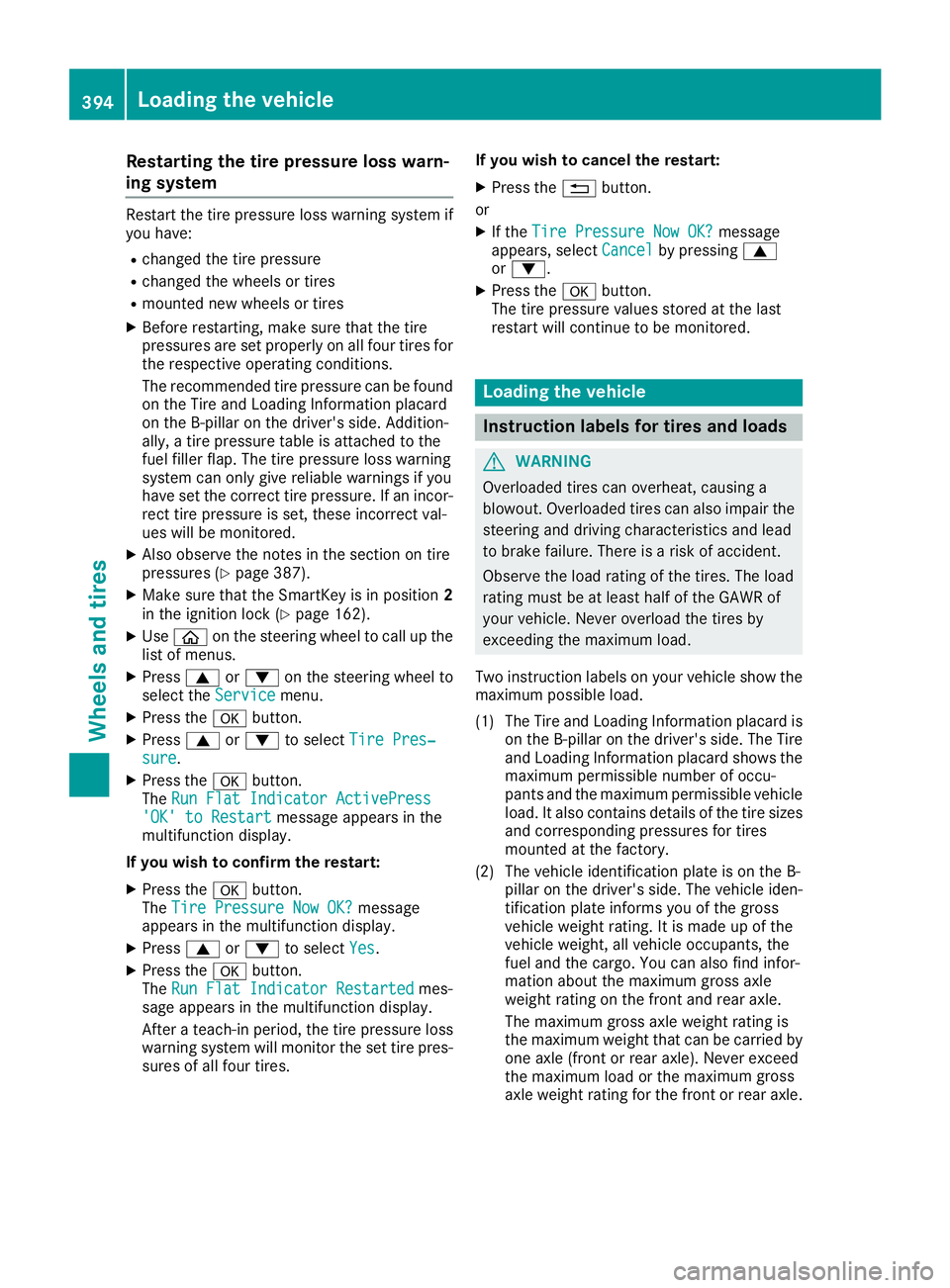
Restarting the tire pressure loss warn-
ing system Restart the tire pressure loss warning system if
you have: R
changed the tire pressure R
changed the wheels or tires R
mounted new wheels or tires X
Before restarting, make sure that the tire
pressures are set properly on all four tires for
the respective operating conditions.
The recommended tire pressure can be found
on the Tire and Loading Information placard
on the B-pillar on the driver's side. Addition-
ally, a tire pressure table is attached to the
fuel filler flap. The tire pressure loss warning
system can only give reliable warnings if you
have set the correct tire pressure. If an incor-
rect tire pressure is set, these incorrect val-
ues will be monitored. X
Also observe the notes in the section on tire
pressures ( Y
page 387).X
Make sure that the SmartKey is in position 2
in the ignition lock ( Y
page 162).X
Use
Page 401 of 438

Example: R
Treadwear grade: 200R
Traction grade: AAR
Temperature grade: A
All passenger car tires must conform to the stat-
utory safety requirements in addition to these
grades.
i The actual values for tires are vehicle-spe-
cific and may deviate from the values in the
illustration.
Treadwear The treadwear grade is a comparative rating
based on the wear rate of the tire when tested
under controlled conditions on a specified U.S.
government course. For example, a tire graded
150 would wear one and one-half times as well
on the government test track as a tire graded
100.
The relative performance of tires depends upon
the actual conditions of their use, however, and
may depart significantly from the norm due to
variations in driving habits, service practices
and differences in road characteristics and cli-
mate.
Traction
G WARNING
The traction grade assigned to this tire is
based on straight-ahead braking traction
tests, and does not include acceleration, cor-
nering, hydroplaning, or peak traction char-
acteristics.
! Avoid wheelspin. This can lead to damage to
the drive train.
The traction grades – from highest to lowest –
are AA, A, B and C. Those grades represent the
tire's ability to stop on wet pavement as meas-
ured under controlled conditions on specified
government test surfaces of asphalt and con-
crete. A tire marked C may have poor traction
performance.
The safe speed on a wet, snow covered or icy
road is always lower than on dry road surfaces.
You should pay special attention to road condi-
tions when temperatures are around freezing
point. Mercedes-Benz recommends a minimum tread
depth of