Page 382 of 390
intervals. You should therefore only use
engine oils and oil filters that are approved for
vehicles with maintenance systems.
For a list of approved engine oils and oil filters,
consult an authorized Mercedes-Benz Cen-
ter. Or visit the website
http://bevo.mercedes-benz.com.
The table shows which engine oils have been
approved for your vehicle.
Model MB-Freigabe
or MB-
Approval
All models
229.5
Use only SAE 0W-40 or SAE 5W-40 engine oils
for Mercedes-AMG vehicles.
i MB approval is indicated on the oil con-
tainers.
Filling capacities The following values refer to an oil change
including the oil filter.
Model Capacity
Mercedes ‑ AMG vehi-
cles 5.8 US qt (5.5 l)
All other mod els
5.9 US qt (5.6 l)
Additives
! Do no t use any additive s in th e engin e oil.
This could damag e th e engine. Engine oil viscosity
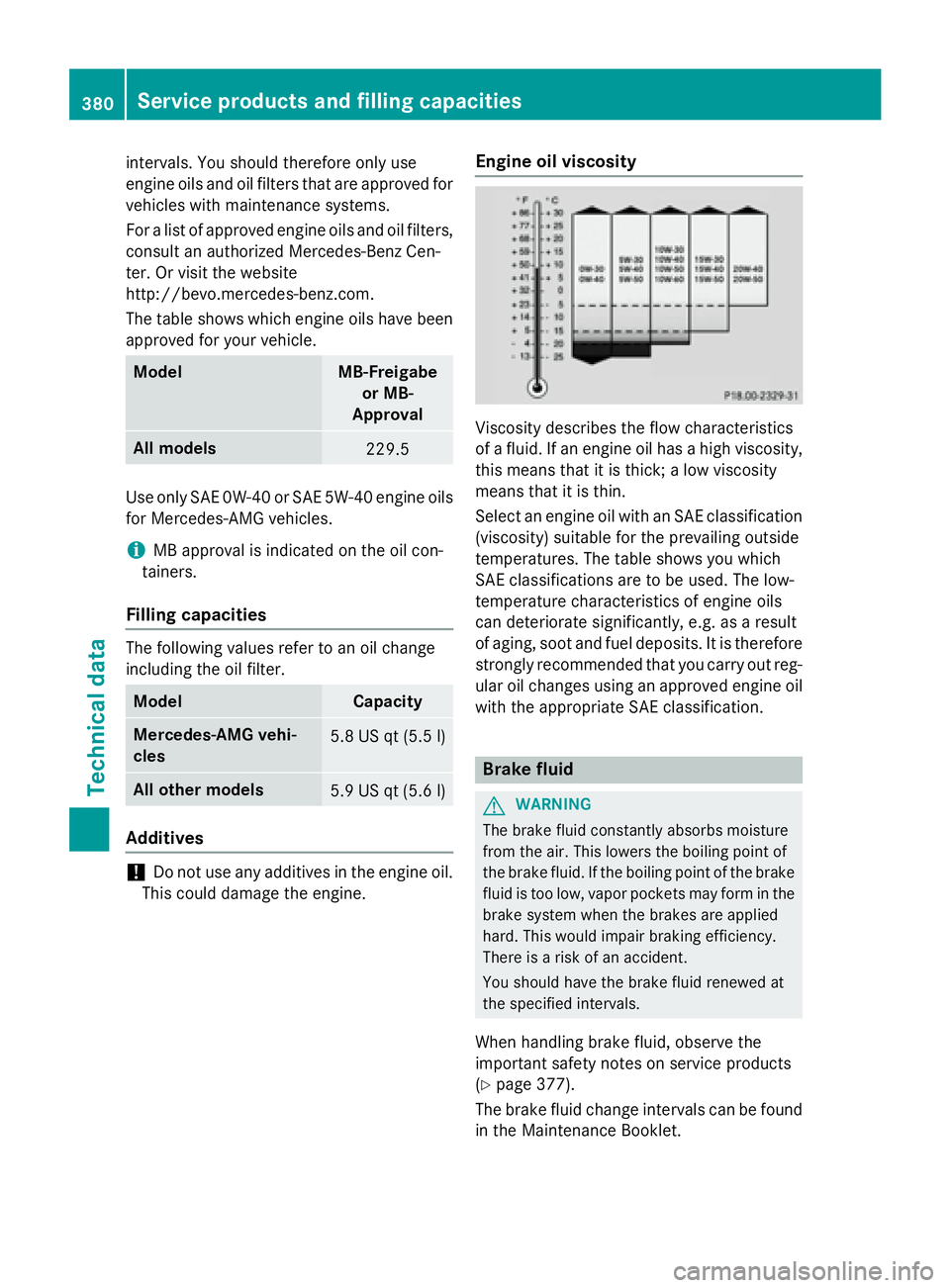
Visco sity describe s th e flo w characteristics
of a fluid . If an engin e oil has a high viscosity,
this mean s that it is thick ; a low viscosit y
mean s that it is thin.
Selec t an engin e oil wit h an SA E clas sif ication
(viscosity) suitable for th e prevailing outside
temperatures . The table sho ws you whic h
SA E classification s are to be used. The low-
temperature characteristics of engin e oils
can deteriorat e significantly, e.g. as a result
of aging, soo t and fuel depo sits. It is therefor e
strongly recommended that you carry out reg -
ular oil changes usin g an approve d engin e oil
wit h th e appropriat e SA E classification .
Brake fluid
G WARNIN G
The brak e fluid constantl y absorbs moisture
from th e air. This lower s th e boiling poin t of
th e brak e fluid . If th e boiling poin t of th e brak e
fluid is to o low, vapo r pockets may for m in th e
brak e system when th e brakes are applie d
hard. This would impair braking efficiency.
There is a ris k of an accident.
You should hav e th e brak e fluid renewed at
th e specifie d intervals.
When handlin g brak e fluid , observ e th e
important safet y note s on ser vic e products
( Y
page 377).
The brak e fluid chang e intervals can be foun d
in th e Maintenance Booklet .380
Service products and filling capacities
Technical data
Page 383 of 390
Only use brake fluid approved by Mercedes-
Benz in accordance with MB-Freigabe or MB-
Approval 331.0.
Information about approved brake fluid can
be obtained at any qualified specialist work-
shop or on the Internet at
http://bevo.mercedes-benz.com.
i Have the brake fluid regularly replaced at
a qualified specialist workshop and the
replacement confirmed in the Maintenance
Booklet.
Coolant
Important safety notes
G WARNING
If antifreeze comes into contact with hot com-
ponents in the engine compartment, it may
ignite. There is a risk of fire and injury.
Let the engine cool down before you add anti-
freeze. Make sure that antifreeze is not spilled
next to the filler neck. Thoroughly clean the
antifreeze from components before starting
the engine.
! Only add coolant that has been premixed
with the desired antifreeze protection. You
could otherwise damage the engine.
Further information on coolants can be
found in the Mercedes-Benz Specifications
for Service Products, MB BeVo 310.1, e.g.
on the Internet at
http://bevo.mercedes-benz.com. Or con-
tact a qualified specialist workshop.
! Always use a suitable coolant mixture,
even in countries where high temperatures
prevail.
Otherwise, the engine cooling system is not
sufficiently protected from corrosion and
overheating.
i Have the coolant regularly replaced at a
qualified specialist workshop and the
replacement confirmed in the Maintenance
Booklet. Comply with the important safety precautions
for service products when handling coolant
( Y
page 377).
The coolant is a mixture of water and anti-
freeze/corrosion inhibitor. It performs the
following tasks: R
corrosion protection R
antifreeze protection R
raising the boiling point
If the coolant has antifreeze protection down
to -35 ‡( -37 †), the boiling point of the cool-
ant during operation is approximately 266 ‡
(130 †).
The antifreeze/corrosion inhibitor concentra-
tion in the engine cooling system should: R
be at least 50%. This will protect the engine
cooling system against freezing down to
approximately -35 ‡ (-37 †) .R
no t exceed 55 % (antifreeze protection
do wn to -49 ‡ [-45 †]). Otherwise, heat
will not be dissipated as effectively.
Mercedes-Benz recommends coolant or anti-
freeze/corrosion inhibitor concentrate in
accordance with MB Specifications for Ser-
vice Products 310.1.
i When the vehicle is first delivered, it is fil-
led with a coolant mixture that ensures
adequate antifreeze and corrosion protec-
tion.
i The coolant is checked with every main-
tenance interval at a qualified specialist
workshop.
Filling capacities
Model Capacity
Mercedes ‑ AMG
vehicles Approx. 12.6 US qt
(11.9 l)
All other models
Approx. 8.2 US qt
(7.8 l)Service products and filling capacities 381
Technical data Z
Page 385 of 390
Filling capacities Missing values were not availab le at time of
going to prin t.
Mercedes ‑ AMG
vehicles Capacity
Ref ri gerant
23.6 ± 0.4 oz
(670 ± 10 g)
PAG oil
4.2 oz
(12 0 g)
Al l ot her models Capacity
Refrigerant
22.9 ± 0.4 oz
(650 ± 10 g)
PA G oil
4.2 oz
(120 g)
Vehicle data
General notes
Please note that for the specified vehicle
data: R
the heights specified may vary as a result
of: -
tires -
load -
condition of the suspension -
optional equipment R
optional equipment reduces the maximum
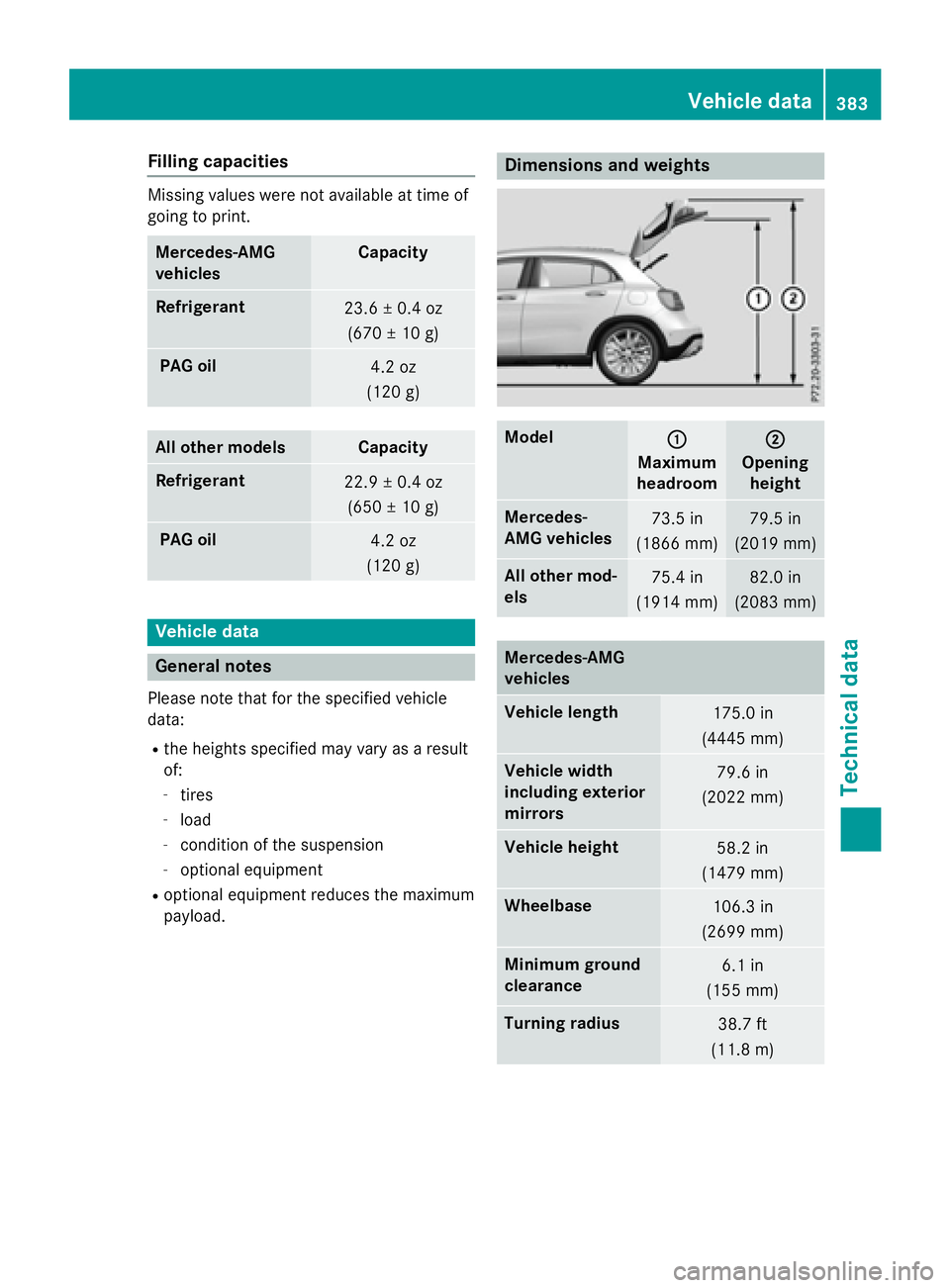
payload. Dimensions and weights
Model
C
Maximum
headroom D
Opening
height
Mercedes-
AMG vehicles 73.5 in
(1866 mm) 79.5 in
(2019 mm)
All other mod-
els 75.4 in
(1914 mm) 82.0 in
(2083 mm)
Mercedes ‑ AMG
vehicles
Vehicle length
175.0 in
(4445 mm)
Vehicle width
including exterior
mirrors 79.6 in
(2022 mm)
Vehicle height
58.2 in
(1479 mm)
Wheelbase
106.3 in
(2699 mm)
Minimum ground
clearance 6.1 in
(155 mm)
Turning radius
38.7 ft
(11.8 m)Vehicle data 383
Technical data Z
Page 386 of 390
Mercedes ‑ AMG
vehicles
Maximum roof
load 220.5 lb
(100 kg)
Maximum trunk
load 220.5 lb
(100 kg)
All other models
Vehicle length
173.9 in
(4417 mm)
Vehicle width
including exterior
mirrors 79.6 in
(2022 mm)
Vehicle height
60.3 in
(1532 mm)
Minimum ground
clearance 8.0 in
(204 mm)
Wheelbase
106.3 in
(2699 mm)
Turning radius
38.7 ft
(11.8 m)
Maximum roof
load 165.3 lb
(75 kg)
Maximum trunk
load 220.5 lb
(100 kg) Vehicle data for off-road driving
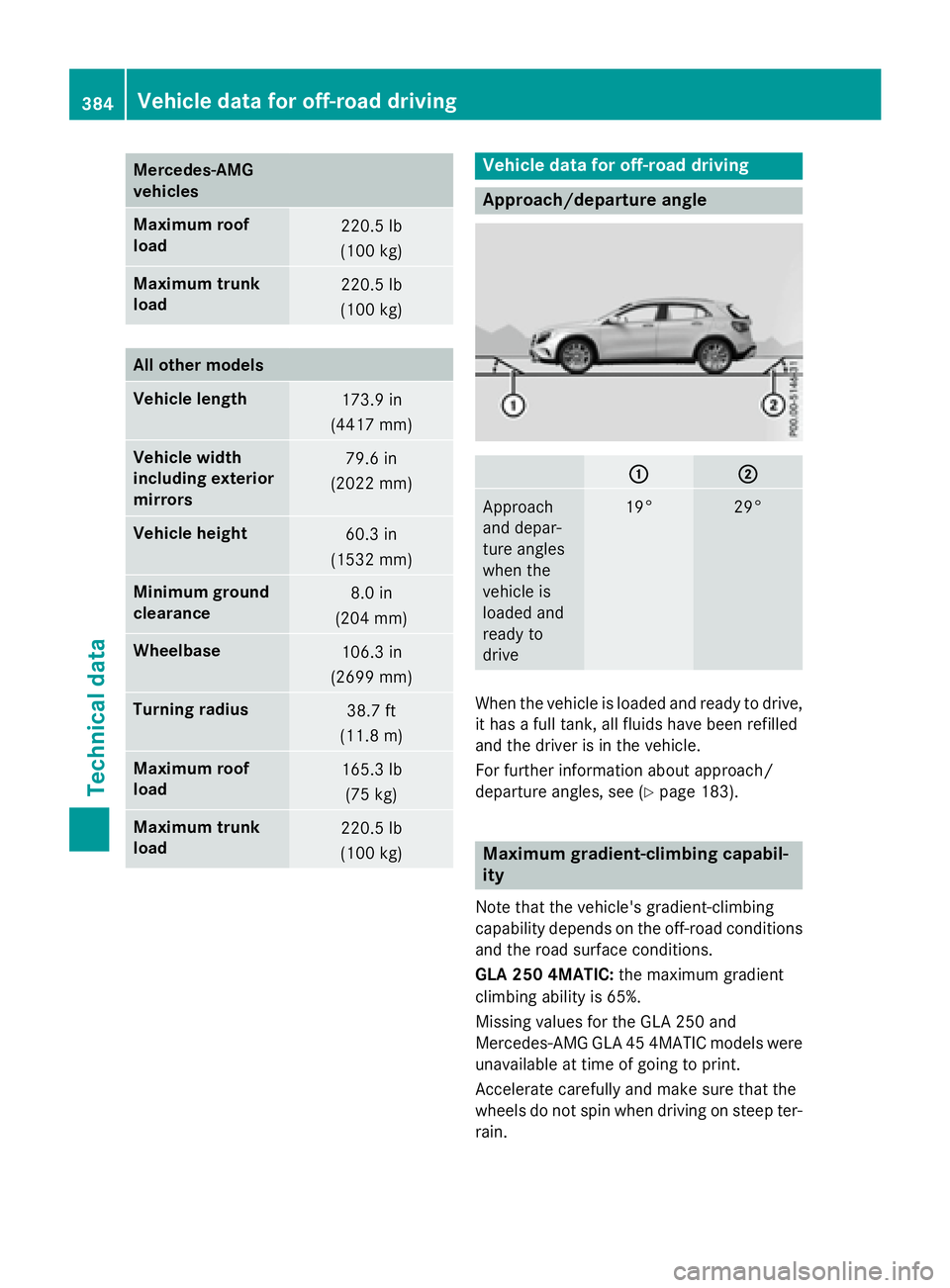
Approach/departure angle
C D
Approach
and depar-
ture angles
when the
vehicle is
loaded and
ready to
drive 19° 29°
When the vehicle is loaded and ready to drive,
it has a full tank, all fluids have been refilled
and the driver is in the vehicle.
For further information about approach/
departure angles, see ( Y
page 183).
Maximum gradient-climbing capabil-
ity
Note that the vehicle's gradient-climbing
capability depends on the off-road conditions
and the road surface conditions.
GLA 250 4MATIC: the maximum gradient
climbing ability is 65%.
Missing values for the GLA 250 and
Mercedes-AMG GLA 45 4MATIC models were
unavailable at time of going to print.
Accelerate carefully and make sure that the
wheels do not spin when driving on steep ter-
rain.384
Vehicle data for off-road driving
Technical data
Page 387 of 390
If the load on the front axle is reduced when
pulling away on a steep uphill slope, the front
wheels have a tendency to spin. 4ETS recog-
nizes this and brakes the wheels accordingly.
The rear wheel torque is increased, making it
easier to drive off.
For further information about the maximum
gradient climbing ability, see ( Y
page 183).
Vehicle data for off-road driving 385
Technical data Z