2016 MERCEDES-BENZ GLA reset
[x] Cancel search: resetPage 101 of 390
Problems with the panorama roof with power tilt/sliding panel
G WARNING
If you do not reset the sliding sunroof after a malfunction or voltage supply interruption, then the
backing up function will malfunction or not work. The sliding sunroof closes with increased or
maximum force. Parts of the body could be trapped in the closing area in the process. This poses
an increased risk of injury or even fatal injury.
In such or similar situations always make sure that no parts of the body are in the closing area.
Always reset the sliding sunroof after a malfunction or voltage supply interruption.
! If the sliding sunroof still cannot be opened or closed as a result of a malfunction, contact
a qualified specialist workshop.
Problem
Possible causes/consequences and P Solutions
The panorama roof with
power tilt/sliding panel
cannot be closed and
you cannot see the
cause. If the panorama roof with power tilt/sliding panel is obstructed
during closing and reopens again slightly: X
Immediately after it blocks, pull the W switch down again to
the point of resistance until the panorama roof with power tilt/
sliding panel is closed.
The panorama roof with power tilt/sliding panel is closed with
more force.
If the panorama roof with power tilt/sliding panel is obstructed
again during closing and reopens again slightly: X
Immediately after it blocks, pull the W switch down again to
the point of resistance until the panorama roof with power tilt/
sliding panel is closed.
The panorama roof with power tilt/sliding panel is closed with-
out the automatic reversing feature.Panorama roof with power tilt/sliding panel 99
Opening and closing Z
Page 114 of 390
Calling up a stored parking position set-
ting X
Turn the SmartKey to position 2 in the igni-
tion lock ( Y
page 149).X
Adjust the exterior mirror on the front-
passenger side with the corresponding but-
ton ( Y
page 109).X
Engage reverse gear.
The exterior mirror on the front-passenger
side moves to the stored parking position.
The exterior mirror on the front-passenger
side moves back to its original position: R
as soon as you exceed a speed of 9 mph
(15 km/h) R
about ten seconds after you have disen-
gaged reverse gear R
if you press button C for the exterior mir-
ror on the driver's side
Memory function
Important safety notes
G WARNING
If you use the memory function on the driver's
side while driving, you could lose control of
the vehicle as a result of the adjustments
being made. There is a risk of an accident.
Only use the memory function on the driver's
side when the vehicle is stationary.
G WARNING
When the memory function adjusts the seat,
you and other vehicle occupants – particularly
children – could become trapped. There is a
risk of injury.
While the memory function is making adjust-
ments, make sure that no one has any body
parts in the sweep of the seat. If somebody
becomes trapped, immediately release the
memory function position button. The adjust-
ment process is stopped. G WARNING
Children could become trapped if they acti-
vate the memory function, particularly when
unattended. There is a risk of injury.
When leaving the vehicle, always take the
SmartKey with you and lock the vehicle. Never
leave children unsupervised in the vehicle.
The memory function can be used at any time,
e.g. even when the SmartKey isn't in the igni-
tion lock.
Storing settings With the memory function, you can store up
to three different settings, e.g. for three dif-
ferent people.
The following settings are stored as a single
memory preset: R
seat and backrest position R
driver's side: position of the exterior mir-
rors on the driver's and front-passenger
sides
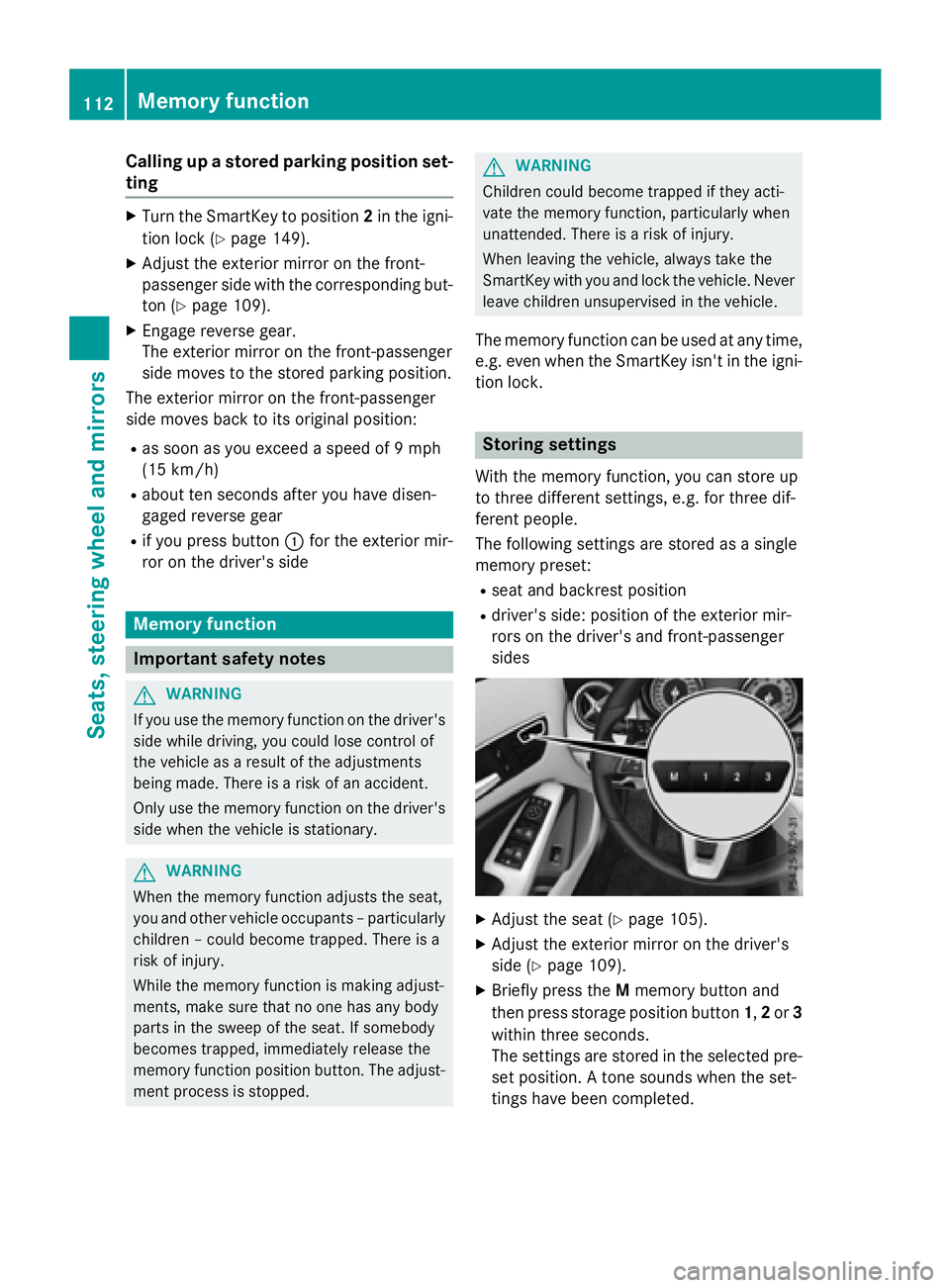
X
Adjust the seat ( Y
page 105). X
Adjust the exterior mirror on the driver's
side ( Y
page 109). X
Briefly press the M memory button and
then press storage position button 1 , 2 or 3
within three seconds.
The settings are stored in the selected pre-
set position. A tone sounds when the set-
tings have been completed.112
Memory function
Seats, steering wheel and mirrors
Page 115 of 390
Calling up a stored setting X
Press and hold the relevant preset position
button 1 , 2 or 3 until the seat and exterior
mirrors are in the stored position.
i The setting procedure is interrupted as
soon as you release the storage position
button.
Memory function 113
Seats, steering wheel and mirrors Z
Page 178 of 390
ECO display
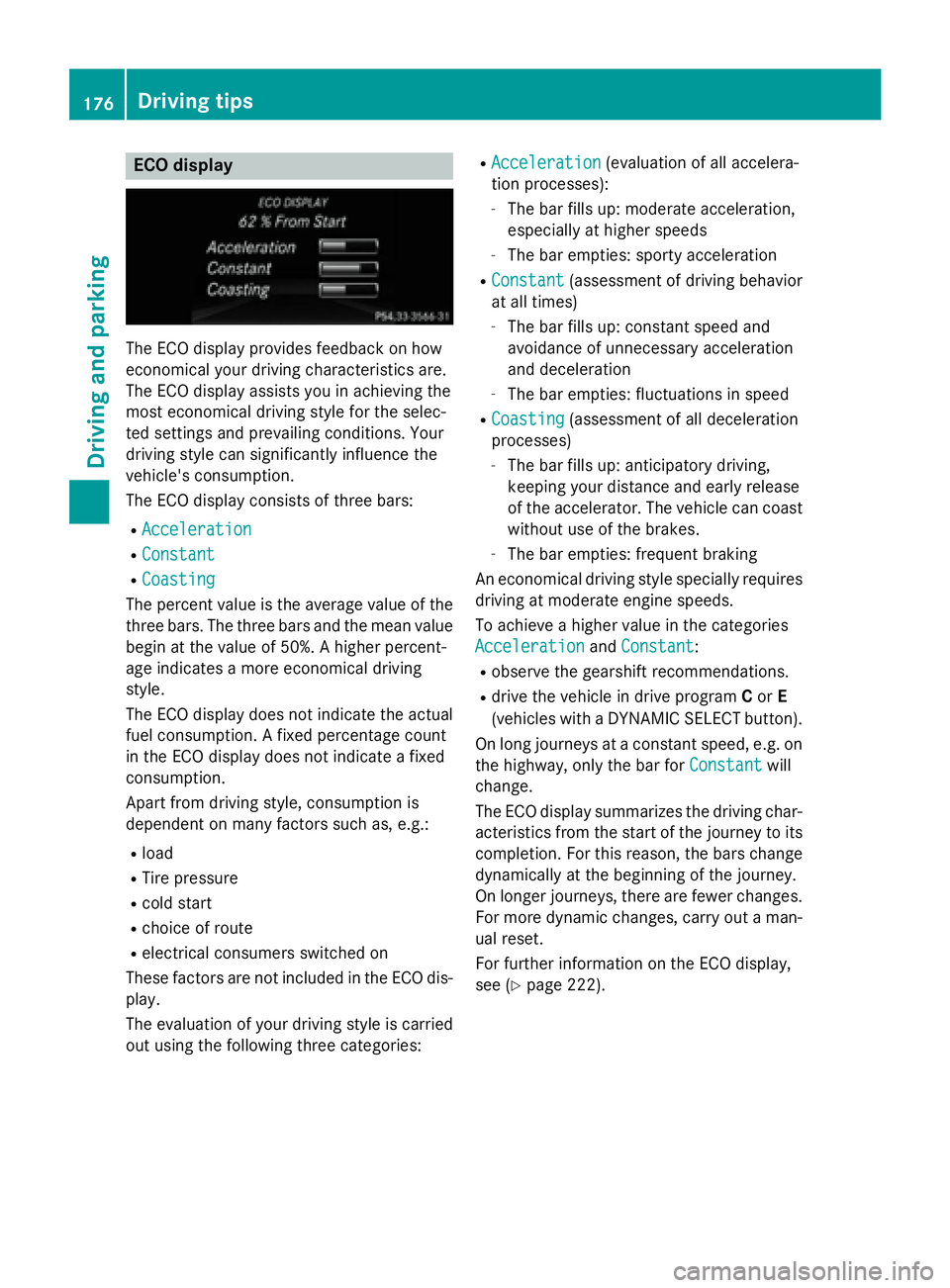
The ECO display provides feedback on how
economical your driving characteristics are.
The ECO display assists you in achieving the
most economical driving style for the selec-
ted settings and prevailing conditions. Your
driving style can significantly influence the
vehicle's consumption.
The ECO display consists of three bars: R
Acceleration R
Constant R
Coasting
The percent value is the average value of the
three bars. The three bars and the mean value
begin at the value of 50%. A higher percent-
age indicates a more economical driving
style.
The ECO display does not indicate the actual
fuel consumption. A fixed percentage count
in the ECO display does not indicate a fixed
consumption.
Apart from driving style, consumption is
dependent on many factors such as, e.g.: R
load R
Tire pressure R
cold start R
choice of route R
electrical consumers switched on
These factors are not included in the ECO dis-
play.
The evaluation of your driving style is carried
out using the following three categories: R
Acceleration (evaluation of all accelera-
tion processes): -
The bar fills up: moderate acceleration,
especially at higher speeds -
The bar empties: sporty acceleration R
Constant (assessment of driving behavior
at all times) -
The bar fills up: constant speed and
avoidance of unnecessary acceleration
and deceleration -
The bar empties: fluctuations in speed R
Coasting (assessment of all deceleration
processes) -
The bar fills up: anticipatory driving,
keeping your distance and early release
of the accelerator. The vehicle can coast
without use of the brakes. -
The bar empties: frequent braking
An economical driving style specially requires
driving at moderate engine speeds.
To achieve a higher value in the categories
Acceleration
and Constant :R
observe the gearshift recommendations. R
drive the vehicle in drive program C or E
(vehicles with a DYNAMIC SELECT button).
On long journeys at a constant speed, e.g. on
the highway, only the bar for Constant
will
change.
The ECO display summarizes the driving char-
acteristics from the start of the journey to its
completion. For this reason, the bars change
dynamically at the beginning of the journey.
On longer journeys, there are fewer changes.
For more dynamic changes, carry out a man-
ual reset.
For further information on the ECO display,
see ( Y
page 222).176
Driving tips
Driving and parking
Page 214 of 390
The functionality of ATTENTION ASSIST is
restricted and warnings may be delayed or
not occur at all: R
if the length of the journey is less than
approximately 30 minutes R
if the road condition is poor, e.g. if the sur-
face is uneven or if there are potholes R
if there is a strong side wind R
if you have adopted a sporty driving style
with high cornering speeds or high rates of
acceleration R
if you are predominantly driving slower
than 37 mph (60 km/h) or faster than
125 mph (200 km/h) R
if the time has been set incorrectly R
in active driving situations, such as when
you change lanes or change your speed
ATTENTION ASSIST is reset when you con-
tinue your journey and starts assessing your
tiredness again if: R
you switch off the engine R
you take off your seat belt and open the
driver's door, e.g. for a change of drivers or
to take a break
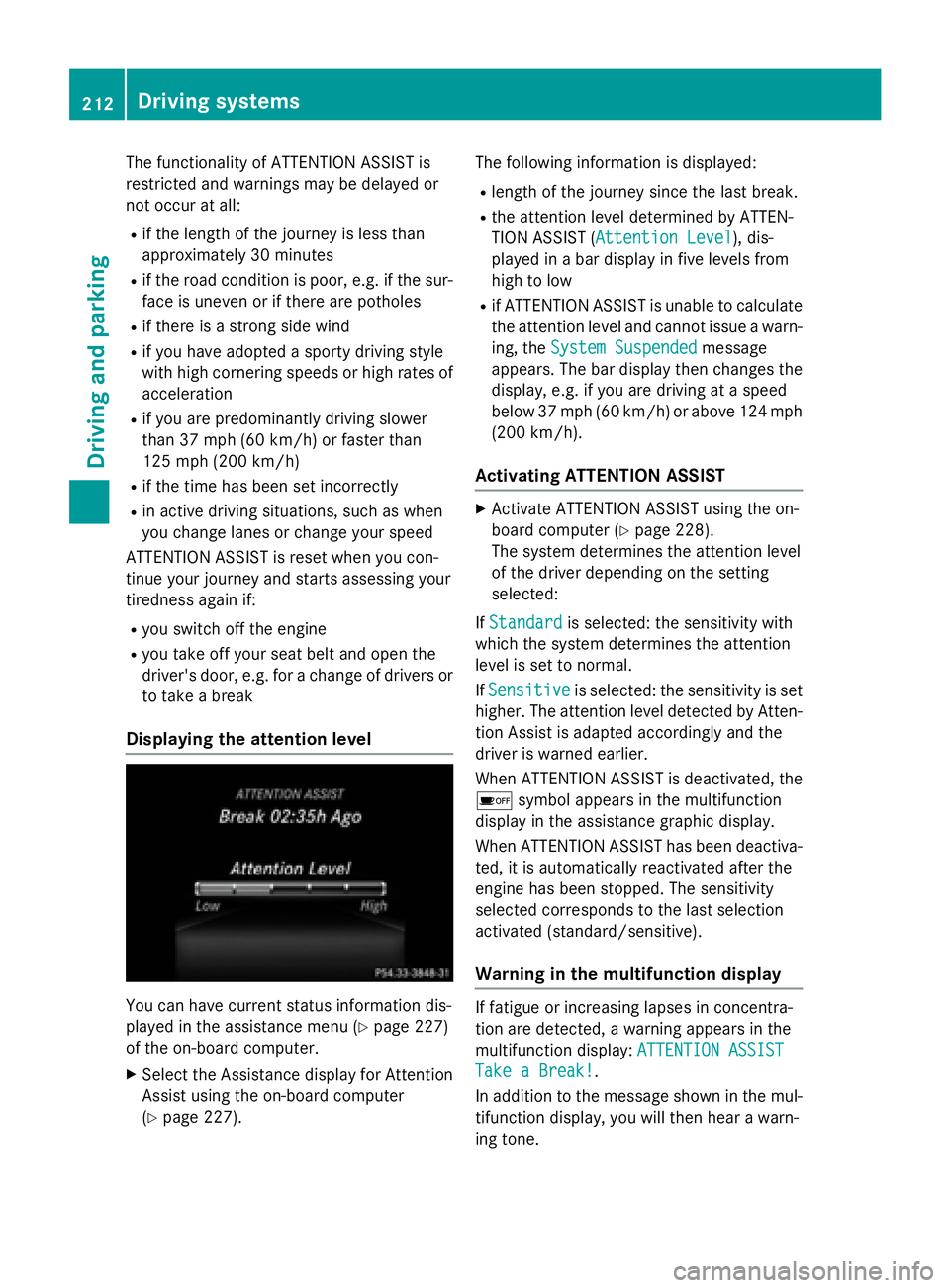
Displaying the attention level
You can have current status information dis-
played in the assistance menu ( Y
page 227)
of the on-board computer. X
Select the Assistance display for Attention
Assist using the on-board computer
( Y
page 227). The following information is displayed: R
length of the journey since the last break. R
the attention level determined by ATTEN-
TION ASSIST ( Attention Level
), dis-
played in a bar display in five levels from
high to low R
if ATTENTION ASSIST is unable to calculate
the attention level and cannot issue a warn-
ing, the System Suspended
message
appears. The bar display then changes the
display, e.g. if you are driving at a speed
below 37 mph (60 km/h) or above 124 mph
(200 km/ h) .
Activating ATTENTION ASSIST X
Activat e ATTENTION ASSIST usin g th e on -
boar d computer ( Y
page 228).
The system determine s th e attention level
of th e driver depending on th e set ting
selected:
If Standard is selected: th e sensitivit y wit h
whic h th e system determine s th e attention
level is set to normal.
If Sensitive is selected: th e sensitivit y is set
higher. The attention level detecte d by Atten-
tion Assis t is adapted accordingly and th e
driver is warned earlier .
When ATTENTI ON ASSIST is deactivated, th e
Page 222 of 390
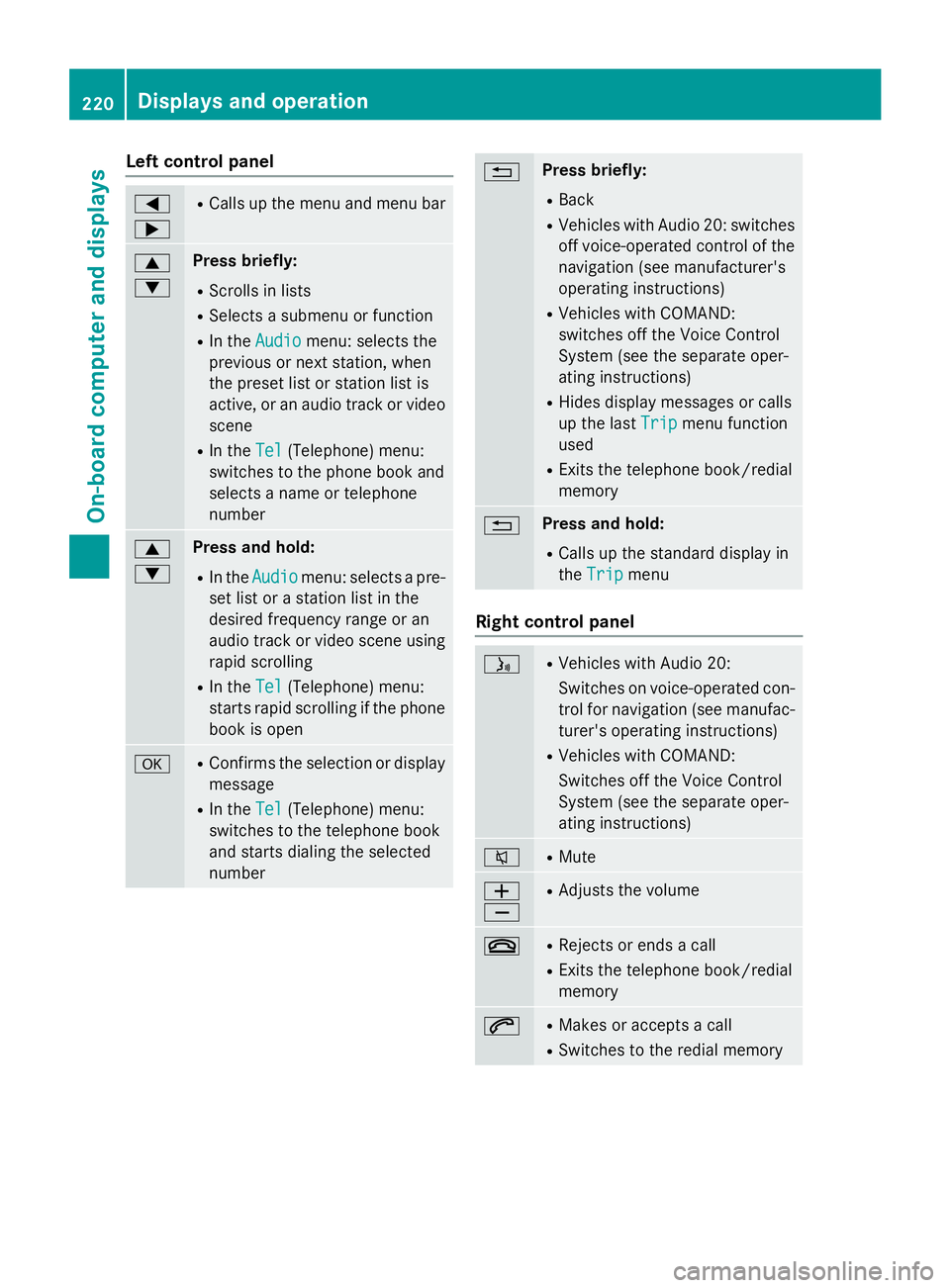
Left control panel Y
e R
Calls up the menu and menu bar
c
d Press briefly: R
Scrolls in lists R
Selects a submenu or function R
In the Audio menu: selects the
previous or next station, when
the preset list or station list is
active, or an audio track or video
scene R
In the Tel (Telephone) menu:
switches to the phone book and
selects a name or telephone
number
c
d Press and hold: R
In the Audio menu: selects a pre-
set list or a station list in the
desired frequency range or an
audio track or video scene using
rapid scrolling R
In the Tel (Telephone) menu:
starts rapid scrolling if the phone
book is open
v R
Confirms the selection or display
message R
In the Tel (Telephone) menu:
switches to the telephone book
and starts dialing the selected
number 8 Press briefly: R
Back R
Vehicles with Audio 20: switches
off voice-operated control of the
navigation (see manufacturer's
operating instructions) R
Vehicles with COMAND:
switches off the Voice Control
System (see the separate oper-
ating instructions) R
Hides display messages or calls
up the last Trip
menu function
used R
Exits the telephone book/redial
memory
8 Press and hold: R
Calls up the standard display in
the Trip
menu
Right control panel
Page 224 of 390
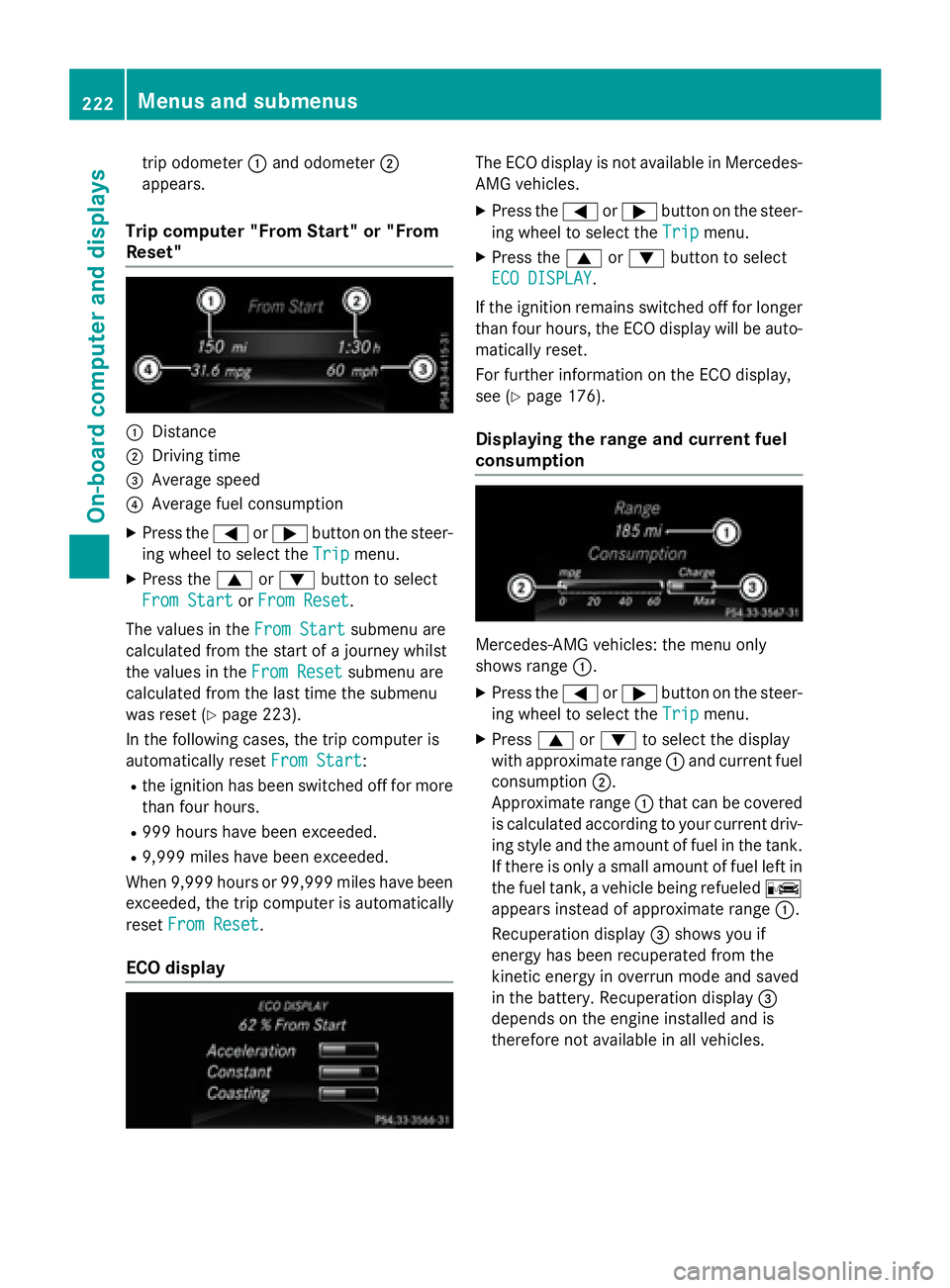
trip odometer C and odometer D
appears.
Trip computer "From Start" or "From
Reset"
C
DistanceD
Driving time
Page 227 of 390
Audio menu
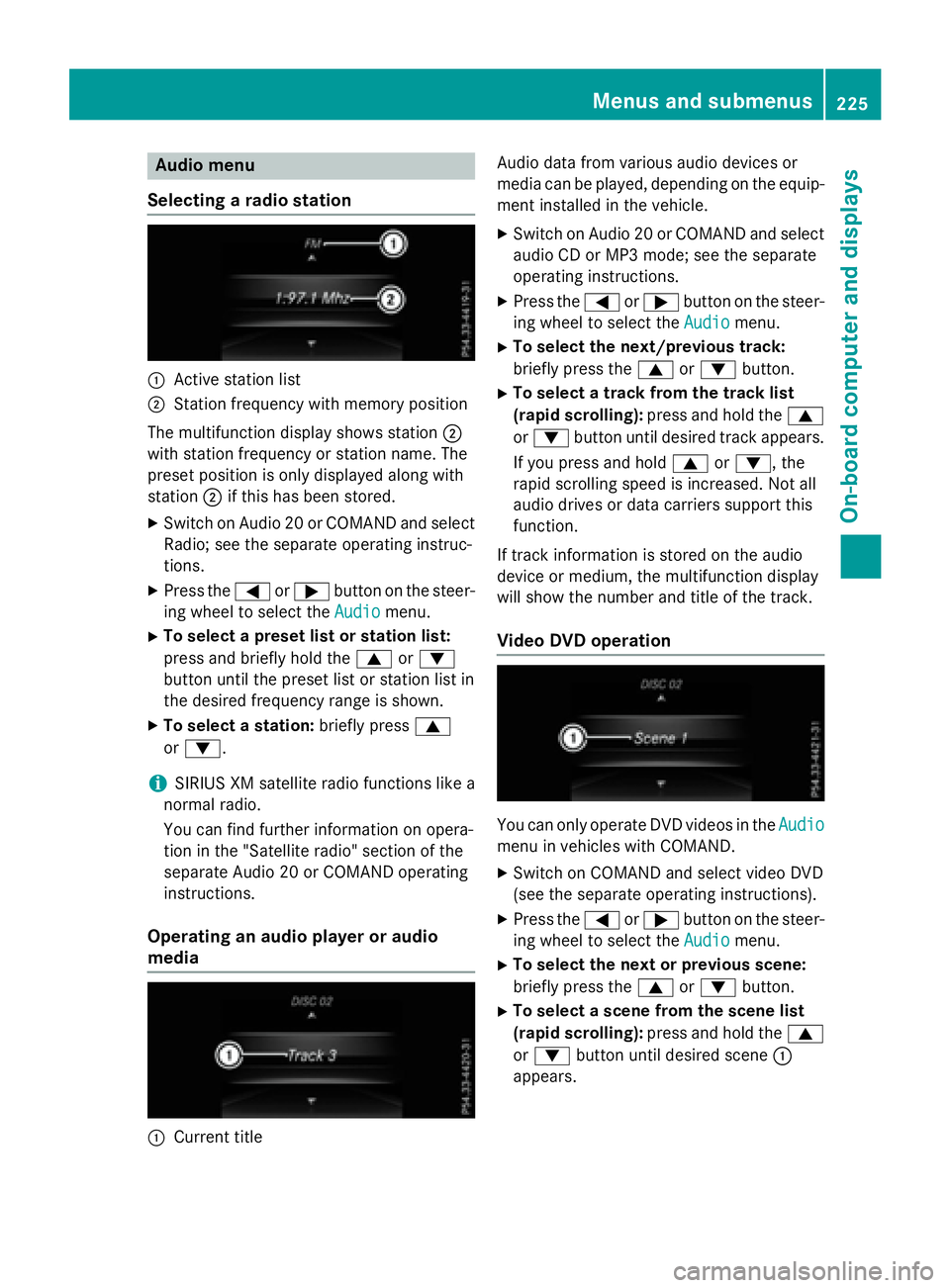
Selecting a ra dio station
C
Active station listD
Station frequency wit h memory position
The multifunction display shows station D
wit h station frequency or station name. The
preset position is only displayed alon g wit h
station D if this has been stored.X
Switc h on Audio 20 or COMAND and select
Radio; see th e separat e operating instruc-
tions. X
Press th e Y or e butto n on th e steer -
ing whee l to select th e Audio
menu.X
To select a preset list or station list :
press and briefly hold th e c or d
butto n until th e preset list or station list in
th e desired frequency range is shown. X
To select a station: briefly press c
or d .
i SIRIUS XM satellit e radi o function s lik e a
normal radio.
You can fin d further information on opera-
tion in th e "Satellit e radio" section of th e
separat e Audio 20 or COMAND operating
instructions.
Operating an audio player or audio
media
C
Curren t titl e Audio dat a from various audio device s or
media can be played, depending on th e equip-
men t installed in th e vehicle. X
Switc h on Audio 20 or COMAND and select
audio CD or MP3 mode; see th e separat e
operating instructions. X
Pre ss th e Y or e butto n on th e st eer -
ing whee l to select th e Audio
menu.X
To select th e next/previou s track :
briefly pre ss th e c or d button.X
To select a track fr om th e track list
(rapid scrolling): pre ss and hold th e c
or d butto n until desired track appears.
If you pre ss and hold c or d , th e
rapi d sc rollin g spee d is increased. Not all
audio drives or dat a carriers support this
function .
If track information is st ore d on th e audio
device or medium, th e multifunction display
will show th e number and titl e of th e track .
Video DVD operation
You can only operate DV D videos in th e Audio
men u in vehicles wit h COMAND .X
Switc h on COMAND and select vide o DV D
(see th e separat e operating instructions). X
Pre ss th e Y or e butto n on th e st eer -
ing whee l to select th e Audio
menu.X
To select th e next or previou s scene:
briefly press th e c or d button.X
To select a scene fr om th e scene list
(rapid scrolling): press and hold th e c
or d butto n until desired sc en e C
appear s.Menus and submenus 22 5
On-board computer and displays Z