2016 MAZDA MODEL 3 4-DOOR seats
[x] Cancel search: seatsPage 56 of 598

2–42
Essential Safety Equipment
SRS Air Bags
Never use a rear-facing child-restraint system in the front seat with an air bag that
could deploy:Rear-facing child-restraint systems on the front seat are particularly dangerous even
though you may feel assured that a front passenger air bag will not deploy based on
the fact that the front passenger air bag deactivation indicator light illuminates. The
child-restraint system can be hit by a deploying air bag and moved violently backward
resulting in serious injury or death to the child.
Do not sit too close to the driver and front passenger air bags:
Sitting too close to the driver and front passenger air bag modules or placing hands or
feet on them is extremely dangerous. The driver and front passenger air bags inflate with
great force and speed. Serious injuries could occur if someone is too close. The driver
should always hold onto only the rim of the steering wheel. The front seat passenger
should keep both feet on the floor. Front seat occupants should adjust their seats as
far back as possible and always sit upright against the seatbacks with seat belts worn
properly.
Sit in the center of the seat and wear seat belts properly: Sitting too close to the side air bag modules or placing hands on them, or sleeping up
against the door or hanging out the windows is extremely dangerous. The side and
curtain air bags inflate with great force and speed directly expanding along the door
on the side the car is hit. Serious injury could occur if someone is sitting too close to the
door or leaning against a window, or if rear seat occupants grab the sides of the front
seatbacks. Give the side and curtain air bags room to work by sitting in the center of the
seat while the vehicle is moving with seat belts worn properly.
Do not attach objects on or around the area where driver and front passenger air bags
deploy: Attaching an object to the driver and front passenger air bag modules or placing
something in front of them is dangerous. In an accident, an object could interfere with air
bag inflation and injure the occupants.
Mazda3_8FA4-EA-15G_Edition1.indb 422015/05/11 14:00:11
Page 57 of 598

2–43
Essential Safety Equipment
SRS Air Bags
Do not attach objects on or around the area where a side air bag deploys:Attaching objects to the front seat in such a way as to cover the outboard side of the
seat in any way is dangerous. In an accident the object could interfere with the side
air bag, which inflates from the outboard side of the front seats, impeding the added
protection of the side air bag system or redirecting the air bag in a way that is dangerous.
Furthermore, the bag could be cut open releasing the gas.
Do not hang net bags, map pouches or backpacks with side straps on the front seats.
Never use seat covers on the front seats. Always keep the side air bag modules in your
front seats free to deploy in the event of a side collision.
Do not attach objects on or around the area where a curtain air bag deploys: Attaching objects to the areas where the curtain air bag activates such as on the
windshield glass, side door glass, front and rear window pillars and along the roof edge
and assist grips is dangerous. In an accident the object could interfere with the curtain
air bag, which inflates from the front and rear window pillars and along the roof edge,
impeding the added protection of the curtain air bag system or redirecting the air bag in
a way that is dangerous. Furthermore, the bag could be cut open releasing the gas.
Do not place hangers or any other objects on the assist grips. When hanging clothes,
hang them on the coat hook directly. Always keep the curtain air bag modules free to
deploy in the event of a side collision or roll-over accident.
Do not touch the components of the supplemental restraint system after the air bags
have inflated: Touching the components of the supplemental restraint system after the air bags have
inflated is dangerous. Immediately after inflation, they are very hot. You could get burned.
Never install any front-end equipment to your vehicle: Installation of front-end equipment, such as frontal protection bar (kangaroo bar, bull
bar, push bar, or other similar devices), snowplow, or winches, is dangerous. The air bag
crash sensor system could be affected. This could cause air bags to inflate unexpectedly,
or it could prevent the air bags from inflating during an accident. Front occupants could
be seriously injured.
Do not modify the suspension: Modifying the vehicle suspension is dangerous. If the vehicle's height or the suspension is
modified, the vehicle will be unable to accurately detect a collision or roll-over accident
resulting in incorrect or unexpected air bag deployment and the possibility of serious
injuries.
Mazda3_8FA4-EA-15G_Edition1.indb 432015/05/11 14:00:11
Page 58 of 598

2–44
Essential Safety Equipment
SRS Air Bags
To prevent false detection by the air bag sensor system, heed the following:
Do not use tires or wheels other than those specified for your Mazda:
Use of any tire or wheel other than those specified for your Mazda (page 9-10) is
dangerous. Use of such wheels will prevent the vehicle's accident detections system
from accurately detecting a collision or roll-over accident resulting in incorrect or
unexpected air bag deployment and the possibility of serious injuries.
Do not overload your vehicle:
Overloading your vehicle is dangerous as it could prevent the air bag crash sensor
system from accurately detecting a collision or roll-over accident resulting in incorrect
or unexpected air bag deployment and the possibility of serious injuries. The gross axle
weight rating (GAWR) and the gross vehicle weight rating (GVWR) for your vehicle are
on the Motor Vehicle Safety Standard Label on the driver's door frame. Do not exceed
these ratings.
Do not drive the vehicle off-road:
Driving your Mazda off-road is dangerous because the vehicle has not been designed
to do so. Driving the vehicle off-road could prevent the air bag crash sensor system
from accurately detecting a collision or roll-over accident resulting in incorrect or
unexpected air bag deployment and the possibility of serious injuries.
Do not modify a front door or leave any damage unrepaired. Always have an
Authorized Mazda Dealer inspect a damaged front door: Modifying a front door or leaving any damage unrepaired is dangerous. Each front
door has a side crash sensor as a component of the supplemental restraint system. If
holes are drilled in a front door, a door speaker is left removed, or a damaged door is left
unrepaired, the sensor could be adversely affected causing it to not detect the pressure
of an impact correctly during a side collision. If a sensor does not detect a side impact
correctly, the side and curtain air bags and the front seat belt pretensioner may not
operate normally which could result in serious injury to occupants.
Do not modify the supplemental restraint system: Modifying the components or wiring of the supplemental restraint system is dangerous.
You could accidentally activate it or make it inoperable. Do not make any modifications
to the supplemental restraint system. This includes installing trim, badges, or anything
else over the air bag modules. It also includes installing extra electrical equipment on or
near system components or wiring. An Authorized Mazda Dealer can provide the special
care needed in the removal and installation of front seats. It is important to protect the air
bag wiring and connections to assure that the bags do not accidentally deploy, and that
the front passenger occupant classification system and the seats retain an undamaged
air bag connection.
Mazda3_8FA4-EA-15G_Edition1.indb 442015/05/11 14:00:11
Page 59 of 598

2–45
Essential Safety Equipment
SRS Air Bags
Do not place luggage or other objects under the front seats:Placing luggage or other objects under the front seats is dangerous. The components
essential to the supplemental restraint system could be damaged, and in the event of
a side collision, the appropriate air bags may not deploy, which could result in death
or serious injury. To prevent damage to the components essential to the supplemental
restraint system, do not place luggage or other objects under the front seats.
Do not operate a vehicle with damaged air bag/seat belt pretensioner system
components: Expended or damaged air bag/seat belt pretensioner system components must be
replaced after any collision which caused them to deploy or damage them. Only a trained
Authorized Mazda Dealer can fully evaluate these systems to see that they will work in
any subsequent accident. Driving with an expended or damaged air bag or pretensioner
unit will not afford you the necessary protection in the event of any subsequent accident
which could result in serious injury or death.
Do not remove interior air bag parts: Removing any components such as the front seats, front dashboard, the steering wheel
or parts on the front and rear window pillars and along the roof edge, containing air bag
parts or sensors is dangerous. These parts contain essential air bag components. The air
bag could accidentally activate and cause serious injuries. Always have an Authorized
Mazda Dealer remove these parts.
Properly dispose of the air bag system: Improper disposal of an air bag or a vehicle with live air bags in it can be extremely
dangerous. Unless all safety procedures are followed, injury could result. Have an
Authorized Mazda Dealer safely dispose of the air bag system or scrap an air bag
equipped vehicle.
Mazda3_8FA4-EA-15G_Edition1.indb 452015/05/11 14:00:11
Page 73 of 598

2–59
Essential Safety Equipment
SRS Air Bags
Do not increase the total seated weight on the front passenger seat:When an infant or small child sits on the front passenger seat, increasing the total seated
weight on the front passenger seat is dangerous. The front passenger seat weight sensors
will detect the increased total seated weight, which could result in the unexpected
deployment of the front passenger front and side air bags and seat belt pretensioner
system in an accident and may cause serious injury. Increasing the total seated weight on
the front passenger seat could result in the front passenger front and side air bags and
seat belt pretensioner system deployment in an accident under the following conditions,
for example:
Luggage or other items are placed on the seat with the child in the child-restraint
system. A rear passenger or luggage push or pull down on the front passenger seatback. A rear passenger steps on the front passenger seat rails with their feet. Luggage or other items are placed on the seatback or hung on the head restraint. Heavy items are placed in the seatback map pocket. The seat is washed. Liquids are spilled on the seat. The front passenger seat is moved backward, pushing into luggage or other items
placed behind it. The front passenger seatback contacts the rear seat. Luggage or other items are placed between the front passenger seat and driver seat. Any accessories which might increase the total seated weight on the front passenger
seat are attached to the front passenger seat.
CAUTION
To assure proper deployment of the front air bag and to prevent damage to the sensors in
the front seat bottoms:
Do not place sharp objects on the front seat bottoms or leave heavy luggage on them. Do not spill any liquids on the front seats or under the front seats.
To allow the sensors to function properly, always perform the following:
Adjust the front seats as far back as possible and always sit upright against the
seatbacks with seat belts worn properly. If you place your child on the front passenger seat, secure the child-restraint system
properly and slide the front passenger seat as far back as possible (page 2-30).
Mazda3_8FA4-EA-15G_Edition1.indb 592015/05/11 14:00:16
Page 101 of 598
3–25
Before Driving
Doors and Locks
WARNING
Close the trunk lid, be sure the seat
backs are latched and do not allow
children to play inside the vehicle:Leaving the trunk lid open or leaving
children in the vehicle with the keys is
dangerous. Children could open the
trunk lid and climb inside resulting
in possible injury or death from heat
exposure.
Always keep the car from being a
tempting place to play by latching the
rear seats, doors and the trunk, and
keeping the keys where children can not
play with them: Leaving children or animals
unattended in a parked vehicle is
dangerous. Babies left sleeping and
children who lock themselves in cars or
trunks can die very quickly from heat
prostration. Do not leave your children
or pets alone in a car at any time. Do
not leave the car, the rear folding seats
or the trunk unlocked.
Opening the Trunk Lid from the
Inside
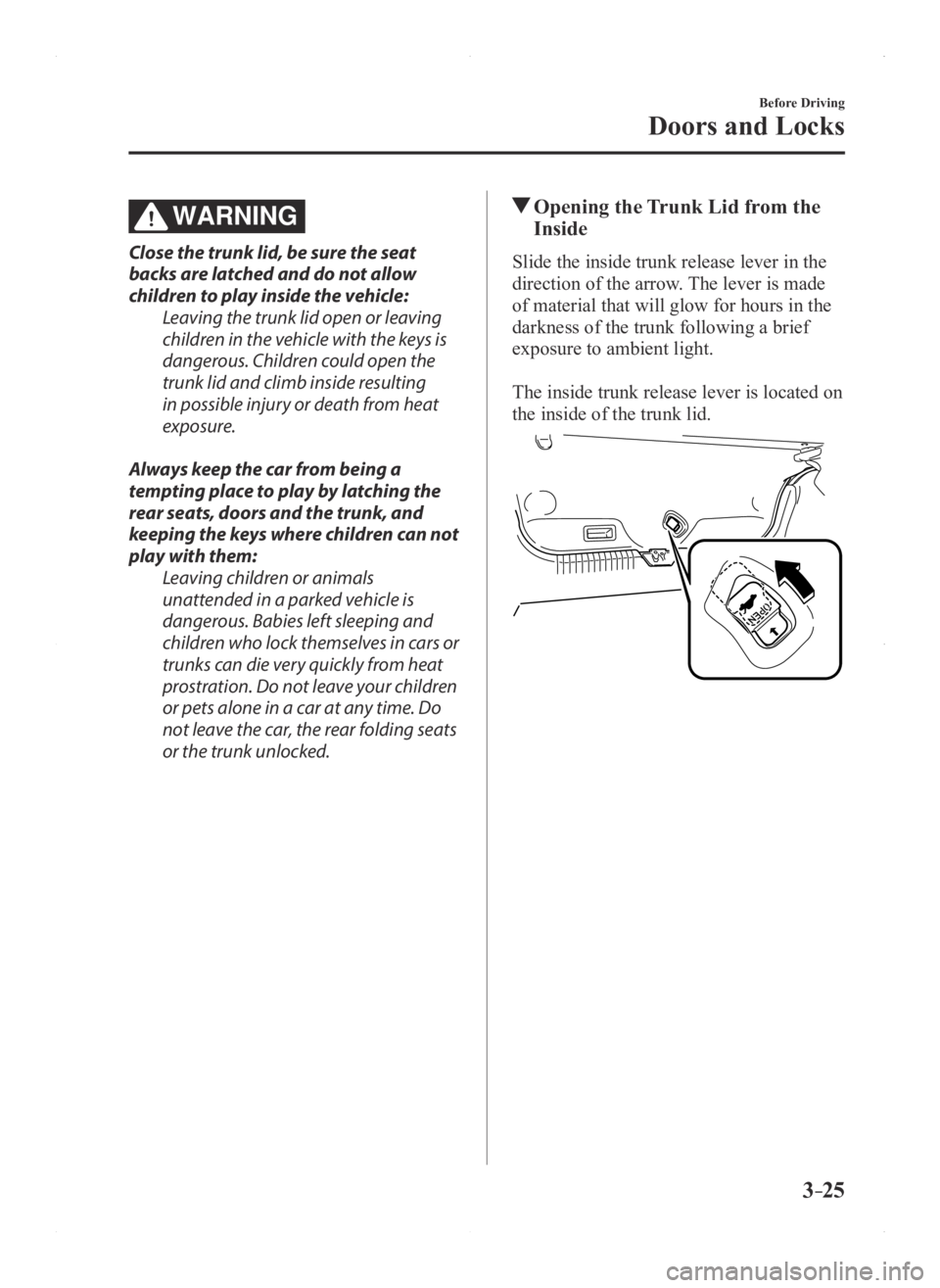
Slide the inside trunk release lever in the
direction of the arrow. The lever is made
of material that will glow for hours in the
darkness of the trunk following a brief
exposure to ambient light.
The inside trunk release lever is located on
the inside of the trunk lid.
Mazda3_8FA4-EA-15G_Edition1.indb 252015/05/11 14:00:24
Page 206 of 598

4–78
When Driving
i-ACTIVSENSE
NOTE
The timing in which the system switches the headlights changes under the\
following
conditions. If the system does not switch the headlights appropriately, manually switch
between high and low beams according to the visibility as well as road and traffic
conditions.
When there are sources of light in the area such as street lamps, illuminated signboards,
and traffic signals. When there are reflective objects in the surrounding area such as reflective plates and
signs. When visibility is reduced under rain, snow and foggy conditions. When driving on roads with sharp turn or hilly terrain. When the headlights/r ear lamps of vehicles in front of you or in the opposite lane are dim
or not illuminated. When there is sufficient darkness such as at dawn or dusk. When the luggage compartment is loaded with heavy objects or the r ear passenger seats
are occupied. When visibility is reduced due to a vehicle in front of you spraying water from its tires
onto your windshield.
Mazda3_8FA4-EA-15G_Edition1.indb 782015/05/11 14:01:00
Page 243 of 598

4–115
When Driving
i-ACTIVSENSE
NOTE
In the following cases, the radar sensor (front) may not be able to detect vehicles ahead
or obstructions.
The rear surface of a vehicle ahead does not reflect radio waves effectively, such as
an unloaded trailer or an automobile with a loading platform covered by a soft top,
vehicles with a hard plastic tailgate, and round-shaped vehicles.
Vehicles ahead with low vehicle height and thus less area for reflecting radio waves. Visibility is reduced due to a vehicle ahead casting off water, snow, or sand from its
tires and onto your windshield. The trunk/luggage compartment is loaded with heavy objects or the r ear passenger
seats are occupied. Ice, snow, or soiling is on the front surface of the front emblem. During inclement weather such as rain, snow, or sand storms. When driving near facilities or objects emitting str ong radio waves.
In the following cases, the radar sensor (front) may detect vehicles in the opposite lane or
surrounding obstructions, or it may not be able to detect vehicles ahead or \
obstructions.
The beginning and end of a curve. Roads with continuous curves. Narrow lane roads due to road construction or lane closures. The vehicle ahead enters the radar sensor's blind spot. The vehicle ahead is running abnormally due to accident or vehicle damag\
e. Roads with repeated up and down slopes Driving on poor r oads or unpaved roads. The distance between your vehicle and the vehicle ahead is extr emely short. A vehicle suddenly comes close such as by cutting into the lane.
To prevent incorrect operation of the system, use tires of the same specified size,
manufacturer, brand, and tread pattern on all four wheels. In addition, do not use tires
with significantly different wear patterns or tire pressures on the same vehicle. (Including
the temporary spare tire)
If the battery power is weak, the system may not operate correctly. When driving on roads with little traffic and few vehicles ahead or obstructions for the
radar sensor (front) to detect, Forward Obstruction Warning/Smart City Brake Support
(FOW/SCBS) warning light (amber) temporarily illuminates, however, this does not
indicate a problem.
Mazda3_8FA4-EA-15G_Edition1.indb 1152015/05/11 14:01:09