Page 238 of 544
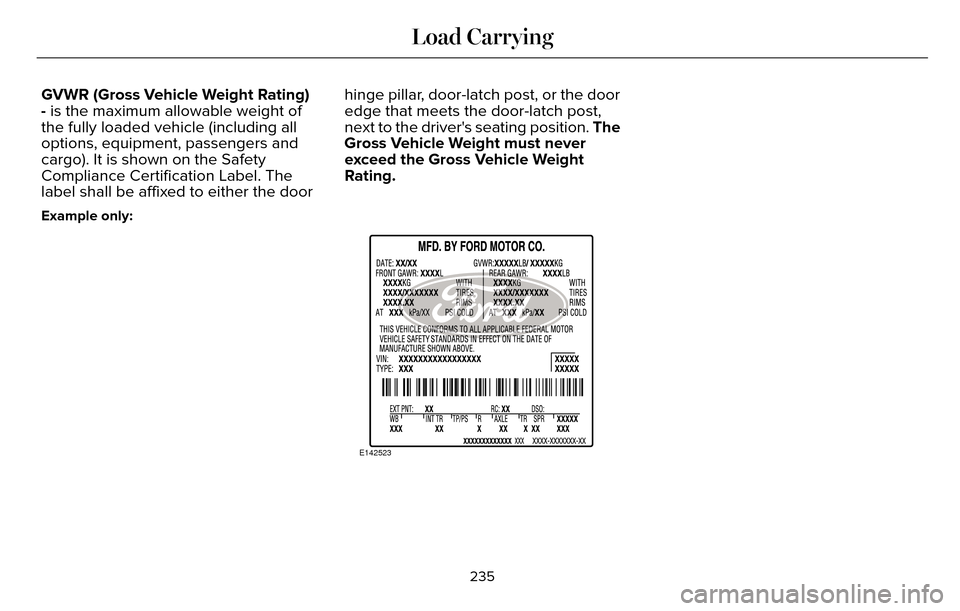
GVWR (Gross Vehicle Weight Rating)
- is the maximum allowable weight of
the fully loaded vehicle (including all
options, equipment, passengers and
cargo). It is shown on the Safety
Compliance Certification Label. The
label shall be affixed to either the doorhinge pillar, door-latch post, or the door
edge that meets the door-latch post,
next to the driver's seating position. The
Gross Vehicle Weight must never
exceed the Gross Vehicle Weight
Rating.
Example only:
E142523
235
Load Carrying
Page 242 of 544

*Suppose your vehicle has a 1400-pound
(635-kilogram) cargo and luggage
capacity. You and one of your friends
decide to pick up cement from the local
home improvement store to finish that
patio you have been planning for the
past two years. Measuring the inside of
the vehicle with the rear seat folded
down, you have room for twelve
100-pound (45-kilogram) bags of
cement. Do you have enough load
capacity to transport the cement to your
home? If you and your friend each weigh
220 pounds (99 kilograms), the
calculation would be: 1400 - (2 x 220) -
(12 x 100) = 1400 - 440 - 1200 = - 240
pounds. No, you do not have enough
cargo capacity to carry that much
weight. In metric units, the calculation
would be: 635 kilograms - (2 x 99
kilograms) - (12 x 45 kilograms) = 635 -
198 - 540 = -103 kilograms. You will need
to reduce the load weight by at least
240 pounds (104 kilograms). If you
remove three 100-pound (45-kilogram)
cement bags, then the load calculation
would be: 1400 - (2 x 220) - (9 x 100) =
1400 - 440 - 900 = 60 pounds. Now youhave the load capacity to transport the
cement and your friend home. In metric
units, the calculation would be: 635
kilograms - (2 x 99 kilograms) - (9 x 45
kilograms) = 635 - 198 - 405 = 32
kilograms.
The above calculations also assume that
the loads are positioned in your vehicle
in a manner that does not overload the
Front or the Rear Gross Axle Weight
Rating specified for your vehicle on the
Safety Compliance Certification Label.
The label shall be affixed to either the
door hinge pillar, door-latch post, or the
door edge that meets the door-latch
post, next to the driver's seating
position.
239
Load Carrying
Page 271 of 544
Protected components
Fuse amp rating
Fuse or relay number
Horn relay.
-
40
Not used.
-
41
Fuel pump relay coil.
-
42
Not used.
-
43
Not used.
-
44
Not used.
-
45
Not used.
–
46
Not used.
–
47
Not used.
–
48
Keep-alive power.
10A
149
Horn.
20A
150
Not used.
-
51
Not used.
-
52
Power seats.
10A
153
268
Fuses
Page 275 of 544
Protected components
Fuse amp rating
Fuse or relay number
Not used.
–
56
Diesel vaporizer or E100.
20A
157
Fuel pump feed.
30A
158
Electronic fan 3.
30A
259
Electronic fan 1.
30A
260
Not used.
-
61
Body control module 1.
50A
262
Electronic fan 2.
25A
163
Not used.
-
64
Front heated seat.
20A
165
Not used.
-
66
Body control module 2.
50A
267
272
Fuses
Page 276 of 544
Protected components
Fuse amp rating
Fuse or relay number
Heated rear window.
40A168
Anti-lock brake system valves.
30A
169
Passenger seat.
30A
170
Not used.
-
71
Transmission oil pump.
20A
172
Rear climate controlled seats.
20A
173
Driver seat module.
30A
174
Wiper motor 1.
25A
175
Power lift gate module.
30A
176
Front climate controlled seats.
30A
177
Trailer tow module.
40A
178
Blower motor.
40A
279
273
Fuses
Page 279 of 544
Protected components
Fuse amp rating
Fuse or relay number
Lighting (ambient, glove box, vanity, dome, trunk).
10A11
Memory seats, Lumbar, Power mirror.
7.5A
12
Driver door unlock.
20A
13
Not used (spare).
5A
14
Subwoofer amplifier.
20A
15
Heated seat relay coil.
10A
26
Not used (spare).
10A
27
Not used (spare).
10A
28
Not used (spare).
10A
29
Power trunk logic.
5A
210
Keypad.
Cellphone passport module.
276
Fuses
Page 282 of 544
Protected components
Fuse amp rating
Fuse or relay number
GPS.
10A132
Voice control.
Adaptive cruise control.
Radio frequency receiver.
Display.
Radio.
20A
133
Active noise control.
CD changer.
Run-start bus (fuse #19, 20, 21, 22, 35, 36, 37, circuit breaker).
30A
134
Restraints control module.
5A
135
Continuous control damping suspension module.
15A
136
Auto dimming rear view mirror.
Rear heated seats.
Heated steering wheel.
15A
137
All wheel drive.
Not used (spare).
30A
38
1Micro fuse.2Dual micro fuse.
279
Fuses
Page 296 of 544

Refer to your scheduled maintenance
information for scheduled intervals for fluid
checks and changes. Your transmission does
not consume fluid. However, the fluid level
should be checked if the transmission is not
working properly. For example, if the
transmission slips or shifts slowly or if you
notice some sign of fluid leakage.
1. Drive the vehicle 20 miles (30 kilometers)or until it reaches normal operating
temperature
2. Park the vehicle on a level surface and engage the parking brake.
3. With the parking brake engaged and your foot on the brake pedal, start the engine
and move the gearshift lever through all
of the gear ranges. Allow a minimum of
10 seconds for each gear to engage.
4. Put the gearshift lever in P (Park) and leave the engine running.
Note: You will need to move the air filter
assembly to access the transmission
dipstick. 5. Remove the dipstick, wiping it clean with
a clean, dry lint free rag. If necessary,
refer to Under hood overview in this
chapter for the location of the dipstick.
6. Install the dipstick making sure it is fully seated in the filler tube by turning it to
the locked position.
7. Remove the dipstick and inspect the fluid level. The fluid should be in the
designated areas for normal operating
temperature.
Moving the Air Filter Assembly (Accessing
the Dipstick)
WARNING
Do not run engine with the air filter
disconnected.
E158839
A
BCD
1. Shut the engine off.
2. Clean the area around the clamp that connects the air filter assembly to the
rubber hose (A).
293
Maintenance