2016 LINCOLN MKZ weight
[x] Cancel search: weightPage 52 of 544

on the floor. Sitting improperly can increase
the chance of injury in a crash event. For
example, if an occupant slouches, lies down,
turns sideways, sits forward, leans forward
or sideways, or puts one or both feet up, the
chance of injury during a crash is greatly
increased.
The conditions listed above may cause the
weight of a properly seated occupant to be
incorrectly interpreted by the front passenger
sensing system. The person in the front
passenger seat may appear heavier or lighter
due to the conditions described in the list
above.
To know if the front passenger
sensing system is operating
properly, See Crash Sensors and
Airbag Indicator (page 52).
Do not attempt to repair or service the
system. Take your vehicle immediately to an
authorized dealer.
If it is necessary to modify an advanced front
airbag system to accommodate a person
with disabilities, contact the Ford Customer
Relationship Center. See Getting the
Services You Need (page 256).
SIDE AIRBAGS
WARNINGS
Do not place objects or mount
equipment on or near the airbag cover,
on the side of the seatbacks (of the front
seats), or in front seat areas that may come
into contact with a deploying airbag. Failure
to follow these instructions may increase the
risk of personal injury in the event of a crash.
Do not use accessory seat covers. The
use of accessory seat covers may
prevent the deployment of the side airbags
and increase the risk of injury in an accident.
Do not lean your head on the door. The
side airbag could injure you as it
deploys from the side of the seatback.
Do not attempt to service, repair, or
modify the airbag, its fuses or the seat
cover on a seat containing an airbag as you
could be seriously injured or killed. Contact
your authorized dealer as soon as possible.
WARNINGS
If the side airbag has deployed, the
airbag will not function again. The side
airbag system (including the seat) must be
inspected and serviced by an authorized
dealer. If the airbag is not replaced, the
unrepaired area will increase the risk of injury
in a crash.
The side airbags are located on the outboard
side of the seatbacks of the front seats. In
certain sideways crashes, the airbag on the
side affected by the crash will be inflated.
The airbag was designed to inflate between
the door panel and occupant to further
enhance the protection provided occupants
in side impact crashes.
49
Supplementary Restraints System
Page 143 of 544

SITTING IN THE CORRECT
POSITION
WARNINGS
Sitting improperly, out of position or
with the seatback reclined too far can
take weight off the seat cushion and affect
the decision of the passenger sensing
system, resulting in serious injury or death
in the event of a crash. Always sit upright
against your seat back, with your feet on the
floor.
Do not recline the seatback as this can
cause the occupant to slide under the
safety belt, resulting in serious injury in the
event of a crash.
Do not place objects higher than the
seatback to reduce the risk of serious
injury in the event of a crash or during heavy
braking.
E68595
When you use them properly, the seat, head
restraint, safety belt and airbags will provide
optimum protection in the event of a crash.
We recommend that you follow these
guidelines:
• Sit in an upright position with the base of your spine as far back as possible.
• Do not recline the seatback more than 30 degrees.
• Adjust the head restraint so that the top of it is level with the top of your head and
as far forward as possible. Make sure that
you remain comfortable. • Keep sufficient distance between
yourself and the steering wheel. We
recommend a minimum of 10 in (25 cm)
between your breastbone and the airbag
cover.
• Hold the steering wheel with your arms slightly bent.
• Bend your legs slightly so that you can press the pedals fully.
• Position the shoulder strap of the safety belt over the center of your shoulder and
position the lap strap tightly across your
hips.
Make sure that your driving position is
comfortable and that you can maintain full
control of your vehicle.
HEAD RESTRAINTS
WARNINGS
Fully adjust the head restraint before
you sit in or operate your vehicle. This
will help minimize the risk of neck injury in
the event of a crash. Do not adjust the head
restraint when your vehicle is moving.
140
Seats
Page 153 of 544

Do not do the following:
• Place heavy objects on the seat.
• Operate the heated seat if water or anyother liquid spills on the seat. Allow the
seat to dry thoroughly.
• Operate the heated seats unless the engine is running. Doing so can cause
the battery to lose charge.
E146322
Touch the heated seat symbol to cycle
through the various heat settings and off.
More indicator lights indicate warmer
settings.
Cooled Seats
The cooled seats will only function when the
engine is running.
E146309
To operate the cooled seats:
Press the cooled seat symbol to cycle
through the various cooling settings and off.
More indicator lights indicate cooler settings.
If the engine falls below 350 RPM while the
cooled seats are on, the feature will turn itself
off. You will need to reactivate it.
Climate controlled seat air filter
replacement
Your vehicle is equipped with lifetime air
filters that are integrated with the seats.
Regular maintenance or replacement is not
needed.
REAR SEAT ARMREST
E144635
Fold the armrest down to use the armrest
and cupholder. To open the storage lid, pull
up on the latch located between the
cupholders.
Armrest pass-through
Note: Do not exceed 80 pounds (36
kilograms) of weight on the pass-through
door.
150
Seats
Page 168 of 544

ENGINE BLOCK HEATER (If Equipped)
WARNINGS
Failure to follow engine block heater
instructions could result in property
damage or serious personal injury.
Do not use your heater with
ungrounded electrical systems or
two-pronged adapters. There is a risk of
electrical shock.
Do not fully close the hood, or allow it
to drop under its own weight when
using the engine block heater. This could
damage the power cable and may cause an
electrical short resulting in fire, injury and
property damage.
Note: The heater is most effective when
outdoor temperatures are below 0°F (-18°C).
The heater acts as a starting aid by warming
the engine coolant. This allows the climate
control system to respond quickly. The
equipment includes a heater element
(installed in the engine block) and a wire
harness. You can connect the system to a
grounded 120-volt AC electrical source. We recommend that you do the following for
a safe and correct operation:
• Use a 16-gauge outdoor extension cord
that is product certified by Underwriter’s
Laboratory (UL) or Canadian Standards
Association (CSA). This extension cord
must be suitable for use outdoors, in cold
temperatures, and be clearly marked
Suitable for Use with Outdoor
Appliances. Do not use an indoor
extension cord outdoors. This could
result in an electric shock or become a
fire hazard.
• Use as short an extension cord as possible.
• Do not use multiple extension cords.
• Make sure that when in operation, the extension cord plug and heater cord plug
connections are free and clear of water.
This could cause an electric shock or fire.
• Make sure your vehicle is parked in a clean area, clear of combustibles.
• Make sure the heater, heater cord and extension cord are firmly connected. • Check for heat anywhere in the electrical
hookup once the system has been
operating for approximately 30 minutes.
• Make sure the system is unplugged and properly stowed before starting and
driving your vehicle. Make sure the
protective cover seals the prongs of the
block heater cord plug when not in use.
• Make sure the heater system is checked for proper operation before winter.
Using the Engine Block Heater
Make sure the receptacle terminals are clean
and dry prior to use. Clean them with a dry
cloth if necessary.
The heater uses 0.4 to 1.0 kilowatt-hours of
energy per hour of use. The system does not
have a thermostat. It achieves maximum
temperature after approximately three hours
of operation. Using the heater longer than
three hours does not improve system
performance and unnecessarily uses
electricity.
165
Starting and Stopping the Engine
Page 192 of 544
Applying the electric parking brake
when the vehicle is moving
WARNINGS
Applying the electric parking brake
while moving will result in use of the
anti-lock braking system. Do not use the
electric parking brake system when the
vehicle is moving unless the normal brake
system is unable to stop the vehicle.
With the exception of emergency
conditions (for example, the brake
pedal does not work or is blocked), do not
apply the electric parking brake while the
vehicle is moving. On bends, or poor road
surfaces or weather conditions, emergency
braking can cause the vehicle to skid out of
control or off the road.
The brake system warning lamp will
flash during an electric parking brake
apply. If the brake system warning lamp
continues to flash there could be a problem
with your electric parking brake. Have the
system checked by an authorized dealer as
soon as possible.
If you apply the electric parking brake when
your vehicle is moving, the brake system
warning lamp will illuminate and a warning
tone will sound. See Information Displays
(page 109).
If your vehicle speed is above 4 mph
(6 km/h), the braking force is applied as long
as the switch is applied. Release or press the
switch, or press the accelerator pedal to stop
the braking force.
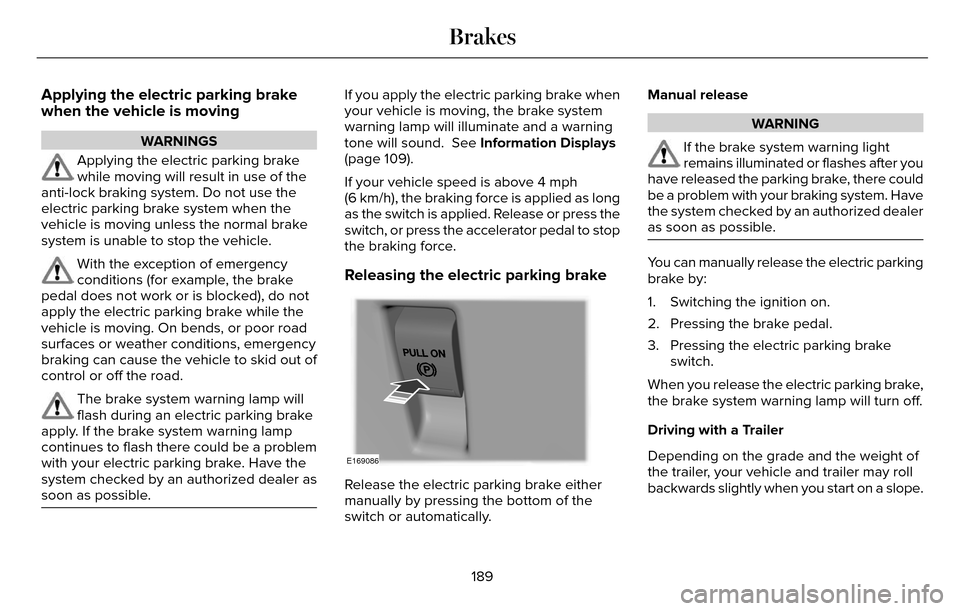
Releasing the electric parking brake
E169086
Release the electric parking brake either
manually by pressing the bottom of the
switch or automatically. Manual release
WARNING
If the brake system warning light
remains illuminated or flashes after you
have released the parking brake, there could
be a problem with your braking system. Have
the system checked by an authorized dealer
as soon as possible.
You can manually release the electric parking
brake by:
1. Switching the ignition on.
2. Pressing the brake pedal.
3. Pressing the electric parking brake switch.
When you release the electric parking brake,
the brake system warning lamp will turn off.
Driving with a Trailer
Depending on the grade and the weight of
the trailer, your vehicle and trailer may roll
backwards slightly when you start on a slope.
189
Brakes
Page 234 of 544
LOAD LIMIT
Vehicle Loading - with and without a
Trailer
This section will guide you in the proper
loading of your vehicle, trailer or both,
to keep your loaded vehicle weight
within its design rating capability, withor without a trailer. Properly loading your
vehicle will provide maximum return of
vehicle design performance. Before
loading your vehicle, familiarize yourself
with the following terms for determining
your vehicle’s weight ratings, with or
without a trailer, from the vehicle’s Tire
Label or Safety Compliance Certification
Label:Base Curb Weight - is the weight of the
vehicle including full fluids and all
standard equipment. It does not include
passengers, cargo, or optional
equipment.
Vehicle Curb Weight - is the weight of
your new vehicle when you picked it up
from your authorized dealer plus any
aftermarket equipment.
E143816
PAYLOAD
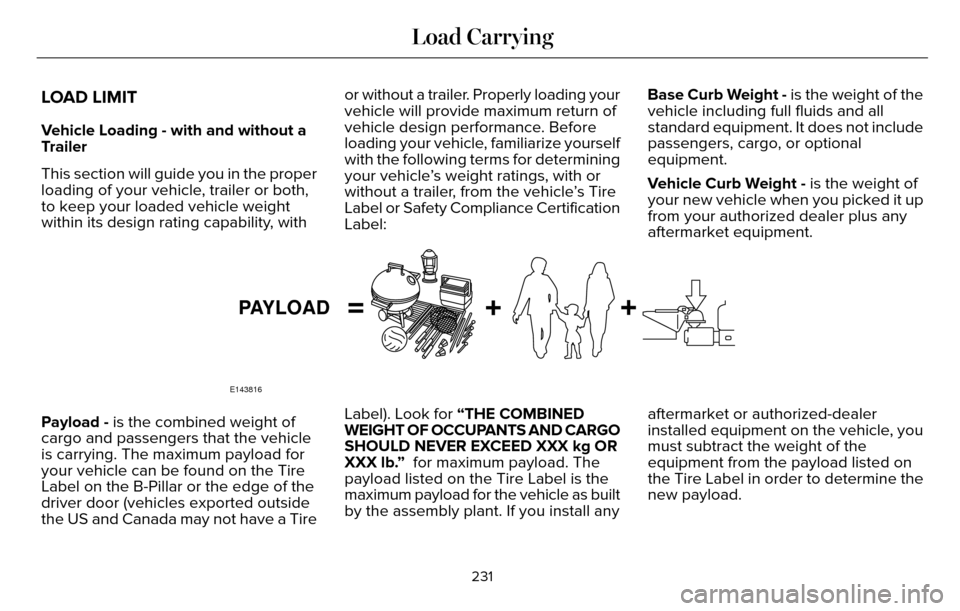
Payload - is the combined weight of
cargo and passengers that the vehicle
is carrying. The maximum payload for
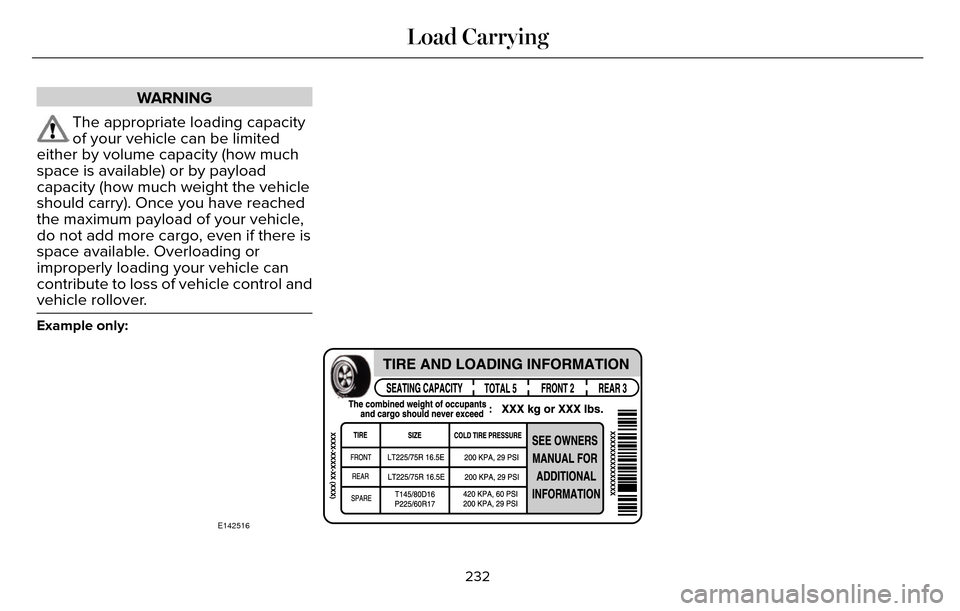
your vehicle can be found on the Tire
Label on the B-Pillar or the edge of the
driver door (vehicles exported outside
the US and Canada may not have a Tire
Label). Look for “THE COMBINED
WEIGHT OF OCCUPANTS AND CARGO
SHOULD NEVER EXCEED XXX kg OR
XXX lb.”
for maximum payload. The
payload listed on the Tire Label is the
maximum payload for the vehicle as built
by the assembly plant. If you install any aftermarket or authorized-dealer
installed equipment on the vehicle, you
must subtract the weight of the
equipment from the payload listed on
the Tire Label in order to determine the
new payload.
231
Load Carrying
Page 235 of 544
WARNING
The appropriate loading capacity
of your vehicle can be limited
either by volume capacity (how much
space is available) or by payload
capacity (how much weight the vehicle
should carry). Once you have reached
the maximum payload of your vehicle,
do not add more cargo, even if there is
space available. Overloading or
improperly loading your vehicle can
contribute to loss of vehicle control and
vehicle rollover.
Example only:
E142516
232
Load Carrying
Page 237 of 544
Cargo Weight - includes all weight
added to the Base Curb Weight,
including cargo and optional equipment.
When towing, trailer tongue load or king
pin weight is also part of cargo weight.
GAW (Gross Axle Weight) - is the total
weight placed on each axle (front and
rear) including vehicle curb weight and
all payload.GAWR (Gross Axle Weight Rating) - is
the maximum allowable weight that can
be carried by a single axle (front or rear).
These numbers are shown on the Safety
Compliance Certification Label. The
label shall be affixed to either the door
hinge pillar, door-latch post, or the door
edge that meets the door-latch post,
next to the driver's seating position. The
total load on each axle must never
exceed its Gross Axle Weight Rating.Note:
For trailer towing information
refer to the RV and Trailer Towing Guide
available at an authorized dealer.
E143818
GVW
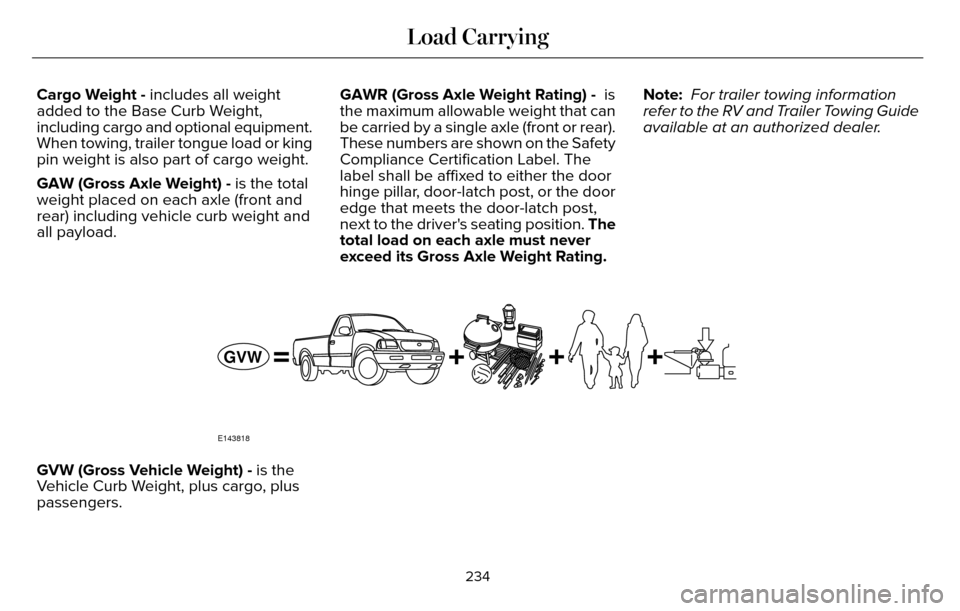
GVW (Gross Vehicle Weight) - is the
Vehicle Curb Weight, plus cargo, plus
passengers.
234
Load Carrying