2016 LINCOLN MKZ ECU
[x] Cancel search: ECUPage 26 of 544

Note:The lock-off device on some child
restraints may not accommodate the
shoulder portion of the inflatable safety belt.
Follow all instructions provided by the
manufacturer of the child restraint regarding
the necessary and proper use of the lock-off
device. In some instances, these devices
have been provided only for use in vehicles
with safety belt systems that would otherwise
require a locking clip.
6. Allow the belt to retract to remove slack. The belt will click as it retracts to indicate
it is in the automatic locking mode.
7. Try to pull the belt out of the retractor to make sure the retractor is in the
automatic locking mode (you should not
be able to pull more belt out). If the
retractor is not locked, unbuckle the belt
and repeat Steps 5 and 6.
E146525
8. Remove remaining slack from the belt.Force the seat down with extra weight,
for example, by pressing down or
kneeling on the child restraint while
pulling down on the lap belt in order to
force slack from the belt. This is
necessary to remove the remaining slack
that will exist once the extra weight of
the child is added to the child restraint.
It also helps to achieve the proper
snugness of the child seat to your
vehicle. Sometimes, a slight lean toward
the buckle will additionally help to
remove remaining slack from the belt.
9. Attach the tether strap (if the child seat is equipped).
E142534
10. Before placing the child in the seat, forcibly move the seat forward and back
to make sure the seat is securely held
in place. To check this, grab the seat at
the belt path and attempt to move it
side to side and forward and back.
There should be no more than 1 inch
(2.5 centimeters) of movement for
proper installation.
Ford recommends checking with a NHTSA
Certified Child Passenger Safety Technician
to make certain the child restraint is properly
installed. In Canada, check with your local
St. John Ambulance office for referral to a
Certified Passenger Seat Technician.
23
Child Safety
Page 27 of 544

Using Lower Anchors and Tethers for
CHildren (LATCH)
WARNINGS
Never attach two child safety seats to
the same anchor. In a collision, one
anchor may not be strong enough to hold
two child safety seat attachments and may
break, causing serious injury or death.
Depending on where you secure a
child restraint, and depending on the
child restraint design, you may block access
to certain safety belt buckle assemblies or
LATCH lower anchors, rendering those
features potentially unusable. To avoid risk
of injury, occupants should only use seating
positions where they are able to be properly
restrained.
The LATCH system is composed of three
vehicle anchor points: two lower anchors
located where seat back and seat cushion
meet (called the seat bight) and one top
tether anchor located behind that seating
position. LATCH compatible child safety seats have
two rigid or webbing mounted attachments
that connect to the two lower anchors at the
LATCH equipped seating positions in your
vehicle. This type of attachment method
eliminates the need to use safety belts to
attach the child seat, however the safety belt
can still be used to attach the child seat. For
forward-facing child seats, the top tether
strap must also be attached to the proper
top tether anchor, if a top tether strap has
been provided with your child seat.
E142535
Your vehicle has LATCH lower anchors for
child seat installation at the seating positions
marked with the child seat symbol.
E144054
The LATCH anchors are located at the rear
section of the rear seat between the cushion
and seat back below the symbols as shown.
Follow the child seat manufacturer's
instructions to properly install a child seat
with LATCH attachments. Follow the
instructions on attaching child safety seats
with tether straps.
Attach LATCH lower attachments of the child
seat only to the anchors shown.
24
Child Safety
Page 28 of 544

Use of Inboard Lower Anchors from the
Outboard Seating Positions (Center Seating
Use)
WARNING
The standardized spacing for LATCH
lower anchors is 11 inches (28
centimeters) center to center. Do not use
LATCH lower anchors for the center seating
position unless the child seat manufacturer's
instructions permit and specify using anchors
spaced at least as far apart as those in this
vehicle.
The lower anchors at the center of the
second row rear seat are spaced 18 inches
(46 centimeters) apart. A child seat with rigid
LATCH attachments cannot be installed at
the center seating position. LATCH
compatible child seats (with attachments on
belt webbing) can only be used at this
seating position provided that the child seat
manufacturer's instructions permit use with
the anchor spacing stated. Do not attach a
child seat to any lower anchor if an adjacent
child seat is attached to that anchor. Each time you use the safety seat, check that
the seat is properly attached to the lower
anchors and tether anchor, if applicable. Tug
the child seat from side to side and forward
and back where it is secured to your vehicle.
The seat should move less than one inch
when you do this for a proper installation.
If the safety seat is not anchored properly,
the risk of a child being injured in a crash
greatly increases.
Combining Safety Belt and LATCH Lower
Anchors for Attaching Child Safety Seats
When used in combination, either the safety
belt or the LATCH lower anchors may be
attached first, provided a proper installation
is achieved. Attach the tether strap afterward,
if included with the child seat.
Using Tether Straps
Many forward-facing child safety
seats include a tether strap which
extends from the back of the child
safety seat and hooks to an anchoring point
called the top tether anchor. Tether straps
are available as an accessory for many older
safety seats.
Contact the manufacturer of your child seat
for information about ordering a tether strap,
or to obtain a longer tether strap if the tether
strap on your safety seat does not reach the
appropriate top tether anchor in your vehicle.
Once the child safety seat has been installed
using either the safety belt, the lower
anchors of the LATCH system, or both, you
can attach the top tether strap.
The tether strap anchors in your vehicle are
in the following positions (shown from top
view):
25
Child Safety
Page 37 of 544

• Height adjuster at the front outboardseating positions.
• Safety belt pretensioner at the front outboard seating positions.
• Belt tension sensor at the front outboard passenger seating position.
· Safety belt warning light and
chime.
· Crash sensors and monitoring
system with readiness indicator.
The safety belt pretensioners at the front
seating positions are designed to tighten the
safety belts when activated. In frontal and
near-frontal crashes, the safety belt
pretensioners may be activated alone or, if
the crash is of sufficient severity, together
with the front airbags. The pretensioners may
also activate when a side curtain airbag is
deployed.
FASTENING THE SAFETY BELTS
Standard belts shown, inflatable belts
similar The front outboard and rear safety restraints
in the vehicle are combination lap and
shoulder belts.
E142587
1. Insert the belt tongue into the proper
buckle (the buckle closest to the direction
the tongue is coming from) until you hear
a snap and feel it latch. Make sure you
securely fasten the tongue in the buckle.
E142588
2. To unfasten, press the release buttonand remove the tongue from the buckle.
Using Safety Belts During Pregnancy
WARNING
Always ride and drive with your
seatback upright and the safety belt
properly fastened. The lap portion of the
safety belt should fit snug and be positioned
low across the hips. The shoulder portion of
the safety belt should be positioned across
the chest. Pregnant women should also
follow this practice. See the following figure.
34
Safety Belts
Page 59 of 544
E151795
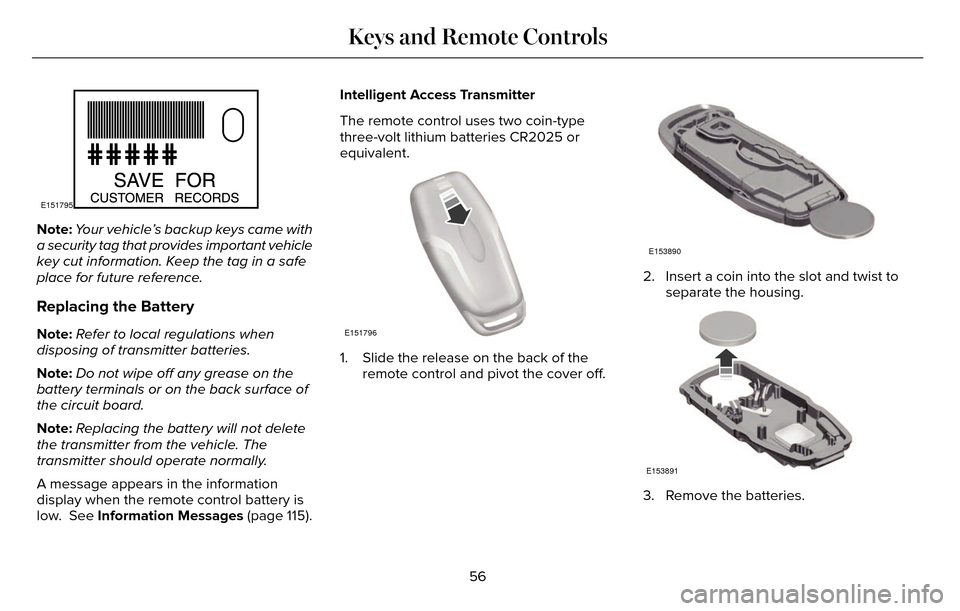
Note:Your vehicle’s backup keys came with
a security tag that provides important vehicle
key cut information. Keep the tag in a safe
place for future reference.
Replacing the Battery
Note: Refer to local regulations when
disposing of transmitter batteries.
Note: Do not wipe off any grease on the
battery terminals or on the back surface of
the circuit board.
Note: Replacing the battery will not delete
the transmitter from the vehicle. The
transmitter should operate normally.
A message appears in the information
display when the remote control battery is
low. See Information Messages (page 115). Intelligent Access Transmitter
The remote control uses two coin-type
three-volt lithium batteries CR2025 or
equivalent.E151796
1. Slide the release on the back of the
remote control and pivot the cover off.
E153890
2. Insert a coin into the slot and twist toseparate the housing.
E153891
3. Remove the batteries.
56
Keys and Remote Controls
Page 68 of 544

USING MYKEY WITH REMOTE
START SYSTEMS
MyKey is not compatible with nonFord-approved, aftermarket remote start
systems. If you choose to install a remote
start system, see an authorized dealer for a
Ford-approved remote start system.
MYKEY TROUBLESHOOTING
Potential Causes
Condition
I cannot create a MyKey. • The key or transmitter used to start the vehicle does not have admin pri\
vileges.
• The key or transmitter used to start the vehicle is the only admin key (\
there always has to be at least one admin key).
• Vehicles with keyless start: The keyless start transmitter is not placed \
in the backup position. See Starting a Gasoline Engine (page 162).
• SecuriLock passive anti-theft system is disabled or in unlimited mode.
• The key or transmitter used to start your vehicle does not have admin pr\
ivileges.
• No MyKeys are created. See Creating a MyKey (page 61).
I cannot program the configurable
settings.
• The key or transmitter used to start your vehicle does not have admin pr\
ivileges.
• No MyKeys are created. See Creating a MyKey (page 61).
I cannot clear the MyKeys.
Purchase a new key from an authorized dealer.
I lost the only admin key.
65
MyKey™
Page 75 of 544

From Outside Your Vehicle
E205262
Press the exterior release button to open the
luggage compartment. Your vehicle must be
unlocked or have an intelligent access
transmitter within 3 ft (1 m) of the luggage
compartment.Note:
Let the power system operate the
decklid after pressing the control. Pushing
or pulling the decklid may activate the
obstacle detection feature and stop the
power operation.
With the Decklid Close Button
E194407
Press the button inside the decklid
on the left-hand side.
Obstacle Detection
The decklid will reverse to full open if it
detects an obstacle while closing. Three
chimes will sound as the decklid begins to
reopen. Remove the obstacle to close the
decklid.
Note: Before driving your vehicle, check the
instrument cluster for a trunk ajar or door
ajar message or warning indicator. Failure
to do this could result in unintentionally
leaving the decklid open while driving.
The decklid will stop and three chimes will
sound if it detects an obstacle while opening.
Remove the obstacle to operate the decklid. Resetting the Power Decklid
The decklid may not operate correctly and
you may need to reset it if:
• The vehicle battery charge is low.
• You disconnect the battery.
• You manually close the decklid and leave
it unlatched.
To reset the power decklid:
1. Disconnect the battery for 20 seconds then reconnect the battery.
2. Manually close the decklid making sure it is fully closed.
3. Power open the decklid using the remote control or instrument panel button.
KEYLESS ENTRY
SECURICODE™ KEYLESS ENTRY
KEYPAD
The keypad is located near the driver
window. It is invisible until touched and then
it lights up so you can see and touch the
appropriate buttons.
72
Locks
Page 77 of 544

Note:Personal entry codes 4 and 5 will not
recall memory positions.
Erasing a Personal Code
1. Enter the factory-set 5-digit code.
2. Press and release 1·2 on the keypad within five seconds.
3. Press and hold 1·2 for two seconds. You must do this within five seconds of
completing Step 2.
All personal codes are now erased and only
the factory-set 5–digit code will work.
Anti-Scan Feature
The keypad will go into an anti-scan mode
if you enter the wrong code seven times (35
consecutive button presses). This mode
disables the keypad for one minute and the
keypad lamp will flash.
The anti-scan feature will turn off after:
• one minute of keypad inactivity
• pressing the unlock button on the remote control • switching the ignition on
• unlocking your vehicle using intelligent
access.
Unlocking and Locking the Doors
To Unlock the Driver Door
Enter the factory-set 5-digit code or your
personal code. You must press each number
within five seconds of each other. The
interior lamps will illuminate.
Note: All doors will unlock if you enable the
all-door unlocking mode. See Locking and
Unlocking (page 67).
To Unlock All Doors
Enter the factory-set code or your personal
code, then press 3·4 within five seconds.
To Lock All Doors
Press and hold 7·8 and 9·0 at the same time
(with the driver door closed). You do not
need to enter the keypad code first. To Release the Trunk
Enter the factory-set code or your personal
code, then press 5·6 within five seconds.
Displaying the Factory Set Code
Note:
You will need to have two
programmed intelligent access keys for this
procedure.
To display the factory-set code in the
information display:
E155835
1. Remove the rubber covering (A) in the cupholder. Place the first programmed
key in the backup slot (B) at the bottom
of the cupholder.
74
Locks