2016 LINCOLN MKT brake sensor
[x] Cancel search: brake sensorPage 233 of 452

This system is designed to alert the driver of
certain collision risks. A radar detects if your
vehicle is rapidly approaching another
vehicle traveling in the same direction as
yours.
If it is, a red warning light illuminates and an
audible warning chime sounds. The brake support system assists the driver
in reducing the collision speed by charging
the brakes. If the risk of collision further
increases after the warning light illuminates,
the brake support prepares the brake system
for rapid braking. This may be apparent to
the driver. The system does not automatically
activate the brakes but, if the brake pedal is
pressed, full force braking is applied even if
the brake pedal is lightly pressed.
Using the Collision Warning System
WARNING
The collision warning system
’s brake
support can only help reduce the
speed at which a collision occurs if the driver
applies the vehicle ’s brakes. The brake pedal
must be pressed just like any typical braking
situation. The warning system sensitivity can be
adjusted to one of three possible settings by
using the information display control. See
General Information (page 108). Note:
If collision warnings are perceived as
being too frequent or disturbing then the
warning sensitivity can be reduced, though
the manufacturer recommends using the
highest sensitivity setting where possible.
Setting lower sensitivity would lead to fewer
and later system warnings.
See General
Information (page 108).
Blocked Sensors 230
MKT (), enUSA, First Printing Driving AidsE156130 E156131 E145632
Page 235 of 452

System Limitations
WARNING
The collision warning system
’s brake
support can only help reduce the
speed at which a collision occurs if the driver
applies the vehicle ’s brakes. The brake pedal
must be pressed just like any typical braking
situation. Due to the nature of radar technology, there
may be certain instances where vehicles do
not provide a collision warning. These
include:
•
Stationary vehicles or vehicles moving
below 6 mph (10 km/h).
• Pedestrians or objects in the roadway.
• Oncoming vehicles in the same lane.
• Severe weather conditions (see blocked
sensor section).
• Debris build-up on the grille near the
headlamps (see blocked sensor section).
• Small distance to vehicle ahead.
• Steering wheel and pedal movements
are large (very active driving style). If the front end of the vehicle is hit or
damaged, the radar sensing zone may be
altered causing missed or false collision
warnings. See your authorized dealer to have
your collision warning radar checked for
proper coverage and operation.
DRIVE CONTROL (If Equipped)
LINCOLN DRIVE CONTROL
Lincoln Drive Control delivers the Lincoln
driving experience through a suite of
sophisticated electronic vehicle systems.
These systems continuously monitor your
driving inputs and the road conditions to
optimize ride comfort, steering, handling,
powertrain response and sound. You can
preset your preferences for these systems
within the information display. Lincoln Drive
Control will respond to your preferences
based on what gear position you select. This
provides a single location to control multiple
systems performance settings. Lincoln Drive Control consists of the
following systems:
•
Continuously controlled damping
dynamically adjusts the shock absorbers
stiffness in real time to match the road
surface and driver inputs. This system
continuously monitors your vehicle ’s
motion (roll, pitch, bounce), suspension
position, load, speed, road conditions,
and steering to adjust the suspension
damping for optimal vehicle control.
• Electronically power-assisted steering
adjusts steering effort and feel based on
your vehicle speed and your inputs.
• Active noise control utilizes your vehicle
electronics to enhance the acoustic
experience.
• Electronic stability control and traction
control maintain your vehicle control in
adverse conditions or high performance
driving.
• Electronic throttle control enhances the
powertrain response to your inputs.
232
MKT (), enUSA, First Printing Driving Aids
Page 276 of 452

Protected components
Fuse amp rating
Fuse or relay number
Trailer tow right-hand stop/turn lamps relay.
Relay
37
Trailer tow reverse lamps relay.
Relay
38
Auxiliary blower motor.
30A **
39
Left front smart window motor.
30A **
40
Left rear smart window motor.
30A **
41
Passenger power seat.
30A **
42
Anti-lock brake system valves.
20A **
43
Windshield washer relay.
Relay
44
Rain sensor.
5A *
45
Canister vent solenoid (EcoBoost engines).
5A *
46
Washer pump.
15A *
47
Front park lamps.
10A *
48
Not used.
-
49
273
MKT (), enUSA, First Printing Fuses
Page 277 of 452
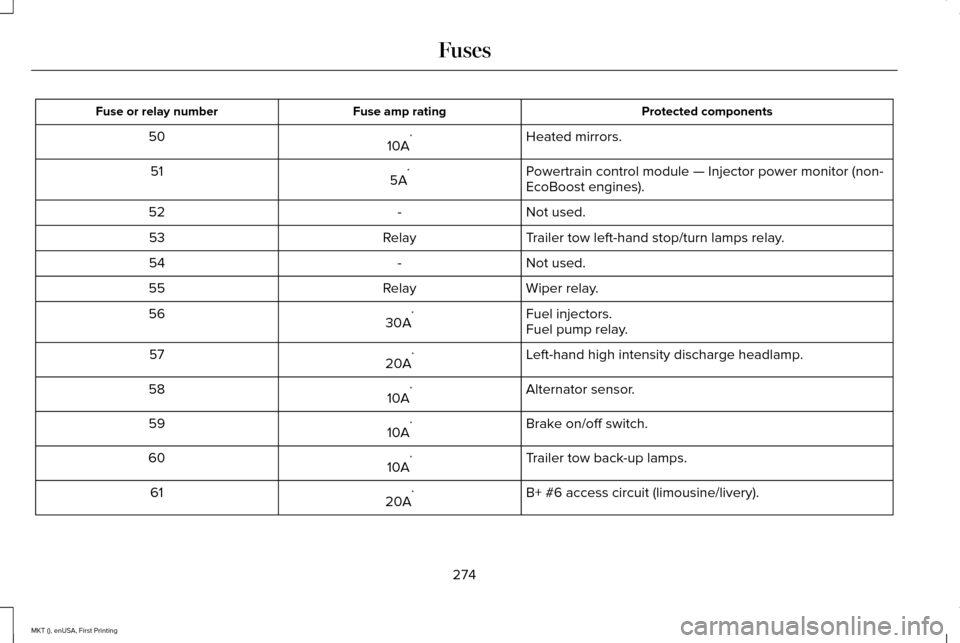
Protected components
Fuse amp rating
Fuse or relay number
Heated mirrors.
10A *
50
Powertrain control module — Injector power monitor (non-
EcoBoost engines).
5A *
51
Not used.
-
52
Trailer tow left-hand stop/turn lamps relay.
Relay
53
Not used.
-
54
Wiper relay.
Relay
55
Fuel injectors.
30A *
56
Fuel pump relay.
Left-hand high intensity discharge headlamp.
20A *
57
Alternator sensor.
10A *
58
Brake on/off switch.
10A *
59
Trailer tow back-up lamps.
10A *
60
B+ #6 access circuit (limousine/livery).
20A *
61
274
MKT (), enUSA, First Printing Fuses
Page 345 of 452

When Inflating Your Tires
When putting air into your tires (such as at a
gas station or in your garage), the tire
pressure monitoring system may not respond
immediately to the air added to your tires.
It may take up to two minutes of driving over
20 mph (32 km/h) for the light to turn off after
you have filled your tires to the
recommended inflation pressure
How Temperature Affects Your Tire
Pressure
The tire pressure monitoring system monitors
tire pressure in each pneumatic tire. While
driving in a normal manner, a typical
passenger tire inflation pressure may
increase about 2 to 4 psi (14 to 28 kPa) from
a cold start situation. If the vehicle is
stationary overnight with the outside
temperature significantly lower than the
daytime temperature, the tire pressure may
decrease about 3 psi (21 kPa) for a drop of
30°F (17°C) in ambient temperature. This
lower pressure value may be detected by
the tire pressure monitoring system as being
significantly lower than the recommended
inflation pressure and activate the system
warning light for low tire pressure. If the low
tire pressure warning light is on, visually
check each tire to verify that no tire is flat. If
one or more tires are flat, repair as
necessary. Check the air pressure in the road
tires. If any tire is under-inflated, carefully
drive the vehicle to the nearest location
where air can be added to the tires. Inflate
all the tires to the recommended inflation
pressure.
CHANGING A ROAD WHEEL
WARNINGS
The use of tire sealant may damage
your tire pressure monitoring system
and should only be used in roadside
emergencies. If you must use a sealant, the
Ford Tire Mobility Kit sealant should be used.
The tire pressure monitoring system sensor
and valve stem on the wheel must be
replaced by an authorized dealer after use
of the sealant. WARNINGS
See Tire Pressure Monitoring System
(page 338). If the tire pressure monitor
sensor becomes damaged, it will no longer
function. Note:
The tire pressure monitoring system
indicator light will illuminate when the spare
tire is in use. To restore the full function of
the monitoring system, all road wheels
equipped with tire pressure monitoring
sensors must be mounted on the vehicle.
If you get a flat tire while driving, do not apply
the brake heavily. Instead, gradually
decrease your speed. Hold the steering
wheel firmly and slowly move to a safe place
on the side of the road.
Have a flat serviced by an authorized dealer
in order to prevent damage to the tire
pressure monitoring system sensors. See
Tire Pressure Monitoring System (page 338).
Replace the spare tire with a road tire as
soon as possible. During repairing or
replacing of the flat tire, have the authorized
dealer inspect the tire pressure monitoring
system sensor for damage.
342
MKT (), enUSA, First Printing Wheels and Tires
Page 451 of 452

Towing the Vehicle on Four Wheels - 3.5L
Ecoboost™/3.7L............................................251
Emergency Towing.............................................251
Recreational Towing...........................................251
Towing.............................................................243
Traction Control.............................................192
Principle of Operation........................................192
Trailer Sway Control....................................244
Transmission Code Designation..............359
Transmission...................................................177
Transmission See: Transmission................................................177
Transporting the Vehicle............................249
U
Under Hood Overview - 2.0L EcoBoost™...................................................288
Under Hood Overview - 3.5L Ecoboost™....................................................290
Under Hood Overview - 3.7L....................292 Engine Shield......................................................293
Universal Garage Door Opener................152 HomeLink Wireless Control System...............152
USB Port
..........................................................381 Using Adaptive Cruise Control.................207
Automatic Cancellation.......................................211
Blocked Sensor....................................................213
Canceling the Set Speed..................................210
Changing the Set Speed....................................211
Detection Issues...................................................211
Following a Vehicle...........................................208
Hilly Condition Usage.........................................211
Overriding the System.......................................210
Resuming the Set Speed....................................211
Setting the Adaptive Cruise Speed...............208
Setting the Gap Distance.................................209
Switching Adaptive Cruise Control Off...........211
Switching Adaptive Cruise Control On........208
Switching to Normal Cruise Control...............214
System Not Available.........................................213
Using All-Wheel Drive...................................181 Driving In Special Conditions With All-Wheel
Drive (AWD)......................................................184
Operating AWD Vehicles With Mismatched Tires....................................................................183
Operating AWD Vehicles With Spare Tires ....................................................................182
Using Cruise Control...................................206 Switching Cruise Control Off...........................207
Switching Cruise Control On...........................206
Using MyKey With Remote Start Systems..........................................................68 Using Snow Chains......................................337
Using Stability Control.................................195
Using Traction Control
.................................192
Switching the System Off..................................192
System Indicator Lights and Messages.........192
Using a Switch.....................................................192
Using the Information Display Controls........192
Utilizing the Mediation/Arbitration Program (Canada Only)
.............................................264
V
Vehicle Care...................................................312 General Information............................................312
Vehicle Certification Label.........................358
Vehicle Identification Number..................358
Vehicle Storage.............................................319 Battery...................................................................320
Body........................................................................\
319
Brakes...................................................................320
Cooling system...................................................320
Engine...................................................................320
Fuel system..........................................................320
General..................................................................319
Miscellaneous.....................................................320
Removing Vehicle From Storage...................320
Tires.......................................................................320
448
MKT (), enUSA, First Printing Index