Page 216 of 660
2164-1. Before driving
RX450h_U_OM0E013U
◆Total load capacity (vehicle capacity weight): P. 582
Total load capacity means the combined weight of occupants, cargo and lug-
gage.
◆Seating capacity: 5 occupants (Front 2, Rear 3)
Seating capacity means the maximum number of occupants whose estimated
average weight is 150 lb. (68 kg) per person.
◆TWR (Trailer Weight Rating) (Vehicles with towing package):
P. 220, 582
TWR means the maximum gross trailer we ight (trailer weight plus its cargo
weight) that your vehicle is able to tow.
◆TWR (Trailer Weight Rating) (Vehicles without towing package)
Lexus does not recommend towing a trailer with your vehicle.
◆Cargo capacity
Cargo capacity may increase or decrease depending on the weight and the
number of occupants.
■Total load capacity and seating capacity
These details are also described on the tire and loading information label. (P. 496)
Vehicle load limits
Vehicle load limits include total load capacity, seating capacity, trailer weight
rating and cargo capacity.
WARNING
■Overloading the vehicle
Do not overload the vehicle.
It may not only cause damage to the tires, but also degrade steering and braking ability,
resulting in an accident.
Page 217 of 660
2174-1. Before driving
4
Driving
RX450h_U_OM0E013U
Contact your Lexus dealer for further information about additional requirements
such as a towing kit, etc.
Trailer towing (vehicles with towing package)
Your vehicle is designed primarily as a passenger-and-load-carrying vehicle.
Towing a trailer can have an adverse im pact on handling, performance, brak-
ing, durability, and fuel consumption. Fo r your safety and the safety of others,
you must not overload your vehicle or trailer. You must also ensure that you
are using appropriate towing equipment, that the towing equipment has been
installed correctly and used properly, and that you employ the requisite driv-
ing habits.
Vehicle-trailer stability and braking pe rformance are affected by trailer sta-
bility, brake performance and setting, tr ailer brakes, the hitch and hitch sys-
tems (if equipped).
To tow a trailer safely, use extreme ca re and drive the vehicle in accordance
with your trailer’s characteri stics and operating conditions.
Lexus warranties do not apply to damage or malfunction caused by towing a
trailer for commercial purposes.
Page 218 of 660
2184-1. Before driving
RX450h_U_OM0E013U
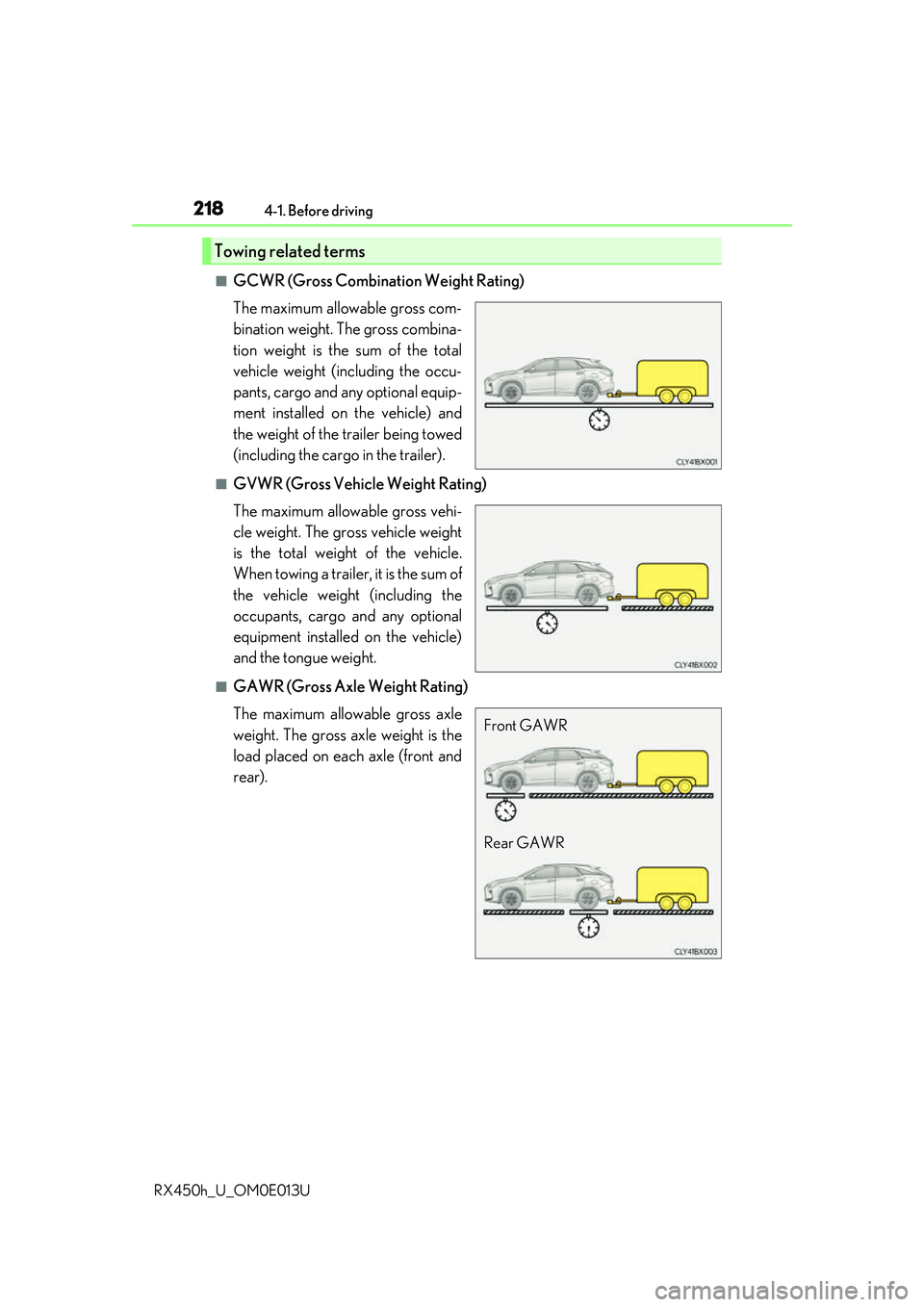
■GCWR (Gross Combination Weight Rating)
The maximum allowable gross com-
bination weight. The gross combina-
tion weight is the sum of the total
vehicle weight (including the occu-
pants, cargo and any optional equip-
ment installed on the vehicle) and
the weight of the trailer being towed
(including the cargo in the trailer).
■GVWR (Gross Vehicle Weight Rating)
The maximum allowable gross vehi-
cle weight. The gross vehicle weight
is the total weight of the vehicle.
When towing a trailer, it is the sum of
the vehicle weight (including the
occupants, cargo and any optional
equipment installed on the vehicle)
and the tongue weight.
■GAWR (Gross Axle Weight Rating)
The maximum allowable gross axle
weight. The gross axle weight is the
load placed on each axle (front and
rear).
Towing related terms
Front GAWR
Rear GAWR
Page 219 of 660
2194-1. Before driving
4
Driving
RX450h_U_OM0E013U
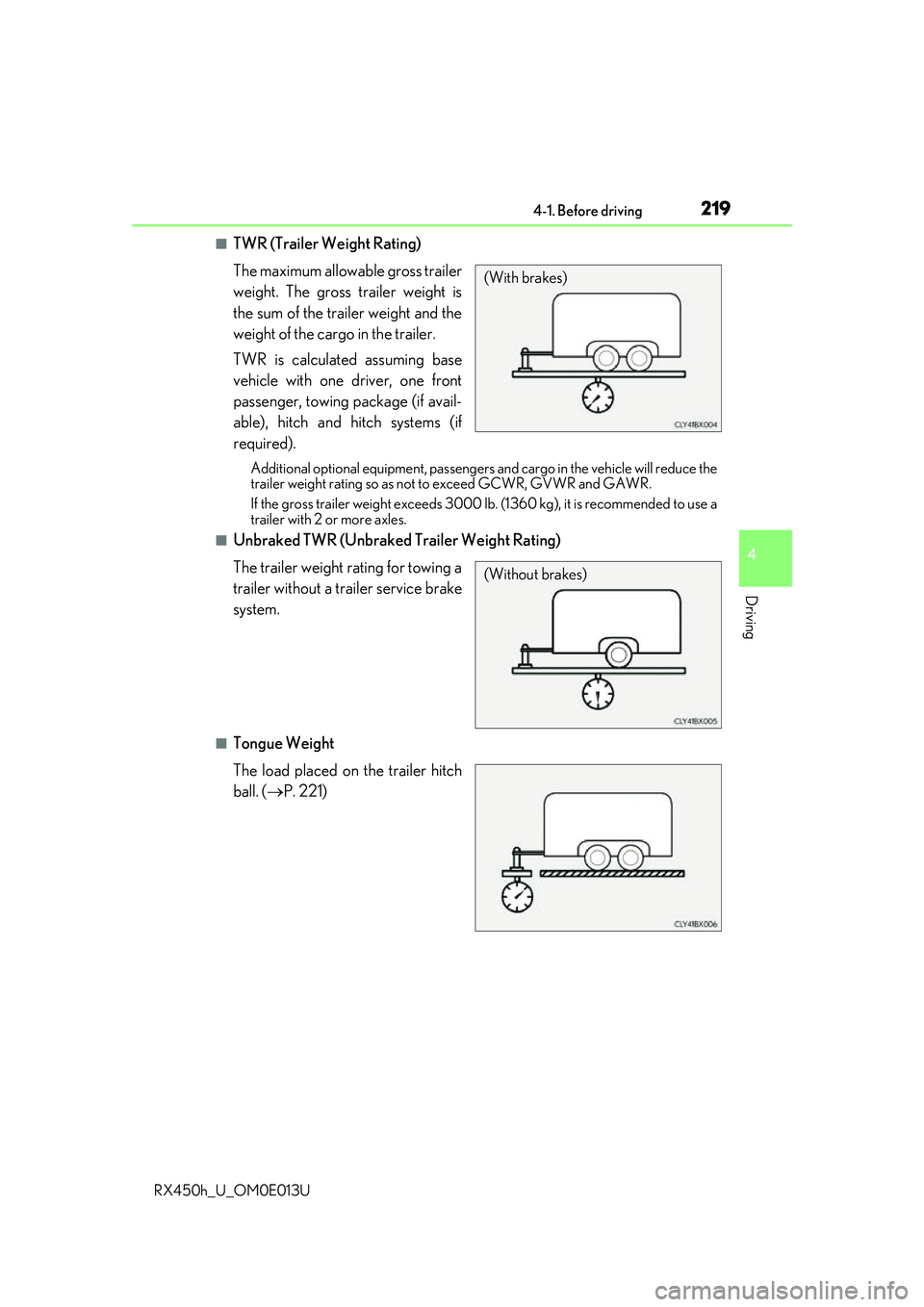
■TWR (Trailer Weight Rating)
The maximum allowable gross trailer
weight. The gross trailer weight is
the sum of the trailer weight and the
weight of the cargo in the trailer.
TWR is calculated assuming base
vehicle with one driver, one front
passenger, towing package (if avail-
able), hitch and hitch systems (if
required).
Additional optional equipment, passengers and cargo in the vehicle will reduce the
trailer weight rating so as not to exceed GCWR, GVWR and GAWR.
If the gross trailer weight exceeds 3000 lb. (1360 kg), it is recommended to use a
trailer with 2 or more axles.
■Unbraked TWR (Unbraked Trailer Weight Rating)
The trailer weight rating for towing a
trailer without a trailer service brake
system.
■Tongue Weight
The load placed on the trailer hitch
ball. ( P. 221)
(With brakes)
(Without brakes)
Page 221 of 660
2214-1. Before driving
4
Driving
RX450h_U_OM0E013U
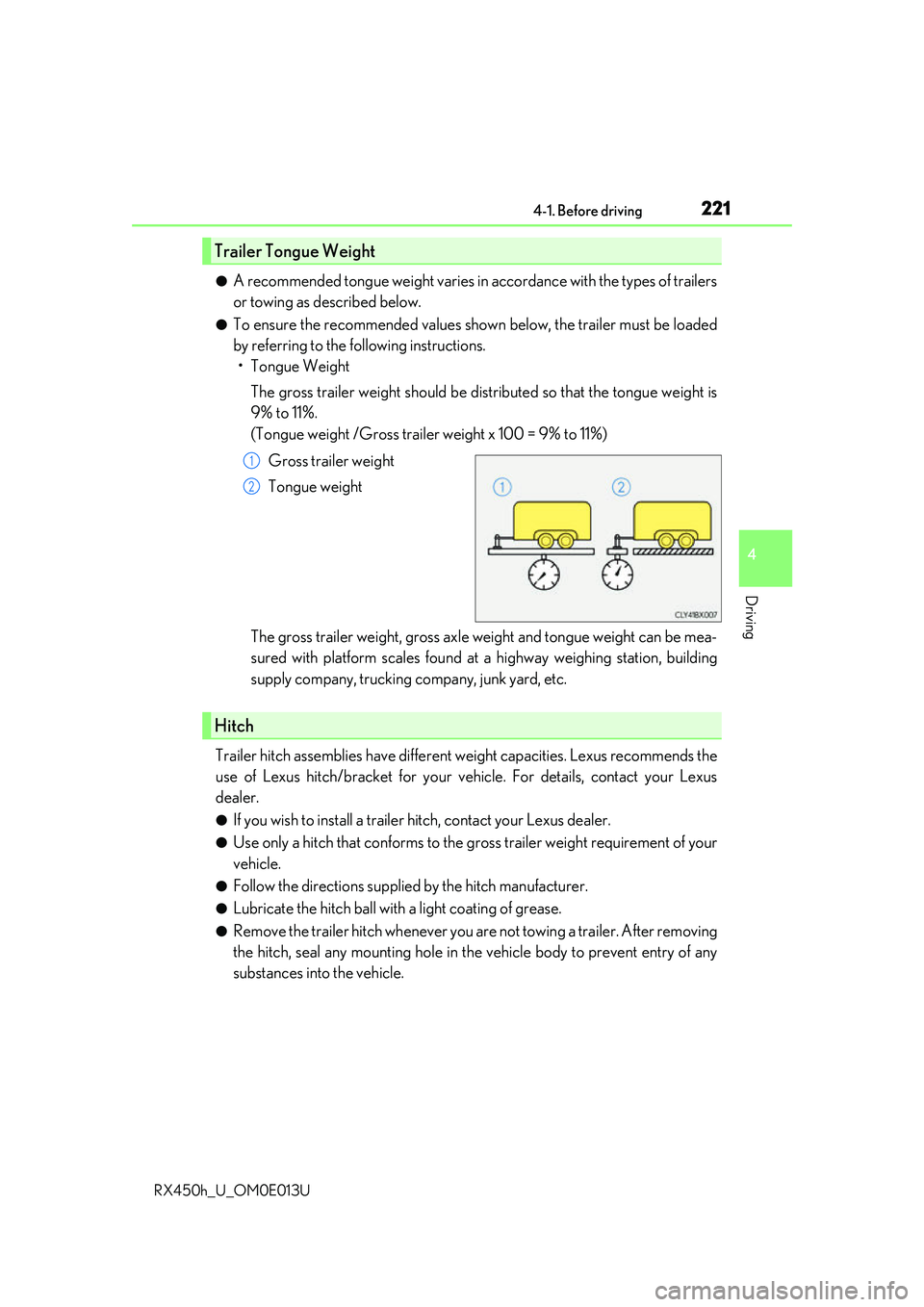
●A recommended tongue weight varies in accordance with the types of trailers
or towing as described below.
●To ensure the recommended values shown below, the trailer must be loaded
by referring to the following instructions. • Tongue Weight
The gross trailer weight should be dist ributed so that the tongue weight is
9% to 11%.
(Tongue weight /Gross trailer weight x 100 = 9% to 11%)
Gross trailer weight
Tongue weight
The gross trailer weight, gross axle weight and tongue weight can be mea-
sured with platform scales found at a highway weighing station, building
supply company, trucking company, junk yard, etc.
Trailer hitch assemblies have different weight capacities. Lexus recommends the
use of Lexus hitch/bracket for your ve hicle. For details, contact your Lexus
dealer.
●If you wish to install a trailer hitch, contact your Lexus dealer.
●Use only a hitch that conforms to the gross trailer weight requirement of your
vehicle.
●Follow the directions supplied by the hitch manufacturer.
●Lubricate the hitch ball with a light coating of grease.
●Remove the trailer hitch whenever you ar e not towing a trailer. After removing
the hitch, seal any mounting hole in the vehicle body to prevent entry of any
substances into the vehicle.
Trailer Tongue Weight
1
2
Hitch
Page 222 of 660
2224-1. Before driving
RX450h_U_OM0E013U
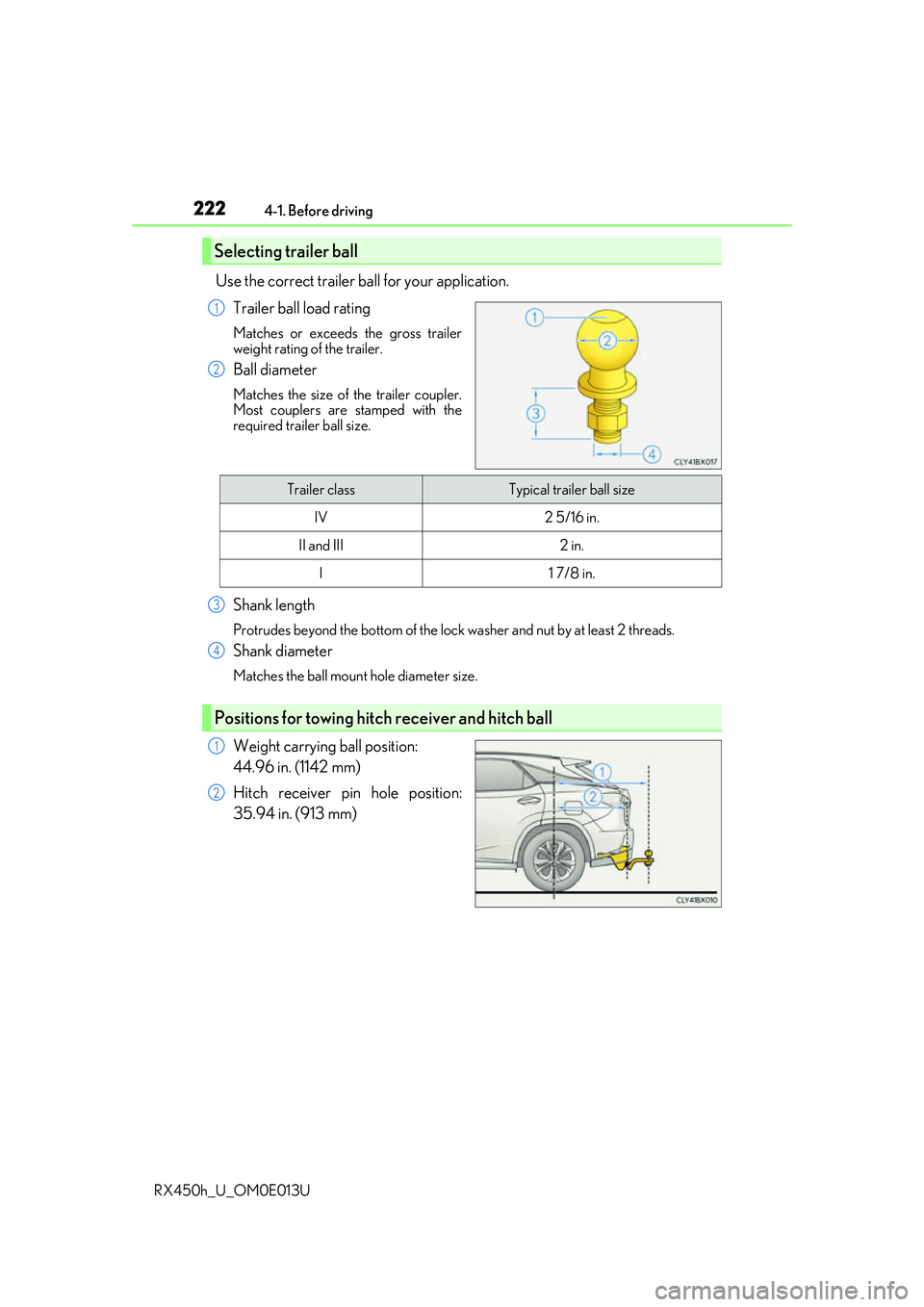
Use the correct trailer ball for your application. Trailer ball load rating
Matches or exceeds the gross trailer
weight rating of the trailer.
Ball diameter
Matches the size of the trailer coupler.
Most couplers are stamped with the
required trailer ball size.
Shank length
Protrudes beyond the bottom of the lock washer and nut by at least 2 threads.
Shank diameter
Matches the ball mount hole diameter size.
Weight carrying ball position:
44.96 in. (1142 mm)
Hitch receiver pin hole position:
35.94 in. (913 mm)
Selecting trailer ball
1
2
Trailer classTypical trailer ball size
IV2 5/16 in.
II and III2 in.
I1 7/8 in.
Positions for towing hitch receiver and hitch ball
3
4
1
2
Page 224 of 660

2244-1. Before driving
RX450h_U_OM0E013U
Your vehicle will handle differently when towing a trailer. Help to avoid an acci-
dent, death or serious injury, keep the following in mind when towing:
●Speed limits for towing a trailer vary by state or province. Do not exceed the
posted towing speed limit.
●Lexus recommends that the vehicle-traile r speed limit is 65 mph (104 km/h)
on a flat, straight, dry road. Do not exce ed this limit, the posted towing speed
limit or the speed limit for your trailer as set forth in your trailer owner’s man-
ual, whichever is lowest. Instability of the towing vehicle-trailer combination
(trailer sway) increases as speed increases. Exceeding speed limits may cause
loss of control.
●Before starting out, check the trailer lights, tires and the vehicle-trailer con-
nections. Recheck after driving a short distance.
●Practice turning, stopping and reversing with the trailer attached in an area
away from traffic until you become acc ustomed to the feel of the vehicle-
trailer combination.
●Reversing with a trailer attached is di fficult and requires practice. Grip the
bottom of the steering wheel and move your hand to the left to move the
trailer to the left. Move your hand to the right to move the trailer to right. (This
is generally opposite to reversing with out a trailer attached.) Avoid sharp or
prolonged turning. Have someone guid e you when reversing to reduce the
risk of an accident.
●As stopping distance is increased when towing a trailer, vehicle-to vehicle dis-
tance should be increased. For each 10 mph (16 km/h) of speed, allow at least
one vehicle and trailer length.
●Avoid sudden braking as you may skid, resulting in the trailer jackknifing and a
loss of vehicle control. This is especi ally true on wet or slippery surfaces.
●Avoid jerky starts or sudden acceleration.
●Avoid jerky steering and sharp turns, an d slow down before making a turn.
●Note that when making a turn, the trailer wheels will be closer than the vehicle
wheels to the inside of the turn. Compensate by making a wider than normal
turning radius.
●Slow down before making a turn, in cross winds, on wet or slippery surfaces,
etc.
Increasing vehicle speed can destabilize the trailer.
●Take care when passing other vehicles . Passing requires considerable dis-
tance. After passing a vehicle, do not fo rget the length of your trailer, and be
sure you have plenty of room before changing lanes.
Trailer towing tips
Page 226 of 660

2264-1. Before driving
RX450h_U_OM0E013U
■Matching trailer ball height to trailer coupler height
■Before towing
Check that the followin g conditions are met:
●Ensure that your vehicle’s tires are properly inflated. ( P. 589)
●Trailer tires are inflated according to the trailer manufacturer’s recommendation.
●All trailer lights work as required by law.
●All lights work each time you connect them.
●The trailer ball is set at the proper height for the coupler on the trailer.
●The trailer is level when it is hitched.
Do not drive if the trailer is not level, and check for improper to ngue weight, overload-
ing, worn suspension, or other possible causes.
●The trailer cargo is securely loaded.
●The rear view mirrors conform to all applicable federal, state/provincial or local regula-
tions. If they do not, install rear view mirrors appropriate for towing purposes.
■AVS (adaptive variable suspension system) (if equipped)
The suspension can be switched fo r improvement in driveability. (P. 382)
No matter which class of tow hitch
applies, for a more safe trailer hookup,
the trailer ball setup
must be the proper
height for the coupler on the trailer.
Coupler
Trailer ball
1
2