2016 LEXUS NX300H ECO
[x] Cancel search: ECOPage 555 of 680

555
8When trouble arises
NX300h_OM_USA_OM78082U
8-1. Essential informationEmergency flashers .................. 556
If your vehicle has to be stopped in an
emergency................................. 557
8-2. Steps to take in an emergency If your vehicle needs to be towed .....................................558
If you think something is wrong ........................................... 564
If a warning light turns on or a warning buzzer
sounds.......................................... 565
If a warning message is displayed..................................... 572
If you have a flat tire................... 575
If the hybrid system will not start .............................................. 588
If the shift lever cannot be shifted from P............................590
If the electronic key does not operate properly ...................... 591
If the 12-volt battery is discharged ................................. 594
If your vehicle overheats ......... 599
If the vehicle becomes stuck ............................................. 603
Page 557 of 680

557
8
When trouble arises
8-1. Essential information
NX300h_OM_USA_OM78082U
If your vehicle has to be stopped in an emergency
Steadily step on the brake pedal with both feet and firmly depress it.
Do not pump the brake pedal repeatedly as this will increase the effort required to
slow the vehicle.
Shift the shift lever to N.
If the shift lever is shifted to N
After slowing down, stop the vehicle in a safe place by the road.
Stop the hybrid system.
If the shift lever cannot be shifted to N
Keep depressing the brake pedal with both feet to reduce vehicle speed as
much as possible.
To stop the hybrid system, press and
hold the power switch for 2 consec-
utive seconds or more, or press it
briefly 3 times or more in succes-
sion.
Stop the vehicle in a safe place by the road.
Only in an emergency, such as if it becomes impossible to stop the vehicle in
the normal way, stop the vehicle using the following procedure:
1
2
3
4
3
Press and hold for 2 seconds or more,
or press briefly 3 times or more
4
WA R N I N G
■If the hybrid system has to be turned off while driving
Power assist for the steering wheel will be lost, making the steering wheel heavier to
turn. Decelerate as much as possible before turning off the hybrid system.
5
Page 558 of 680
5588-2. Steps to take in an emergency
NX300h_OM_USA_OM78082U
If your vehicle needs to be towed
The following may indicate a problem with your hybrid transmission. Contact
your Lexus dealer or commercial towing service before towing. ( P. 5 6 2 )
●The hybrid warning message shows on the multi-information display and the
vehicle does not move.
●The vehicle makes an abnormal sound.
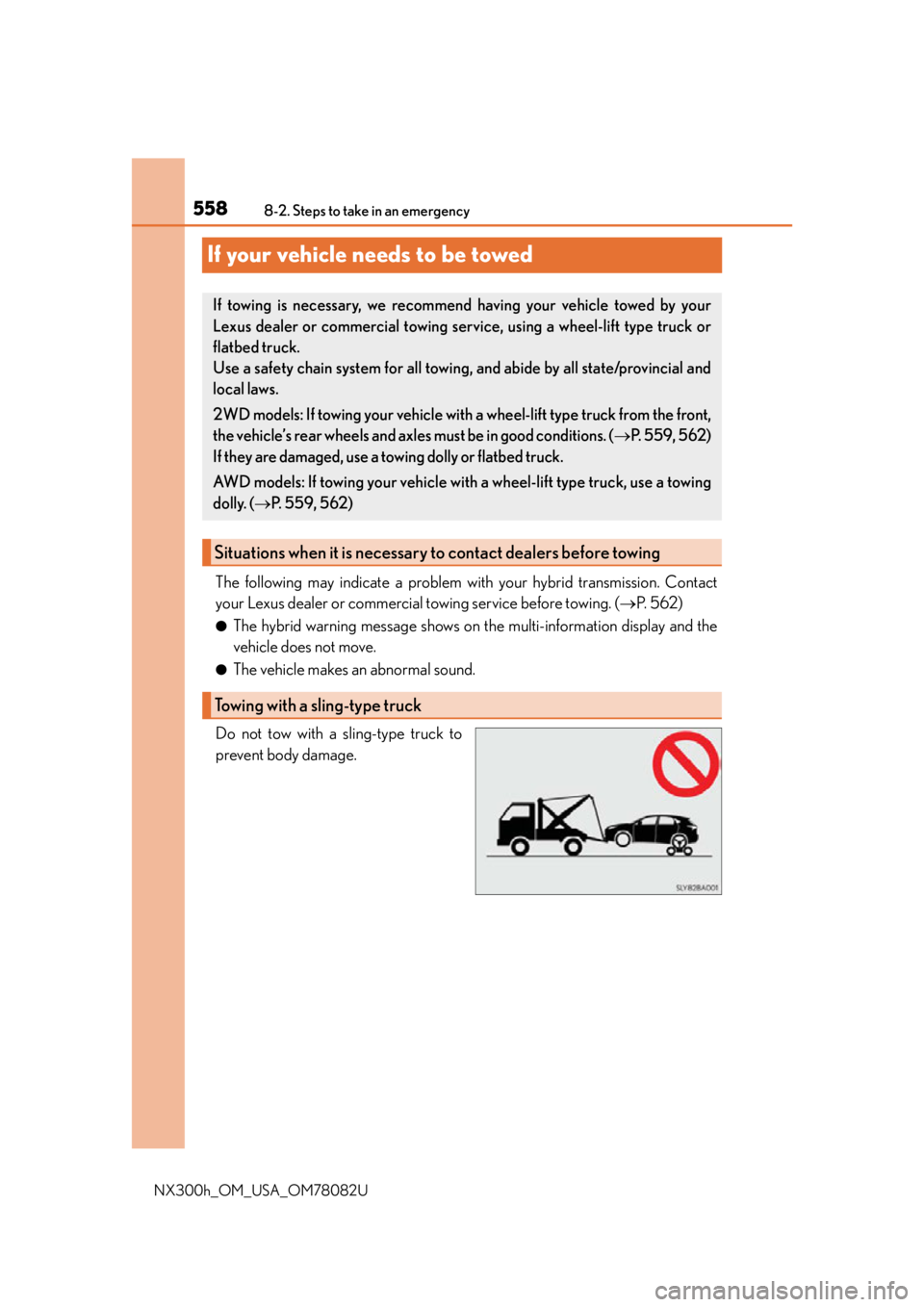
Do not tow with a sling-type truck to
prevent body damage.
If towing is necessary, we recommend having your vehicle towed by your
Lexus dealer or commercial towing se rvice, using a wheel-lift type truck or
flatbed truck.
Use a safety chain system for all towing, and abide by all state/provincial and
local laws.
2WD models: If towing your vehicle with a wheel-lift type truck from the front,
the vehicle’s rear wheels and axles must be in good conditions. (P. 559, 562)
If they are damaged, use a towing dolly or flatbed truck.
AWD models: If towing your vehicle with a wheel-lift type truck, use a towing
dolly. ( P. 559, 562)
Situations when it is necessary to contact dealers before towing
Towing with a sling-type truck
Page 562 of 680

5628-2. Steps to take in an emergency
NX300h_OM_USA_OM78082U
WA R N I N G
Observe the following precautions.
Failure to do so may result in death or serious injury.
■When towing the vehicle
2WD models
AW D m o d e l s
■While towing
●When towing using a cables or chains, avoid sudden starts, etc. which place excessive
stress on the towing eyelets, cables or chains. The towing eyelets, cables or chains
may become damaged, broken debris may hit people, and cause serious damage.
●Do not turn the power switch off.
There is a possibility that the steering wheel is locked and cannot be operated.
■Installing towing eyelets to the vehicle
Make sure that towing eyelets are installed securely.
If not securely installed, towing eyelets may come loose during towing.
Be sure to transport the vehicle with the front
wheels raised or with all four wheels raised off
the ground. If the vehicle is towed with the front
wheels contacting the ground, the drivetrain
and related parts may be damaged or electric-
ity generated by the operation of the motor
may cause a fire to occur depending on the
nature of the damage or malfunction.
Be sure to transport the vehicle with all four
wheels raised off the ground. If the vehicle is
towed with the tires contacting the ground, the
drivetrain or related parts may be damaged,
the vehicle may fly off the truck, or electricity
generated by the operation of the motor may
cause a fire to occur depending on the nature
of the damage or malfunction.
Page 568 of 680

5688-2. Steps to take in an emergency
NX300h_OM_USA_OM78082U
*1: This light illuminates on the multi-information display.
*2: Driver’s and front passenger’s seat belt warning buzzer:The driver’s seat belt warning buzzer sounds to alert the driver that his or her seat belt
is not fastened. Once the power switch is turned to ON mode, the buzzer sounds for
6 seconds. If the vehicle reaches a speed of 12 mph (20 km/h), the buzzer sounds
once. If the seat belt is st ill unfastened after 24 second s, the buzzer will sound inter-
mittently for 10 seconds. Then, if the seat be lt is still unfastened, the buzzer will sound
in a different tone for 20 more seconds.
The front passenger’s seat belt warning buzzer sounds to alert the front passenger
that his or her seat belt is not fastened. The buzzer sounds once if the vehicle reaches
a speed of 12 mph (20 km/h). If the seat belt is still unfastened after 24 seconds, the
buzzer will sound intermittently for 10 seconds. Then, if the seat belt is still unfastened,
the buzzer will sound in a different tone for 20 more seconds.
■SRS warning light
This warning light system monitors the airbag sensor assembly, front impact sensors, side
impact sensors (front), side impact sensors (r ear), driver’s seat position sensor, driver’s
seat belt buckle switch, front passenger occupant classification system (ECU and sen-
sors), “AIR BAG ON” indicator light, “AIR BAG OFF” indicator light, front passenger’s
seat belt buckle switch, driver ’s seat belt pretensioner, front passenger’s seat belt preten-
sioner and force limiter, airbags, interconnecting wiring and power sources. ( P. 4 0 )
■Front passenger detection sensor, seat belt reminder and warning buzzer
●If luggage is placed on the front passenger seat, the front passenger detection sensor
may cause the warning light to flash and the warning buzzer to sound even if a passen-
ger is not sittin g in the seat.
●If a cushion is placed on th e seat, the sensor may not detect a passenger, and the warn-
ing light may not operate properly.
■Electric power steering system warning light (warning buzzer)
When the 12-volt battery charge becomes insufficient of the voltage temporarily drops,
the electric power steering system warnin g light may come on and the warning buzzer
may sound.
■If the malfunction indicator lamp comes on while driving
First check the following:
●Is the fuel tank empty?
If it is, fill the fuel tank immediately.
●Is the fuel tank cap loose?
If it is, tighten it securely.
The light will go off after several driving trips.
If the light does not go off even after severa l trips, contact your Lexus dealer as soon as
possible.
Page 570 of 680

5708-2. Steps to take in an emergency
NX300h_OM_USA_OM78082U
WA R N I N G
■If both the ABS and the brake system warning lights remain on
Stop your vehicle in a safe place immediately and contact your Lexus dealer. The vehi-
cle will become extremely unstable during braking, and the ABS system may fail, which
could cause an accident resulting in death or serious injury.
■When the electric power steering system warning light comes on
When the light comes on yellow, the assist to the power steering is restricted. When the
light comes on red, the assist to the power steering is lost and handling operations of
the steering wheel become extremely heavy. When steering wheel operations are
heavier than usual, grip the steering wheel firmly and operate it using more force than
usual.
■If the tire pressure warning light comes on
Be sure to observe the following precautions. Failure to do so could cause a loss of
vehicle control and result in death or serious injury.
●Stop your vehicle in a safe place as soon as possible. Adjust the tire inflation pressure
immediately.
●If the tire pressure warning light comes on even after tire inflation pressure adjust-
ment, it is probable that you have a flat tire. Check the tires. If a tire is flat, change it
with the spare tire and have the flat tire repaired by the nearest Lexus dealer.
●Avoid abrupt maneuvering and braking. If the vehicle tires deteriorate, you could lose
control of the steering wheel or the brakes.
■If a blowout or sudden air leakage should occur
The tire pressure warning system may not activate immediately.
Page 571 of 680

5718-2. Steps to take in an emergency
8
When trouble arises
NX300h_OM_USA_OM78082U
WA R N I N G
■Maintenance of the tires
Each tire, including the spare (if provided), should be checked monthly when cold and
inflated to the inflation pressure recomm ended by the vehicle manufacturer on the
vehicle placard or tire inflation pressure la bel (tire and load information label). (If your
vehicle has tires of a different size than the size indicated on the vehicle placard or tire
inflation pressure label [tire and load in formation label], you should determine the
proper tire inflation pressure for those tires.)
As an added safety feature, your vehicle has been equipped with a tire pressure moni-
toring system (TPMS-tire pressure warning system) that illuminates a low tire pressure
telltale (tire pressure warning light) when on e or more of your tires is significantly
under-inflated. Accordingly, when the low ti re pressure telltale (tire pressure warning
light) illuminates, you should stop and check your tires as soon as possible, and inflate
them to the proper pressure. Driving on a significantly under-inflated tire causes the
tire to overheat and can lead to tire failure. Under-inflation also reduces fuel efficiency
and tire tread life, and ma y affect the vehicle’s handling and stopping ability.
Please note that the TPMS (tire pressure wa rning system) is not a substitute for proper
tire maintenance, and it is the driver’s resp onsibility to maintain correct tire pressure,
even if under-inflation has no t reached the level to trigger illumination of the TPMS low
tire pressure telltale (tire pressure warning light).
Your vehicle has also been equipped with a TPMS (tire pressure warning system) mal-
function indicator to indicate when the system is not operating properly. The TPMS
(tire pressure warning system) malfunction indi cator is combined with the low tire pres-
sure telltale (tire pressure warning light). When the system detects a malfunction, the
telltale will flash for approximately one minu te and then remain continuously illumi-
nated. This sequence will cont inue upon subsequent vehicle start-ups as long as the
malfunction exists. When the malfunction indicator is illuminated, the system may not
be able to detect or signal low tire pressure as intended.
TPMS (tire pressure warning system) malfun ctions may occur for a variety of reasons,
including the installation of replacement or alternate tires or wheels on the vehicle that
prevent the TPMS (tire pressure warning system) from functioning properly. Always
check the TPMS (tire pressure warning syst em) malfunction telltale after replacing one
or more tires or wheels on your vehicle to ensure that the replacement or alternate
tires and wheels allow the TPMS (tire pressure warning system) to continue to function
properly.
NOTICE
■To ensure the tire pressure warning system operates properly
Do not install tires with different specificatio ns or makers, as the tire pressure warning
system may not operate properly.
Page 585 of 680

5858-2. Steps to take in an emergency
8
When trouble arises
NX300h_OM_USA_OM78082U
Firmly tighten each wheel nut two or
three times in the order shown in the
illustration.
Tightening torque:
76 ft•lbf (103 N•m, 10.5 kgf•m)
Stow the flat tire, tire jack and all tools.
■The compact spare tire
●The compact spare tire is identified by the label “TEMPORARY USE ONLY” on the
tire sidewall.
Use the compact spare tire temporarily, and only in an emergency.
●Make sure to check the tire inflation pressure of the compact spare tire. ( P. 6 1 3 )
■After completing the tire change
The tire pressure warning system must be reset. ( P. 5 1 8 )
■When using the compact spare tire
As the compact spare tire is not equipped wi th a tire pressure warning valve and trans-
mitter, low inflation pressure of the spare ti re will not be indicated by the tire pressure
warning system. Also, if you replace the compact spare tire after the tire pressure warn-
ing light comes on, th e light remains on.
■When the compact spare tire is equipped
The vehicle becomes lower when driving with the compact spare tire compared to when
driving with standard tires.
■If you have a flat front tire on a road covered with snow or ice (except for 225/60R18
tires)
Install the compact spare tire on one of the rear wheels of the vehicle. Perform the follow-
ing steps and fit tire chains to the front tires:
Replace a rear tire with the compact spare tire.
Replace the flat front tire with the tire removed from the rear of the vehicle.
Fit tire chains to the front tires.
5
6
1
2
3