2016 Lexus GS350 wheel size
[x] Cancel search: wheel sizePage 513 of 624

5137-2. Steps to take in an emergency
GS350_200t_GS F_OM_OM30E86U_(U)
7
When trouble arises
WA R N I N G
■Caution while driving
Observe the following precautions.
Failure to do so may cause an accident.
●The emergency tire puncture repair kit is made exclusively for your vehicle. Do not
use it on other vehicles.
●Do not use the emergency tire puncture repair kit for tires that are a different size
than the specified ones or fo r any other purpose. Doing so may cause the tires to not
be repaired properly.
■Precautions for use of the sealant
●Ingesting the sealant is hazardous to your health. If you ingest sealant, consume as
much water as possible, and then immediately consult a doctor.
●If sealant gets in eyes or adheres to skin, immediately wash it off with water. If discom-
fort persists, consult a doctor.
■When fixing the flat tire
●Stop your vehicle in a safe and flat area.
●Do not touch the wheels or the area around the brakes immediately after the vehicle
has been driven.
After the vehicle has been driven, the wheels and the area around the brakes may be
extremely hot. Touching these areas with hands, feet or other body parts may result in
burns.
●Connect the valve and hose securely wi th the tire installed on the vehicle.
●If the hose is not properly connected to the valve, air leakage may occur or sealant
may be sprayed out.
●If the hose comes off the valve while inflating the tire, there is a risk that the hose will
move abruptly due to air pressure.
●After inflation of the tire has completed, the sealant may splatter when the hose is dis-
connected or some air is let out of the tire.
●Follow the operation procedure to repair the tire. If the procedures not followed, the
sealant may spray out.
●Keep back from the tire while it is being re paired, as there is a chance of it bursting
while the repair operation is being perfor med. If you notice any cracks or deforma-
tion of the tire, turn off the compressor sw itch and stop the repair operation immedi-
ately.
●The repair kit may overheat if operated for a long period of time. Do not operate the
repair kit continuously for more than 35 minutes.
●Parts of the repair kit become hot during op eration. Be careful handling the repair kit
during and after operation. Do not touch the metal part connecting the bottle and the
compressor. It will be extremely hot.
●Do not attach the vehicle speed warning sticker to an area other than the one indi-
cated. If the sticker is attached to an area where an SRS airbag is located, such as the
pad of the steering wheel, it may preven t the SRS air bag from operating properly.
Page 550 of 624

550
GS350_200t_GS F_OM_OM30E86U_(U)8-1. Specifications
GS350/GS200t (type A)
GS350/GS200t (type B)
Steering
Free playLess than 1.2 in. (30 mm)
Tires and wheels
Ti r e s i z e225/50R17 94W, T155/70D17 110M (spare)
Tire inflation pressure
(Recommended cold
tire inflation pressure)
Driving under normal conditions
Front: 35 psi (240 kPa, 2.4 kgf/cm2 or bar)
Rear: 35 psi (240 kPa, 2.4 kgf/cm2 or bar)
Spare: 60 psi (420 kPa, 4.2 kgf/cm2 or bar)
Driving at high speeds (above 118 mph [190 km/h]) (in coun-
tries where such speeds are permitted by law)
Add 10 psi (70 kPa, 0.7 kgf/cm
2 or bar) to the front tires
and rear tires. Never exceed the maximum cold tire infla-
tion pressure indicated on the tire sidewall.
Wheel size17 7 1 /2J, 17 4T (spare)
Wheel nut torque76 ft•lbf (103 N•m, 10.5 kgf•m)
Ti r e s i z e225/50R17 94W, T145/70D18 107M (spare)
Tire inflation pressure
(Recommended cold
tire inflation pressure)
Driving under normal conditions
Front: 35 psi (240 kPa, 2.4 kgf/cm2 or bar)
Rear: 35 psi (240 kPa, 2.4 kgf/cm2 or bar)
Spare: 60 psi (420 kPa, 4.2 kgf/cm2 or bar)
Driving at high speeds (above 118 mph [190 km/h]) (in coun-
tries where such speeds are permitted by law)
Add 10 psi (70 kPa, 0.7 kgf/cm
2 or bar) to the front tires
and rear tires. Never exceed the maximum cold tire infla-
tion pressure indicated on the tire sidewall.
Wheel size17 7 1 /2J, 18 4T (spare)
Wheel nut torque76 ft•lbf (103 N•m, 10.5 kgf•m)
Page 551 of 624
GS350_200t_GS F_OM_OM30E86U_(U)
5518-1. Specifications
8
Vehicle specifications
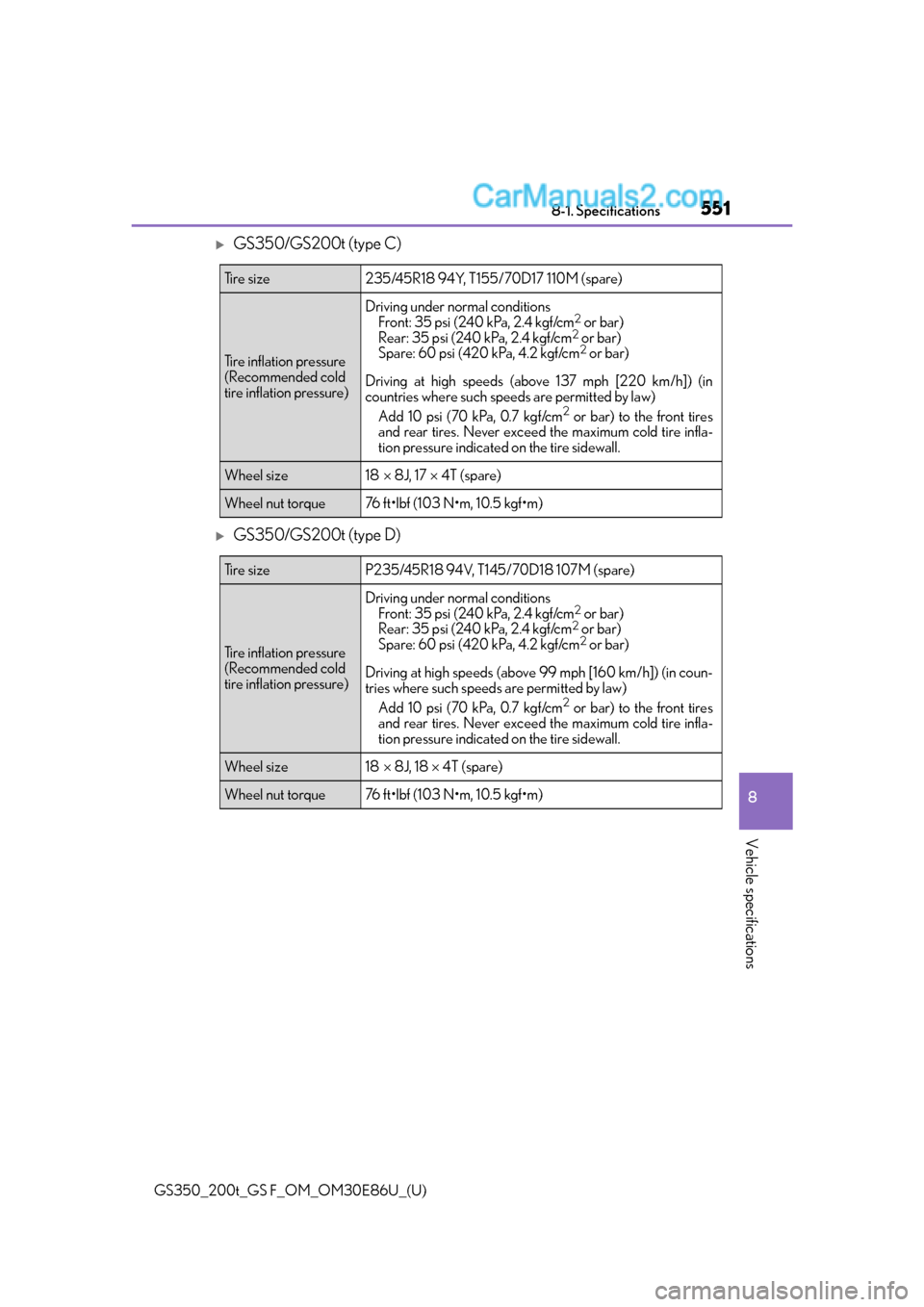
GS350/GS200t (type C)
GS350/GS200t (type D)
Ti r e s i z e235/45R18 94Y, T155/70D17 110M (spare)
Tire inflation pressure
(Recommended cold
tire inflation pressure)
Driving under normal conditionsFront: 35 psi (240 kPa, 2.4 kgf/cm2 or bar)
Rear: 35 psi (240 kPa, 2.4 kgf/cm2 or bar)
Spare: 60 psi (420 kPa, 4.2 kgf/cm2 or bar)
Driving at high speeds (above 137 mph [220 km/h]) (in
countries where such speeds are permitted by law)
Add 10 psi (70 kPa, 0.7 kgf/cm
2 or bar) to the front tires
and rear tires. Never exceed the maximum cold tire infla-
tion pressure indicated on the tire sidewall.
Wheel size18 8J, 17 4T (spare)
Wheel nut torque76 ft•lbf (103 N•m, 10.5 kgf•m)
Ti r e s i z eP235/45R18 94V, T145/70D18 107M (spare)
Tire inflation pressure
(Recommended cold
tire inflation pressure)
Driving under normal conditions
Front: 35 psi (240 kPa, 2.4 kgf/cm2 or bar)
Rear: 35 psi (240 kPa, 2.4 kgf/cm2 or bar)
Spare: 60 psi (420 kPa, 4.2 kgf/cm2 or bar)
Driving at high speeds (above 99 mph [160 km/h]) (in coun-
tries where such speeds are permitted by law)
Add 10 psi (70 kPa, 0.7 kgf/cm
2 or bar) to the front tires
and rear tires. Never exceed the maximum cold tire infla-
tion pressure indicated on the tire sidewall.
Wheel size18 8J, 18 4T (spare)
Wheel nut torque76 ft•lbf (103 N•m, 10.5 kgf•m)
Page 552 of 624
552
GS350_200t_GS F_OM_OM30E86U_(U)8-1. Specifications
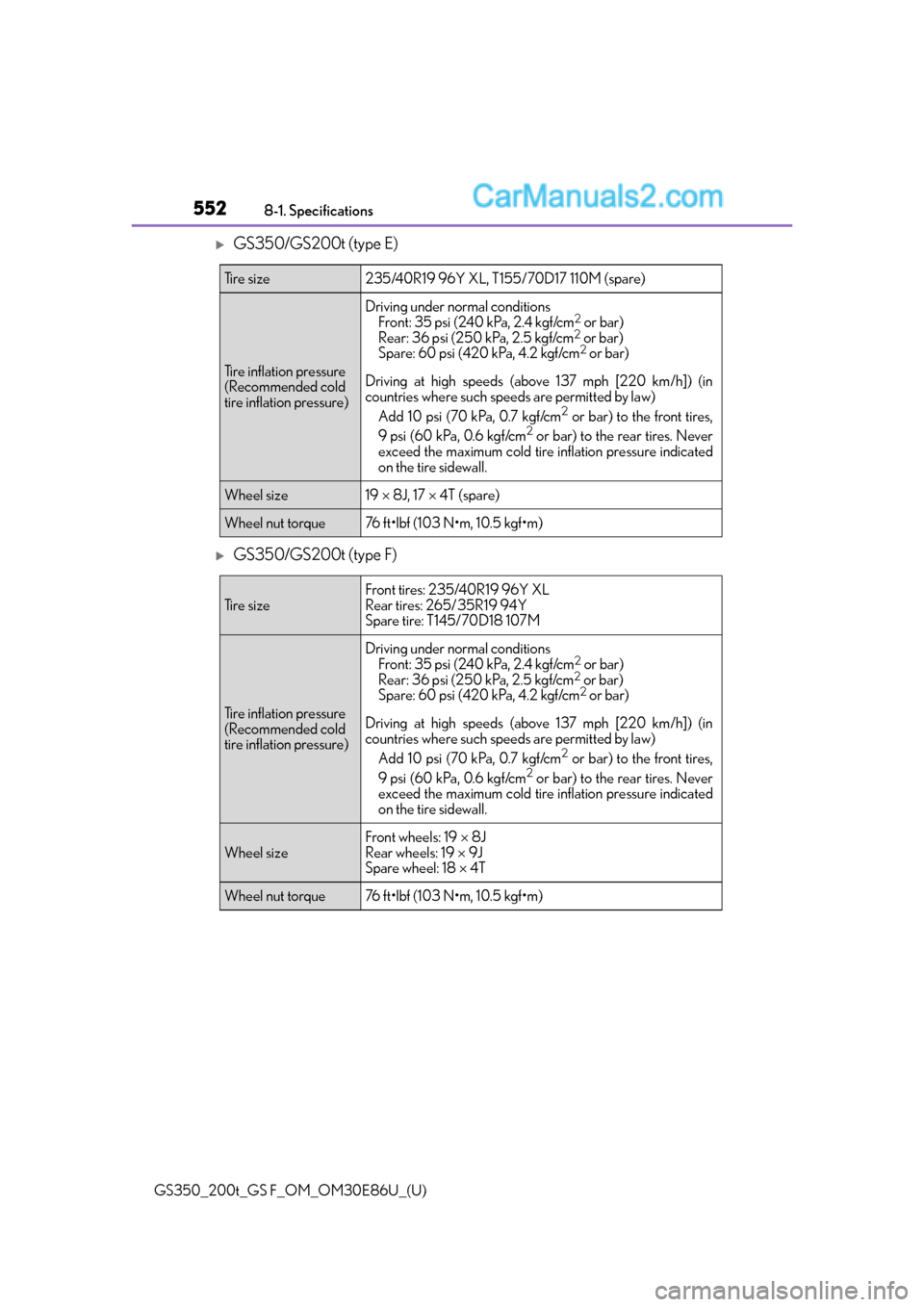
GS350/GS200t (type E)
GS350/GS200t (type F)
Ti r e s i z e235/40R19 96Y XL, T155/70D17 110M (spare)
Tire inflation pressure
(Recommended cold
tire inflation pressure)
Driving under normal conditions
Front: 35 psi (240 kPa, 2.4 kgf/cm2 or bar)
Rear: 36 psi (250 kPa, 2.5 kgf/cm2 or bar)
Spare: 60 psi (420 kPa, 4.2 kgf/cm2 or bar)
Driving at high speeds (above 137 mph [220 km/h]) (in
countries where such speeds are permitted by law)
Add 10 psi (70 kPa, 0.7 kgf/cm
2 or bar) to the front tires,
9 psi (60 kPa, 0.6 kgf/cm2 or bar) to the rear tires. Never
exceed the maximum cold tire inflation pressure indicated
on the tire sidewall.
Wheel size19 8J, 17 4T (spare)
Wheel nut torque76 ft•lbf (103 N•m, 10.5 kgf•m)
Ti r e s i z e
Front tires: 235/40R19 96Y XL
Rear tires: 265/ 35R19 94Y
Spare tire: T145/70D18 107M
Tire inflation pressure
(Recommended cold
tire inflation pressure)
Driving under normal conditions
Front: 35 psi (240 kPa, 2.4 kgf/cm2 or bar)
Rear: 36 psi (250 kPa, 2.5 kgf/cm2 or bar)
Spare: 60 psi (420 kPa, 4.2 kgf/cm2 or bar)
Driving at high speeds (above 137 mph [220 km/h]) (in
countries where such speeds are permitted by law)
Add 10 psi (70 kPa, 0.7 kgf/cm
2 or bar) to the front tires,
9 psi (60 kPa, 0.6 kgf/cm2 or bar) to the rear tires. Never
exceed the maximum cold tire inflation pressure indicated
on the tire sidewall.
Wheel size
Front wheels: 19 8J
Rear wheels: 19 9J
Spare wheel: 18 4T
Wheel nut torque76 ft•lbf (103 N•m, 10.5 kgf•m)
Page 553 of 624

GS350_200t_GS F_OM_OM30E86U_(U)
5538-1. Specifications
8
Vehicle specifications
GS350/GS200t (type G)
GS F (type A)
Ti r e s i z e235/40R19 96V XL, T145/70D18 107M (spare)
Tire inflation pressure
(Recommended cold
tire inflation pressure)
Driving under normal conditionsFront: 35 psi (240 kPa, 2.4 kgf/cm2 or bar)
Rear: 36 psi (250 kPa, 2.5 kgf/cm2 or bar)
Spare: 60 psi (420 kPa, 4.2 kgf/cm2 or bar)
Driving at high speeds (above 99 mph [160 km/h]) (in coun-
tries where such speeds are permitted by law)
Add 10 psi (70 kPa, 0.7 kgf/cm
2 or bar) to the front tires,
9 psi (60 kPa, 0.6 kgf/cm2 or bar) to the rear tires. Never
exceed the maximum cold tire inflation pressure indicated
on the tire sidewall.
Wheel size19 8J, 18 4T (spare)
Wheel nut torque76 ft•lbf (103 N•m, 10.5 kgf•m)
Ti r e s i z eFront tires: 255/ 35ZR19 (92Y)
Rear tires: 275/35ZR19 (96Y)
Tire inflation pressure
(Recommended cold
tire inflation pressure)
Driving under normal conditions
Front: 36 psi (250 kPa, 2.5 kgf/cm2 or bar)
Rear: 36 psi (250 kPa, 2.5 kgf/cm2 or bar)
Driving at high speeds (above 137 mph [220 km/h]) (in
countries where such speeds are permitted by law)
Add 8 psi (50 kPa, 0.5 kgf/cm
2 or bar) to the front tires
and rear tires. Never exceed the maximum cold tire infla-
tion pressure indicated on the tire sidewall.
Wheel sizeFront wheels: 19 9J
Rear wheels: 19 10J
Wheel nut torque76 ft•lbf (103 N•m, 10.5 kgf•m)
Page 554 of 624

554
GS350_200t_GS F_OM_OM30E86U_(U)8-1. Specifications
GS F (type B)
Ti r e s i z e
Front tires: 255/ 35ZR19 (92Y)
Rear tires: 275/35ZR19 (96Y)
Spare tire: 225/40ZR19 (93Y) XL
Tire inflation pressure
(Recommended cold
tire inflation pressure)
Driving under normal conditions
Front: 36 psi (250 kPa, 2.5 kgf/cm2 or bar)
Rear: 36 psi (250 kPa, 2.5 kgf/cm2 or bar)
Spare: 42 psi (290 kPa, 2.9 kgf/cm2 or bar)
Driving at high speeds (above 137 mph [220 km/h]) (in
countries where such speeds are permitted by law)
Add 8 psi (50 kPa, 0.5 kgf/cm
2 or bar) to the front tires
and rear tires. Never exceed the maximum cold tire infla-
tion pressure indicated on the tire sidewall.
Wheel sizeFront wheels: 19 9J
Rear wheels: 19 10J
Spare wheel: 19 8 1 /2J
Wheel nut torque76 ft•lbf (103 N•m, 10.5 kgf•m)
Light bulbs
Light bulbsBulb No.WTy p e
ExteriorFront turn signal lights*7444NA28A
Outer foot lightsW5W5B
InteriorVanity lights8B
Trunk light3.8B
A: Wedge base bulbs (amber)
B: Wedge base bulbs (clear)
*: Vehicles with single-beam headlights
Page 560 of 624

560
GS350_200t_GS F_OM_OM30E86U_(U)8-1. Specifications
DOT symbol*
Tire Identification Number (TIN)
Tire manufacturer’s identification
mark
Ti r e s i z e c o d e
Manufacturer’s optional tire type
code (3 or 4 letters)
Manufacturing week
Manufacturing year
*: The DOT symbol certifies that the tire co
nforms to applicable Federal Motor Vehicle
Safety Standards.
■Typical tire size information
The illustration indicates typical tire
size.
Ti r e u s e
(P = Passenger car,
T = Temporary use)
Section width (millimeters)
Aspect ratio
(tire height to section width)
Tire construction code (R = Radial, D = Diagonal)
Wheel diameter (inches)
Load index (2 digits or 3 digits)
Speed symbol (alphabet with one letter)
Typical DOT and Tire Identification Number (TIN)
1
2
3
4
5
6
Tire size
7
1
2
3
4
5
6
7
Page 564 of 624

564
GS350_200t_GS F_OM_OM30E86U_(U)8-1. Specifications
Occupant distributionDistribution of occupants in
a vehicle as specified in the
third column of Table 1* below
Production options weight
The combined weight of installed regular production
options weighing over 5 lb. (2.3 kg) in excess of the
standard items which they replace, not previously con-
sidered in curb weight or accessory weight, including
heavy duty brakes, ride levelers, roof rack, heavy duty
battery, and special trim
RimA metal support for a tire or a tire and tube assembly
upon which the tire beads are seated
Rim diameter
(Wheel diameter)Nominal diameter of the bead seat
Rim size designationRim diameter and width
Rim type designationThe industry manufacturer’s designation for a rim by
style or code
Rim widthNominal distance between rim flanges
Vehicle capacity weight
(Total load capacity)The rated cargo and luggage load plus 150 lb. (68 kg)
times the vehicle’s designated seating capacity
Vehicle maximum load on
the tireThe load on an individual tire that is determined by dis-
tributing to each axle its share of the maximum loaded
vehicle weight, and dividing by two
Vehicle normal load on the
tireThe load on an individual tire that is determined by dis-
tributing to each axle its sh are of curb weight, accessory
weight, and normal occupant weight (distributed in
accordance with Table 1
* below), and dividing by two
We a t h e r s i d eThe surface area of the rim not covered by the inflated
tire
Bead
The part of the tire that is made of steel wires, wrapped
or reinforced by ply cords and that is shaped to fit the
rim
Bead separationA breakdown of the bond be tween components in the
bead
Bias ply tireA pneumatic tire in which the ply cords that extend to
the beads are laid at altern ate angles substantially less
than 90 degrees to the centerline of the tread
CarcassThe tire structure, except tread and sidewall rubber
which, when inflated, bears the load
ChunkingThe breaking away of pieces of the tread or sidewall
CordThe strands forming th e plies in the tire
Tire related termMeaning