Page 82 of 501
Safety features of your vehicle
66
3
Problems may arise if the sensor
installation angles are changed
due to the deformation of the front
bumper, front end module, body or
front doors and/or B pillar where
side collision sensors are installed.
Have the vehicle checked and
repaired by an authorized Kia deal-
er.
Your vehicle has been designed to absorb impact and deploy the air
bag(s) in certain collisions.
Installing bumper guards (or side
step or running board) or replacing
a bumper (or front door module)
with non-genuine parts may
adversely affect your vehicle’s col-
lision and air bag deployment per-
formance.
C040801AAM
Air bag inflation conditions
Front air bags
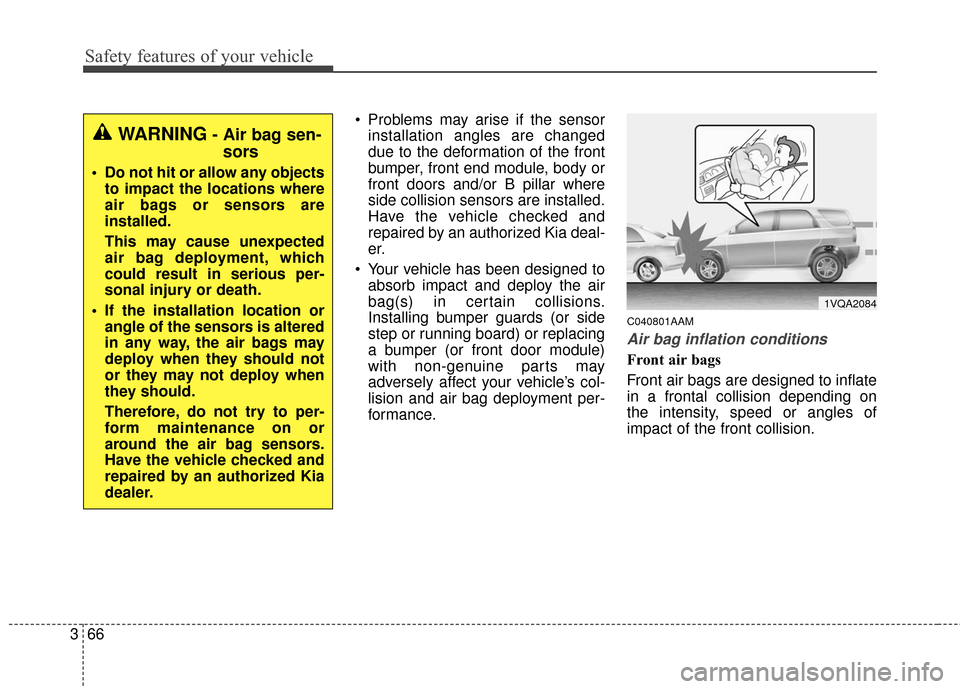
Front air bags are designed to inflate
in a frontal collision depending on
the intensity, speed or angles of
impact of the front collision.
1VQA2084
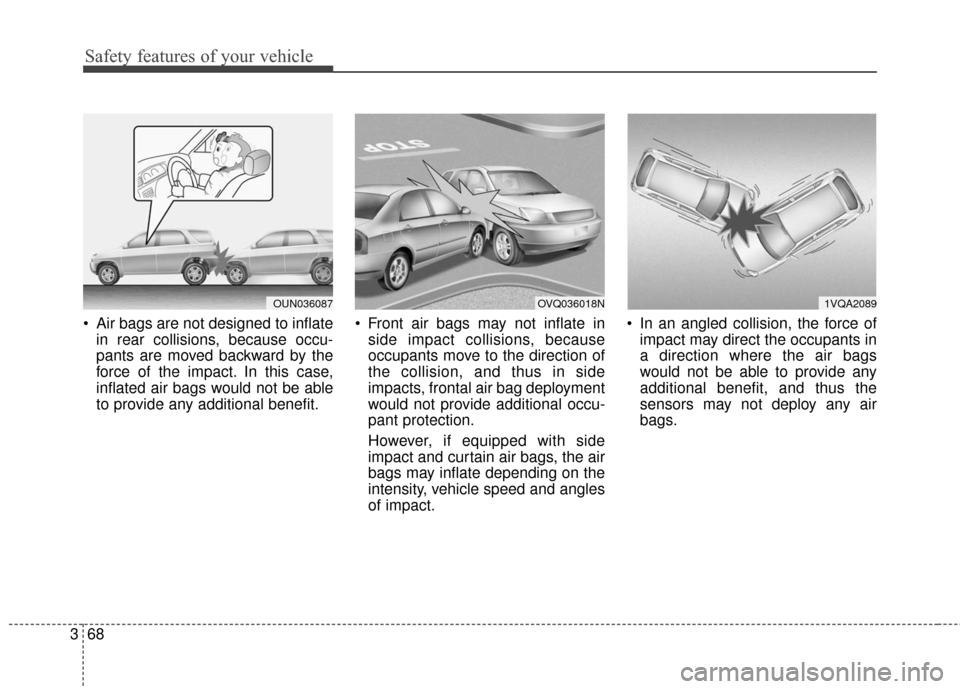
WARNING- Air bag sen-sors
Do not hit or allow any objects
to impact the locations where
air bags or sensors are
installed.
This may cause unexpected
air bag deployment, which
could result in serious per-
sonal injury or death.
If the installation location or angle of the sensors is altered
in any way, the air bags may
deploy when they should not
or they may not deploy when
they should.
Therefore, do not try to per-
form maintenance on or
around the air bag sensors.
Have the vehicle checked and
repaired by an authorized Kia
dealer.
Page 83 of 501
367
Safety features of your vehicle
* The actual air bags in the vehicle maydiffer from the illustration.
Side impact and/or curtain air bags
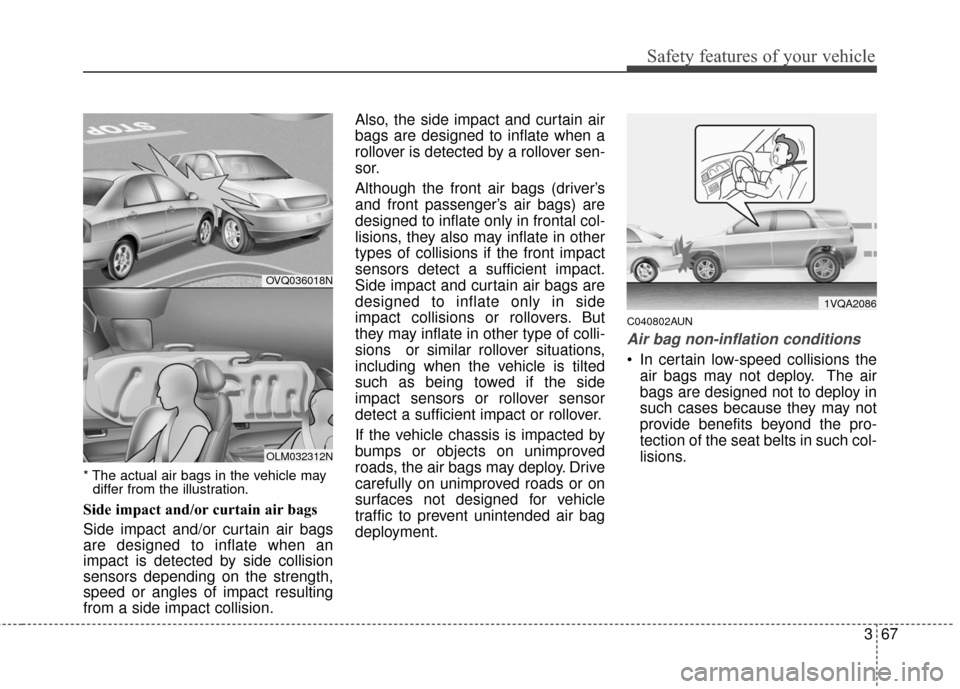
Side impact and/or curtain air bags
are designed to inflate when an
impact is detected by side collision
sensors depending on the strength,
speed or angles of impact resulting
from a side impact collision. Also, the side impact and curtain air
bags are designed to inflate when a
rollover is detected by a rollover sen-
sor.
Although the front air bags (driver’s
and front passenger’s air bags) are
designed to inflate only in frontal col-
lisions, they also may inflate in other
types of collisions if the front impact
sensors detect a sufficient impact.
Side impact and curtain air bags are
designed to inflate only in side
impact collisions or rollovers. But
they may inflate in other type of colli-
sions or similar rollover situations,
including when the vehicle is tilted
such as being towed if the side
impact sensors or rollover sensor
detect a sufficient impact or rollover.
If the vehicle chassis is impacted by
bumps or objects on unimproved
roads, the air bags may deploy. Drive
carefully on unimproved roads or on
surfaces not designed for vehicle
traffic to prevent unintended air bag
deployment.
C040802AUN
Air bag non-inflation conditions
In certain low-speed collisions the
air bags may not deploy. The air
bags are designed not to deploy in
such cases because they may not
provide benefits beyond the pro-
tection of the seat belts in such col-
lisions.
1VQA2086
OVQ036018N
OLM032312N
Page 84 of 501
Safety features of your vehicle
68
3
Air bags are not designed to inflate
in rear collisions, because occu-
pants are moved backward by the
force of the impact. In this case,
inflated air bags would not be able
to provide any additional benefit. Front air bags may not inflate in
side impact collisions, because
occupants move to the direction of
the collision, and thus in side
impacts, frontal air bag deployment
would not provide additional occu-
pant protection.
However, if equipped with side
impact and curtain air bags, the air
bags may inflate depending on the
intensity, vehicle speed and angles
of impact. In an angled collision, the force of
impact may direct the occupants in
a direction where the air bags
would not be able to provide any
additional benefit, and thus the
sensors may not deploy any air
bags.
OUN0360871VQA2089OVQ036018N
Page 85 of 501
369
Safety features of your vehicle
Just before impact, drivers oftenbrake heavily. Such heavy braking
lowers the front portion of the vehi-
cle causing it to “ride” under a vehi-
cle with a higher ground clearance.
Air bags may not inflate in this
"under-ride" situation because
deceleration forces that are detect-
ed by sensors may be significantly
reduced by such “under-ride” colli-
sions. Front air bags may not inflate in
rollover accidents because front air
bag deployment would not provide
additional occupant protection.
However, if equipped with side
impact and curtain air bags, the air
bags may inflate in a rollover, when
it is detected by the rollover sensor. Air bags may not inflate if the vehi-
cle collides with objects such as
utility poles or trees, where the
point of impact is concentrated to
one area and the full force of the
impact is not delivered to the sen-
sors.
1VQA20901VQA20911VQA2092
Page 86 of 501
Safety features of your vehicle
70
3
C041100AUN
SRS Care
The SRS is virtually maintenance-
free and so there are no parts you
can safely service by yourself. If the
SRS air bag warning light does not
illuminate, when you turn the ignition
on, or continuously remains on, or
continuously blinks. have your vehi-
cle immediately inspected by an
authorized Kia dealer.
Any work on the SRS system, such
as removing, installing, repairing, or
any work on the steering wheel, the
front passenger’s panel, front seats
and roof rails must be performed by
an authorized Kia dealer. Improper
handling of the SRS system may
result in serious personal injury. For cleaning the air bag pad covers,
use only a soft, dry cloth or one
which has been moistened with plain
water. Solvents or cleaners could
adversely affect the air bag covers
and proper deployment of the sys-
tem.
If components of the air bag system
must be discarded, or if the vehicle
must be scrapped, certain safety
precautions must be observed. An
authorized Kia dealer knows these
precautions and can give you the
necessary information. Failure to fol-
low these precautions and proce-
dures could increase the risk of per-
sonal injury.
WARNING- Tampering
with SRS
Do not tamper with or discon-
nect SRS wiring, or other compo-
nents of the SRS system. Doing
so could result in the accidental
inflation of the air bags or by ren-
dering the SRS inoperative.
WARNING- TowingVehicle
Always have the ignition off
when your vehicle is being
towed. The side air bags may
inflate if the vehicle is tilted
such as when being towed
because of the rollover sensors
in the vehicle.
Page 135 of 501
Features of your vehicle
48
4
D140102AHM-EE-C1
Electrochromic Mirror (ECM)
(if equipped)
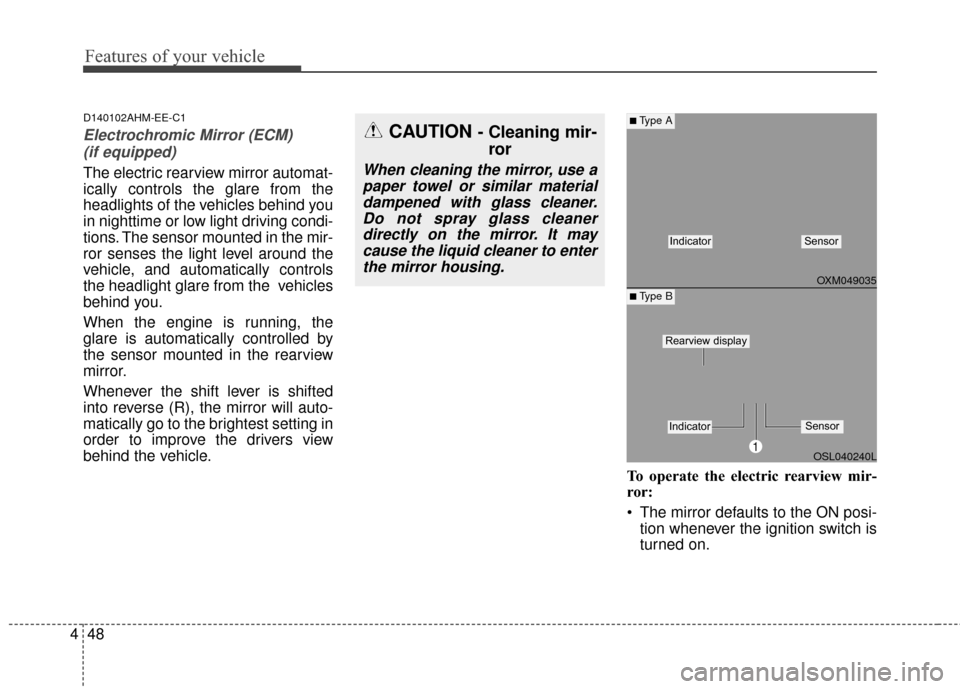
The electric rearview mirror automat-
ically controls the glare from the
headlights of the vehicles behind you
in nighttime or low light driving condi-
tions. The sensor mounted in the mir-
ror senses the light level around the
vehicle, and automatically controls
the headlight glare from the vehicles
behind you.
When the engine is running, the
glare is automatically controlled by
the sensor mounted in the rearview
mirror.
Whenever the shift lever is shifted
into reverse (R), the mirror will auto-
matically go to the brightest setting in
order to improve the drivers view
behind the vehicle.
To operate the electric rearview mir-
ror:
The mirror defaults to the ON posi-tion whenever the ignition switch is
turned on.
OXM049035
OSL040240L
■Type A
■ Type B
IndicatorSensor
1
IndicatorSensor
Rearview display
CAUTION - Cleaning mir-ror
When cleaning the mirror, use a
paper towel or similar materialdampened with glass cleaner.Do not spray glass cleanerdirectly on the mirror. It maycause the liquid cleaner to enterthe mirror housing.
Page 136 of 501
449
Features of your vehicle
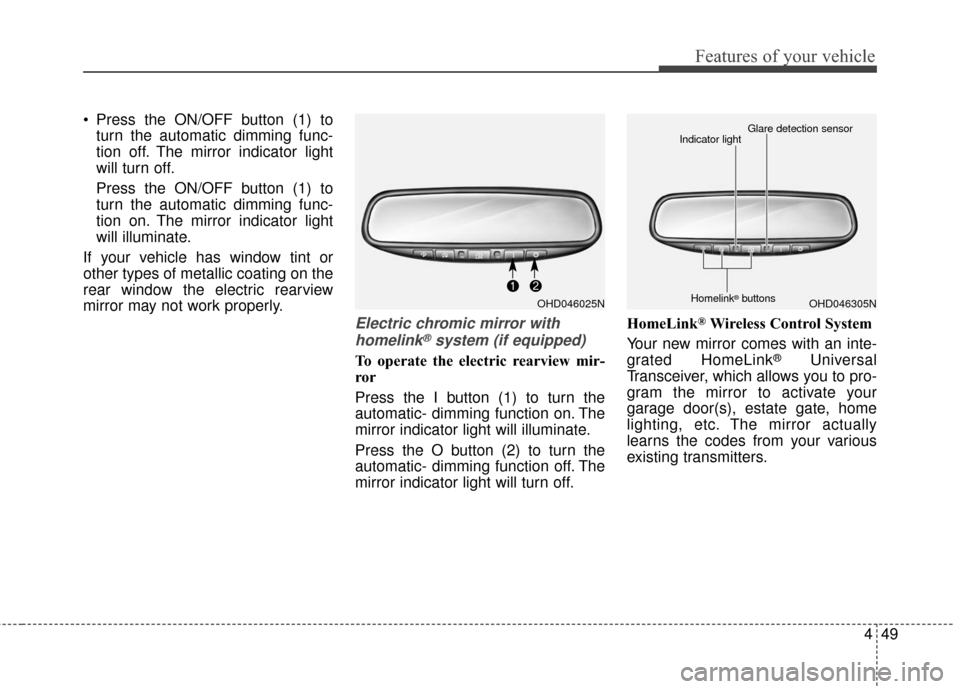
Press the ON/OFF button (1) toturn the automatic dimming func-
tion off. The mirror indicator light
will turn off.
Press the ON/OFF button (1) to
turn the automatic dimming func-
tion on. The mirror indicator light
will illuminate.
If your vehicle has window tint or
other types of metallic coating on the
rear window the electric rearview
mirror may not work properly.
Electric chromic mirror with homelink®system (if equipped)
To operate the electric rearview mir-
ror
Press the I button (1) to turn the
automatic- dimming function on. The
mirror indicator light will illuminate.
Press the O button (2) to turn the
automatic- dimming function off. The
mirror indicator light will turn off. HomeLink
®Wireless Control System
Your new mirror comes with an inte-
grated HomeLink
®Universal
Transceiver, which allows you to pro-
gram the mirror to activate your
garage door(s), estate gate, home
lighting, etc. The mirror actually
learns the codes from your various
existing transmitters.
OHD046025NOHD046305N
Glare detection sensor
Indicator light
Homelink®buttons
Page 166 of 501
479
Features of your vehicle
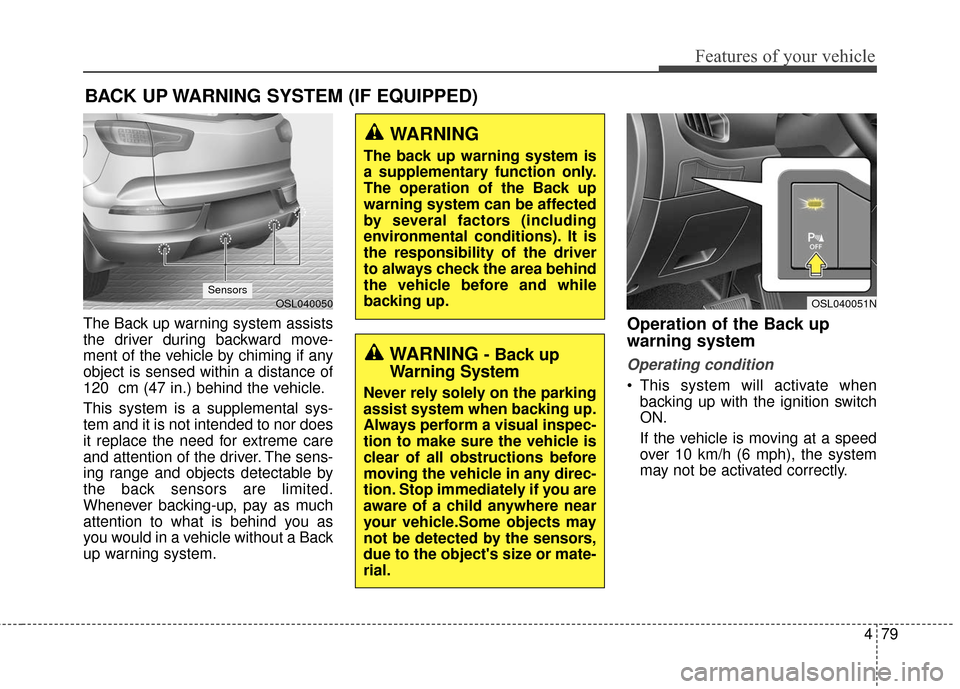
The Back up warning system assists
the driver during backward move-
ment of the vehicle by chiming if any
object is sensed within a distance of
120 cm (47 in.) behind the vehicle.
This system is a supplemental sys-
tem and it is not intended to nor does
it replace the need for extreme care
and attention of the driver. The sens-
ing range and objects detectable by
the back sensors are limited.
Whenever backing-up, pay as much
attention to what is behind you as
you would in a vehicle without a Back
up warning system.Operation of the Back up
warning system
Operating condition
This system will activate whenbacking up with the ignition switch
ON.
If the vehicle is moving at a speed
over 10 km/h (6 mph), the system
may not be activated correctly.
BACK UP WARNING SYSTEM (IF EQUIPPED)
WARNING
The back up warning system is
a supplementary function only.
The operation of the Back up
warning system can be affected
by several factors (including
environmental conditions). It is
the responsibility of the driver
to always check the area behind
the vehicle before and while
backing up.
OSL040051NOSL040050Sensors
WARNING- Back up
Warning System
Never rely solely on the parking
assist system when backing up.
Always perform a visual inspec-
tion to make sure the vehicle is
clear of all obstructions before
moving the vehicle in any direc-
tion. Stop immediately if you are
aware of a child anywhere near
your vehicle.Some objects may
not be detected by the sensors,
due to the object's size or mate-
rial.