Page 477 of 501
759
Maintenance
Waxing
Wax the vehicle when water will no
longer bead on the paint.
Always wash and dry the vehicle
before waxing. Use a good quality
liquid or paste wax, and follow the
manufacturer’s instructions. Wax all
metal trim to protect it and to main-
tain its luster.
Removing oil, tar, and similar materi-
als with a spot remover will usually
strip the wax from the finish. Be sure
to re-wax these areas even if the rest
of the vehicle does not yet need wax-
ing.
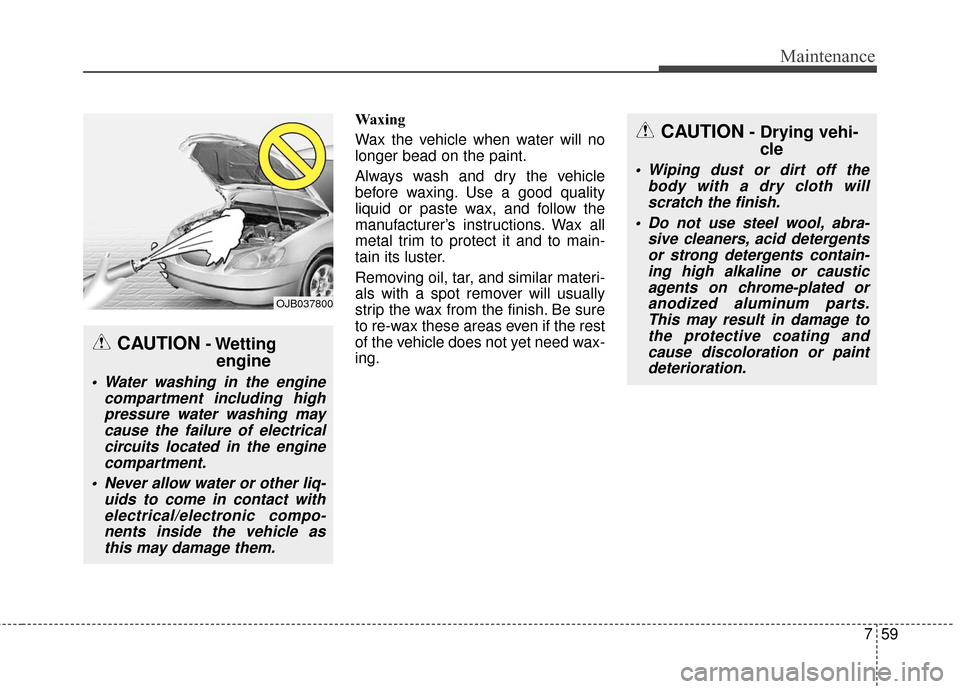
CAUTION- Wettingengine
Water washing in the engine
compartment including highpressure water washing maycause the failure of electricalcircuits located in the enginecompartment.
Never allow water or other liq- uids to come in contact withelectrical/electronic compo-nents inside the vehicle asthis may damage them.
CAUTION- Drying vehi- cle
Wiping dust or dirt off the
body with a dry cloth willscratch the finish.
Do not use steel wool, abra- sive cleaners, acid detergentsor strong detergents contain-ing high alkaline or causticagents on chrome-plated oranodized aluminum parts.This may result in damage tothe protective coating andcause discoloration or paintdeterioration.
OJB037800
Page 484 of 501
Maintenance
66
7
G270201AUN
Canister
Fuel vapors generated inside the fuel
tank are absorbed and stored in the
onboard canister. When the engine is
running, the fuel vapors absorbed in
the canister are drawn into the surge
tank through the purge control sole-
noid valve.
G270202AHM
Purge Control Solenoid Valve
(PCSV)
The purge control solenoid valve is
controlled by the Engine Control
Module (ECM); when the engine
coolant temperature is low during
idling, the PCSV closes so that evap-
orated fuel is not taken into the
engine. After the engine warms up
during ordinary driving, the PCSV
opens to introduce evaporated fuel to
the engine.
G270300AUN
3. Exhaust emission control system
The Exhaust Emission Control
System is a highly effective system
which controls exhaust emissions
while maintaining good vehicle per-
formance.
G270301AUN
Vehicle modifications
This vehicle should not be modified.
Modification of your vehicle could
affect its performance, safety or
durability and may even violate gov-
ernmental safety and emissions reg-
ulations.
In addition, damage or performance
problems resulting from any modifi-
cation may not be covered under
warranty.
If you use unauthorized electronic
devices, it may cause the vehicle to
operate abnormally, wire damage,
battery discharge or fire. For your
safety, do not use unauthorized
electronic devices.
G270302AUN-EU
Engine exhaust gas precautions
(carbon monoxide)
Carbon monoxide can be present with other exhaust fumes.
Therefore, if you smell exhaust
fumes of any kind inside your vehi-
cle, have it inspected and repaired
immediately. If you ever suspect
exhaust fumes are coming into
your vehicle, drive it only with all
the windows fully open. Have your
vehicle checked and repaired
immediately.
WARNING - Exhaust
Engine exhaust gases contain
carbon monoxide (CO). Though
colorless and odorless, it is
dangerous and could be lethal if
inhaled. Follow the instructions
on this page to avoid CO poi-
soning.
Page 485 of 501
767
Maintenance
Do not operate the engine in con-fined or closed areas (such as
garages) any more than what is
necessary to move the vehicle in or
out of the area.
When the vehicle is stopped in an open area for more than a short
time with the engine running,
adjust the ventilation system (as
needed) to draw outside air into the
vehicle.
Never sit in a parked or stopped vehicle for any extended time with
the engine running.
When the engine stalls or fails to start, excessive attempts to restart
the engine may cause damage to
the emission control system.G270303AAM
Operating precautions for catalyt-
ic converters (if equipped)
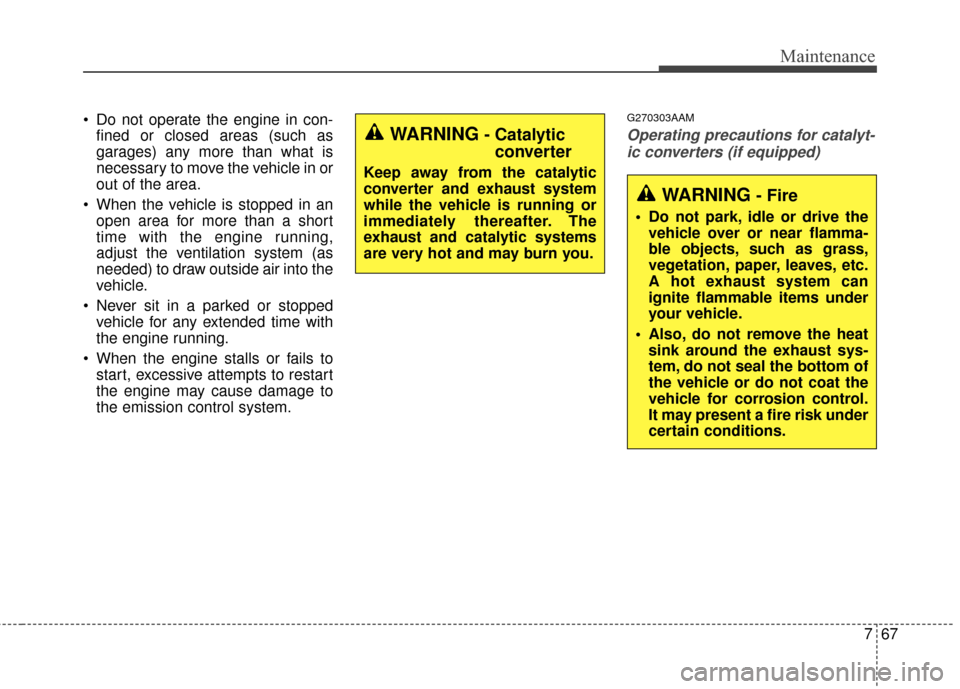
WARNING- Fire
Do not park, idle or drive the vehicle over or near flamma-
ble objects, such as grass,
vegetation, paper, leaves, etc.
A hot exhaust system can
ignite flammable items under
your vehicle.
Also, do not remove the heat sink around the exhaust sys-
tem, do not seal the bottom of
the vehicle or do not coat the
vehicle for corrosion control.
It may present a fire risk under
certain conditions.
WARNING- Catalytic converter
Keep away from the catalytic
converter and exhaust system
while the vehicle is running or
immediately thereafter. The
exhaust and catalytic systems
are very hot and may burn you.
Page 486 of 501
Maintenance
68
7
Your vehicle is equipped with a cat-
alytic converter emission control
device.
Therefore, the following precautions
must be observed:
Use only UNLEADED FUEL for
gasoline engines.
Do not operate the vehicle when there are signs of engine malfunc-
tion, such as misfire or a noticeable
loss of performance.
Do not misuse or abuse the engine. Examples of misuse are
coasting with the ignition off and
descending steep grades in gear
with the ignition off.
Do not operate the engine at high idle speed for extended periods (5
minutes or more).
Do not modify or tamper with any part of the engine or emission con-
trol system. All inspections and
adjustments must be made by an
authorized Kia dealer. Avoid driving with an extremely low
fuel level. Running out of fuel could
cause the engine to misfire, dam-
aging the catalytic converter.
Failure to observe these precautions
could result in damage to the catalyt-
ic converter and to your vehicle.
Additionally, such actions could void
your warranties.
Page 487 of 501
Specifications & Consumer information
Dimensions . . . . . . . . . . . . . . . . . . . . . . . . . . . . . . . . 8-2
Bulb wattage . . . . . . . . . . . . . . . . . . . . . . . . . . . . . . . 8-2
Tires and wheels . . . . . . . . . . . . . . . . . . . . . . . . . . . . 8-3
Recommended lubricants and capacities . . . . . . . 8-4
• Recommended SAE viscosity number. . . . . . . . . . . . . 8-6
Vehicle identification number (VIN) . . . . . . . . . . . 8-7
Vehicle certification label. . . . . . . . . . . . . . . . . . . . . 8-7
Tire specification and pressure label . . . . . . . . . . . 8-8
Engine number . . . . . . . . . . . . . . . . . . . . . . . . . . . . . 8-8
8
Page 490 of 501
RECOMMENDED LUBRICANTS AND CAPACITIES
8
These lubricants and fluids are recommended for use in your vehicle.
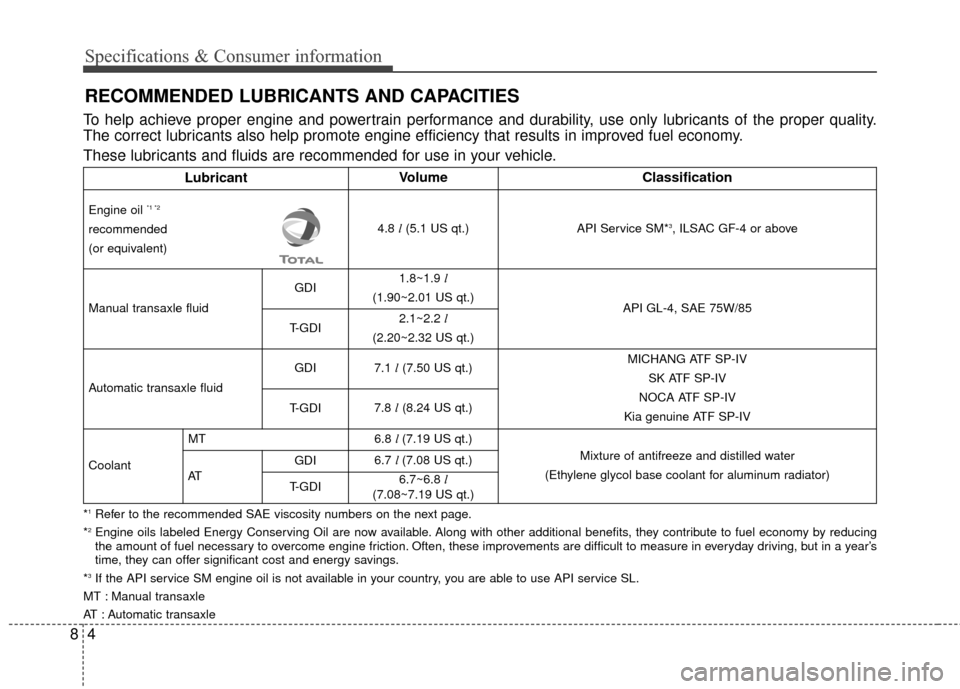
To help achieve proper engine and powertrain performance and durability, use only lubricants of the proper quality.
The correct lubricants also help promote engine efficiency that results in improved fuel economy.
*1Refer to the recommended SAE viscosity numbers on the next page.
*2Engine oils labeled Energy Conserving Oil are now available. Along with other additional benefits, they contribute to fuel economy by reducing
the amount of fuel necessary to overcome engine friction. Often, these improvements are difficult to measure in everyday driving, but in a year’s
time, they can offer significant cost and energy savings.
*
3If the API service SM engine oil is not available in your country, you are able to use API service SL.
MT : Manual transaxle
AT : Automatic transaxle
4
Specifications & Consumer information
LubricantVolumeClassification
Engine oil *1 *2
recommended
(or equivalent)4.8 l(5.1 US qt.)API Service SM*3, ILSAC GF-4 or above
Manual transaxle fluid
GDI1.8~1.9 l
(1.90~2.01 US qt.)
API GL-4, SAE 75W/85
T-GDI2.1~2.2 l
(2.20~2.32 US qt.)
Automatic transaxle fluid
GDI7.1 l(7.50 US qt.)MICHANG ATF SP-IV
SK ATF SP-IV
NOCA ATF SP-IV
Kia genuine ATF SP-IV
T-GDI7.8 l(8.24 US qt.)
Coolant
MT6.8 l (7.19 US qt.)
Mixture of antifreeze and distilled water
(Ethylene glycol base coolant for aluminum radiator)
AT
GDI6.7 l (7.08 US qt.)
T-GDI6.7~6.8 l
(7.08~7.19 US qt.)
Page 492 of 501
Temperature Range for SAE Viscosity Numbers
68
Specifications & Consumer information
I040000AAM-EU
Recommended SAE viscosity
number
Always be sure to clean the area
around any filler plug, drain plug, or
dipstick before checking or draining
any lubricant. This is especially
important in dusty or sandy areas
and when the vehicle is used on
unpaved roads. Cleaning the plug
and dipstick areas will prevent dirt
and grit from entering the engine and
other mechanisms that could be
damaged.
Engine oil viscosity (thickness) has
an effect on fuel economy and cold
weather operating (engine start and
engine oil flowability). Lower viscosi-
ty engine oils can provide better fuel
economy and cold weather perform-
ance, however, higher viscosity
engine oils are required for satisfac-
tory lubrication in hot weather. Using
oils of any viscosity other than those
recommended could result in engine
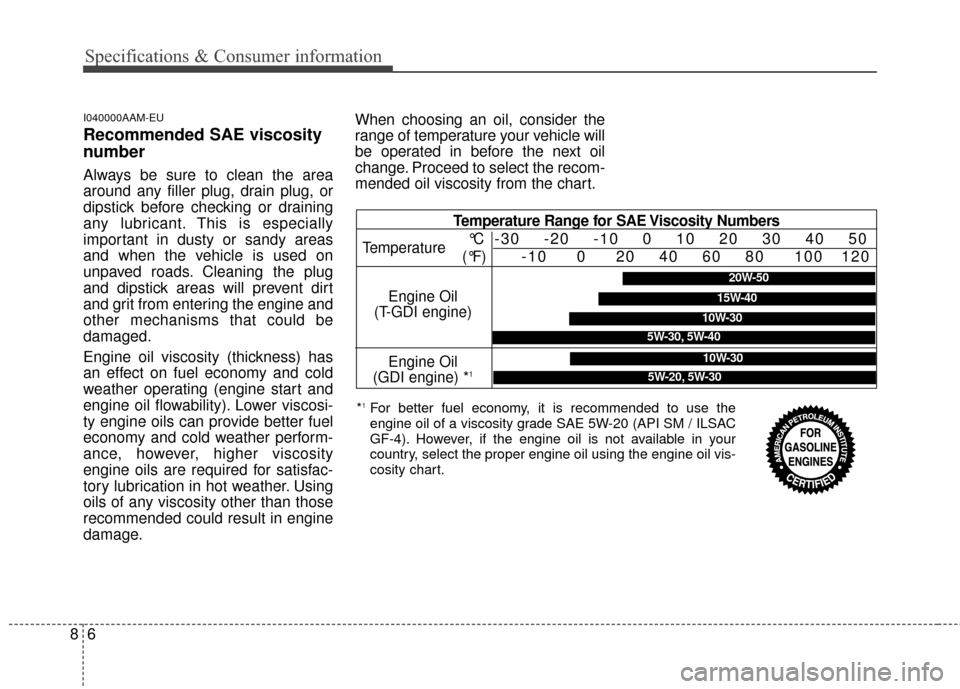
damage.When choosing an oil, consider the
range of temperature your vehicle will
be operated in before the next oil
change. Proceed to select the recom-
mended oil viscosity from the chart.
*1For better fuel economy, it is recommended to use the
engine oil of a viscosity grade SAE 5W-20 (API SM / ILSAC
GF-4). However, if the engine oil is not available in your
country, select the proper engine oil using the engine oil vis-
cosity chart.
Temperature
Engine Oil
(GDI engine) *
1
Engine Oil
(T-GDI engine) °C
(°F)
-30 -20 -10 0 10 20 30 40 50 -10 0 20 40 60 80 100 120
10W-30
5W-20, 5W-30
10W-30
5W-30, 5W-40
15W-40
20W-50
Page 494 of 501
H030000APB
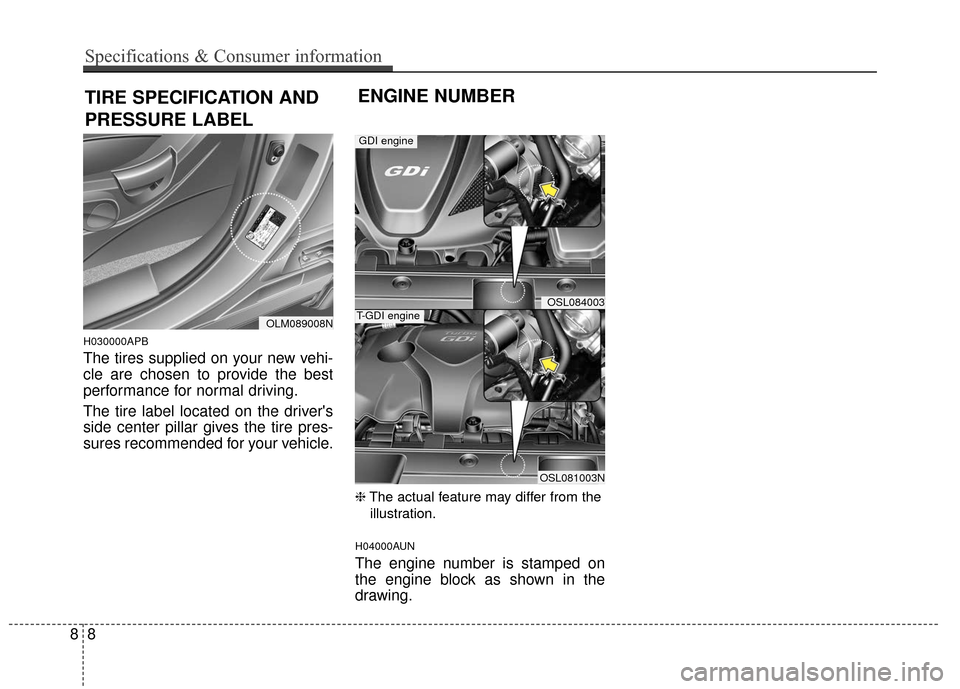
The tires supplied on your new vehi-
cle are chosen to provide the best
performance for normal driving.
The tire label located on the driver's
side center pillar gives the tire pres-
sures recommended for your vehicle.
❈The actual feature may differ from the
illustration.
H04000AUN
The engine number is stamped on
the engine block as shown in the
drawing.
ENGINE NUMBER
OLM089008N
TIRE SPECIFICATION AND
PRESSURE LABEL
OSL084003
OSL081003N
GDI engine
T-GDI engine
88
Specifications & Consumer information