2016 KIA Sorento tow
[x] Cancel search: towPage 439 of 565

What to do in an emergency
16
6
When using a compact spare tire,
observe the following precautions:
Under no circumstances should
you exceed 80 km/h (50 mph); a
higher speed could damage the
tire.
Ensure that you drive slowly enough for the road conditions to
avoid all hazards. Any road hazard,
such as a pothole or debris, could
seriously damage the compact
spare.
Any continuous road use of this tire could result in tire failure, loss of
vehicle control, and possible per-
sonal injury.
Do not exceed the vehicle’s maxi- mum load rating or the load-carry-
ing capacity shown on the sidewall
of the compact spare tire.
Avoid driving over obstacles. The compact spare tire diameter is
smaller than the diameter of a con-
ventional tire and reduces the
ground clearance approximately
25 mm (1 inch), which could result
in damage to the vehicle. Do not take this vehicle through an
automatic vehicle wash while the
compact spare tire is installed.
Do not use the compact spare tire on any other vehicle because this
tire has been designed especially
for your vehicle.
The compact spare tire’s tread life is shorter than a regular tire.
Inspect your compact spare tire
regularly and replace worn com-
pact spare tires with the same size
and design, mounted on the same
wheel.
The compact spare tire should not be used on any other wheels, nor
should standard tires, snow tires,
wheel covers or trim rings be used
with the compact spare wheel. If
such use is attempted, damage to
these items or other vehicle com-
ponents may occur. Do not use more than one compact
spare tire at a time.
Do not tow a trailer while the com- pact spare tire is installed.
UM CAN (ENG) 6.QXP 12/1/2014 1:09 PM Page 16
Page 441 of 565

What to do in an emergency
18
6
TOWING
Towing service
If emergency towing is necessary,
we recommend having it done by an
authorized Kia dealer or a commer-
cial tow-truck service. Proper lifting
and towing procedures are neces-
sary to prevent damage to the vehi-
cle. The use of wheel dollies or
flatbed is recommended.
For trailer towing guidelines informa-
tion, refer to “Trailer towing” in sec-tion 5.
On AWD vehicles, your vehicle must
be towed with a wheel lift and dollies
or flatbed equipment with all the
wheels off the ground.
On FWD vehicles, it is acceptable to
tow the vehicle with the rear wheels
on the ground (without dollies) and
the front wheels off the ground.
If any of the loaded wheels or sus-
pension components are damaged
or the vehicle is being towed with the
front wheels on the ground, use a
towing dolly under the front wheels.
When being towed by a commercial
tow truck and wheel dollies are not
used, the front of the vehicle should
always be lifted, not the rear.
OUM064022 dolly
dolly
WARNING - Side and
curtain Air bag
If your vehicle is equipped with
side and curtain air bag, set the
ignition switch to LOCK or ACC
position when the vehicle is
being towed.
The side and curtain air bag
may deploy when the ignition is
ON, and the rollover sensor
detects the situation as a
rollover.
CAUTION
The AWD vehicle should never be towed with the wheels on theground. This can cause seriousdamage to the transaxle or theAWD system.
UM CAN (ENG) 6.QXP 12/1/2014 1:09 PM Page 18
Page 442 of 565

619
What to do in an emergency
When towing your vehicle in an
emergency without wheel dollies :
1. Set the ignition switch in the ACCposition.
2. Place the transaxle shift lever in N (Neutral).
3. Release the parking brake.Removable towing hook
(if equipped)
1. Remove the towing hook from the tool case.
2. Remove the hole cover pressing the lower part of the cover on the
front bumper.
3. Install the towing hook by turning it clockwise into the hole until it is
fully secured.
4. Remove the towing hook and install the cover after use.
CAUTION - Towing
Do not tow the vehicle back-wards with the front wheels onthe ground as this may causedamage to the vehicle.
Do not tow with sling-type equipment. Use wheel lift orflatbed equipment.
CAUTION - Towing gear
position
Failure to place the transaxleshift lever in N (Neutral) maycause internal damage to thetransaxle.
OUM064013
OUM064012
OUM064016
UM CAN (ENG) 6.QXP 12/1/2014 1:09 PM Page 19
Page 443 of 565
What to do in an emergency
20
6
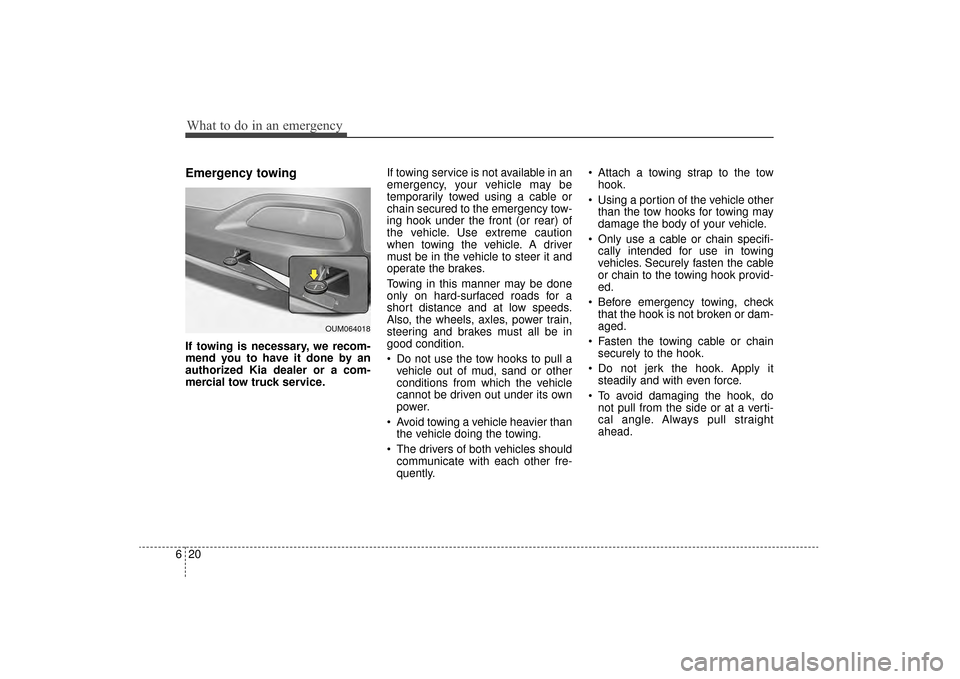
Emergency towing
If towing is necessary, we recom-
mend you to have it done by an
authorized Kia dealer or a com-
mercial tow truck service. If towing service is not available in an
emergency, your vehicle may be
temporarily towed using a cable or
chain secured to the emergency tow-
ing hook under the front (or rear) of
the vehicle. Use extreme caution
when towing the vehicle. A driver
must be in the vehicle to steer it and
operate the brakes.
Towing in this manner may be done
only on hard-surfaced roads for a
short distance and at low speeds.
Also, the wheels, axles, power train,
steering and brakes must all be in
good condition.
Do not use the tow hooks to pull a
vehicle out of mud, sand or other
conditions from which the vehicle
cannot be driven out under its own
power.
Avoid towing a vehicle heavier than the vehicle doing the towing.
The drivers of both vehicles should communicate with each other fre-
quently. Attach a towing strap to the tow
hook.
Using a portion of the vehicle other than the tow hooks for towing may
damage the body of your vehicle.
Only use a cable or chain specifi- cally intended for use in towing
vehicles. Securely fasten the cable
or chain to the towing hook provid-
ed.
Before emergency towing, check that the hook is not broken or dam-
aged.
Fasten the towing cable or chain securely to the hook.
Do not jerk the hook. Apply it steadily and with even force.
To avoid damaging the hook, do not pull from the side or at a verti-
cal angle. Always pull straight
ahead.
OUM064018
UM CAN (ENG) 6.QXP 12/1/2014 1:09 PM Page 20
Page 444 of 565

621
What to do in an emergency
Use a towing strap less than 5 m(16 feet) long. Attach a white or red
cloth (about 30 cm (12 inches)
wide) in the middle of the strap for
easy visibility.
Drive carefully so that the towing strap is not loose during towing.
Emergency towing precautions
Turn the ignition switch to ACC sothe steering wheel isn’t locked.
Place the transaxle shift lever in N (Neutral).
Release the parking bake.
Press the brake pedal with more force than usual since you will have
reduced brake performance.
More steering effort will be required because the power steer-
ing system will be disabled.
If you are driving down a long hill, the brakes may overheat and brake
performance will be reduced. Stop
often and let the brakes cool off.
If the car is being towed with all four wheels on the ground, it can
be towed only from the front. Be
sure that the transaxle is in neutral.
Be sure the steering is unlocked by
placing the ignition switch in the
ACC position. A driver must be in
the towed vehicle to operate the
steering and brakes.
OUM064014
CAUTION
To avoid serious damage to the automatic transaxle, limitthe vehicle speed to 15 km/h(10 mph) and drive less than1.5 km (1 mile) when towing.
Before towing, check the auto- matic transaxle for fluid leaksunder your vehicle. If the auto-matic transaxle fluid is leak-ing, a flatbed equipment ortowing dolly must be used.
UM CAN (ENG) 6.QXP 12/1/2014 1:09 PM Page 21
Page 472 of 565

Maintenance
28
7
SEVERE DRIVING CONDITIONS
A - Repeatedly driving short distance of less than 8 km (5 miles)
in normal temperature or less than 16 km (10 miles) in freez-
ing temperature
B - Extensive engine idling or low speed driving for long dis- tances
C - Driving on rough, dusty, muddy, unpaved, graveled or salt- spread roads
D - Driving in areas using salt or other corrosive materials or in very cold weather
E - Driving in sandy areas F - Driving in heavy traffic area over 32°C (90°F)
G- Driving on uphill, downhill, or mountain road
H - Towing a Trailer, or using a camper, or roof rack
I - Driving as a patrol car, taxi, other commercial use or vehicle
towing
J - Driving over 170 km/h (106 mph)
K - Frequently driving in stop-and-go conditions
MAINTENANCE ITEMMAINTENANCE OPERATIONMAINTENANCE INTERVALSDRIVING
CONDITION
STEERING GEAR BOX, LINKAGE &
BOOTS/LOWER ARM BALL JOINT, UPPER
ARM BALL JOINT
IMORE FREQUENTLYC, D, E, F, G, H, I
DRIVE SHAFTS AND BOOTSIEVERY 12,000 KM (7,500 MILES) OR 6 MONTHSC, D, E, F, G, H, I, J
TRANSFER CASE OIL (AWD) REVERY 120,000 KM (75,000 MILES)C, D, E, G, H, I, J
REAR AXLE OIL (AWD)REVERY 120,000 KM (75,000 MILES)C, D, E, G, H, I, J
CLIMATE CONTROL AIR FILTER
(FOR EVAPORATOR AND BLOWER UNIT)RMORE FREQUENTLYC, E
PROPELLER SHAFTIEVERY 12,000 KM (7,500 MILES) OR 6 MONTHSC, E
UM CAN (ENG) 7.qxp 12/1/2014 1:17 PM Page 28
Page 479 of 565

735
Maintenance
ENGINE COOLANT
The high-pressure cooling system
has a reservoir filled with year round
antifreeze coolant. The reservoir is
filled at the factory.
Check the antifreeze protection and
coolant level at least once a year: at
the beginning of the winter season,
and before traveling to a colder cli-
mate.Checking the coolant level Turn the engine off and wait until itcools down. Use extreme care
when removing the radiator cap.
Wrap a thick towel around it, and
turn it counterclockwise slowly to
the first stop. Step back while the
pressure is released from the cool-
ing system.
When you are sure all the pressure
has been released, press down on
the cap, using a thick towel, and
continue turning counterclockwise
to remove it.
Even if the engine is not operating, do not remove the radiator cap or
the drain plug while the engine and
radiator are hot. Hot coolant and
steam may still blow out under
pressure, causing serious injury.
WARNING
Removing radiator
cap
Never attempt to remove the
radiator cap while the engine is
operating or hot. Doing so
might lead to cooling system
and engine damage and could
result in serious personal injury
from escaping hot coolant or
steam.
UM CAN (ENG) 7.qxp 12/1/2014 1:17 PM Page 35
Page 564 of 565

I9
Index
Tire rotation . . . . . . . . . . . . . . . . . . . . . . . . . . . . . . . 7-52
Tire sidewall labeling . . . . . . . . . . . . . . . . . . . . . . . . 7-55
Tire traction . . . . . . . . . . . . . . . . . . . . . . . . . . . . . . . 7-55
Wheel alignment and tire balance . . . . . . . . . . . . . . 7-53
Wheel replacement . . . . . . . . . . . . . . . . . . . . . . . . . . 7-55
Towing . . . . . . . . . . . . . . . . . . . . . . . . . . . . . . . . . . . . \
. 6-18 Emergency towing . . . . . . . . . . . . . . . . . . . . . . . . . . 6-20
Removable towing hook. . . . . . . . . . . . . . . . . . . . . . 6-19
Towing service . . . . . . . . . . . . . . . . . . . . . . . . . . . . . 6-18
Trailer towing . . . . . . . . . . . . . . . . . . . . . . . . . . . . . . . . 5-98 Driving with a trailer . . . . . . . . . . . . . . . . . . . . . . . 5-100
Hitches . . . . . . . . . . . . . . . . . . . . . . . . . . . . . . . . . . . 5-\
99
If you do decide to pull a trailer . . . . . . . . . . . . . . 5-104
Maintenance when trailer towing. . . . . . . . . . . . . . 5-103
Safety chains . . . . . . . . . . . . . . . . . . . . . . . . . . . . . . 5-99
Trailer brakes . . . . . . . . . . . . . . . . . . . . . . . . . . . . . . 5-99
Trip modes (trip computer). . . . . . . . . . . . . . . . . . . . . . 4-79 A/V mode . . . . . . . . . . . . . . . . . . . . . . . . . . . . . . . . . 4-83
Digital speedometer . . . . . . . . . . . . . . . . . . . . . . . . . 4-82
Fuel Economy . . . . . . . . . . . . . . . . . . . . . . . . . . . . . 4-79
One time driving information mode . . . . . . . . . . . . 4-82
ASCC/LDWS mode . . . . . . . . . . . . . . . . . . . . . . . . . 4-83
Service mode . . . . . . . . . . . . . . . . . . . . . . . . . . . . . . 4-84
Trip A/B . . . . . . . . . . . . . . . . . . . . . . . . . . . . . . . . . . 4-81\
Trip Modes . . . . . . . . . . . . . . . . . . . . . . . . . . . . . . . . 4-79
Turn by turn mode . . . . . . . . . . . . . . . . . . . . . . . . . . 4-83
User settings mode . . . . . . . . . . . . . . . . . . . . . . . . . . 4-85
Warning messages . . . . . . . . . . . . . . . . . . . . . . . . . . 4-89 Vehicle break-in process . . . . . . . . . . . . . . . . . . . . . . . . . 1-5
Vehicle certification label . . . . . . . . . . . . . . . . . . . . . . . . 8-9
Vehicle data collection and event data recorders . . . . . . 1-6
Vehicle handling instructions . . . . . . . . . . . . . . . . . . . . . 1-5
Vehicle identification number (VIN) . . . . . . . . . . . . . . . 8-9
Vehicle load limit . . . . . . . . . . . . . . . . . . . . . . . . . . . . 5-106
Certification label . . . . . . . . . . . . . . . . . . . . . . . . . . 5-110
Tire and loading information label. . . . . . . . . . . . . 5-106
Vehicle weight glossary . . . . . . . . . . . . . . . . . . . . . . . 5-112 Base curb weight . . . . . . . . . . . . . . . . . . . . . . . . . . 5-112
Cargo weight . . . . . . . . . . . . . . . . . . . . . . . . . . . . . 5-112
GAW (Gross axle weight) . . . . . . . . . . . . . . . . . . . 5-112
GAWR (Gross axle weight rating) . . . . . . . . . . . . . 5-112
GVW (Gross vehicle weight). . . . . . . . . . . . . . . . . 5-112
GVWR (Gross vehicle weight rating) . . . . . . . . . . 5-112
Vehicle curb weight . . . . . . . . . . . . . . . . . . . . . . . . 5-112
Warning and indicator lights. . . . . . . . . . . . . . . . . . . . . 4-96 Indicator lights . . . . . . . . . . . . . . . . . . . . . . . . . . . . 4-104
Warning lights . . . . . . . . . . . . . . . . . . . . . . . . . . . . . 4-96
Washer fluid . . . . . . . . . . . . . . . . . . . . . . . . . . . . . . . . . 7-39 Checking the washer fluid level . . . . . . . . . . . . . . . . 7-39
Welcome system . . . . . . . . . . . . . . . . . . . . . . . . . . . . . 4-126 Headlight (headlamp) escort function . . . . . . . . . . 4-126V
W
UM CAN (ENG) INDEX.qxp 12/1/2014 11:55 AM Page 9