Page 53 of 449

Safety features of your vehicle
38
3
B240B05L
Passenger’s front air bag
A fully inflated air bag, in combination
with a properly worn seat belt, slows the
driver's or the passenger's forward
motion, reducing the risk of head and
chest injury.
After complete inflation, the air bag imme-
diately starts deflating, enabling the driv-
er to maintain forward visibility and the
ability to steer or operate other controls.
✽ ✽
NOTICE
Before you replace a fuse or disconnect
a battery terminal, turn the ignition
switch to the LOCK position and
remove the ignition key. Never remove
or replace the air bag related fuse(s)
when the ignition switch is in the ON
position. Failure to heed this warning
will cause the SRS air bag warning light
to illuminate.
B240B03L
Driver’s front air bag (3)
WARNING - Air bag
obstructions
Do not install or place any acces-
sories on the steering wheel,
instrument panel, or on the front
passenger's panel above the glove
box in a vehicle Such objects may
become dangerous projectiles if
the air bag deploys.
Page 56 of 449
341
Safety features of your vehicle
WARNING - ODS system
Riding in an improper position
adversely affects the occupant
detection system (ODS) and may
result in the deactivation of front
passenger airbag. It is important for
the driver to instruct the passenger
as to the proper seating instruc-
tions as contained in this manual.(Continued)
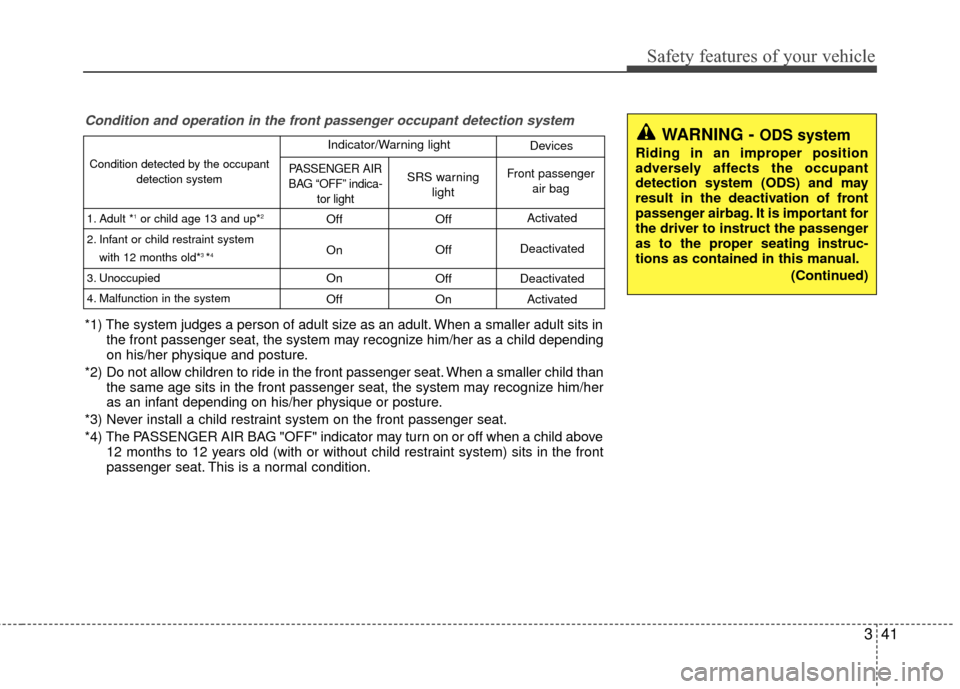
Condition and operation in the front passenger occupant detection system
*1) The system judges a person of adult size as an adult. When a smaller adult sits inthe front passenger seat, the system may recognize him/her as a child depending
on his/her physique and posture.
*2) Do not allow children to ride in the front passenger seat. When a smaller child than the same age sits in the front passenger seat, the system may recognize him/her
as an infant depending on his/her physique or posture.
*3) Never install a child restraint system on the front passenger seat.
*4) The PASSENGER AIR BAG "OFF" indicator may turn on or off when a child above 12 months to 12 years old (with or without child restraint system) sits in the front
passenger seat. This is a normal condition.
Condition detected by the occupant
detection system
1. Adult *
1or child age 13 and up*2
2. Infant or child restraint system with 12 months old*3 *4
3. Unoccupied
4. Malfunction in the system
Off
On
On
Off Off
Off
Off
On Activated
Deactivated
Deactivated Activated
PASSENGER AIR
BAG “OFF” indica- tor lightSRS warninglightFront passenger air bag
Indicator/Warning light Devices
Page 58 of 449

343
Safety features of your vehicle
When an adult is seated in the front pas-
senger seat, if the PASSENGER AIR
BAG “OFF” indicator is on, turn the igni-
tion switch to the LOCK position and ask
the passenger to sit properly (sitting
upright with the seat back in an upright
position, centered on the seat cushion
with their seat belt on, legs comfortably
extended and their feet on the floor).
Restart the engine and have the person
remain in that position. This will allow the
system to detect the person and to
enable the passenger air bag.If the PASSENGER AIR BAG “OFF” indi-
cator is still on, ask the passenger to
move to the rear seat.
✽ ✽
NOTICE
The PASSENGER AIR BAG “OFF”
indicator illuminates for about 4 sec-
onds after the ignition switch is turned
to the ON position or after the engine is
started. If the front passenger seat is
occupied, the occupant detection sensor
will then classify the front passenger
after several more seconds.
B990A01O
WARNING - “AIR BAG
OFF” light
Do not allow an adult passenger to
ride in the front seat when the PAS-
SENGER AIR BAG “OFF” indicator
is illuminated, because the air bag
will not deploy in the event of a
crash. The driver must instruct the
passenger to reposition himself in
the seat. Failure to properly posi-
tion yourself may lead to airbag
deactivation resulting in airbag
non-deployment and in a collision.
If the PASSENGER AIR BAG “OFF”
indicator remains illuminated after
the passenger repositions them-
selves properly and the car is
restarted, it is recommended that
passenger move to the rear seat
because the passenger's front air
bag will not deploy.
Page 60 of 449
345
Safety features of your vehicle
The indications of the system's presence
are the letters "AIR BAG" embossed on
the air bag pad cover in the steering
wheel and the passenger's side front
panel pad above the glove box.
The SRS consists of air bags installed
under the pad covers in the center of the
steering wheel and the passenger's side
front panel above the glove box.
The purpose of the SRS is to provide the
vehicle's driver and/or the front passen-
ger with additional protection than that
offered by the seat belt system alone in
case of a frontal impact of sufficient
severity. The SRS uses sensors to gather
information about the driver's seat posi-
tion, the driver's and front passenger's
seat belt usage and impact severity.The advanced SRS offers the ability to
control the air bag inflation with two lev-
els. A first stage level is provided for mod-
erate-severity impacts. A second stage
level is provided for more severe impacts.
The passenger’s front air bag is designed
to help reduce the injury of children sit-
ting close to the instrument panel in low
speed collisions. However, children are
safer if they are restraint in the rear seat.
According to the impact severity, seating
position and seat belt usage, the SRSCM
(SRS Control Module) controls the air
bag inflation. Failure to properly wear
seat belts can increase the risk or sever-
ity of injury in an accident.
Additionally, your vehicle is equipped
with an occupant detection system in the
front passenger's seat. The occupant
detection system detects the presence of
a passenger in the front passenger's seat
and will turn off the front passenger's air
bag under certain conditions. For more
detail, see "Occupant detection system"
in this section.
Do not place any objects that may cause
magnetic fields near the front seat. These
may cause a malfunction of the seat
track position sensor.
Page 63 of 449
Safety features of your vehicle
48
3
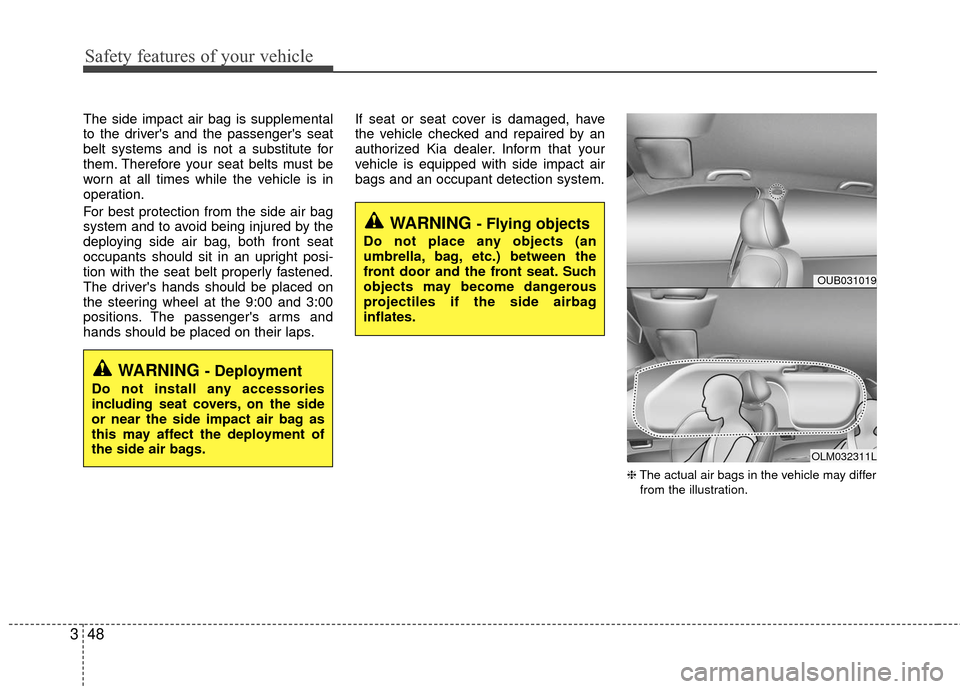
The side impact air bag is supplemental
to the driver's and the passenger's seat
belt systems and is not a substitute for
them. Therefore your seat belts must be
worn at all times while the vehicle is in
operation.
For best protection from the side air bag
system and to avoid being injured by the
deploying side air bag, both front seat
occupants should sit in an upright posi-
tion with the seat belt properly fastened.
The driver's hands should be placed on
the steering wheel at the 9:00 and 3:00
positions. The passenger's arms and
hands should be placed on their laps. If seat or seat cover is damaged, have
the vehicle checked and repaired by an
authorized Kia dealer. Inform that your
vehicle is equipped with side impact air
bags and an occupant detection system.
❈
The actual air bags in the vehicle may differ
from the illustration.
WARNING - Deployment
Do not install any accessories
including seat covers, on the side
or near the side impact air bag as
this may affect the deployment of
the side air bags.
WARNING - Flying objects
Do not place any objects (an
umbrella, bag, etc.) between the
front door and the front seat. Such
objects may become dangerous
projectiles if the side airbag
inflates.
OUB031019
OLM032311L
Page 65 of 449
Safety features of your vehicle
50
3
Why didn’t my air bag go off in a
collision? (Inflation and non-infla-
tion conditions of the air bag)
There are many types of accidents in
which the air bag would not be expect-
ed to provide additional protection.
These include rear impacts, second or
third collisions in multiple impact
accidents, as well as low speed
impacts.
Air bag collision sensors
(1) SRS control module
(2) Front impact sensor (3) Side impact sensor
1233
OUB035031N/OUB031032/OUB035040N/OUB031033/OUB031047N
Page 74 of 449
43
Features of your vehicle
Record your key number
The key code number
is stamped on the key
code tag attached to
the key set. Should
you lose your keys,
this number will enable an authorized Kia
dealer to duplicate the keys easily.
Remove the key code tag and store it in
a safe place. Also, record the key code
number and keep it in a safe and handy
place, but not in the vehicle.
Key operations
Type A
Used to start the engine, lock and unlock
the doors.
Type B
To unfold the key, press the release but-
ton then the key will unfold automatically.
To fold the key, fold the key manually
while pressing the release button.
KEYS
■Type A
OTF044369
■Type B
OFD047002-A/OED036001A
CAUTION - Key button operation
Do not fold the key without press-
ing the release button. This may damage the key.
Page 77 of 449

Features of your vehicle
64
Even though you press the button, the
doors will not lock and the chime will
sound for 3 seconds if any of the follow-
ing occurs:
The smart key is in the vehicle.
The ignition switch is in the ACC or ONposition.
Any door except the trunk (or tailgate) is opened.Unlocking
Pressing the button of the driver's out-
side door handle with all doors closed
and locked, unlocks the driver's door. The
hazard warning lights will blink and the
chime will sound twice to indicate that the
driver's door is unlocked. All doors are
unlocked if the button is pressed once
more within 4 seconds. The hazard warn-
ing lights will blink and the chime will
sound twice to indicate that all the doors
are unlocked.
Pressing the button in the front passen-
ger's outside door handle with all doors
closed and locked, unlocks all the doors.
The hazard warning lights will blink and
the chime will sound twice to indicate that
all doors are unlocked. The button will
only operate when the smart key is with-
in 0.7~1 m (28~40 in.) from the outside
door handle.
Trunk unlocking (4 door)
The trunk is opened if the trunk unlock
button is pressed.
Once the trunk is opened and then
closed, the trunk will lock automatically.
If the trunk is closed with the smart key in
the trunk, the warning chime will sound
for about 5 seconds and the trunk will not
lock.
Tailgate unlocking (5 door) (if equipped)
If you are within 0.7 m (28 in.) from the
outside tailgate handle, with your smart
key in possession, the tailgate will unlock
and open when you press the tailgate
handle switch.
The hazard warning lights will blink twice
to indicate that the tailgate is unlocked.
Also, once the tailgate is opened and
then closed, the tailgate will lock auto-
matically.
Start-up
You can start the engine without inserting
the key. For detailed information refer to
“Starting the engine with a smart key” in
section 5.

