2016 KIA Rio Position light
[x] Cancel search: Position lightPage 54 of 449
339
Safety features of your vehicle
Occupant detection system
Your vehicle is equipped with an occu-
pant detection system in the front pas-
senger's seat.
The occupant detection system is
designed to detect the presence of a
properly-seated front passenger and
determine if the passenger's front air bag
should be enabled (may inflate) or not.
The driver's front air bag is not affected
or controlled by the occupant detection
system.
Main components of occupant detec-tion system
A detection device located within the front passenger seat track.
Electronic system to determine whether passenger air bag systems
should be activated or deactivated.
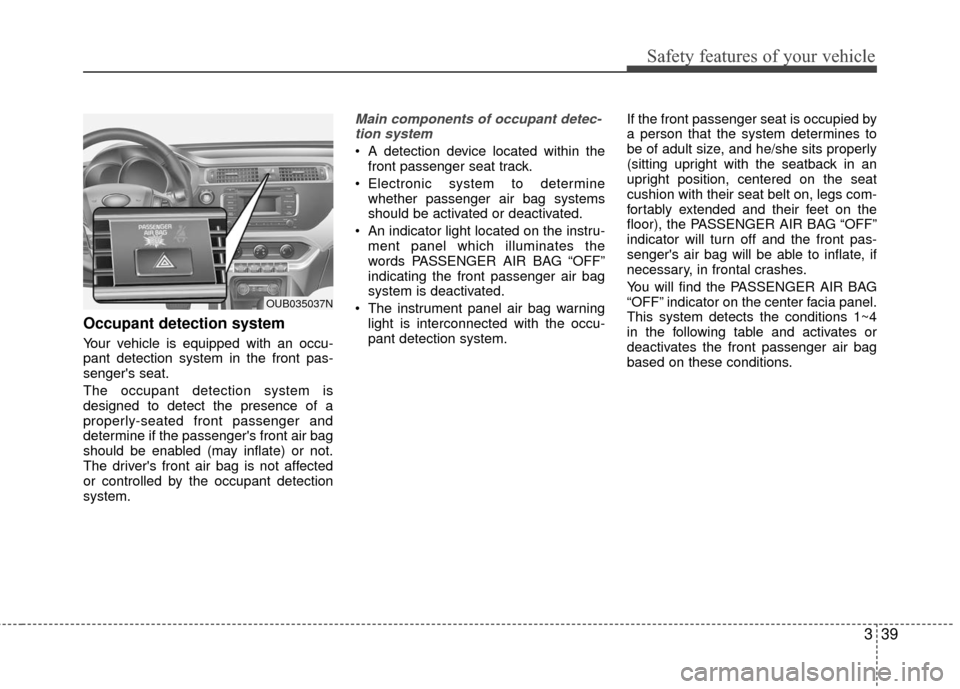
An indicator light located on the instru- ment panel which illuminates the
words PASSENGER AIR BAG “OFF”
indicating the front passenger air bag
system is deactivated.
The instrument panel air bag warning light is interconnected with the occu-
pant detection system. If the front passenger seat is occupied by
a person that the system determines to
be of adult size, and he/she sits properly
(sitting upright with the seatback in an
upright position, centered on the seat
cushion with their seat belt on, legs com-
fortably extended and their feet on the
floor), the PASSENGER AIR BAG “OFF”
indicator will turn off and the front pas-
senger's air bag will be able to inflate, if
necessary, in frontal crashes.
You will find the PASSENGER AIR BAG
“OFF” indicator on the center facia panel.
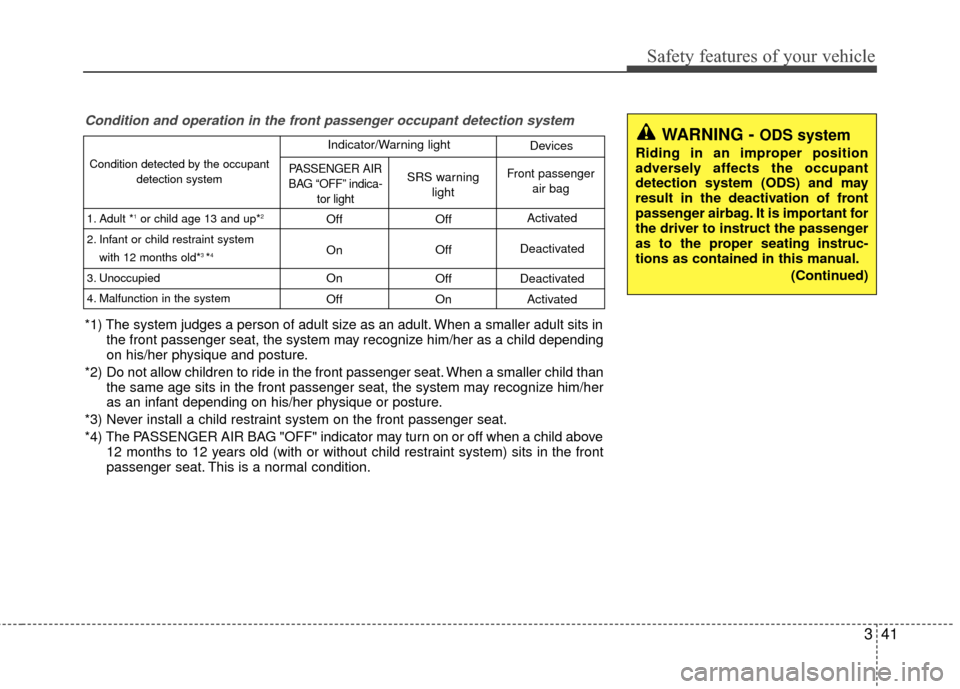
This system detects the conditions 1~4
in the following table and activates or
deactivates the front passenger air bag
based on these conditions.
OUB035037N
Page 56 of 449
341
Safety features of your vehicle
WARNING - ODS system
Riding in an improper position
adversely affects the occupant
detection system (ODS) and may
result in the deactivation of front
passenger airbag. It is important for
the driver to instruct the passenger
as to the proper seating instruc-
tions as contained in this manual.(Continued)
Condition and operation in the front passenger occupant detection system
*1) The system judges a person of adult size as an adult. When a smaller adult sits inthe front passenger seat, the system may recognize him/her as a child depending
on his/her physique and posture.
*2) Do not allow children to ride in the front passenger seat. When a smaller child than the same age sits in the front passenger seat, the system may recognize him/her
as an infant depending on his/her physique or posture.
*3) Never install a child restraint system on the front passenger seat.
*4) The PASSENGER AIR BAG "OFF" indicator may turn on or off when a child above 12 months to 12 years old (with or without child restraint system) sits in the front
passenger seat. This is a normal condition.
Condition detected by the occupant
detection system
1. Adult *
1or child age 13 and up*2
2. Infant or child restraint system with 12 months old*3 *4
3. Unoccupied
4. Malfunction in the system
Off
On
On
Off Off
Off
Off
On Activated
Deactivated
Deactivated Activated
PASSENGER AIR
BAG “OFF” indica- tor lightSRS warninglightFront passenger air bag
Indicator/Warning light Devices
Page 58 of 449

343
Safety features of your vehicle
When an adult is seated in the front pas-
senger seat, if the PASSENGER AIR
BAG “OFF” indicator is on, turn the igni-
tion switch to the LOCK position and ask
the passenger to sit properly (sitting
upright with the seat back in an upright
position, centered on the seat cushion
with their seat belt on, legs comfortably
extended and their feet on the floor).
Restart the engine and have the person
remain in that position. This will allow the
system to detect the person and to
enable the passenger air bag.If the PASSENGER AIR BAG “OFF” indi-
cator is still on, ask the passenger to
move to the rear seat.
✽ ✽
NOTICE
The PASSENGER AIR BAG “OFF”
indicator illuminates for about 4 sec-
onds after the ignition switch is turned
to the ON position or after the engine is
started. If the front passenger seat is
occupied, the occupant detection sensor
will then classify the front passenger
after several more seconds.
B990A01O
WARNING - “AIR BAG
OFF” light
Do not allow an adult passenger to
ride in the front seat when the PAS-
SENGER AIR BAG “OFF” indicator
is illuminated, because the air bag
will not deploy in the event of a
crash. The driver must instruct the
passenger to reposition himself in
the seat. Failure to properly posi-
tion yourself may lead to airbag
deactivation resulting in airbag
non-deployment and in a collision.
If the PASSENGER AIR BAG “OFF”
indicator remains illuminated after
the passenger repositions them-
selves properly and the car is
restarted, it is recommended that
passenger move to the rear seat
because the passenger's front air
bag will not deploy.
Page 59 of 449
Safety features of your vehicle
44
3
Any child age 12 and under should ride
in the rear seat. Children too large for
child restraints should use the available
lap/shoulder belts. No matter what type
of crash, children of all ages are safer
when restrained in the rear seat.
✽ ✽
NOTICE
Do not modify or replace the front pas-
senger seat. Don't place anything on or
attach anything such as a blanket, front
seat covers or after market seat heater
to the front passenger seat. This can
adversely affect the occupant detection
system.
If the occupant detection system is not
working properly, the SRS air bag warn-
ing light on the instrument panel will
illuminate because the passenger's front
air bag is connected with the occupant
detection system. If there is a malfunc-
tion of the occupant detection system,
the PASSENGER AIR BAG “OFF” indica-
tor will not illuminate and the passenger's
front air bag will inflate in frontal impact
crashes even if there is no occupant in
the front passenger's seat.
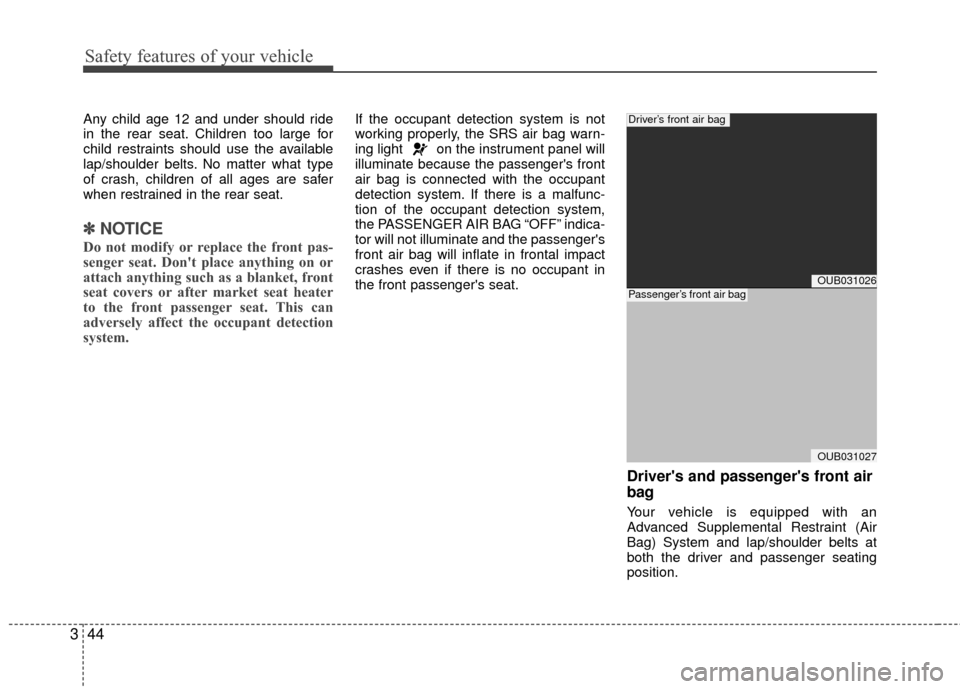
Driver's and passenger's front air
bag
Your vehicle is equipped with an
Advanced Supplemental Restraint (Air
Bag) System and lap/shoulder belts at
both the driver and passenger seating
position.
OUB031026
OUB031027
Driver’s front air bag
Passenger’s front air bag
Page 77 of 449

Features of your vehicle
64
Even though you press the button, the
doors will not lock and the chime will
sound for 3 seconds if any of the follow-
ing occurs:
The smart key is in the vehicle.
The ignition switch is in the ACC or ONposition.
Any door except the trunk (or tailgate) is opened.Unlocking
Pressing the button of the driver's out-
side door handle with all doors closed
and locked, unlocks the driver's door. The
hazard warning lights will blink and the
chime will sound twice to indicate that the
driver's door is unlocked. All doors are
unlocked if the button is pressed once
more within 4 seconds. The hazard warn-
ing lights will blink and the chime will
sound twice to indicate that all the doors
are unlocked.
Pressing the button in the front passen-
ger's outside door handle with all doors
closed and locked, unlocks all the doors.
The hazard warning lights will blink and
the chime will sound twice to indicate that
all doors are unlocked. The button will
only operate when the smart key is with-
in 0.7~1 m (28~40 in.) from the outside
door handle.
Trunk unlocking (4 door)
The trunk is opened if the trunk unlock
button is pressed.
Once the trunk is opened and then
closed, the trunk will lock automatically.
If the trunk is closed with the smart key in
the trunk, the warning chime will sound
for about 5 seconds and the trunk will not
lock.
Tailgate unlocking (5 door) (if equipped)
If you are within 0.7 m (28 in.) from the
outside tailgate handle, with your smart
key in possession, the tailgate will unlock
and open when you press the tailgate
handle switch.
The hazard warning lights will blink twice
to indicate that the tailgate is unlocked.
Also, once the tailgate is opened and
then closed, the tailgate will lock auto-
matically.
Start-up
You can start the engine without inserting
the key. For detailed information refer to
“Starting the engine with a smart key” in
section 5.
Page 81 of 449
Features of your vehicle
10
4
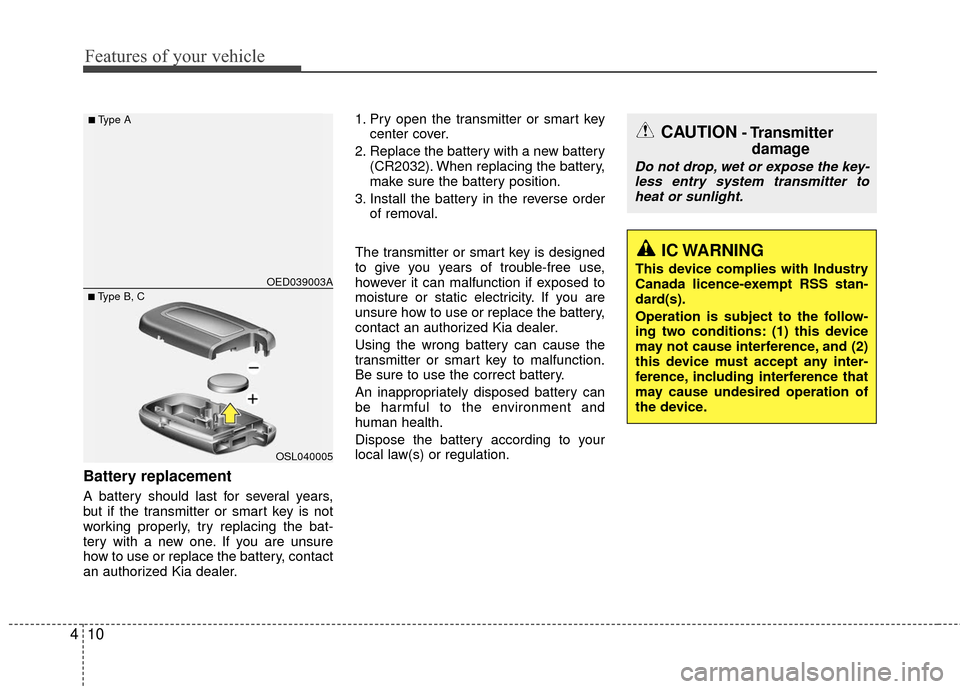
Battery replacement
A battery should last for several years,
but if the transmitter or smart key is not
working properly, try replacing the bat-
tery with a new one. If you are unsure
how to use or replace the battery, contact
an authorized Kia dealer. 1. Pry open the transmitter or smart key
center cover.
2. Replace the battery with a new battery (CR2032). When replacing the battery,
make sure the battery position.
3. Install the battery in the reverse order of removal.
The transmitter or smart key is designed
to give you years of trouble-free use,
however it can malfunction if exposed to
moisture or static electricity. If you are
unsure how to use or replace the battery,
contact an authorized Kia dealer.
Using the wrong battery can cause the
transmitter or smart key to malfunction.
Be sure to use the correct battery.
An inappropriately disposed battery can
be harmful to the environment and
human health.
Dispose the battery according to your
local law(s) or regulation.
CAUTION- Transmitter damage
Do not drop, wet or expose the key-
less entry system transmitter to heat or sunlight.
■Type B, C OED039003A
■Type A
OSL040005
IC WARNING
This device complies with Industry
Canada licence-exempt RSS stan-
dard(s).
Operation is subject to the follow-
ing two conditions: (1) this device
may not cause interference, and (2)
this device must accept any inter-
ference, including interference that
may cause undesired operation of
the device.
Page 96 of 449
425
Features of your vehicle
Power windows
The ignition switch must be in the ON
position for power windows to operate.
Each door has a power window switch
that controls the door’s window. The driv-
er has a power window lock switch which
can block the operation of passenger
windows.
The power windows can be operated for
approximately 30 seconds after the igni-
tion key is removed or turned to the ACC
or LOCK position. However, if the front
doors are opened, the power windows
cannot be operated even within the 30
second period.
In cold and wet climates, power windows
may not work properly due to freezing
conditions.
✽ ✽NOTICE
While driving with the rear windows
down or with the sunroof (if equipped)
in an open (or partially open) position,
your vehicle may demonstrate a wind
buffeting or pulsation noise. This noise
is a normal occurrence and can be
reduced or eliminated by taking the fol-
lowing actions. If the noise occurs with
one or both of the rear windows down,
partially lower both front windows
approximately one inch. If you experi-
ence the noise with the sunroof open,
slightly reduce the size of the sunroof
opening.
Window opening and closing
(if equipped)
The driver’s door has a master power
window switch that controls all the win-
dows in the vehicle.
To open or close a window, press down
or pull up the front portion of the corre-
sponding switch to the first detent posi-
tion (5).
Auto down window (if equipped) (Driver’s window)
Pressing the power window switch
momentarily to the second detent posi-
tion (6) completely lowers the driver’s
window even when the switch is
released. To stop the window at the
desired position while the window is in
operation, momentarily pull up the switch
to the opposite direction of the window
movement.
Page 99 of 449

Features of your vehicle
28
4
Opening the hood
1. Pull the release lever to unlatch the
hood. The hood should pop open
slightly.
Open the hood after turning off the
engine on a flat surface, shifting the shift
lever to the P(Park) position for automat-
ic transaxle and to the 1st(First) gear or
R(Reverse) for manual transaxle, and
setting the parking brake. 2. Go to the front of the vehicle, raise the
hood slightly, push the secondary latch
(1) inside of the hood center and lift
the hood (2). 3. Pull out the support rod from the hood.
4. Hold the hood opened with the support
rod.
HOOD
WARNING- Hot parts
Grasp the support rod in the area
wrapped in rubber. The plastic will
help prevent you from being burned
by hot metal when the engine is
hot.
OUB041021OUB045022LOUB041023