2016 KIA RIO HATCHBACK oil pressure
[x] Cancel search: oil pressurePage 378 of 477

Maintenance
28
7
150,000 miles or 120 months
❑ Inspect air conditioning compressor, air conditioner refrigerant and
performance (if equipped)
❑ Inspect cooling system *1
❑Inspect drive belt *4
(First 60,000 miles or 72 months after
every 15,000 miles or 24 months)
❑ Inspect drive shaft and boots
❑ Inspect fuel filter *2
❑Inspect fuel line, hoses and connection
❑Inspect fuel tank air filter *2
❑Inspect manual transaxle fluid (if equipped)
(Every 37,500 miles (60,000 km) or 48 months)
❑ Inspect vapor hose and fuel filler cap
❑Inspect visually the following items
1) Battery condition
2) Brake fluid / clutch (if equipped) fluid
3) Brake lines, hoses and connections
4) Brake pedal and operation
5) Chassis/body nuts and bolts
6) Drum brake and linings (if equipped)
7) Disc brakes and pads (if equipped)
8) Exhaust pipe and muffler
9) Front suspension ball joints
(Continued)
(Continued)
10) Fuel tank, cap, lines and hoses
11) Lubricate all locks and hinges
12) Parking brakes
13) Steering operation and linkage
14) Suspension mounting bolts
❑ Replace air cleaner filter
❑Replace climate control air filter (if equipped)
❑Replace engine coolant *5
(First 120,000 miles or 120 months
after every 30,000 miles or 24 months)
❑ Replace engine oil and filter
❑Add fuel additive *A
❑Rotate tires - including tire pressure and tread wear
NORMAL MAINTENANCE SCHEDULE (CONT.)
*1lnspect "Water Pump" when replacing the drive belt or timing belt.
*2Fuel filter & Fuel tank air filter are considered to be maintenance free\
but peri-
odic inspection is recommended for this maintenance schedule depends on
fuel quality. If there are some important safety matters like fuel flow restriction,
surging, loss of power, hard starting problem etc, replace the fuel filter imme-
diately regardless of maintenance schedule and consult an authorized Kia
dealer for details.
*
4The drive belt should be replaced when cracks occur or tension is reduced excessively.
*
5When replacing coolant, use only a qualified coolant additive for your vehicle and never mix hard water in the coolant filled at the factory.
An improper coolant mixture can result in serious malfunction or engine damage.
*
AIf TOP TIER Detergent Gasoline is not available, one bottle of additive is rec-
ommended. Additives are available from your authorized Kia dealer along with
information on how to use them. Do not mix other additives.
❈ Inspect : Inspect and if necessary, adjust, correct, clean or replace.
Page 386 of 477

Maintenance
36
7
ENGINE COOLANT
Changing the engine oil and
filter
Have engine oil and filter changed by
an authorized Kia dealer according
to the Maintenance Schedule at the
beginning of this section. The high-pressure cooling system
has a reservoir filled with year-round
antifreeze coolant. The reservoir is
filled at the factory.
Check the antifreeze protection and
coolant level at least once a year, at
the beginning of the winter season,
and before traveling to a colder cli-
mate.
Checking the coolant level
Check the condition and connections
of all cooling system hoses and
heater hoses. Replace any swollen
or deteriorated hoses.
The coolant level should be filled
between F (MAX) and L (MIN) marks
on the side of the coolant reservoir
when the engine is cool.
WARNING - California
proposition 65
Engine oil contains chemicals
known to the State of California
to cause cancer, birth defects
and reproductive harm. Used
engine oil may cause irritation
or cancer of the skin if left in
contact with the skin for pro-
longed periods of time. Always
protect your skin by washing
your hands thoroughly with
soap and warm water as soon
as possible after handling used
oil.WARNING - Cooling fan
Use caution when
working near the
blade of the cooling
fan. The electric
motor (cooling fan) is
controlled by engine coolant
temperature, refrigerant pres-
sure and vehicle speed. It may
sometimes operate even when
the engine is not running.
OAM072005
Page 410 of 477

Maintenance
60
7
Temperature -A, B & C
The temperature grades are A (the
highest), B and C representing the
tire’s resistance to the generation of
heat and its ability to dissipate heat
when tested under controlled condi-
tions on a specified indoor laboratory
test wheel.
Sustained high temperature can
cause the material of the tire to
degenerate and reduce tire life, and
excessive temperature can lead to
sudden tire failure. The grade C cor-
responds to a level of performance
which all passenger car tires must
meet under the Federal Motor
Vehicle Safety Standard No. 109.
Grades B and A represent higher
levels of performance on the labora-
tory test wheel than the minimum
required by law. Tire terminology and definitions
Air Pressure:
The amount of air
inside the tire pressing outward on
the tire. Air pressure is expressed in
pounds per square inch (psi) or kilo-
pascal (kPa).
Accessory Weight : This means the
combined weight of optional acces-
sories. Some examples of optional
accessories are, automatic
transaxle, power seats, and air con-
ditioning.
Aspect Ratio : The relationship of a
tire's height to its width.
Belt: A rubber coated layer of cords
that is located between the plies and
the tread. Cords may be made from
steel or other reinforcing materials.
Bead: The tire bead contains steel
wires wrapped by steel cords that
hold the tire onto the rim.
Bias Ply Tire : A pneumatic tire in
which the plies are laid at alternate
angles less than 90 degrees to the
centerline of the tread. Cold Tire Pressure: The amount of
air pressure in a tire, measured in
pounds per square inch (psi) or kilo-
pascals (kPa) before a tire has built
up heat from driving.
Curb Weight: This means the weight
of a motor vehicle with standard and
optional equipment including the
maximum capacity of fuel, oil and
coolant, but without passengers and
cargo.
DOT Markings: A code molded into
the sidewall of a tire signifying that
the tire is in compliance with the U.S.
Department of Transportation motor
vehicle safety standards. The DOT
code includes the Tire Identification
Number (TIN), an alphanumeric des-
ignator which can also identify the
tire manufacturer, production plant,
brand and date of production.
GVWR: Gross Vehicle Weight Rating
GAWR FRT: Gross Axle Weight
Rating for the Front Axle.
GAWR RR: Gross Axle Weight
Rating for the Rear axle.
Page 442 of 477
Maintenance
92
7
Waxing
Wax the vehicle when water will no
longer bead on the paint.
Always wash and dry the vehicle
before waxing. Use a good quality
liquid or paste wax, and follow the
manufacturer’s instructions. Wax all
metal trim to protect it and to main-
tain its luster.
Removing oil, tar, and similar materi-
als with a spot remover will usually
strip the wax from the finish. Be sure
to re-wax these areas even if the rest
of the vehicle does not yet need wax-
ing.
CAUTION - Wetting
engine
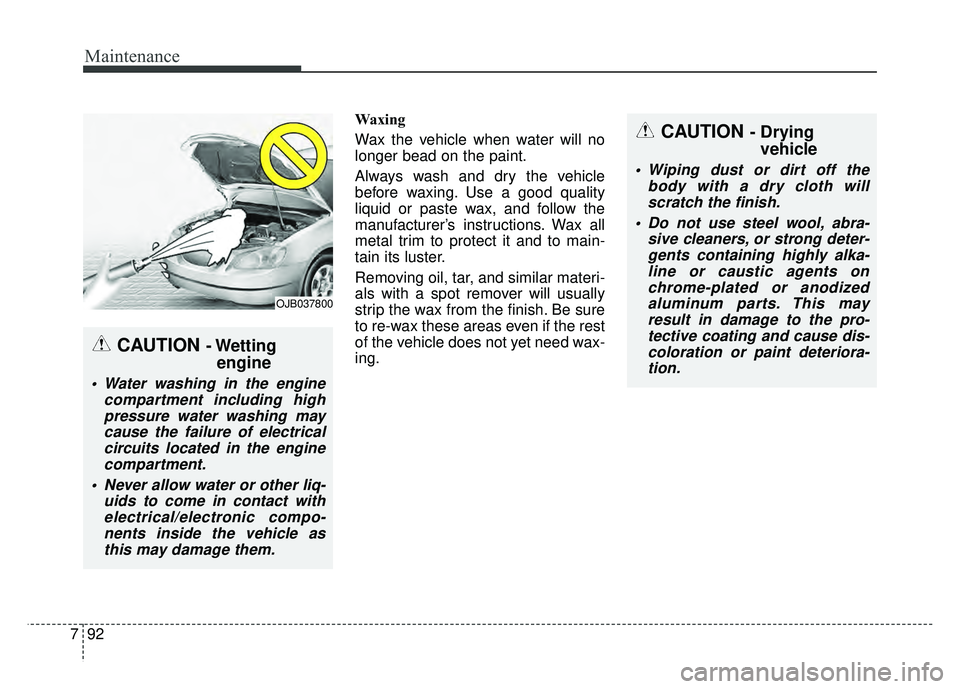
Water washing in the engine
compartment including highpressure water washing maycause the failure of electricalcircuits located in the enginecompartment.
Never allow water or other liq- uids to come in contact withelectrical/electronic compo-nents inside the vehicle asthis may damage them.
OJB037800
CAUTION - Drying vehicle
Wiping dust or dirt off the
body with a dry cloth willscratch the finish.
Do not use steel wool, abra- sive cleaners, or strong deter-gents containing highly alka-line or caustic agents onchrome-plated or anodizedaluminum parts. This mayresult in damage to the pro-tective coating and cause dis-coloration or paint deteriora-tion.
Page 461 of 477
Specifications, Consumer information, Reporting safety defects
10
8
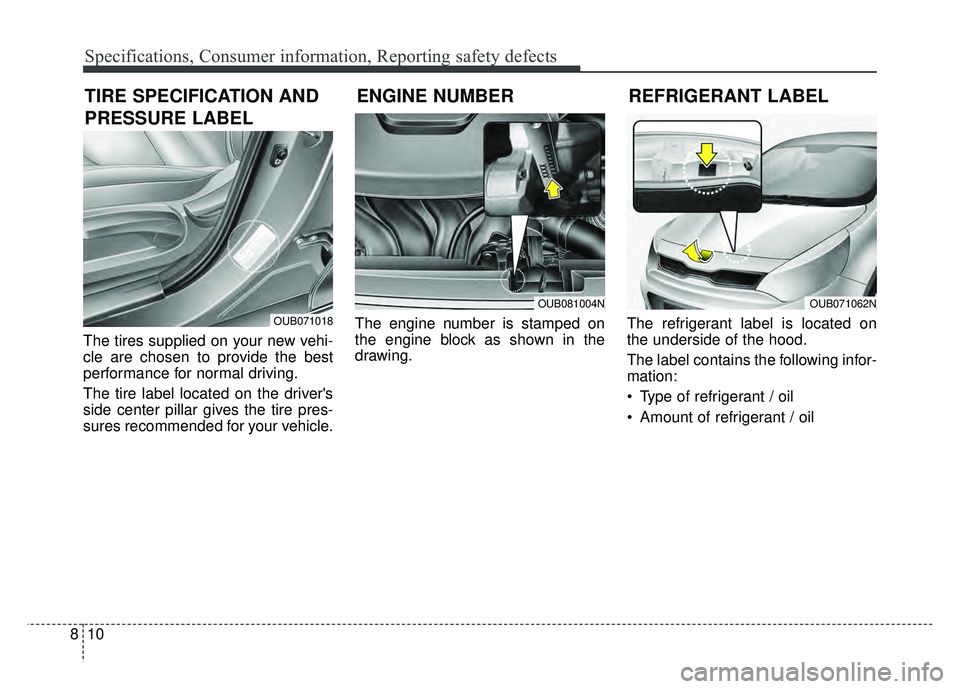
The tires supplied on your new vehi-
cle are chosen to provide the best
performance for normal driving.
The tire label located on the driver's
side center pillar gives the tire pres-
sures recommended for your vehicle. The engine number is stamped on
the engine block as shown in the
drawing.
The refrigerant label is located on
the underside of the hood.
The label contains the following infor-
mation:
Type of refrigerant / oil
Amount of refrigerant / oil
OUB081004N
ENGINE NUMBER
REFRIGERANT LABELTIRE SPECIFICATION AND
PRESSURE LABEL
OUB071018
OUB071062N
Page 473 of 477

I7
Index
Maintenance schedule··················\
··················\
··················\
7-8
Maintenance under severe usage conditions ·················7-30\
Normal maintenance schedule··················\
··················\
···7-9
Maintenance services ··················\
··················\
··················\
·7-4
Manual climate control system··················\
··················\
··4-88 Air conditioning ··················\
··················\
··················\
····4-94
Climate control air filter ··················\
··················\
··········4-96
Heating and air conditioning ··················\
··················\
···4-89
Manual transaxle··················\
··················\
··················\
······5-13
Memory fuse ··················\
··················\
··················\
············7-67
Mirrors ··················\
··················\
··················\
··················\
···4-43 Day/night rearview mirror ··················\
··················\
·······4-43
Folding the outside rearviwe mirror ··················\
··········4-45
Inside rearview mirror ··················\
··················\
·············4-43
Outside rearview mirror ··················\
··················\
··········4-43
Remote control ··················\
··················\
··················\
······4-44
Multi fuse ··················\
··················\
··················\
·················7-68\
Occupant detection system ··················\
··················\
········3-37
Odometer ··················\
··················\
··················\
·················4-49\
Oil (Engine) ··················\
··················\
··················\
·············7-35
Outside rearview mirror··················\
··················\
·············4-43
Outside rearview mirror remote control ··················\
······4-44
Overheats ··················\
··················\
··················\
··················\
·6-8
Owner maintenance ··················\
··················\
··················\
···7-6 Parking brake··················\
··················\
··················\
··5-24, 7-41
Power brakes ··················\
··················\
··················\
············5-22
Power outlet ··················\
··················\
··················\
···········4-121
Power window lock button ··················\
··················\
········4-29
Pre-tensioner seat belt··················\
··················\
················3-18
Push starting··················\
··················\
··················\
···············6-7
Rear seat··················\
··················\
··················\
··················\
···3-9
Rear-Camera Display··················\
··················\
·················4-76\
Recommended cold tire inflation pressures ··················\
7-51
Recommended lubricants and capacities ··················\
·······8-7
Recommended SAE viscosity number ··················\
········8-8
Refrigerant label ··················\
··················\
··················\
······8-10
Remote control (Mirror) ··················\
··················\
············4-44
Remote keyless entry ··················\
··················\
··················\
·4-9
Remote(or Smart) key battery replacement ··················\
·4-11
Replacement light bulb ··················\
··················\
··············7-78
Road warning ··················\
··················\
··················\
·············6-2
Rocking the vehicle ··················\
··················\
··················\
·5-48
Roof antenna ··················\
··················\
··················\
··········4-125
O
P
R