Page 3 of 488
ii
1 2 3 4 5 6 78 9Introduction
Your vehicle at a glance
Safety features of your vehicle
Features of your vehicle
Driving your vehicle
What to do in an emergency
Maintenance
Specifications & Consumer information
Appendix
IIndex
table of contents
Page 5 of 488
Introduction
2
1
We want to help you get the greatest
possible driving pleasure from your vehi-
cle. Your Owner’s Manual can assist you
in many ways. We strongly recommend
that you read the entire manual. In order
to minimize the chance of death or injury,
you must read the WARNING and CAU-
TION sections in the manual.
Illustrations complement the words in this
manual to best explain how to enjoy your
vehicle. By reading your manual, you
learn about features, important safety
information, and driving tips under vari-
ous road conditions.
The general layout of the manual is pro-
vided in the Table of Contents. Use the
index when looking for a specific area or
subject; it has an alphabetical listing of all
information in your manual.
Sections: This manual has eight sections
plus an index. Each section begins with a
brief list of contents so you can tell at a
glance if that section has the information
you want. You will find various WARNINGs,
CAUTIONs, and NOTICEs in this manu-
al. These WARNINGs were prepared to
enhance your personal safety. You should
carefully read and follow ALL procedures
and recommendations provided in these
WARNINGs, CAUTIONs and NOTICEs.
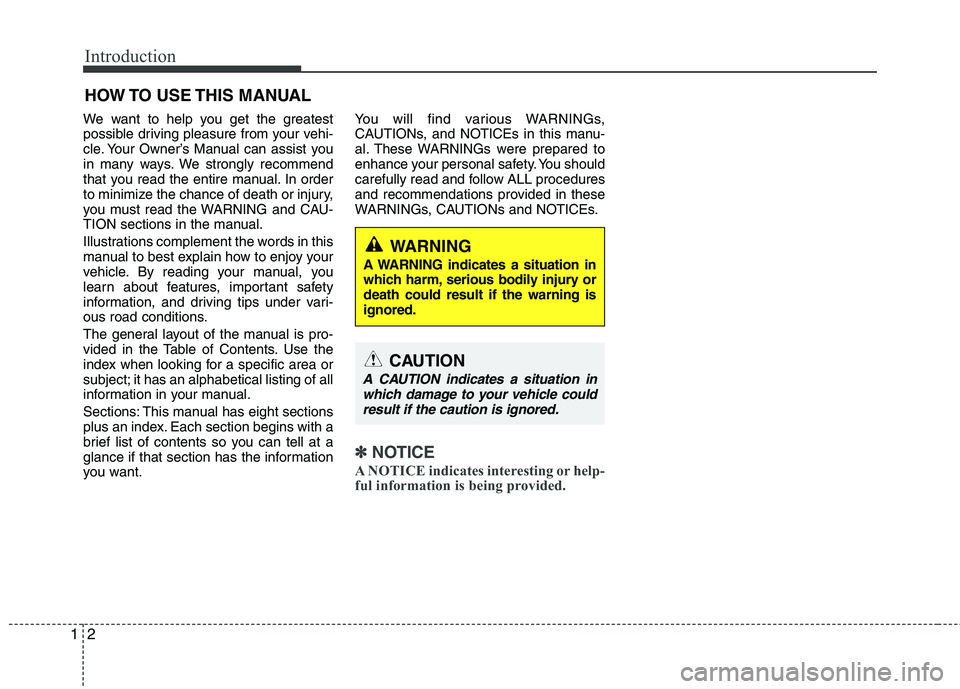
✽✽
NOTICE
A NOTICE indicates interesting or help-
ful information is being provided.
HOW TO USE THIS MANUAL
WARNING
A WARNING indicates a situation in
which harm, serious bodily injury ordeath could result if the warning isignored.
CAUTION
A CAUTION indicates a situation in which damage to your vehicle couldresult if the caution is ignored.
Page 6 of 488

13
Introduction
Gasoline engine
Unleaded
For Europe
For the optimal vehicle performance, we
recommend you use unleaded gasoline
which has an octane rating of RON(Research Octane Number) 95 / AKI
(Anti Knock Index) 91 or higher. (Do not
use methanol blended fuels)
You may use unleaded gasoline with an
octane rating of RON 91~94 / AKI 87~90
but it may result in slight performance
reduction of the vehicle.
Except Europe
Your new Kia vehicle is designed to use
only unleaded fuel having an Octane
Rating of RON (Research Octane
Number) 91 / AKI (Anti-Knock Index) 87
or higher. (Do not use methanol blendedfuels)
Your new vehicle is designed to obtain
maximum performance with UNLEADED
FUEL, as well as minimize exhaust emis-
sions and spark plug fouling.
Leaded (if equipped)
For some countries, your vehicle is
designed to use leaded gasoline. When
you are going to use leaded gasoline, we
recommend that you ask an authorizedKia dealer whether leaded gasoline in
your vehicle is available or not. Octane Rating of leaded gasoline is
same with unleaded one.
FUEL REQUIREMENTS
WARNING
• Do not "top off" after the nozzle automatically shuts off when refueling.
Always check that the fuel cap is installed securely to prevent fuel
spillage in the event of an acci-dent.
CAUTION
NEVER USE LEADED FUEL. The
use of leaded fuel is detrimental to
the catalytic converter and willdamage the engine control sys-tem’s oxygen sensor and affect emission control.
Never add any fuel system cleaningagents to the fuel tank other thanwhat has been specified. (We recom-mend that you consult an authorized
Kia dealer for details.)
Page 8 of 488

15
Introduction
Do not use methanol
Fuels containing methanol (wood alco-
hol) should not be used in your vehicle.
This type of fuel can reduce vehicle per-
formance and damage components ofthe fuel system, engine control systemand emission control system.
Fuel Additives
Kia recommends that you use unleaded
gasoline which has an octane rating of
RON(Research Octane Number) 95 /
AKI(Anti Knock Index) 91 or higher (for
Europe) or Octane Rating of RON(Reasearch Octane Number) 91 /
AKI(Anti-Knock Index)87 or higher
(except Europe).
For customers who do not use good
quality gasolines including fuel additives
regularly, and have problems starting or
the engine does not run smoothly, one
bottle of additives added to the fuel tank
at every 15,000km (For Europe)/
5,000km (Except Europe). Additives are
available from your authorized Kia dealer
along with information on how to use
them. Do not mix other additives.
Operation in foreign countries
If you are going to drive your vehicle in
another country, be sure to:
Observe all regulations regarding reg-istration and insurance.
Determine that acceptable fuel is avail- able. No special break-in period is needed. By
following a few simple precautions for the
first 1,000 km (600 miles) you may add to
the performance, economy and life of
your vehicle.
Do not race the engine.
While driving, keep your engine speed
(rpm, or revolutions per minute)
between 2,000 rpm and 4,000 rpm.
Do not maintain a single speed for long
periods of time, either fast or slow.
Varying engine speed is needed to
properly break-in the engine.
Avoid hard stops, except in emergencies,
to allow the brakes to seat properly.
Don't tow a trailer during the first 2,000 km (1,200 miles) of operation.
VEHICLE BREAK-IN PROCESS
Page 355 of 488
611
What to do in an emergency
6. Loosen the wheel lug nuts coun-terclockwise one turn each, but do
not remove any nut until the tire
has been raised off the ground. 7. Place the jack at the front or rear
jacking position closest to the tire
you are changing. Place the jackat the designated locations under
the frame. The jacking positions
are plates welded to the frame
with two tabs and a raised dot to
index with the jack.
WARNING - Changing a tire
To prevent vehicle movement
while changing a tire, always
set the parking brake fully,
and always block the wheel
diagonally opposite the wheel
being changed.
We recommend that the wheels of the vehicle be
blocked, and that no person
remain in the vehicle that is
being jacked.
OTA060003OSA067023
Page 428 of 488

Maintenance
50
7
Tire sidewall labeling
This information identifies and
describes the fundamental charac-
teristics of the tire and also provides
the tire identification number (TIN)
for safety standard certification. TheTIN can be used to identify the tire incase of a recall.
1. Manufacturer or brand name
Manufacturer or Brand name is
shown.
2. Tire size designation
A tire’s sidewall is marked with a tire
size designation. You will need this
information when selecting replace-
ment tires for your car. The following
explains what the letters and numbers
in the tire size designation mean.
Example tire size designation:
(These numbers are provided as an
example only; your tire size designator
could vary depending on your vehicle.) 175/50R15 75H
175 - Tire width in millimeters.
50 - Aspect ratio. The tire’s section
height as a percentage of its width.
R - Tire construction code (Radial).
15 - Rim diameter in inches.
75 - Load Index, a numerical code associated with the maximum
load the tire can carry.
H - Speed Rating Symbol. See the
speed rating chart in this section
for additional information. Wheel size designation
Wheels are also marked with impor-
tant information that you need if you
ever have to replace one. The follow-
ing explains what the letters and
numbers in the wheel size designa-tion mean.
Example wheel size designation: 5.5JX15
5.5 - Rim width in inches. J - Rim contour designation.
15 - Rim diameter in inches.
Tire speed ratings
The chart below lists many of the dif-
ferent speed ratings currently being
used for passenger car tires. The
speed rating is part of the tire size
designation on the sidewall of the
tire. This symbol corresponds to that
tire's designed maximum safe oper-ating speed.
I030B04JM
1
1
23
4
5,6
7
Page 465 of 488
83
Specifications & Consumer information
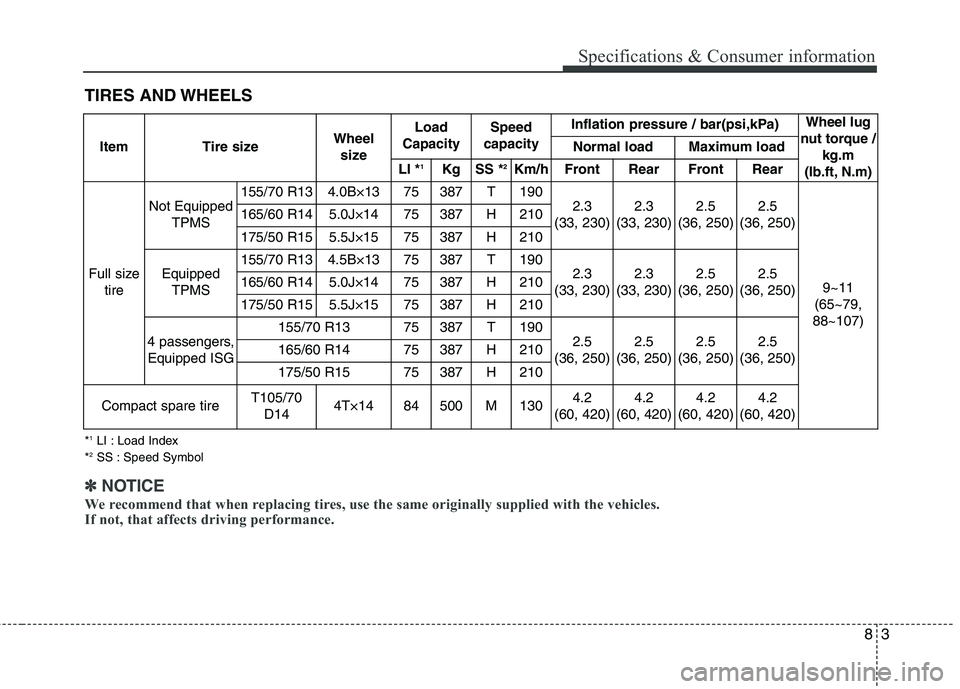
TIRES AND WHEELSItem Tire size Wheel
size Load
Capacity Speed
capacity Inflation pressure / bar(psi,kPa)
Wheel lug
nut torque / kg.m
(lb.ft, N.m)
Normal load Maximum load
LI * 1
Kg SS * 2
Km/h Front Rear Front Rear
Full size tire
Not Equipped TPMS155/70 R13 4.0B×13 75 387 T 190 2.3
(33, 230) 2.3
(33, 230) 2.5
(36, 250) 2.5
(36, 250)
9~11
(65~79,
88~107)
165/60 R14 5.0J×14 75 387 H 210
175/50 R15 5.5J×15 75 387 H 210
Equipped TPMS155/70 R13 4.5B×13 75 387 T 190 2.3
(33, 230) 2.3
(33, 230) 2.5
(36, 250) 2.5
(36, 250)
165/60 R14 5.0J×14 75 387 H 210
175/50 R15 5.5J×15 75 387 H 210
4 passengers, Equipped ISG155/70 R13 75 387 T 190 2.5
(36, 250) 2.5
(36, 250) 2.5
(36, 250) 2.5
(36, 250)
165/60 R14 75 387 H 210
175/50 R15 75 387 H 210
Compact spare tire
T105/70 D14 4T×14 84 500 M 130 4.2
(60, 420) 4.2
(60, 420) 4.2
(60, 420) 4.2
(60, 420)
✽✽ NOTICE
We recommend that when replacing tires, use the same originally supplied with the ve hicles.
If not, that affects driving performance.
* 1
LI : Load Index
* 2
SS : Speed Symbol
Page 480 of 488