Page 394 of 488

Maintenance
16
7
NORMAL MAINTENANCE SCHEDULE (CONT.)
120,000 km (80,000 miles) or 96months
❑ Inspect air cleaner filter - Except China, India, Middle East
❑ Inspect air conditioner refrigerant/compressor (if equipped)
❑ Inspect battery condition
❑ Inspect brake lines, hoses and connections
❑ Inspect brake fluid (Except Europe)
❑ Replace brake fluid (For Europe)
❑ Inspect disc brakes and pads
❑ Inspect drive belt * 1
❑
Inspect drive shafts and boots
❑ Inspect exhaust system
❑ Inspect front suspension ball joints
❑ Inspect fuel filter (For Europe) * 6
❑
Inspect fuel lines, hoses and connections
❑ Inspect parking brake
❑ Inspect steering gear rack, linkage and boots
❑ Inspect tire (pressure & tread wear)
❑ Inspect automatic transaxle fluid (if equipped)
❑ Inspect manual transaxle fluid (if equipped)
❑ Inspect vapor hose and fuel filler cap
(Continued)
(Continued)
❑ Inspect valve clearance * 5
(For Gasoline Engine)
(Every 95,000 km (60,000 miles) or 48 months * 4
)
❑ Replace air cleaner filter - For China, India, Middle East
❑ Replace climate control air filter (if equipped)
❑ Replace engine oil and filter - Except Middle East, Brazil * 2
❑
Replace engine oil and filter - For Middle East, Brazil * 2
(Every 10,000 km (6,500 miles) or 12months * 3
)
❑ Replace fuel filter (Except Europe)
❑ Replace spark plugs - For Leaded Gasoline Engine
❑ Replace spark plugs
- For Unleaded Gasoline Engine or LPG Engine
(Every 160,000 km (100,000 miles) or 120 months)
❑ Replace coolant * 7
(At first, 210,000 km (120,000 miles) or 120months
after that, every 30,000 km (20,000 miles) or 24months * 4
)
❑ Inspect cooling system
(At first, 60,000 km (40,000 miles) or 48months
after that, every 30,000 km (20,000 miles) or 24months)
❑ Add fuel additives * 8
(Every 15,000 km or 12months - For Europe, every 5,000 km or 6months - Except Europe)
❈ Inspect : Inspect and if necessary, adjust, correct, clean or
replace.
Page 395 of 488
717
Maintenance
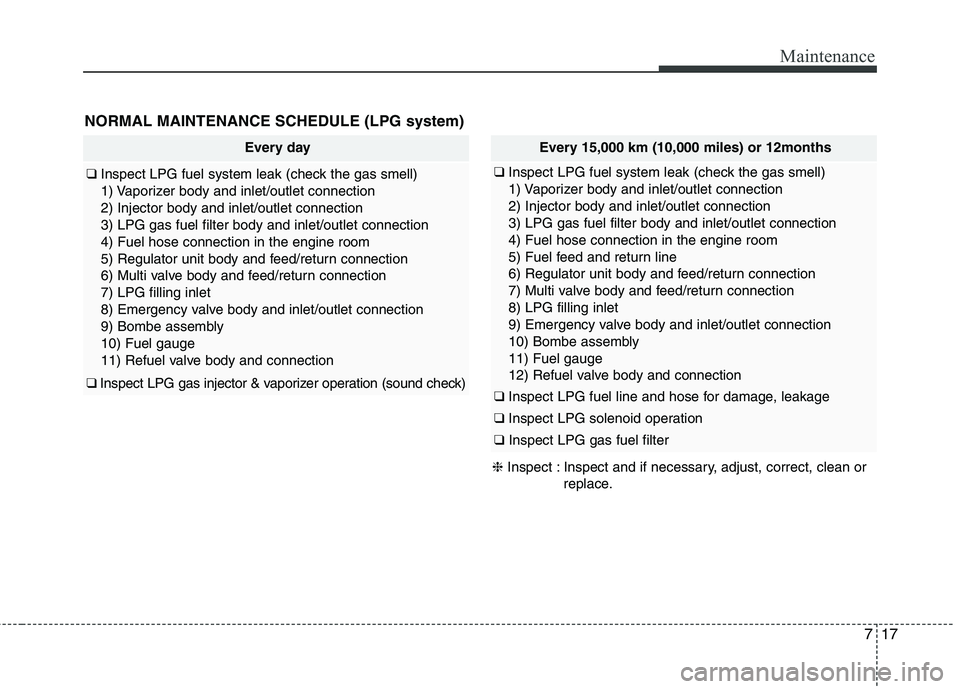
Every day
❑ Inspect LPG fuel system leak (check the gas smell)
1) Vaporizer body and inlet/outlet connection2) Injector body and inlet/outlet connection3) LPG gas fuel filter body and inlet/outlet connection4) Fuel hose connection in the engine room
5) Regulator unit body and feed/return connection
6) Multi valve body and feed/return connection7) LPG filling inlet
8) Emergency valve body and inlet/outlet connection
9) Bombe assembly10) Fuel gauge
11) Refuel valve body and connection
❑ Inspect LPG gas injector & vaporizer operation (sound check)
NORMAL MAINTENANCE SCHEDULE (LPG system)
Every 15,000 km (10,000 miles) or 12months
❑ Inspect LPG fuel system leak (check the gas smell)
1) Vaporizer body and inlet/outlet connection2) Injector body and inlet/outlet connection3) LPG gas fuel filter body and inlet/outlet connection4) Fuel hose connection in the engine room
5) Fuel feed and return line
6) Regulator unit body and feed/return connection
7) Multi valve body and feed/return connection8) LPG filling inlet
9) Emergency valve body and inlet/outlet connection
10) Bombe assembly11) Fuel gauge
12) Refuel valve body and connection
❑ Inspect LPG fuel line and hose for damage, leakage
❑ Inspect LPG solenoid operation
❑ Inspect LPG gas fuel filter
❈ Inspect : Inspect and if necessary, adjust, correct, clean or
replace.
Page 396 of 488
Maintenance
18
7
NORMAL MAINTENANCE SCHEDULE (LPG system)
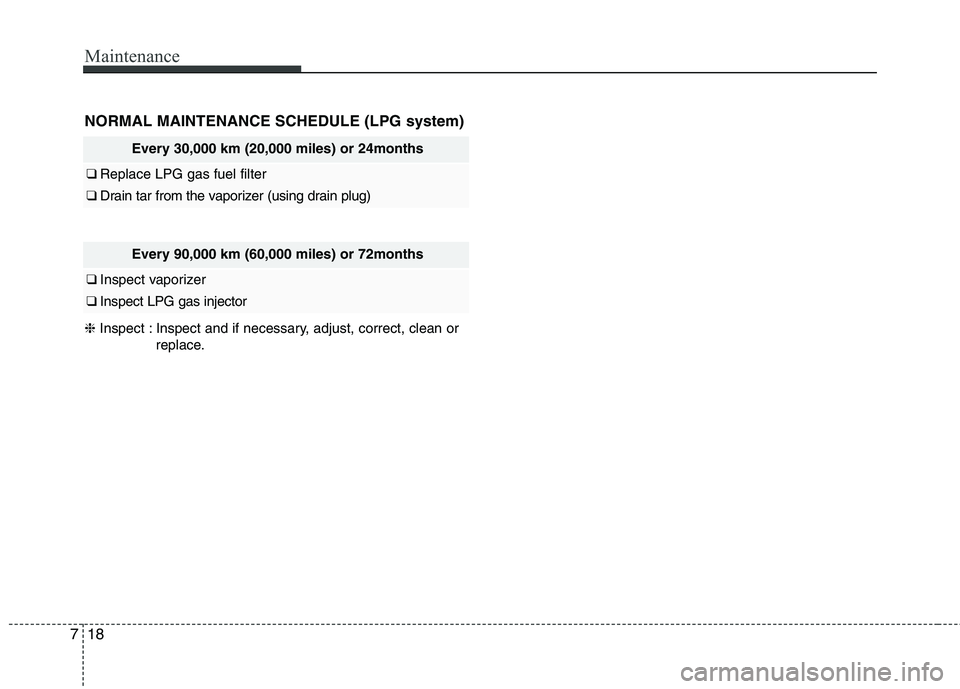
Every 30,000 km (20,000 miles) or 24months
❑ Replace LPG gas fuel filter
❑ Drain tar from the vaporizer (using drain plug)
Every 90,000 km (60,000 miles) or 72months
❑ Inspect vaporizer
❑ Inspect LPG gas injector
❈ Inspect : Inspect and if necessary, adjust, correct, clean or
replace.
Page 399 of 488
721
Maintenance
EXPLANATION OF SCHEDULED MAINTENANCE ITEMS
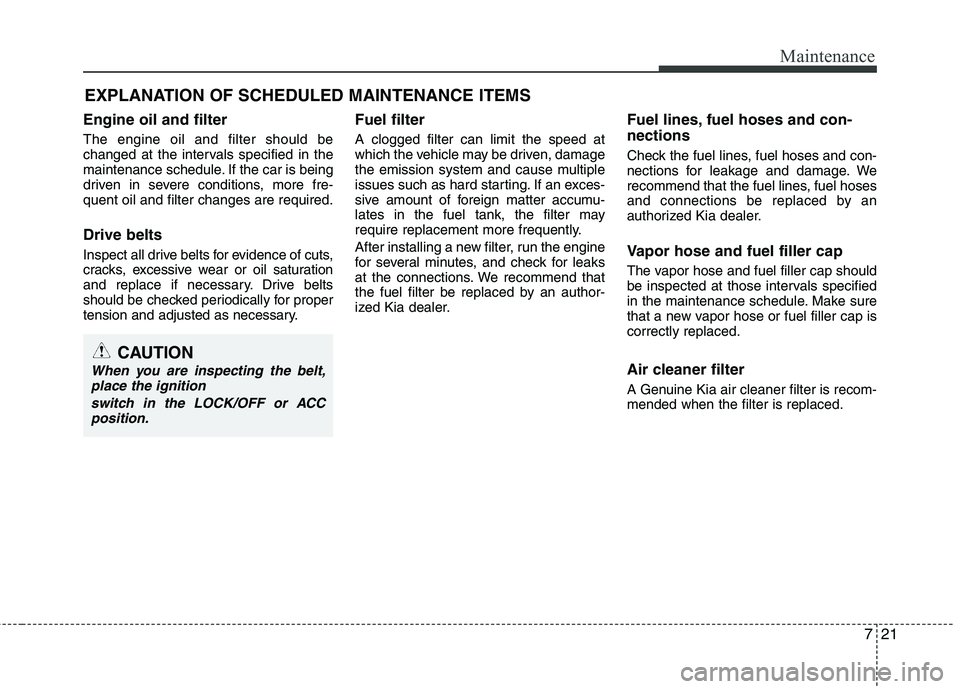
Engine oil and filter The engine oil and filter should be
changed at the intervals specified in the
maintenance schedule. If the car is being
driven in severe conditions, more fre-quent oil and filter changes are required. Drive belts
Inspect all drive belts for evidence of cuts,
cracks, excessive wear or oil saturation
and replace if necessary. Drive belts
should be checked periodically for proper
tension and adjusted as necessary. Fuel filter A clogged filter can limit the speed at
which the vehicle may be driven, damage
the emission system and cause multiple
issues such as hard starting. If an exces-
sive amount of foreign matter accumu-
lates in the fuel tank, the filter may
require replacement more frequently.
After installing a new filter, run the engine
for several minutes, and check for leaks
at the connections. We recommend that
the fuel filter be replaced by an author-
ized Kia dealer.
Fuel lines, fuel hoses and con- nections
Check the fuel lines, fuel hoses and con-
nections for leakage and damage. We
recommend that the fuel lines, fuel hoses
and connections be replaced by an
authorized Kia dealer.
Vapor hose and fuel filler cap
The vapor hose and fuel filler cap should
be inspected at those intervals specified
in the maintenance schedule. Make sure
that a new vapor hose or fuel filler cap iscorrectly replaced.
Air cleaner filter
A Genuine Kia air cleaner filter is recom- mended when the filter is replaced.
CAUTION
When you are inspecting the belt,
place the ignition
switch in the LOCK/OFF or ACCposition.
Page 460 of 488
Maintenance
82
7
EMISSION CONTROL SYSTEM (IF EQUIPPED)
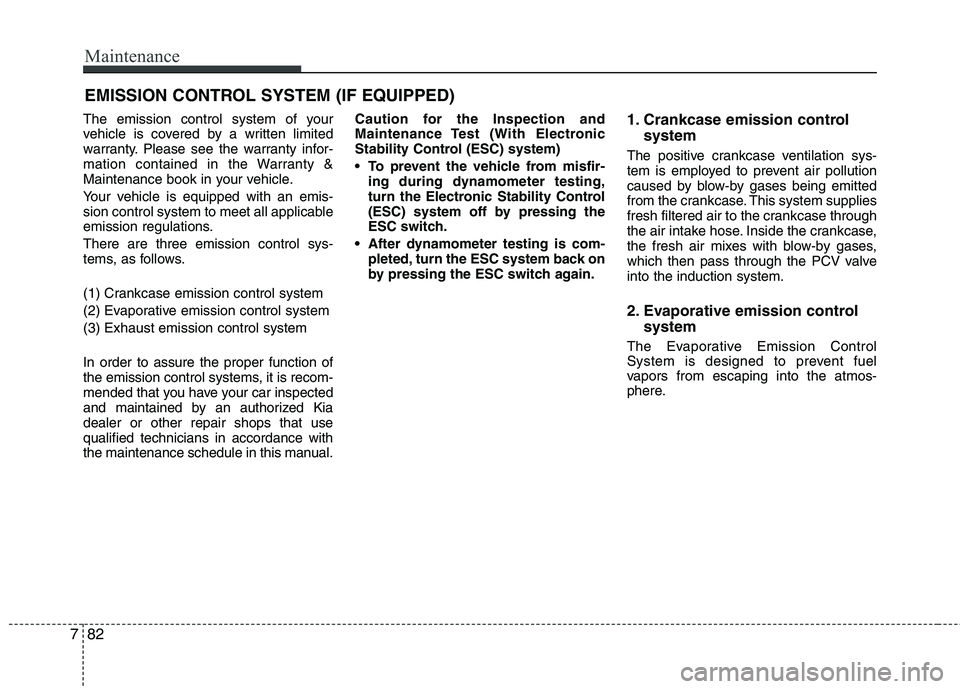
The emission control system of your
vehicle is covered by a written limited
warranty. Please see the warranty infor-
mation contained in the Warranty &
Maintenance book in your vehicle.
Your vehicle is equipped with an emis-
sion control system to meet all applicable
emission regulations. There are three emission control sys-
tems, as follows.
(1) Crankcase emission control system
(2) Evaporative emission control system(3) Exhaust emission control system In order to assure the proper function of
the emission control systems, it is recom-
mended that you have your car inspected
and maintained by an authorized Kiadealer or other repair shops that usequalified technicians in accordance with
the maintenance schedule in this manual. Caution for the Inspection and
Maintenance Test (With Electronic
Stability Control (ESC) system)
To prevent the vehicle from misfir-
ing during dynamometer testing,
turn the Electronic Stability Control
(ESC) system off by pressing the
ESC switch.
After dynamometer testing is com- pleted, turn the ESC system back on
by pressing the ESC switch again. 1. Crankcase emission control
system
The positive crankcase ventilation sys-
tem is employed to prevent air pollution
caused by blow-by gases being emitted
from the crankcase. This system supplies
fresh filtered air to the crankcase through
the air intake hose. Inside the crankcase,
the fresh air mixes with blow-by gases,
which then pass through the PCV valveinto the induction system.
2. Evaporative emission control system
The Evaporative Emission Control
System is designed to prevent fuel
vapors from escaping into the atmos-
phere.