2016 KIA CEED oil
[x] Cancel search: oilPage 7 of 643

Introduction
4
1
Use of MTBE
Kia recommends avoiding fuels contain-
ing MTBE (Methyl Tertiary Butyl Ether)
over 15.0% vol. (Oxygen Content 2.7%
weight) in your vehicle.
Fuel containing MTBE over 15.0% vol.
(Oxygen Content 2.7% weight) may
reduce vehicle performance and produce
vapor lock or hard starting.
Do not use methanol
Fuels containing methanol (wood alco-
hol) should not be used in your vehicle.
This type of fuel can reduce vehicle per-
formance and damage components ofthe fuel system, engine control systemand emission control system.
Fuel Additives
Kia recommends that you use unleaded
gasoline which has an octane rating of
RON (Research Octane Number) 95 / AKI
(Anti Knock Index) 91 or higher (for
Europe) or Octane Rating of RON(Research Octane Number) 91 / AKI (Anti-
Knock Index) 87 or higher (except Europe).
For customers who do not use good
quality gasolines including fuel additives
regularly, and have problems starting or
the engine does not run smoothly, one
bottle of additives added to the fuel tank
at every 15,000km (for Europe)/ 5,000km
(except Europe). Additives are available
from your authorized Kia dealer along
with information on how to use them. Do
not mix other additives.
Operation in foreign countries
If you are going to drive your vehicle in
another country, be sure to:
Observe all regulations regarding reg-
istration and insurance.
Determine that acceptable fuel is avail- able. Diesel engine
Diesel fuel
Diesel engine must be operated only on
commercially available diesel fuel that
complies with EN 590 or comparable
standard. (EN stands for "European
Norm"). Do not use marine diesel fuel,
heating oils, or non-approved fuel addi-
tives, as this will increase wear andcause damage to the engine and fuel
system. The use of non-approved fuels
and / or fuel additives will result in a limi-
tation of your warranty rights.
Diesel fuel of above cetane 51 is used in
your vehicle. If two types of diesel fuel
are available, use summer or winter fuel
properly according to the following tem-
perature conditions.
Above -5°C (23°F) ... Summer type
diesel fuel.
Below -5°C (23°F) ... Winter type diesel fuel.
Watch the fuel level in the tank very care-
fully : If the engine stops through fuel fail-
ure, the circuits must be completely
purged to permit restarting.
CAUTION
Your New Vehicle Limited Warranty may not cover damage to the fuelsystem and any performance prob- lems that are caused by the use of
fuels containing methanol or fuelscontaining MTBE (Methyl TertiaryButyl Ether) over 15.0% vol.(Oxygen Content 2.7% weight.)
JD PE eng 1.QXP 11/26/2015 10:23 AM Page 4
Page 8 of 643

15
Introduction
Biodiesel
Commercially supplied Diesel blends of no more than 7% biodiesel, commonly
known as "B7 Diesel" may be used in
your vehicle if Biodiesel meets EN 14214
or equivalent specifications. (EN stands
for "European Norm"). The use of biofu-
els exceeding 7% made from rapeseed
methyl ester (RME), fatty acid methyl
ester (FAME), vegetable oil methyl ester
(VME) etc. or mixing diesel exceeding7% with biodiesel will cause increased
wear or damage to the engine and fuel
system. Repair or replacement of worn ordamaged components due to the use of
non approved fuels will not be covered by
the manufactures warranty.No special break-in period is needed. By
following a few simple precautions for the
first 1,000 km (600 miles) you may add to
the performance, economy and life of
your vehicle.
Do not race the engine.
While driving, keep your engine speed
(rpm, or revolutions per minute)
between 2,000 rpm and 4,000 rpm.
Do not maintain a single speed for long
periods of time, either fast or slow.
Varying engine speed is needed to
properly break-in the engine.
Avoid hard stops, except in emergen-
cies, to allow the brakes to seat prop-
erly.
Don't tow a trailer during the first 2,000 km (1,200 miles) of operation.CAUTION
Do not let any gasoline or water
enter the tank. This would make itnecessary to drain it out and to bleed the lines to avoid jamming the
injection pump and damaging theengine.
CAUTION - Diesel Fuel
(if equipped with DPF)
It is recommended to use the regu- lated automotive diesel fuel for
diesel vehicle equipped with theDPF system.
If you use diesel fuel including highsulfur (more than 50 ppm sulfur) andunspecified additives, it can cause
the DPF system to be damaged andwhite smoke can be emitted.
CAUTION
Never use any fuel, whether diesel, B7 biodiesel or otherwise,
that fails to meet the latest petro-leum industry specification.
Never use any fuel additives or treatments that are not recom-mended or approved by the vehi-
cle manufacturer.
VEHICLE BREAK-IN PROCESS
JD PE eng 1.QXP 11/26/2015 10:23 AM Page 5
Page 14 of 643

Your vehicle at a glance
6
2
ENGINE COMPARTMENT
OJD072001/OJD072002
❈
The actual engine room in the vehicle may differ from the illustration. 1. Engine oil filler cap ............................7-28
2. Brake/clutch fluid reservoir ................7-32
3. Positive battery terminal ....................7-42
4. Negative battery terminal ..................7-42
5. Fuse box ............................................7-56
6. Air cleaner ........................................7-35
7. Radiator cap ......................................7-31
8. Engine coolant reservoir....................7-29
9. Engine oil dipstick..............................7-27
10. Windshield washer fluid reservoir ....7-33
■■
Gasoline engine (GDI)
■■Gasoline engine (MPI)
JD PE eng 2.QXP 9/9/2015 4:10 PM Page 6
Page 15 of 643

27
Your vehicle at a glance
1. Engine oil filler cap ............................7-28
2. Brake/clutch fluid reservoir ................7-32
3. Positive battery terminal ....................7-42
4. Negative battery terminal ..................7-42
5. Fuse box ............................................7-56
6. Air cleaner ........................................7-35
7. Radiator cap ......................................7-31
8. Engine coolant reservoir....................7-29
9. Engine oil dipstick..............................7-27
10. Windshield washer fluid reservoir ....7-33
OJD075106L❈The actual engine room in the vehicle may differ from the illustration.
■
■
Gasoline engine (Gamma 1.6 T-GDI)
JD PE eng 2.QXP 9/9/2015 4:10 PM Page 7
Page 16 of 643

Your vehicle at a glance
8
2
OGD075001/OJD075100L
❈
The actual engine room in the vehicle may differ from the illustration. 1. Engine oil filler cap ............................7-28
2. Brake/clutch fluid reservoir ................7-32
3. Positive battery terminal ....................7-42
4. Negative battery terminal ..................7-42
5. Fuse box ............................................7-56
6. Air cleaner ........................................7-35
7. Radiator cap ......................................7-31
8. Engine coolant reservoir....................7-29
9. Engine oil dipstick..............................7-27
10. Windshield washer fluid reservoir ....7-33
■■
Gasoline Engine (Kappa 1.4 MPI)
■■Gasoline Engine (Kappa 1.0 T-GDI)
JD PE eng 2.QXP 9/9/2015 4:10 PM Page 8
Page 17 of 643

29
Your vehicle at a glance
OJD075101L
❈
The actual engine room in the vehicle may differ from the illustration.
1. Engine oil filler cap ............................7-28
2. Brake/clutch fluid reservoir ................7-32
3. Positive battery terminal ....................7-42
4. Negative battery terminal ..................7-42
5. Fuse box ............................................7-56
6. Air cleaner ........................................7-35
7. Radiator cap ......................................7-31
8. Engine coolant reservoir....................7-29
9. Engine oil dipstick..............................7-27
10. Windshield washer fluid reservoir ....7-33
11. Fuel filter ........................................7-34
■■
Diesel engine (UII)
JD PE eng 2.QXP 9/9/2015 4:11 PM Page 9
Page 37 of 643
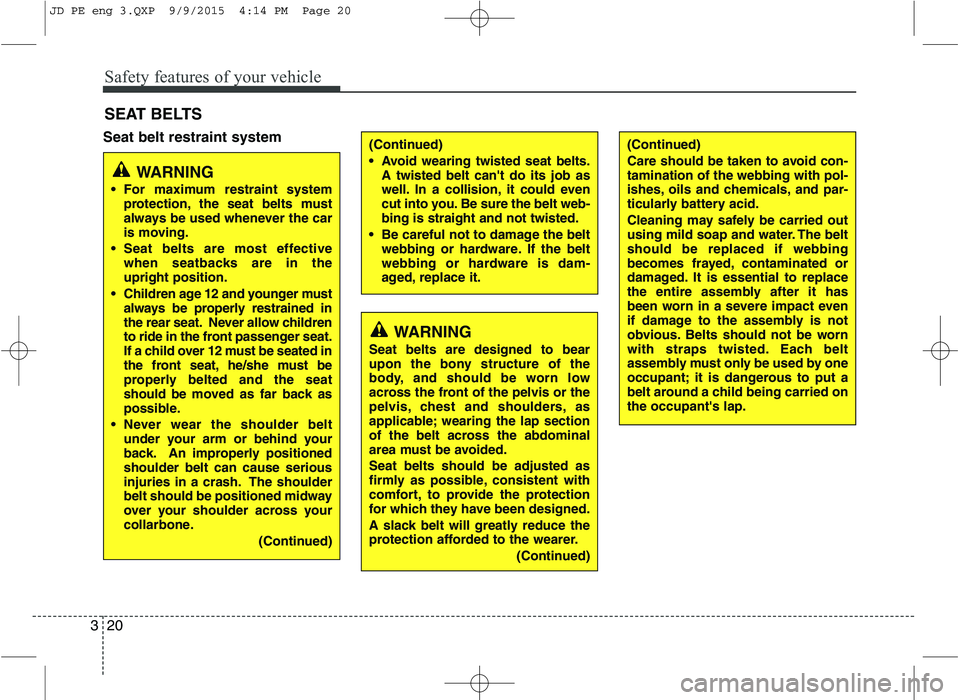
Safety features of your vehicle
20
3
Seat belt restraint system SEAT BELTS(Continued)
Avoid wearing twisted seat belts.
A twisted belt can't do its job as
well. In a collision, it could even
cut into you. Be sure the belt web-bing is straight and not twisted.
Be careful not to damage the belt webbing or hardware. If the belt
webbing or hardware is dam-
aged, replace it.
WARNING
Seat belts are designed to bear
upon the bony structure of the
body, and should be worn low
across the front of the pelvis or the
pelvis, chest and shoulders, as
applicable; wearing the lap section
of the belt across the abdominal
area must be avoided. Seat belts should be adjusted as
firmly as possible, consistent with
comfort, to provide the protection
for which they have been designed.
A slack belt will greatly reduce the
protection afforded to the wearer.
(Continued)
WARNING
For maximum restraint system protection, the seat belts must
always be used whenever the car
is moving.
Seat belts are most effective when seatbacks are in theupright position.
Children age 12 and younger must always be properly restrained in
the rear seat. Never allow children
to ride in the front passenger seat.
If a child over 12 must be seated in
the front seat, he/she must be
properly belted and the seat
should be mo ved as far back as
possible.
Never wear the shoulder belt under your arm or behind your
back. An improperly positionedshoulder belt can cause serious
injuries in a crash. The shoulder
belt should be positioned midway
over your shoulder across your
collarbone.
(Continued)
(Continued)
Care should be taken to avoid con- tamination of the webbing with pol-
ishes, oils and chemicals, and par-
ticularly battery acid.
Cleaning may safely be carried out
using mild soap and water. The beltshould be replaced if webbing
becomes frayed, contaminated or
damaged. It is essential to replace
the entire assembly after it has
been worn in a severe impact even
if damage to the assembly is not
obvious. Belts should not be worn
with straps twisted. Each belt
assembly must only be used by one
occupant; it is dangerous to put a
belt around a child being carried onthe occupant's lap.
JD PE eng 3.QXP 9/9/2015 4:14 PM Page 20
Page 170 of 643

487
Features of your vehicle
Tire Pressure Monitoring System(TPMS) indicator (if equipped)
Low tire pressure telltale/
TPMS malfunction indicator
The low tire pressure telltale comes on
for 3 seconds after the ignition switch is
turned to the ON position.
The low tire pressure and position tell- tales illuminates when one or more of
your tires is significantly underinflated.
The TPMS malfunction indicator will illu-
minate after it blinks for approximately
one minute when there is a problem with
the Tire Pressure Monitoring System.
If this occurs, we recommend that the
system be checked by an authorized Kia
dealer.
For more details, refer to the TPMS in chapter 6.
The low tire pressure position telltale illu-
minates on the LCD display.
Engine oil pressure warn-ing
This warning light indicates the engine oil
pressure is low.
If the warning light illuminates while driv- ing:
1. Drive safely to the side of the road and stop.
2. With the engine off, check the engine oil level. If the level is low, add oil as required.
If the warning light remains on after
adding oil or if oil is not available, we rec-
ommend that you call an authorized Kia
dealer.
WARNING - Safe stopping
The TPMS cannot alert you to severe and sudden tire damage caused by external factors.
If you notice any vehicle instabili- ty, immediately take your foot offthe accelerator pedal, apply thebrakes gradually and with lightforce, and slowly move to a safeposition off the road.
CAUTION
If the engine does not stop immedi-
ately after the engine oil pressurewarning light is illuminated, severedamage could result.
JD PE eng 4.QXP 1/28/2016 5:18 PM Page 87