2016 KIA CEED brake
[x] Cancel search: brakePage 397 of 643

Driving your vehicle
24
5
For smooth operation, depress the brake
pedal when shifting from N (Neutral) to aforward or reverse gear.Transaxle ranges
The indicator lights in the instrument clus-
ter displays the shift lever position when
the ignition switch is in the ON position.
P (Park)
Always come to a complete stop before
shifting into P (Park). This position locks
the transaxle and prevents the frontwheels from rotating.
WARNING - Automatic
transaxle
Always check the surrounding areas near your vehicle for peo-
ple, especially children, before
shifting a vehicle into D (Drive) or
R (Reverse).
Before leaving the driver’s seat, always make sure the shift lever
is in the P (Park) position; then
set the parking brake fully and
shut the engine off. Unexpected
and sudden vehicle movementcan occur if these precautions
are not followed in the order iden-tified.
Do not use the engine brake (shifting from a high gear to
lower gear) rapidly on slippery
roads. The vehicle may slip caus-ing an accident.
CAUTION
To avoid damage to your
transaxle, do not accelerate theengine in R (Reverse) or any for- ward gear position with the
brakes on.
When stopped on an upgrade, do not hold the vehicle stationarywith engine power. Use the serv-ice brake or the parking brake.
Do not shift from N (Neutral) or P (Park) into D (Drive), or R(Reverse) when the engine isabove idle speed.
WARNING
Shifting into P (Park) while the vehicle is in motion will cause the
drive wheels to lock which will
cause you to lose control of the
vehicle.
Do not use the P (Park) position in place of the parking brake.
Always make sure the shift lever
is latched in the P (Park) position
and set the parking brake fully.
Never leave a child unattended in a vehicle.
CAUTION
The transaxle may be damaged if
you shift into P (Park) while thevehicle is in motion.
JD PE eng 5.QXP 9/30/2015 5:23 PM Page 24
Page 398 of 643

525
Driving your vehicle
R (Reverse)
Use this position to drive the vehicle
backward.
N (Neutral)
The wheels and transaxle are not
engaged. The vehicle will roll freely even
on the slightest incline unless the parking
brake or service brakes are applied.D (Drive)
This is the normal forward driving posi-
tion. The transaxle will automatically shift
through a 6-gear sequence, providing the
best fuel economy and power.
For extra power when passing another
vehicle or climbing grades, depress the
accelerator pedal fully (more than 80%)
until the kick down mechanism works
with a clicking noise, at which time the
transaxle will automatically downshift to
the next lower gear.
✽✽
NOTICE
Always come to a complete stop before shifting into D (Drive).
A clicking noise heard from the kick down mechanism by depressing the
accelerator pedal fully is a normal
condition.
Sports mode
Whether the vehicle is stationary or in
motion, sports mode is selected by push-
ing the shift lever from the D (Drive) posi-
tion into the manual gate. To return to D
(Drive) range operation, push the shift
lever back into the main gate.
In sports mode, moving the shift lever
backwards and forwards will allow you to
make gearshifts rapidly. In contrast to a
manual transaxle, the sports mode
allows gearshifts with the acceleratorpedal depressed.
Up (+) : Push the lever forward once to
shift up one gear.
Down (-) : Pull the lever backwards once to shift down one gear.
CAUTION
Always come to a complete stop
before shifting into or out of R(Reverse); you may damage the transaxle if you shift into R (Reverse)while the vehicle is in motion, except
as explained in “Rocking the vehi-cle”, in this manual.
OJD052006
Sports
mode
++++ ((((UUUUPPPP))))
---- ((((DDDDOOOOWWWWNNNN))))
WARNING
Do not drive with the shift lever in N
(Neutral). The engine brake will not
work and lead to an accident.
JD PE eng 5.QXP 9/30/2015 5:24 PM Page 25
Page 400 of 643

527
Driving your vehicle
Shift lock system (if equipped)
For your safety, the automatic transaxle
has a shift lock system which prevents
shifting the transaxle from P (Park) or N
(Neutral) into R (Reverse) unless the
brake pedal is depressed.
To shift the transaxle from P (Park) or N
(Neutral) into R (Reverse):
1. Depress and hold the brake pedal.
2. Start the engine or turn the ignitionswitch to the ON position.
3. Move the shift lever.
If the brake pedal is repeatedly depressed and released with the shift
lever in the P (Park) position, a chattering
noise near the shift lever may be heard.
This is a normal condition. Shift-lock override
If the shift lever cannot be moved from
the P (Park) or N (Neutral) position into R
(Reverse) position with the brake pedal
depressed, continue depressing the
brake, then do the following:
1. Press the shift-lock release button.
2. Move the shift lever.
3. We recommend that the system be
inspected by an authorized Kia dealer. Ignition key interlock system
(if equipped)
The ignition key cannot be removed
unless the shift lever is in the P (Park)position.
WARNING
Always fully depress the brake
pedal before and while shifting out
of the P (Park) position into anoth-
er position to avoid inadvertent
motion of the vehicle which could
injure persons in or around the
vehicle.
OJD052007
JD PE eng 5.QXP 9/30/2015 5:24 PM Page 27
Page 401 of 643

Driving your vehicle
28
5
Good driving practices
Never move the shift lever from P
(Park) or N (Neutral) to any other posi-
tion with the accelerator pedaldepressed.
Never move the shift lever into P (Park) when the vehicle is in motion.
Be sure the vehicle is completely stopped before you attempt to shift into
R (Reverse) or D (Drive).
Never take the vehicle out of gear and coast down a hill. This may be
extremely hazardous. Always leave the
vehicle in gear when moving.
Do not "ride" the brakes. This can cause them to overheat and malfunc-
tion. Instead, when you are driving
down a long hill, slow down and shift to
a lower gear. When you do this, engine
braking will help slow down the vehicle.
Slow down before shifting to a lower gear. Otherwise, the lower gear maynot be engaged.
Always use the parking brake. Do not depend on placing the transaxle in P
(Park) to keep the vehicle from moving. Exercise extreme caution when driving
on a slippery surface. Be especially
careful when braking, accelerating or
shifting gears. On a slippery surface,
an abrupt change in vehicle speed can
cause the drive wheels to lose traction
and the vehicle to go out of control.
Optimum vehicle performance and economy is obtained by smoothly
depressing and releasing the accelera-tor pedal.
WARNING
Always buckle-up! In a collision, an unbelted occupant is signifi-
cantly more likely to be seriously
injured or killed than a properlybelted occupant.
Avoid high speeds when corner- ing or turning.
Do not make quick steering wheel movements, such as sharp
lane changes or fast, sharp turns.
The risk of rollover is greatly increased if you lose control of
your vehicle at highway speeds.
Loss of control often occurs if two or more wheels drop off the
roadway and the driver over-
steers to reenter the roadway.
In the event your vehicle leaves the roadway, do not steer sharply.
Instead, slow down before pulling
back into the travel lanes.
Never exceed posted speed lim- its.
JD PE eng 5.QXP 9/30/2015 5:24 PM Page 28
Page 402 of 643
529
Driving your vehicle
Moving up a steep grade from a stand-ing start
To move up a steep grade from a stand-
ing start, depress the brake pedal, shift
the shift lever to D (Drive). Select the
appropriate gear depending on load
weight and steepness of the grade, and
release the parking brake. Depress the
accelerator gradually while releasing the
service brakes.
When accelerating from a stop on a
steep hill, the vehicle may have a ten-
dency to roll backwards. Shifting the
shift lever into 2 (Second Gear) will
help prevent the vehicle from rolling
backwards.
WARNING
If your vehicle becomes stuck in
snow, mud, sand, etc., then you
may attempt to rock the vehicle free
by moving it forward and backward.
Do not attempt this procedure if
people or objects are anywhere
near the vehicle. During the rocking
operation the vehicle may suddenly
move forward of backward as it
becomes unstuck, causing injury
or damage to nearby people orobjects.
JD PE eng 5.QXP 9/30/2015 5:24 PM Page 29
Page 403 of 643
Driving your vehicle
30
5
DUAL CLUTCH TRANSMISSION (DCT) (IF EQUIPPED)
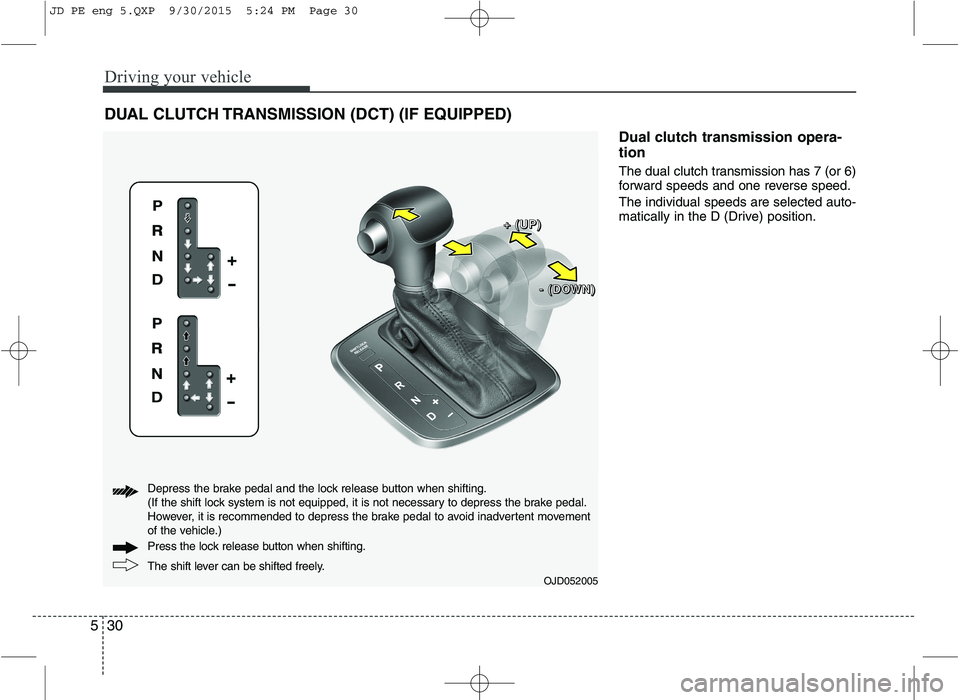
Dual clutch transmission opera- tion
The dual clutch transmission has 7 (or 6)
forward speeds and one reverse speed. The individual speeds are selected auto-
matically in the D (Drive) position.
OJD052005
++++ ((((UUUUPPPP))))
---- ((((DDDDOOOOWWWWNNNN))))
The shift lever can be shifted freely.
Press the lock release button when shifting.
Depress the brake pedal and the lock release button when shifting.
(If the shift lock system is not equipped, it is not necessary to depress the brake pedal.
However, it is recommended to depress the brake pedal to avoid inadvertent movement
of the vehicle.)
JD PE eng 5.QXP 9/30/2015 5:24 PM Page 30
Page 404 of 643

531
Driving your vehicle
The Dual Clutch Transmission givesthe driving feel of a manual transmis-
sion, yet provides the ease of a fully
automatic transmission. Unlike a tradi-
tional automatic transmission, the gear
shifting can be felt (and heard) on the
dual clutch transmission
- Think of it as an automatically shiftingmanual transmission.
- Shift into Drive range and get fully automatic shifting, similar to a con-
ventional automatic transmission.
Dual clutch transmission adopts dry- type dual clutch, which is different from
torque converter of automatic trans-
mission, and shows better acceleration
performance during driving. But, initial
launch might be little bit slower than
Automatic Transmission.
The dry-type clutch transfers torque and provides a direct driving feeling
which may feel different from a con-
ventional automatic transmission with
a torque converter. This may be more
noticeable when starting from a stop or
low vehicle speed.
When rapidly accelerating at low vehi- cle speed, engine could rev at high rpm
depending on vehicle drive condition. For smooth launch uphill, press down
the accelerator pedal smoothly
depending on the current conditions.
If you release your foot from the accel- erator pedal at low vehicle speed, you
may feel strong engine brake, which is
similar to manual transmission.
When driving downhill, you may use Sports Mode and press the paddle
shifters to downshift to a lower gear in
order to control your speed without
using the brake pedal excessively.
When you turn the engine on and off, you may hear clicking sounds as the
system goes through a self test. This is
a normal sound for the Dual Clutch
Transmission.
WARNING
To reduce the risk of serious injury or death:
ALWAYS check the surrounding areas near your vehicle for peo-
ple, especially children, before
shifting a vehicle into D (Drive) or
R (Reverse).
Before leaving the driver’s seat, always make sure the shift lever
is in the P (Park) position, then
set the parking brake, and place
the ignition switch in the
LOCK/OFF position. Unexpected
and sudden vehicle movementcan occur if these precautions
are not followed.
Do not use engine braking (shift- ing from a high gear to lower
gear) rapidly on slippery roads.
The vehicle may slip causing anaccident.
JD PE eng 5.QXP 9/30/2015 5:24 PM Page 31
Page 405 of 643

Driving your vehicle
32
5
CAUTION
To hold the vehicle on a hill use
the foot brake or the parkingbrake. If the vehicle is held by
applying the accelerator pedal ona hill the clutch and transmission will be overheated resulting indamage.
At this time, a warning messagewill appear on the LCD displayand you may feel a vibration.
(Continued)
(Continued) If the clutch becomes overheated by excessive use of the clutch to
hold on a hill, you may notice ashudder feeling and a blinkingdisplay on the instrument cluster. When this occurs, the clutch is
disabled until the clutch cools to normal temperatures. If this occurs, pull over to a safe loca-tion, shift into P (Park) and apply
the foot brake for a few minutes.
If the LCD warning is active, the foot brake must be applied.
Ignoring the warnings can lead to damage to the transmission.
If the display continues to blink, for your safety, we recommendthat you contact an authorizedKia dealer.
(Continued)(Continued)
Under certain conditions such asrepeated launch on steep grades,the clutch in the transmission
could overheat. When the clutchis overheated, the safe protection mode engages. If the safe protec-tion mode engages, the gear posi-
tion indicator on the clusterblinks with a chime sound.
(Continued)
OJD055176LOJD055175L
OJD055177L
JD PE eng 5.QXP 9/30/2015 5:24 PM Page 32