2016 KIA CEED tire pressure
[x] Cancel search: tire pressurePage 521 of 643

715
Maintenance
NORMAL MAINTENANCE SCHEDULE - FOR EUROPE (EXCEPT RUSSIA) (CONT.)
MAINTENANCE INTERVALS
MAINTENANCE ITEM Number of months or driving distance, whichever comes first
Months
244872 96120 144168 192
Kmx1,000
306090 120150 180210 240
Milesx1,000
204060 80100 120140 160
Fuel lines, fuel hoses and connections (Diesel)IIIIIIII
Fuel lines, fuel hoses and connections (Gasoline)IIII
Fuel filler cap (Diesel)IIII
Intercooler, in/out hose, air intake hose (Gasoline T-GDI)Inspect every 15,000 km (10,000 miles)
Manual transaxle fluid (if equipped) * 8IIII
Parking brake (Hand type)IIIIIIII
Spark plugs (Gamma MPI, Nickel)RRRR
Spark plugs (Gamma/Kappa T-GDI, Iridium)Replace every 75,000 km (50,000 miles) or 60 months
Spark plugs (Gamma GDI, Kappa MPI, Iridium)Replace every 150,000 km (100,000 miles) or 120 months
Steering gear rack, linkage and bootsIIIIIIII
Tire (pressure & tread wear)Inspect every 30,000km(20,000miles) or 12 months
Valve clearance (Gasoline) *11II
Vapor hose and fuel filler cap (Gasoline)IIII
Automatic transaxle fluidNo check, No service required
JD PE eng 7.QXP 14.04.2016 18:15 Page 15
Page 527 of 643

721
Maintenance
NORMAL MAINTENANCE SCHEDULE - EXCEPT EUROPE (INCLUDING RUSSIA) (CONT.)
MAINTENANCE INTERVALS
MAINTENANCE ITEM Number of months or driving distance, whichever comes first
Months
122436 4860 7284 96
Kmx1,000
153045 6075 90105 120
Milesx1,000
102030 4050 6070 80
Fuel filler cap (Diesel) II
Fuel tank air filter (Gasoline, if equipped)IRIR
Fuel lines, fuel hoses and connections (Diesel)IIII
Fuel lines, fuel hoses and connections (Gasoline)II
Intercooler, in/out hose, air intake hose
(Gasoline T-GDI)IIIIIIII
Manual transaxle fluid (if equipped) II
Parking brake (Hand type)IIII
Spark plugs (Gamma MPI, Nickel)RR
Spark plugs (Gamma/Kappa T-GDI, Iridium) * 5Replace every 75,000 km (50,000 miles) or 60 months
Spark plugs (Gamma GDI, Kappa MPI, Iridium)Replace every 150,000 km (100,000 miles) or 120 months
Steering gear rack, linkage and bootsIIIIIIII
Tire (pressure & tread wear)IIIIIIII
Valve clearance (Gasoline) *6I
Vapor hose and fuel filler cap (Gasoline)II
Automatic transaxle fluidNo check, No service required
JD PE eng 7.QXP 14.04.2016 18:15 Page 21
Page 551 of 643
745
Maintenance
TIRES AND WHEELS
Tire care
For proper maintenance, safety, and
maximum fuel economy, you must
always maintain recommended tire
inflation pressures and stay within
the load limits and weight distribution
recommended for your vehicle. Recommended cold tire inflation pressures All tire pressures (including the
spare) should be checked when the
tires are cold. “Cold Tires” means the
vehicle has not been driven for at
least three hours or driven less than1.6 km (1 mile).
Recommended pressures must be
maintained for the best ride, top vehi-
cle handling, and minimum tire wear.
For recommended inflation pressure
refer to “Tire and wheels” in chapter 8. All specifications (sizes and pres-
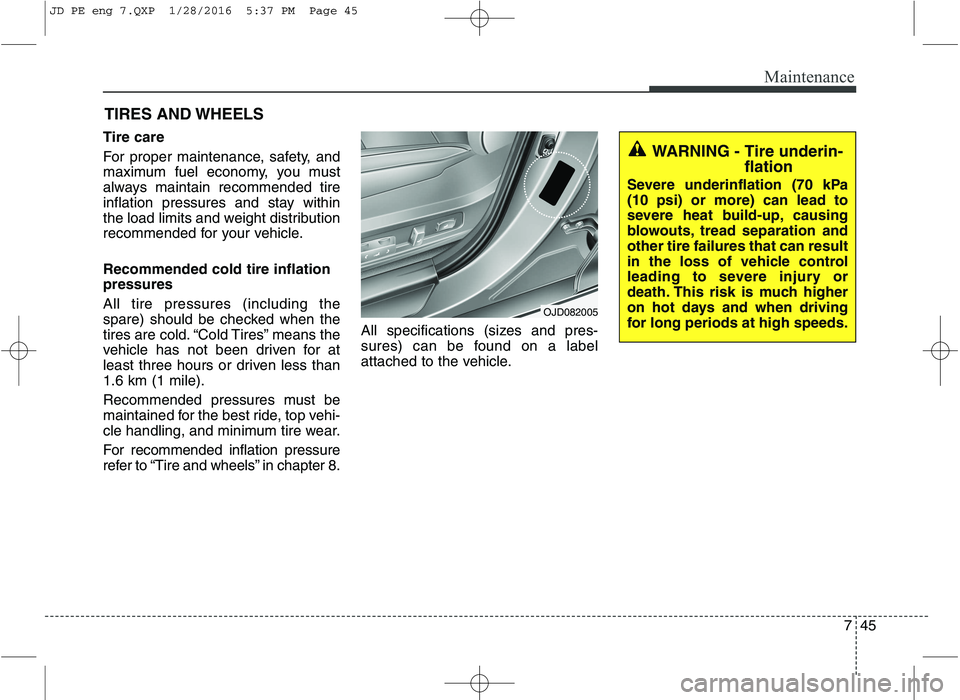
sures) can be found on a label
attached to the vehicle.
WARNING - Tire underin-
flation
Severe underinflation (70 kPa (10 psi) or more) can lead to
severe heat build-up, causing
blowouts, tread separation andother tire failures that can result
in the loss of vehicle control
leading to severe injury or
death. This risk is much higher
on hot days and when driving
for long periods at high speeds.
OJD082005
JD PE eng 7.QXP 1/28/2016 5:37 PM Page 45
Page 552 of 643
Maintenance
46
7
WARNING - Tire inflation
Overinflation or underinflation
can reduce tire life, adversely
affect vehicle handling, and
lead to sudden tire failure. This
could result in loss of vehicle
control and potential injury.
CAUTION - Tire pressure
Always observe the following:
Check tire pressure when the tires are cold. (After vehiclehas been parked for at leastthree hours or hasn't been driven more than 1.6 km (1mile) since startup.)
Check the pressure of your spare tire each time you checkthe pressure of other tires.
Never overload your vehicle. Be careful not to overload avehicle luggage rack if yourvehicle is equipped with one.
Worn, old tires can cause acci- dents. If your tread is badlyworn, or if your tires have been damaged, replace them.
CAUTION
Underinflation also results in excessive wear, poor handlingand reduced fuel economy.Wheel deformation also ispossible. Keep your tire pres-sures at the proper levels. If a tire frequently needs refilling,we recommend that the sys-tem be checked by an author- ized Kia dealer.
Overinflation produces a harsh ride, excessive wear atthe center of the tire tread, anda greater possibility of dam- age from road hazards.
CAUTION
Warm tires normally exceed recommended cold tire pres-sures by 28 to 41 kPa (4 to 6 psi). Do not release air fromwarm tires to adjust the pres-sure or the tires will be under- inflated.
Be sure to reinstall the tire inflation valve caps. Withoutthe valve cap, dirt or moisturecould get into the valve core and cause air leakage. If avalve cap is missing, install anew one as soon as possible.
JD PE eng 7.QXP 1/28/2016 5:37 PM Page 46
Page 553 of 643
747
Maintenance
Checking tire inflation pressure
Check your tires once a month or
more.
Also, check the tire pressure of the
spare tire.
How to check
Use a good quality gauge to check
tire pressure. You can not tell if your
tires are properly inflated simply by
looking at them. Radial tires may
look properly inflated even when
they're underinflated.
Check the tire's inflation pressure
when the tires are cold. - "Cold"
means your vehicle has been sitting
for at least three hours or driven nomore than 1.6 km (1 mile).Remove the valve cap from the tire
valve stem. Press the tire gauge firm-
ly onto the valve to get a pressure
measurement. If the cold tire inflationpressure matches the recommendedpressure on the tire and loading
information label, no further adjust-
ment is necessary. If the pressure is
low, add air until you reach the rec-ommended amount.
If you overfill the tire, release air by pushing on the metal stem in the
center of the tire valve. Recheck the
tire pressure with the tire gauge. Be
sure to put the valve caps back on
the valve stems. They help prevent
leaks by keeping out dirt and mois-
ture.
WARNING
Inspect your tires frequently for proper inflation as well as
wear and damage. Always use
a tire pressure gauge.
Tires with too much or too little pressure wear unevenly caus-
ing poor handling, loss of vehi-
cle control, and sudden tirefailure leading to accidents,
injuries, and even death. Therecommended cold tire pres-
sure for your vehicle can be
found in this manual and onthe tire label located on the dri-
ver's side center pillar.
Worn tires can cause acci- dents. Replace tires that are
worn, show uneven wear, or
are damaged.
Remember to check the pres- sure of your spare tire. Kia
recommends that you check
the spare every time you
check the pressure of the
other tires on your vehicle.
JD PE eng 7.QXP 1/28/2016 5:37 PM Page 47
Page 554 of 643

Maintenance
48
7
Tire rotation
To equalize tread wear, it is recom- mended that the tires be rotated
every 12,000 km (7,500 miles) or
sooner if irregular wear develops.
During rotation, check the tires for
correct balance.
When rotating tires, check for uneven
wear and damage. Abnormal wear is
usually caused by incorrect tire pres-
sure, improper wheel alignment, out-
of-balance wheels, severe braking or
severe cornering. Look for bumps or
bulges in the tread or side of tire.
Replace the tire if you find either of
these conditions. Replace the tire if
fabric or cord is visible. After rotation,
be sure to bring the front and rear tire
pressures to specification and check
lug nut tightness.
Refer to “Tire and wheels” in chapter 8.Disc brake pads should be inspected
for wear whenever tires are rotated.
✽✽ NOTICE
Rotate radial tires that have an
asymmetric tread pattern only from
front to rear and not from right to
left.
WARNING
Do not use the compact spare tire for tire rotation.
Do not mix bias ply and radial ply tires under any circum-
stances. This may cause
unusual handling characteris-tics that could result in death,
severe injury, or property
damage.
S2BLA790
S2BLA790A
CBGQ0707A
■Without a spare tire
■
With a full-size spare tire (if equipped)
■ Directional tires (if equipped)
JD PE eng 7.QXP 1/28/2016 5:37 PM Page 48
Page 559 of 643

753
Maintenance
3. Checking tire life (TIN : Tire Identification Number)
Any tires that are over 6 years, based
on the manufacturing date, tire
strength and performance, decline
with age naturally (even unused
spare tires). Therefore, the tires(including the spare tire) should be
replaced by new ones. You can find
the manufacturing date on the tire
sidewall (possibly on the inside of the
wheel), displaying the DOT Code.
The DOT Code is a series of num-
bers on a tire consisting of numbers
and English letters. The manufactur-
ing date is designated by the last four
digits (characters) of the DOT code.
DOT : XXXX XXXX OOOO
The front part of the DOT means a
plant code number, tire size and tread
pattern and the last four numbers indi-
cate week and year manufactured.
For example:
DOT XXXX XXXX 1616 represents
that the tire was produced in the 16th
week of 2016.
4. Tire ply composition and material
The number of layers or plies of rub-
ber-coated fabric are in the tire. Tire
manufacturers also must indicate the
materials in the tire, which include
steel, nylon, polyester, and others.
The letter "R" means radial ply con-
struction; the letter "D" means diago-
nal or bias ply construction; and theletter "B" means belted-bias ply con-
struction.
5. Maximum permissible inflationpressure
This number is the greatest amount of air pressure that should be put in
the tire. Do not exceed the maximum
permissible inflation pressure. Refer
to the Tire and Loading Information
label for recommended inflation
pressure.
6. Maximum load rating
This number indicates the maximum
load in kilograms and pounds that can
be carried by the tire. When replacing
the tires on the vehicle, always use a
tire that has the same load rating as
the factory installed tire.
WARNING - Tire age
Tires degrade over time, even
when they are not being used.
Regardless of the remaining
tread, it is recommended that
tires generally be replaced after
six (6) years of normal service.
Heat caused by hot climates orfrequent high loading condi-
tions can accelerate the aging
process. Failure to follow this
Warning can result in sudden
tire failure, which could lead to
a loss of control and an acci-
dent involving serious injury ordeath.
JD PE eng 7.QXP 1/28/2016 5:37 PM Page 53
Page 561 of 643
755
Maintenance
Low aspect ratio tire (if equipped)
Low aspect ratio tires, whose aspect
ratio is lower than 50, are provided
for sporty looks.
Because the low aspect ratio tires
are optimized for handling and brak-
ing, it may be more uncomfortable to
ride in and there is more noise com-
pare with normal tires.CAUTION
Because the sidewall of the lowaspect ratio tire is shorter thanthe normal, the wheel and tire of the low aspect ratio tire is easi-er to be damaged. So, follow theinstructions below.
- When driving on a rough road or off road, drive cautiouslybecause tires and wheels maybe damaged. And after driving,inspect tires and wheels.
- When passing over a pothole, speed bump, manhole, or curbstone, drive slowly so that thetires and wheels are not dam-aged.
- If the tire is impacted, we rec- ommend that you inspect thetire condition or contact anauthorized Kia dealer.
- To prevent damage to the tire, inspect the tire condition andpressure every 3,000km.
CAUTION
It is not easy to recognize the tire damage with your owneyes. But if there is the slight- est hint of tire damage, eventhough you cannot see the tiredamage with your own eyes, have the tire checked orreplaced because the tiredamage may cause air leak- age from the tire.
If the tire is damaged by driv- ing on a rough road, off road,pothole, manhole, or curbstone, it will not be covered by the warranty.
You can find out the tire infor- mation on the tire sidewall.
JD PE eng 7.QXP 1/28/2016 5:37 PM Page 55