Page 41 of 587

WARNING!
•Driving with the liftgate open can allow poisonous
exhaust gases into your vehicle. You and your
passengers could be injured by these fumes. Keep
the liftgate closed when you are operating the
vehicle.
• If you are required to drive with the liftgate open,
make sure that all windows are closed, and the
climate control blower switch is set at high speed.
Do not use the recirculation mode.
Gas props support the liftgate in the open position.
However, because the gas pressure drops with tempera-
ture, it may be necessary to assist the props when
opening the liftgate in cold weather.
OCCUPANT RESTRAINT SYSTEMS
Some of the most important safety features in your
vehicle are the restraint systems:
• Seat Belt Systems
• Supplemental Restraint Systems (SRS) Air Bags
• Supplemental Active Head Restraints
• Child Restraints
Important Safety Precautions
Please pay close attention to the information in this
section. It tells you how to use your restraint system
properly, to keep you and your passengers as safe as
possible.
2
THINGS TO KNOW BEFORE STARTING YOUR VEHICLE 39
Page 59 of 587

WARNING!(Continued)
only used to install rear-facing or forward-facing
child restraints that have a harness for restraining
the child.
Supplemental Active Head Restraints (AHR)
These head restraints are passive, deployable compo-
nents, and vehicles with this equipment cannot be readily
identified by any markings, only through visual inspec-
tion of the head restraint. The head restraint will be split
in two halves, with the front half being soft foam and
trim, the back half being decorative plastic.
How The Active Head Restraints (AHR) Work
The Occupant Restraint Controller (ORC) determines
whether the severity, or type of rear impact will require the Active Head Restraints (AHR) to deploy. If a rear
impact requires deployment, both the driver and front
passenger seat AHRs will be deployed.
When AHRs deploy during a rear impact, the front half
of the head restraint extends forward to minimize the gap
between the back of the occupant’s head and the AHR.
This system is designed to help prevent or reduce the
extent of injuries to the driver and front passenger in
certain types of rear impacts.
NOTE:
The Active Head Restraints (AHR) may or may
not deploy in the event of a front or side impact.
However if during a front impact, a secondary rear
impact occurs, the AHR may deploy based on the sever-
ity and type of the impact.
2
THINGS TO KNOW BEFORE STARTING YOUR VEHICLE 57
Page 60 of 587
WARNING!
•All occupants, including the driver, should not
operate a vehicle or sit in a vehicle’s seat until the
head restraints are placed in their proper positions
in order to minimize the risk of neck injury in the
event of a collision.
• Do not place items over the top of the Active Head
Restraint, such as coats, seat covers or portable
DVD players. These items may interfere with the
operation of the Active Head Restraint in the event
of a collision and could result in serious injury or
death.
• Active Head Restraints may be deployed if they are
struck by an object such as a hand, foot or loose
cargo. To avoid accidental deployment of the Ac-
tive Head Restraint ensure that all cargo is secured,
(Continued)
Active Head Restraint (AHR) Components
1 — Head Restraint Front Half
(Soft Foam and Trim) 3 — Head Restraint Back Half
(Decorative Plastic Rear Cover)
2 — Seatback 4 — Head Restraint Guide Tubes
58 THINGS TO KNOW BEFORE STARTING YOUR VEHICLE
Page 61 of 587

WARNING!(Continued)
as loose cargo could contact the Active Head Re-
straint during sudden stops. Failure to follow this
warning could cause personal injury if the Active
Head Restraint is deployed.
NOTE: For more information on properly adjusting and
positioning the head restraint, refer to “Adjusting Active
Head Restraints” in “Understanding The Features Of
Your Vehicle.”
Resetting Active Head Restraints (AHR)
If the Active Head Restraints are triggered during a
collision, the front half of the head restraint will be
extended forward and separated from the rear half of the
head restraint (See Image). Do not drive your vehicle
after the AHRs have deployed. The head restraint must
be reset into the original position to best protect the
occupant for all types of collisions. An authorized FCA US LLC dealer must reset the AHRs on the driver ’s and
front passenger ’s seat before driving. Personally attempt-
ing to reset the AHRs may result in damage to the AHRs
that could impair their function.
AHR In Reset Position
2
THINGS TO KNOW BEFORE STARTING YOUR VEHICLE 59
Page 87 of 587
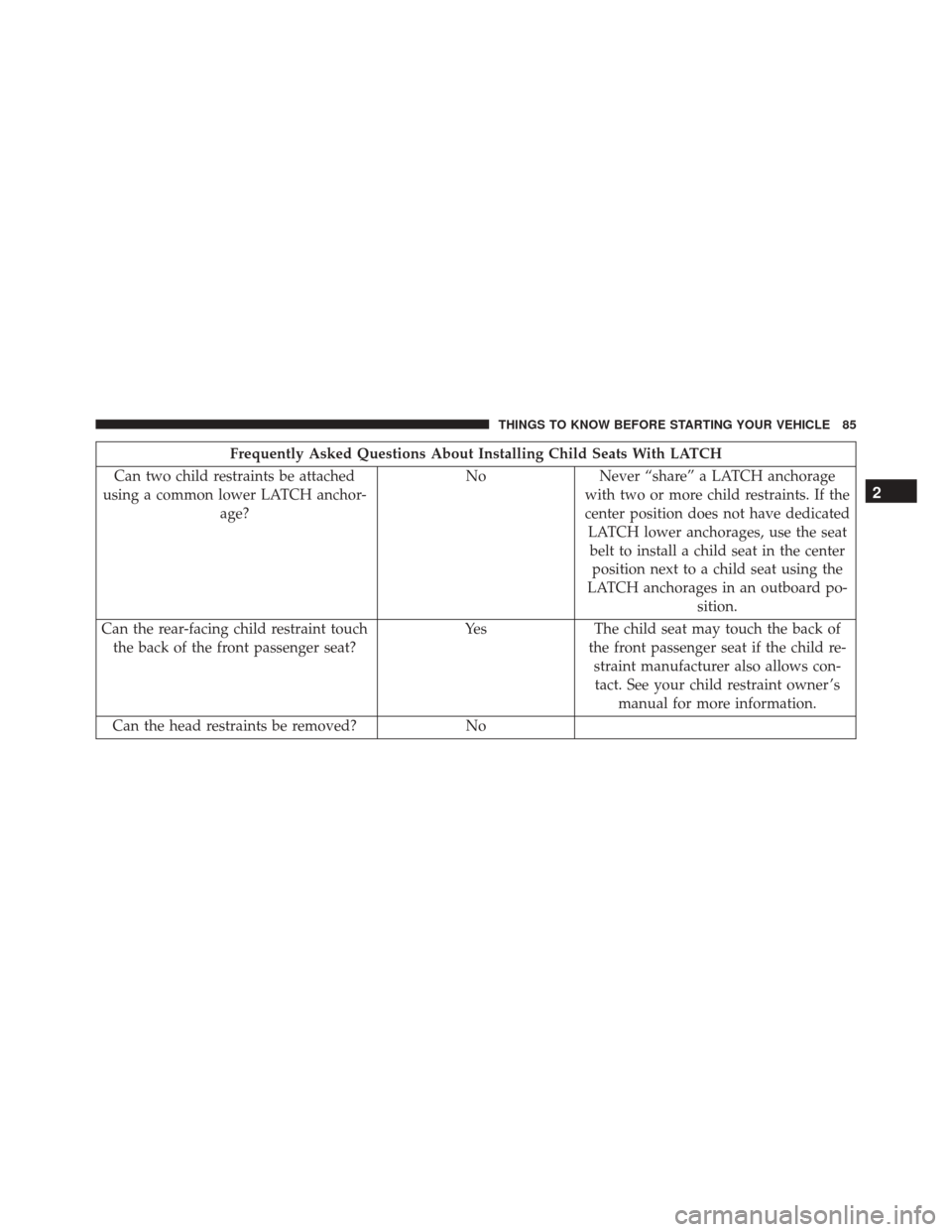
Frequently Asked Questions About Installing Child Seats With LATCH
Can two child restraints be attached
using a common lower LATCH anchor- age? No Never “share” a LATCH anchorage
with two or more child restraints. If the
center position does not have dedicated LATCH lower anchorages, use the seatbelt to install a child seat in the center position next to a child seat using the
LATCH anchorages in an outboard po- sition.
Can the rear-facing child restraint touch the back of the front passenger seat? Yes
The child seat may touch the back of
the front passenger seat if the child re- straint manufacturer also allows con-tact. See your child restraint owner ’s manual for more information.
Can the head restraints be removed? No
2
THINGS TO KNOW BEFORE STARTING YOUR VEHICLE 85
Page 90 of 587

restraints with flexible, webbing mounted lower attach-
ments can be installed in any rear seating position.
WARNING!
Never use the same lower anchorage to attach more
than one child restraint. If you are installing LATCH-
compatible child restraints next to each other, you
must use the seat belt for the center position. You can
then use either the LATCH anchors or the vehicle’s
seat belt for installing child seats in the outboard
positions. Please refer to “Installing The LATCH-
Compatible Child Restraint System” for typical in-
stallation instructions.
Always follow the directions of the child restraint
manufacturer when installing your child restraint. Not
all child restraint systems will be installed as described
here.
To Install A LATCH-Compatible Child Restraint
If the selected seating position has a Switchable Auto-
matic Locking Retractor (ALR) seat belt, stow the seat
belt, following the instructions below. See the section
“Installing Child Restraints Using the Vehicle Seat Belt”
to check what type of seat belt each seating position has.
1. Loosen the adjusters on the lower straps and on the tether strap of the child seat so that you can more
easily attach the hooks or connectors to the vehicle
anchorages.
2. Place the child seat between the lower anchorages for that seating position. For some second row seats, you
may need to recline the seat and / or raise the head
restraint to get a better fit. If the rear seat can be moved
forward and rearward in the vehicle, you may wish to
move it to its rear-most position to make room for the
child seat. You may also move the front seat forward
to allow more room for the child seat.
88 THINGS TO KNOW BEFORE STARTING YOUR VEHICLE
Page 94 of 587
Frequently Asked Questions About Installing Child Restraints With Seat Belts
What is the weight limit (child’s weight + weight of the child re-
straint) for using the Tether Anchor with the seat belt to attach a for- ward facing child restraint? Weight limit of the
Child Restraint Always use the tether anchor when using the seat
belt to install a forward facing child restraint, up to the recommended weight limit of the child re- straint.
Can the rear-facing child restraint
touch the back of the front passen- ger seat? Yes
Contact between the front passenger seat and the
child restraint is allowed, if the child restraint manufacturer also allows contact.
Can the head restraints be re- moved? No
Can the buckle stalk be twisted to
tighten the seat belt against the belt path of the child restraint? No
Do not twist the buckle stalk in a seating position
with an ALR retractor.
92 THINGS TO KNOW BEFORE STARTING YOUR VEHICLE
Page 106 of 587

�VOICE COMMAND — IF EQUIPPED ........143
▫ Voice Command System Operation .........143
▫ Commands ........................ .145
▫ Voice Training ...................... .149
� SEATS ............................. .149
▫ Power Seats — If Equipped ..............150
▫ Heated Seats — If Equipped .............152
▫ Manual Front Seat Adjustment ............153
▫ Manual Seat Height Adjustment — If
Equipped .......................... .154
▫ Manual Lumbar — If Equipped ...........155
▫ Driver’s Seatback Recline ................155
▫ Head Restraints ..................... .156▫
Folding Rear Seat .....................160
▫ Reclining Rear Seat — If Equipped .........161
� TO OPEN AND CLOSE THE HOOD .........162
� LIGHTS ............................ .164
▫ Multifunction Lever ...................164
▫ Headlights And Parking Lights ...........165
▫ Automatic Headlights — If Equipped .......165
▫ Daytime Running Lights — If Equipped .....166
▫ Lights-On Reminder ...................166
▫ Fog Lights — If Equipped ...............166
▫ Turn Signals ........................ .167
▫ High/Low Beam Switch ................167
▫ Flash-To-Pass ....................... .168
104 UNDERSTANDING THE FEATURES OF YOUR VEHICLE