Page 316 of 745

Yellow Telltale Indicator Lights
Engine Check/Malfunction Indicator Light (MIL)
Yellow TelltaleLight What It Means
Engine Check/Malfunction Indicator Light (MIL)
The Engine Check/Malfunction Indicator Light (MIL) is a part of an Onboard Diagnostic Sys-
tem called OBD II that monitors engine and automatic transmission control systems. The light
will illuminate when the ignition is in the ON position before engine start. If the bulb does not
come on when turning the key from OFF to ON/RUN, have the condition checked promptly.
Certain conditions, such as a loose or missing gas cap, poor quality fuel, etc., may illuminate
the light after engine start. The vehicle should be serviced if the light stays on through several
typical driving styles. In most situations, the vehicle will drive normally and will not require
towing.
When the engine is running, the MIL may flash to alert serious conditions that could lead to
immediate loss of power or severe catalytic converter damage. The vehicle should be serviced
as soon as possible if this occurs.
314 UNDERSTANDING YOUR INSTRUMENT PANEL
Page 329 of 745
Turn Signal Indicator Lights
Green TelltaleLight What It Means
Turn Signal Indicator Lights
The instrument cluster directional arrow will flash independently for the LEFT or RIGHT
turn signal as selected, as well as the exterior turn signal lamp(s) (front and rear) as selected
when the multifunction lever is moved down (LEFT) or up (RIGHT).
NOTE:
•A continuous chime will sound if the vehicle is driven more than 1 mile (1.6 km) with
either turn signal on.
•Check for an inoperative outside light bulb if either indicator flashes at a rapid rate.
4
UNDERSTANDING YOUR INSTRUMENT PANEL 327
Page 632 of 745

▫Brake System ....................... .668
▫ Front/Rear Axle Fluid ..................670
▫ Transfer Case ....................... .671
▫ Automatic Transmission ................672
▫ Appearance Care And Protection From
Corrosion .......................... .674
� FUSES ............................. .680
▫ Power Distribution Center ...............681
� VEHICLE STORAGE ....................689
� REPLACEMENT BULBS .................690
� BULB REPLACEMENT ..................691
▫ High Intensity Discharge Headlamps (HID) —
If Equipped ........................ .692▫
Halogen Headlamps — If Equipped ........692
▫ Front Turn Signal .....................693
▫ Front Fog Lamps .....................693
▫ Rear Tail, Stop, and Turn Signal Lamps ......694
▫ Rear Liftgate Mounted Tail Lamp ..........695
▫ Center High-Mounted Stop Lamp (CHMSL) . .697
▫ Rear License Lamp ....................697
� FLUID CAPACITIES ....................698
� FLUIDS, LUBRICANTS, AND GENUINE
PARTS ............................. .699
▫ Engine ............................ .699
▫ Chassis ........................... .701
630 MAINTAINING YOUR VEHICLE
Page 637 of 745
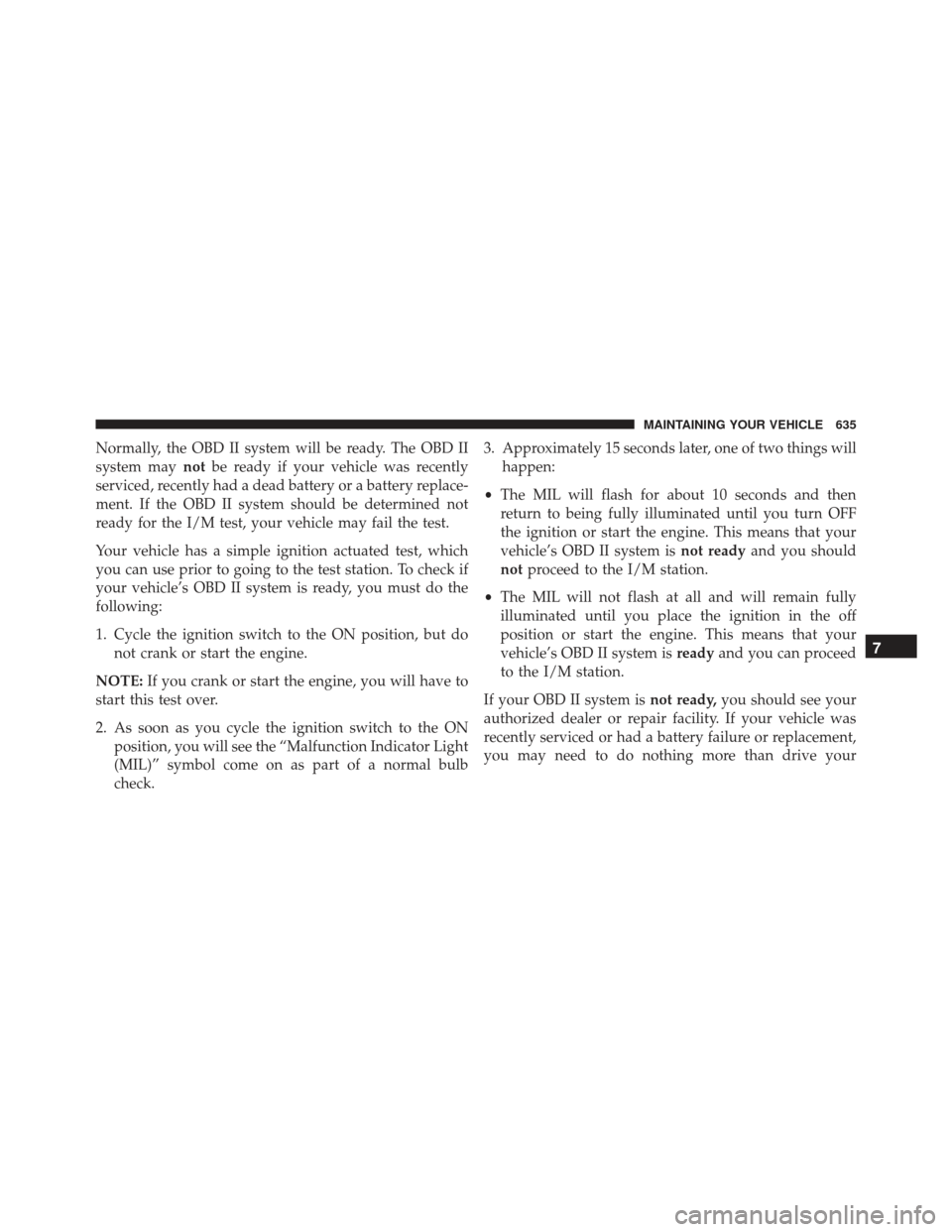
Normally, the OBD II system will be ready. The OBD II
system maynotbe ready if your vehicle was recently
serviced, recently had a dead battery or a battery replace-
ment. If the OBD II system should be determined not
ready for the I/M test, your vehicle may fail the test.
Your vehicle has a simple ignition actuated test, which
you can use prior to going to the test station. To check if
your vehicle’s OBD II system is ready, you must do the
following:
1. Cycle the ignition switch to the ON position, but do not crank or start the engine.
NOTE: If you crank or start the engine, you will have to
start this test over.
2. As soon as you cycle the ignition switch to the ON position, you will see the “Malfunction Indicator Light
(MIL)” symbol come on as part of a normal bulb
check. 3. Approximately 15 seconds later, one of two things will
happen:
• The MIL will flash for about 10 seconds and then
return to being fully illuminated until you turn OFF
the ignition or start the engine. This means that your
vehicle’s OBD II system is not readyand you should
not proceed to the I/M station.
• The MIL will not flash at all and will remain fully
illuminated until you place the ignition in the off
position or start the engine. This means that your
vehicle’s OBD II system is readyand you can proceed
to the I/M station.
If your OBD II system is not ready,you should see your
authorized dealer or repair facility. If your vehicle was
recently serviced or had a battery failure or replacement,
you may need to do nothing more than drive your
7
MAINTAINING YOUR VEHICLE 635
Page 692 of 745
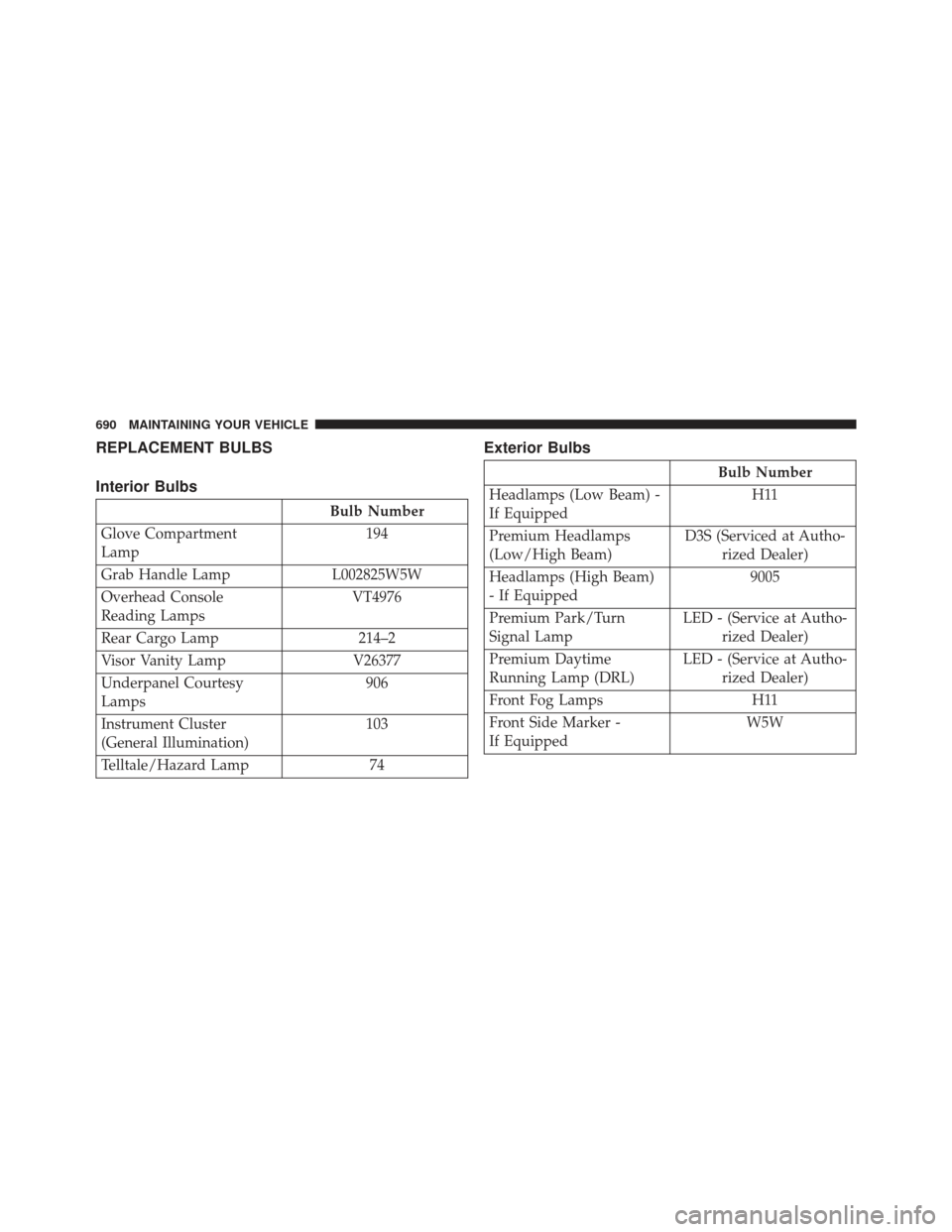
REPLACEMENT BULBS
Interior Bulbs
Bulb Number
Glove Compartment
Lamp 194
Grab Handle Lamp L002825W5W
Overhead Console
Reading Lamps VT4976
Rear Cargo Lamp 214–2
Visor Vanity Lamp V26377
Underpanel Courtesy
Lamps 906
Instrument Cluster
(General Illumination) 103
Telltale/Hazard Lamp 74
Exterior Bulbs
Bulb Number
Headlamps (Low Beam) -
If Equipped H11
Premium Headlamps
(Low/High Beam) D3S (Serviced at Autho-
rized Dealer)
Headlamps (High Beam)
- If Equipped 9005
Premium Park/Turn
Signal Lamp LED - (Service at Autho-
rized Dealer)
Premium Daytime
Running Lamp (DRL) LED - (Service at Autho-
rized Dealer)
Front Fog Lamps H11
Front Side Marker -
If Equipped W5W
690 MAINTAINING YOUR VEHICLE
Page 693 of 745
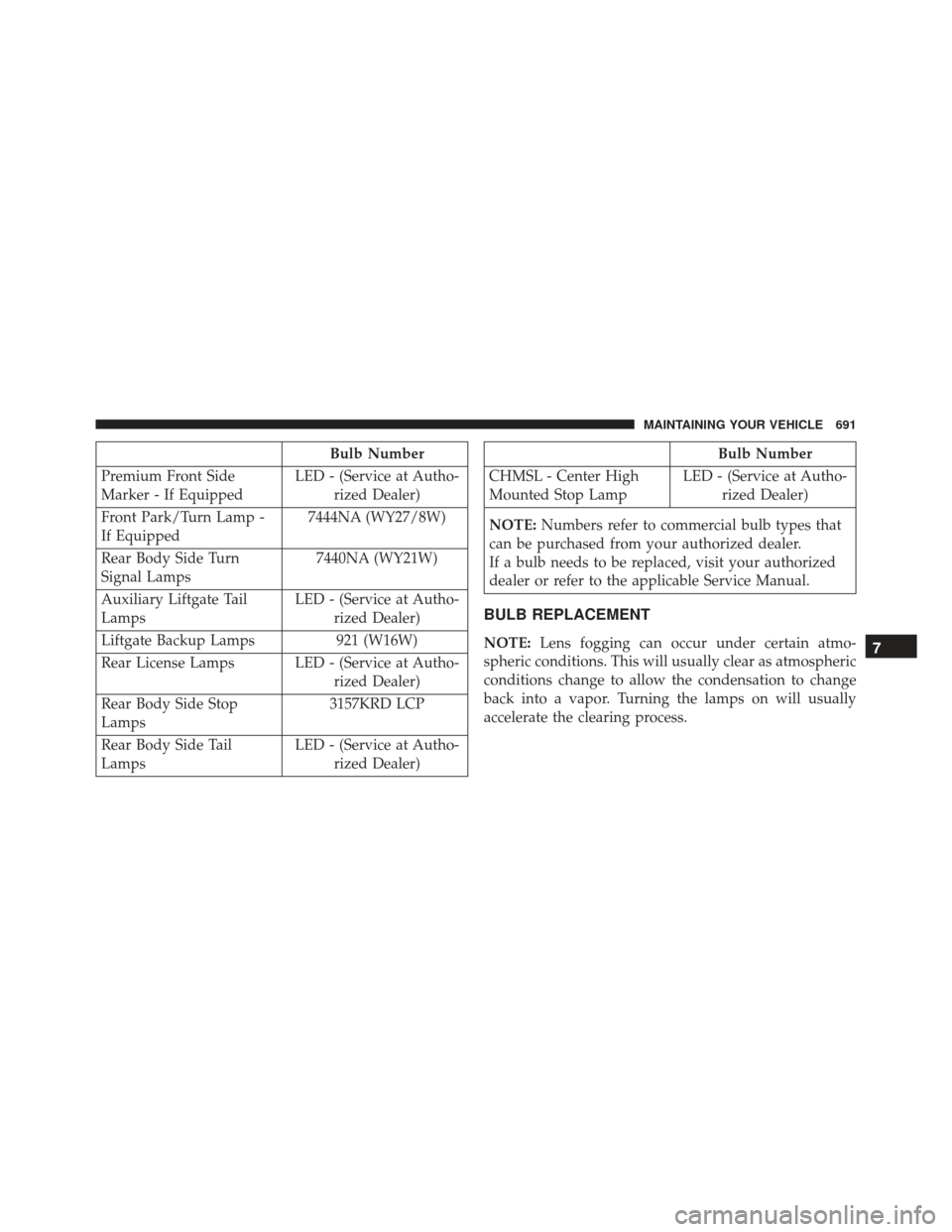
Bulb Number
Premium Front Side
Marker - If Equipped LED - (Service at Autho-
rized Dealer)
Front Park/Turn Lamp -
If Equipped 7444NA (WY27/8W)
Rear Body Side Turn
Signal Lamps 7440NA (WY21W)
Auxiliary Liftgate Tail
Lamps LED - (Service at Autho-
rized Dealer)
Liftgate Backup Lamps 921 (W16W)
Rear License Lamps LED - (Service at Autho- rized Dealer)
Rear Body Side Stop
Lamps 3157KRD LCP
Rear Body Side Tail
Lamps LED - (Service at Autho-
rized Dealer)Bulb Number
CHMSL - Center High
Mounted Stop Lamp LED - (Service at Autho-
rized Dealer)
NOTE: Numbers refer to commercial bulb types that
can be purchased from your authorized dealer.
If a bulb needs to be replaced, visit your authorized
dealer or refer to the applicable Service Manual.
BULB REPLACEMENT
NOTE: Lens fogging can occur under certain atmo-
spheric conditions. This will usually clear as atmospheric
conditions change to allow the condensation to change
back into a vapor. Turning the lamps on will usually
accelerate the clearing process.7
MAINTAINING YOUR VEHICLE 691
Page 694 of 745
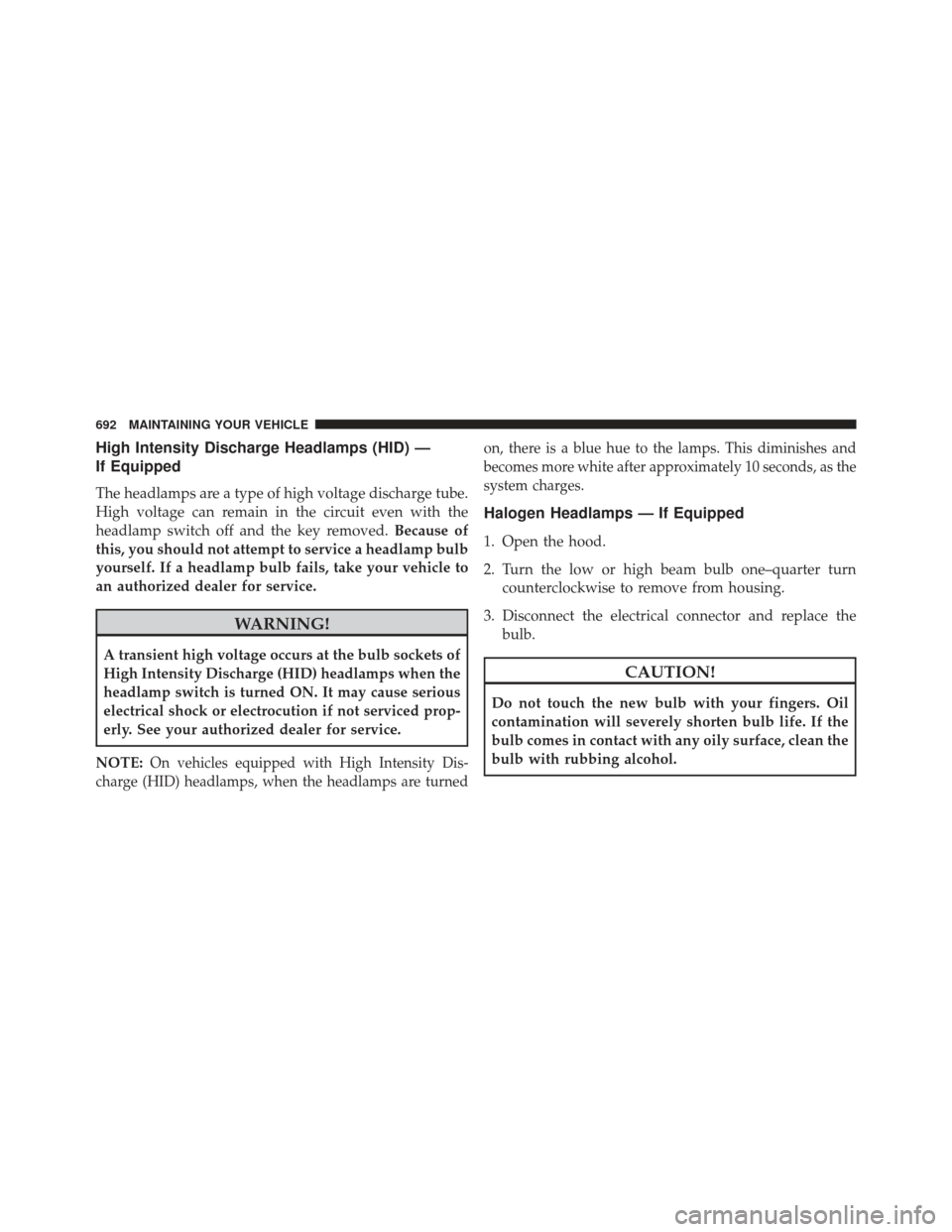
High Intensity Discharge Headlamps (HID) —
If Equipped
The headlamps are a type of high voltage discharge tube.
High voltage can remain in the circuit even with the
headlamp switch off and the key removed.Because of
this, you should not attempt to service a headlamp bulb
yourself. If a headlamp bulb fails, take your vehicle to
an authorized dealer for service.
WARNING!
A transient high voltage occurs at the bulb sockets of
High Intensity Discharge (HID) headlamps when the
headlamp switch is turned ON. It may cause serious
electrical shock or electrocution if not serviced prop-
erly. See your authorized dealer for service.
NOTE:
On vehicles equipped with High Intensity Dis-
charge (HID) headlamps, when the headlamps are turned on, there is a blue hue to the lamps. This diminishes and
becomes more white after approximately 10 seconds, as the
system charges.
Halogen Headlamps — If Equipped
1. Open the hood.
2. Turn the low or high beam bulb one–quarter turn
counterclockwise to remove from housing.
3. Disconnect the electrical connector and replace the bulb.
CAUTION!
Do not touch the new bulb with your fingers. Oil
contamination will severely shorten bulb life. If the
bulb comes in contact with any oily surface, clean the
bulb with rubbing alcohol.
692 MAINTAINING YOUR VEHICLE
Page 695 of 745
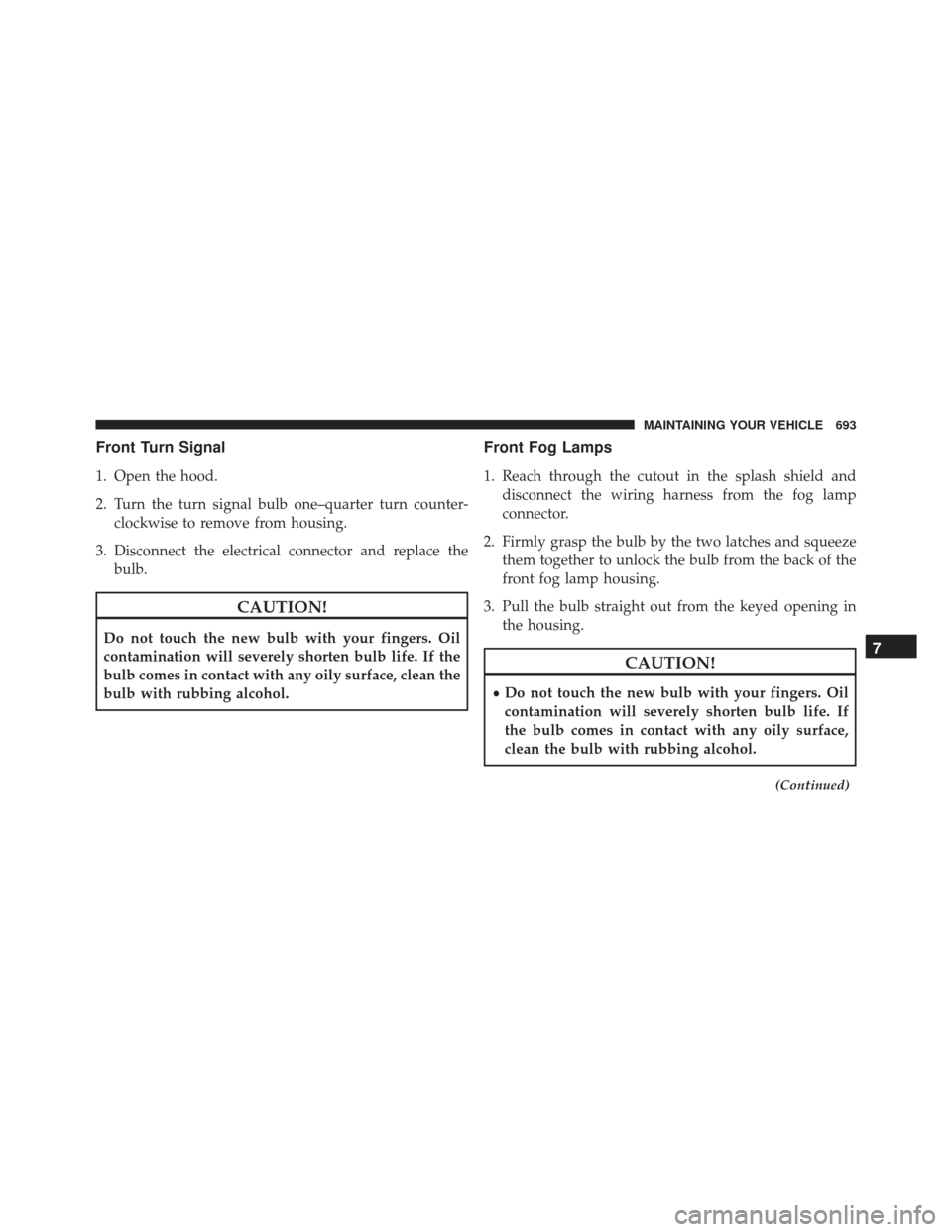
Front Turn Signal
1. Open the hood.
2. Turn the turn signal bulb one–quarter turn counter-clockwise to remove from housing.
3. Disconnect the electrical connector and replace the bulb.
CAUTION!
Do not touch the new bulb with your fingers. Oil
contamination will severely shorten bulb life. If the
bulb comes in contact with any oily surface, clean the
bulb with rubbing alcohol.
Front Fog Lamps
1. Reach through the cutout in the splash shield anddisconnect the wiring harness from the fog lamp
connector.
2. Firmly grasp the bulb by the two latches and squeeze them together to unlock the bulb from the back of the
front fog lamp housing.
3. Pull the bulb straight out from the keyed opening in the housing.
CAUTION!
•Do not touch the new bulb with your fingers. Oil
contamination will severely shorten bulb life. If
the bulb comes in contact with any oily surface,
clean the bulb with rubbing alcohol.
(Continued)
7
MAINTAINING YOUR VEHICLE 693